
You're standing in a Melbourne showroom with a quartz sample in one hand and cabinet swatches in the other. It looks right, but you still need to know whether it suits the room's sunlight, what the quote includes, and who will make sure the countertop fits the cabinets. Those decisions matter as much as the color.
For homeowners, designers, and builders planning quartz countertops in Melbourne, FL, the practical approach is to assess each surface by its exposure and use, then coordinate the material with cabinet dimensions, fabrication, and installation. A good-looking slab is only a good choice if it works where you plan to install it.
Why Melbourne Homeowners Are Weighing Quartz Now
A kitchen or bathroom remodel often narrows quickly to a few countertop materials. Quartz appeals to buyers who want a broad choice of patterns without the routine sealing associated with some natural stones. But before choosing a slab, it helps to check how it will perform in the actual location, how its details affect the quote, and how the fabricator will coordinate with the cabinet installer.
Regional construction activity provides useful context for the local market. Brevard County, which includes Melbourne, recorded 4,624 private housing units authorized by building permits in 2025, compared with 4,603 in 2024 and 6,537 in 2023. The county also recorded 5,258 in 2022 and 5,174 in 2021. The 2025 figure was about 29.3% below 2023, but 10.6% above 2021, based on the Brevard County private-housing permit series.
Those figures cover multiple types of permitted residential structures across the county, not just Melbourne homes. They count units authorized by permits, not completed houses, countertop orders, or installed quartz surfaces. Treat them as a regional construction indicator, not a direct measure of countertop demand.
What the local figures can and can't tell you
The permit totals show that new residential projects remain part of the area's construction picture, even as annual counts vary. New builds and remodels may create demand for finished kitchen and bathroom surfaces, but permits don't tell you which materials owners will choose. Remodeling activity also isn't captured as a direct quartz-sales measure.
Use this guide to decide where quartz makes sense in your home, what details to settle before requesting a final quote, and what to ask the people responsible for cabinetry and fabrication. The right decision starts with the location and the installation plan, not just the showroom sample.
Material Benefits and Style Options for Quartz
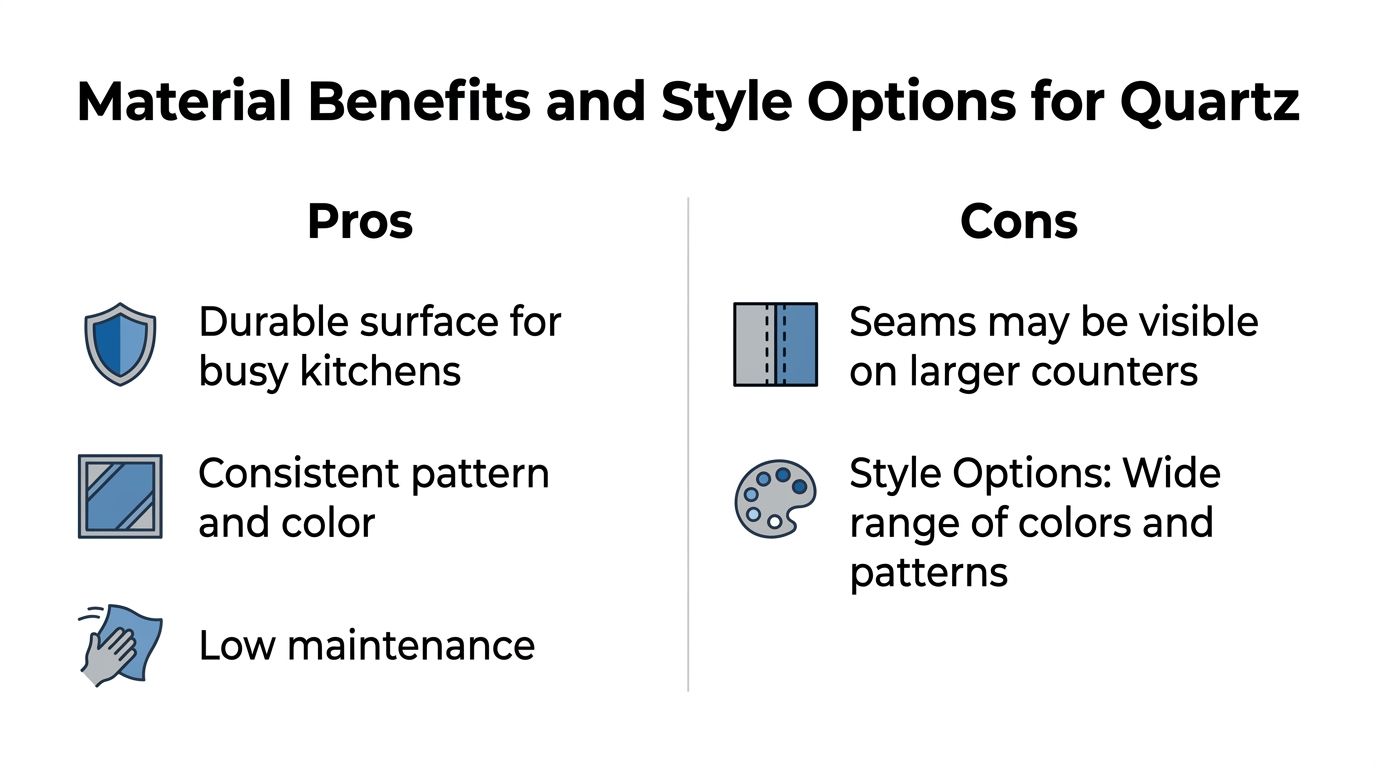
Engineered quartz is made from mineral particles bound with resin. That construction gives buyers a manufactured surface with a consistent color and pattern, rather than the natural variation found from slab to slab in stone. Many quartz products are non-porous and don't require routine sealing, which makes everyday cleanup straightforward.
Quartz can suit busy indoor kitchens and bathrooms, but it isn't damage-proof. Hot cookware can harm the surface, so use a trivet rather than setting a hot pan directly on the counter. Seams can also remain visible, especially where a layout requires multiple pieces. Ask the fabricator to show you the proposed seam locations before approving the template.
Choose the look for the room, not just the sample
Quartz comes in a wide range of colors and patterns, including designs that suggest the veining of natural stone and more uniform, understated options. A dramatic pattern can become the focal point of a kitchen, while a quieter surface may work better alongside distinctive cabinetry or a strong backsplash. View a full slab when possible. A small sample can't show how the pattern repeats across a long counter or around a corner.
Finish and edge details shape the final look, too. A polished surface reflects more light and has a smooth appearance. Matte finishes offer a softer visual effect, though they may show fingerprints or marks differently depending on the color and product. Edge profiles range from simple square looks to more decorative shapes. Check the manufacturer's care guidance and ask the fabricator which profiles are available for the slab you've selected.
Practical rule: Bring cabinet, flooring, and backsplash samples to the slab viewing. Compare them in the room's light before you approve a color.
Coordinate the countertop with cabinet color and hardware early. If you're comparing materials as well as colors, this guide to choosing kitchen countertops can help you frame the decision around how the space is used.
Where Quartz Works in a Florida Home
Quartz can be a strong choice indoors, but don't assume it belongs on every surface around a Florida home. Engineered quartz contains resin binders, and prolonged ultraviolet exposure can degrade those resins, leading to fading or yellowing. One reported accelerated-weathering comparison measured a 12% luminance loss in a light quartz surface after 2,000 hours. That is a result from one test, not a universal prediction for every quartz product or home, as described in this countertop materials guide.
Heat and ultraviolet exposure are separate concerns. A trivet helps protect quartz from hot cookware. It doesn't shield resin from sunlight. Before ordering, consider how much direct sun each counter receives over the day, including seasonal changes and sunlight entering through large windows.
Match the surface to its exposure
| Location | Exposure risk | Suggested material or approach |
|---|---|---|
| Shaded interior kitchen | Low UV exposure; hot cookware remains a concern | Standard quartz can work. Use trivets and follow the product's care instructions. |
| Counter near a large south- or west-facing window | Repeated direct sunlight may affect resin over time | Ask the manufacturer about UV performance and consider another material if the surface receives intense sun. |
| Screened porch | Exposure varies with orientation, shade, and how open the space is | Don't assume screening makes quartz suitable. Check direct-sun exposure and product specifications. |
| Lanai | Sun and heat conditions depend on the structure and location | Consider a UV-rated alternative, porcelain, or sintered stone if the counter gets sustained direct sun. |
| Outdoor kitchen | High exposure to sunlight and outdoor conditions | Don't specify standard quartz without explicit suitability guidance from the product manufacturer. |
For a bright indoor kitchen, look at the counter itself, not just the room name. A shaded worktop may be a different material decision from an island beside broad glazing. Ask the supplier to review the specific product's suitability for that exposure, and get the answer in writing before ordering.
What Quartz Costs and What Changes the Price
Two quartz quotes can differ even when the counters appear to cover similar areas. The slab's grade and pattern affect material selection and how much of the slab a layout uses. A complex pattern may require extra planning to align veins across corners or adjoining sections. Edge profiles, sink and cooktop cutouts, backsplash choices, and waterfall ends also change fabrication work.

The final amount of material depends on the measured layout, not just an early estimate from a sketch. Ask whether the quote includes templating, fabrication, delivery, installation, sink cutouts, faucet holes, backsplash pieces, and cleanup. If the quote excludes an item, ask for its cost separately so you can compare proposals on the same scope.
Compare line items, not a single total
Supply conditions can also shift. In 2025, engineered quartz represented 33.8% of U.S. import value in the combined natural-stone and engineered-quartz countertop market, down from 38.0% in 2024. The engineered-quartz category declined by about $265 million year over year to $1.35 billion, according to the 2024-to-2025 stone import comparison. These are import values, not local retail prices or installed-project costs. They indicate changes in international supply flows, not what a Melbourne fabricator will charge for a particular job.
For your project, the useful move is to verify the current slab price and lead time with the supplier. Don't assume that an online sample or an earlier estimate reflects today's inventory.
Ask each supplier to price the same slab, layout, edge, cutouts, backsplash, and installation scope. A consistent specification makes the comparison meaningful.
For a broader view of renovation budgeting, use this kitchen renovation cost overview as a planning reference, then request a project-specific countertop quote. This video can also help you think through the countertop selection and planning process.
Installation Steps and Permit Requirements
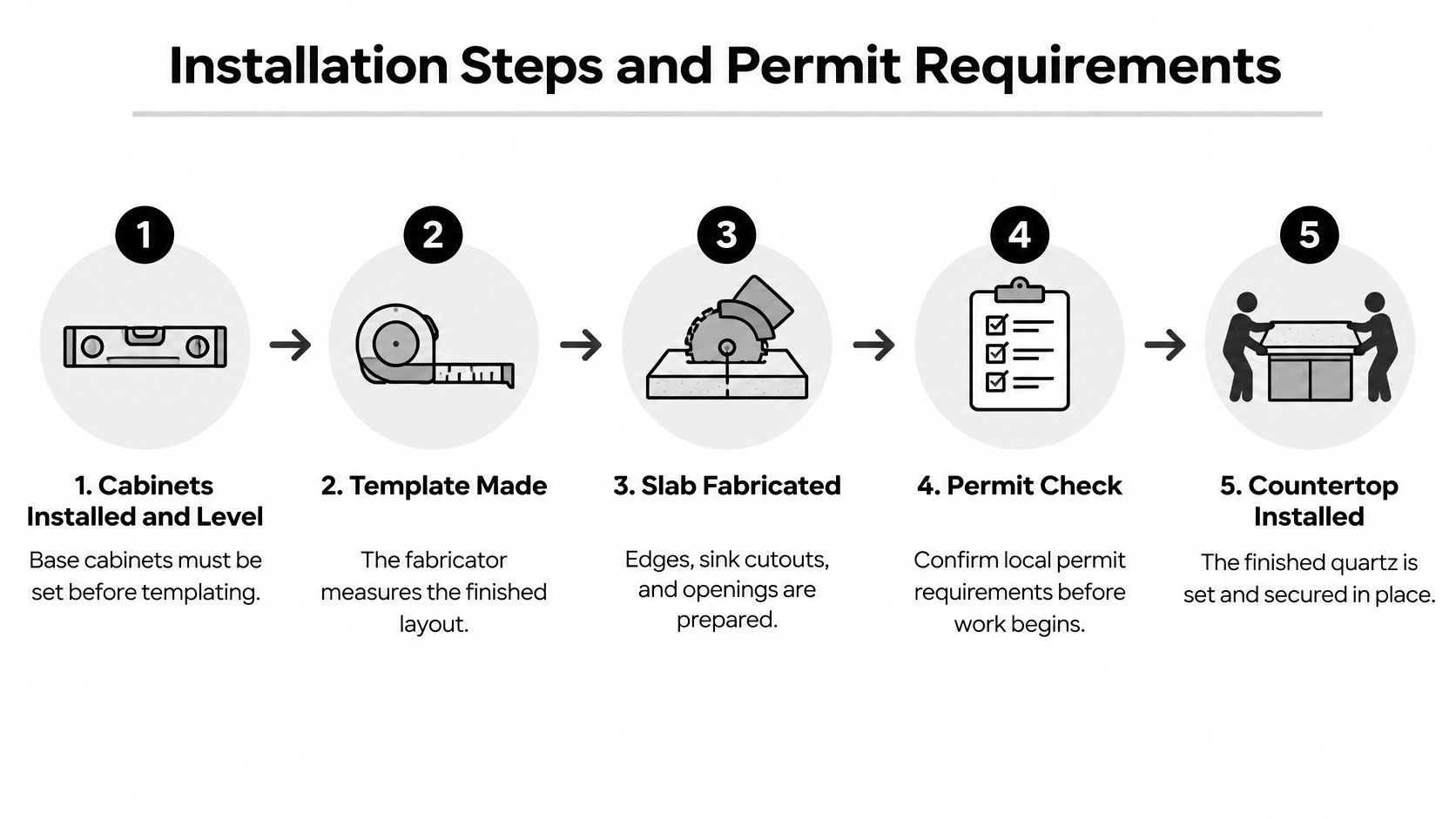
Countertop installation starts after the cabinets are in place and level. The fabricator needs to measure the finished cabinet run, not just work from a drawing. If cabinet positions change after templating, the template and fabrication may no longer match the room.
Follow the sequence and lock decisions before cutting
- Install and level the cabinets. Confirm that the cabinets are secured and that the finished layout is ready to measure. The countertop relies on a stable base.
- Complete the template visit. The fabricator measures the actual cabinet run and records corners, overhangs, and adjoining surfaces. Be present if you can, especially to review seams and overhangs.
- Confirm the slab and details. Approve the slab, edge profile, sink model, faucet-hole placement, cooktop openings, and backsplash plan. Changes after fabrication begins can mean added work or delays.
- Confirm permit requirements. A countertop replacement may or may not need a permit, depending on the project scope and local rules. Check with the City of Melbourne or Brevard County building department, and ask the contractor or fabricator who will handle any required paperwork.
- Schedule delivery and installation. Clear access to the kitchen, confirm that plumbing connections are coordinated, and understand whether the installer or another trade will reconnect the sink and faucet.
Before ordering, make sure the sink model and dimensions are final. An undermount sink, a drop-in sink, and an integrated-looking edge can call for different fabrication details. Cooktop cutouts and faucet locations also need to be set before the slab is cut.
A home remodel checklist can help keep the countertop, cabinet, and trade decisions in view. Ask the project lead for the expected sequence and what needs to be completed before the template appointment.
Choosing a Local Fabricator and Cabinet Partner
A stone fabricator, general contractor, and cabinet maker handle different parts of the job. The fabricator selects and cuts the slab, finishes edges, and installs the countertop. A general contractor coordinates the schedule and trades. A cabinet maker designs or installs the base cabinets that the counter will sit on. Some businesses handle more than one role, but don't assume responsibilities overlap. Ask who owns each handoff.
| Partner | Main responsibility | Clarify before hiring |
|---|---|---|
| Stone fabricator | Measures, cuts, finishes, and installs the slab | Who templates, what the quote includes, and how seams are chosen |
| General contractor | Coordinates the overall project and trades | Who schedules cabinet completion, templating, plumbing, and installation |
| Cabinet maker | Builds or installs the cabinet base | How cabinet tolerances and final measurements are coordinated with the fabricator |
For buyers who want cabinetry coordinated with countertop selection, Sinclair Cabinetry Inc is a Cape Coral-based custom cabinet manufacturer offering kitchen and bathroom cabinetry, customizable designs, installation, and remodeling services. Ask any cabinet and countertop partner how they schedule templating after cabinet installation and how they resolve fit issues if actual dimensions differ from the plans. You can also compare local options using this guide to custom cabinet companies.
Ask how the shop protects workers and handles material
Quartz fabrication involves cutting, grinding, and polishing, which can create respirable crystalline silica dust. OSHA's U.S. permissible exposure limit is 50 micrograms per cubic meter as an eight-hour time-weighted average, a standard discussed in this countertops industry overview. Ask the fabricator what dust-control procedures it uses, including wet cutting, local exhaust, and respiratory protection. A supplier should be able to explain its process clearly.
Add these questions to your comparison:
- Dust control: How do you control silica dust during cutting, grinding, and polishing?
- Slab composition: What materials and binders are in the product I'm considering?
- Recycled content: Can you provide documentation for any recycled minerals or glass?
- Offcuts: What happens to usable remnants from my project? Can they be reused, and how are leftover materials handled?
- Coordination: Who confirms cabinet readiness, template timing, and the installation date?
These questions help you judge more than appearance and price. They also show whether the supplier has a clear process for communicating about fabrication, worker protection, and leftover material.
Caring for Quartz and Taking the Next Step
Quartz is straightforward to maintain, but it still needs sensible care. Wipe routine spills with a soft cloth and mild, non-abrasive cleaner. Avoid abrasive pads and harsh products unless the manufacturer specifically approves them. Clean up spills promptly, especially around seams and edges, where residue can be harder to remove.
Use a cutting board to protect the surface from knife marks and a trivet or hot pad beneath cookware. Neither habit makes the counter indestructible, but both reduce avoidable damage. For counters near windows or in semi-outdoor areas, continue to account for sun exposure instead of assuming ordinary kitchen care addresses it.
Before requesting a final quote, gather your cabinet plan or current measurements, sink and cooktop specifications, backsplash requirements, preferred edge, and a photo of the room. Send the same information to two or three suppliers so you can compare the proposed material, layout, scope, lead time, and installation responsibilities. Don't approve fabrication until the template details and slab selection are settled.
This week, identify which counters get direct sun, confirm the cabinet and sink specifications, and book supplier consultations. If you want cabinetry coordinated with the countertop, ask about design, cabinet installation, and templating as one connected process rather than treating each decision separately.
Sinclair Cabinetry Inc offers custom kitchen and bathroom cabinetry, installation, and remodeling services that can be coordinated with countertop planning. Visit Sinclair Cabinetry Inc to discuss your cabinet layout and quartz project.