
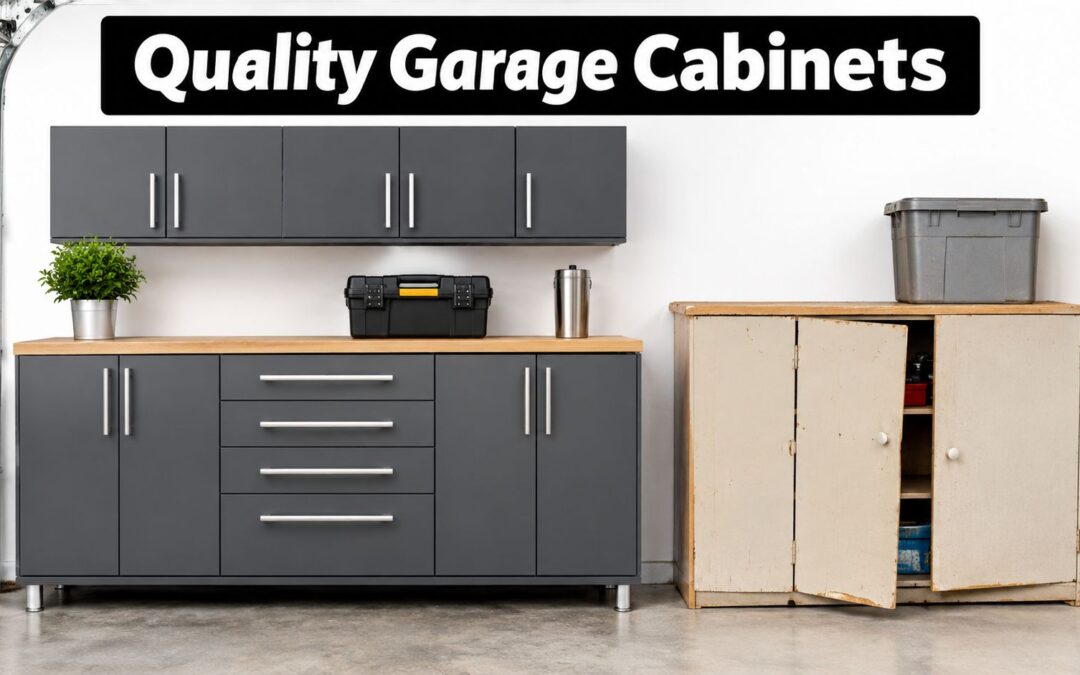
Your garage door opens, the car barely fits, and you're stepping over paint cans, a leaning ladder, and bins that won't stack straight. The old cabinet in the corner looked fine when you bought it, but the door sags, the shelf bows under cans, and the bottom edge is swollen where meltwater sat last winter. That's the usual starting point for a cabinet replacement, and it's also where the wrong purchase repeats itself. A garage isn't a kitchen with worse lighting. It's hotter, colder, wetter, and dirtier, and it stores heavier, sharper, and sometimes flammable things. High quality garage cabinets are built for those conditions first and styled second.
A Quality Scorecard for Garage Cabinets
Quote sheets love door styles and colors because those are easy to picture. They tell you almost nothing about service life. Score every quote against these seven components before you look at price.
| Component | What high quality looks like | Red flag |
|---|---|---|
| Cabinet box | 3/4 inch solid wood or plywood sides with dado or dovetail joints | Thin backs and stapled corners |
| Doors and frames | Solid frames with glued and screwed joints, one-piece or well-bonded doors | Hollow doors and paper-edged particleboard |
| Panel emissions | Documented TSCA Title VI compliance for every composite panel | No documentation for MDF, particleboard or plywood |
| Finish | Catalyzed coating with sealed edges and drilled holes | Light lacquer on cut edges |
| Drawer slides | Full-extension, load-rated ball-bearing or undermount slides | Plastic rollers with no load rating |
| Hinges | Soft-close, concealed and adjustable hinges | Loose hinges with no adjustment |
| Fasteners and hardware | Corrosion-resistant screws, anchors and pulls | Plain steel fasteners in damp areas |
How to Use the Scorecard in Five Minutes
Read a quote line by line and mark each component that's specified in writing. Box thickness and joinery matter because stapled corners rack when you load one side with oil, paint, or power tools. A dadoed or dovetailed box stays square, so doors keep their gaps. Drawers need a stated load rating, not just a smooth demo in a showroom with an empty drawer. Hinges need adjustment screws because garage floors and walls move enough across seasons that a fixed hinge will leave you with rubbing doors.
Panel emissions belong on the same checklist as joinery. The U.S. EPA consumer guide to the Formaldehyde Standards for Composite Wood Products Act sets maximum emission levels of 0.05 parts per million (ppm) for hardwood plywood, 0.09 ppm for particleboard, 0.11 ppm for medium-density fiberboard, and 0.13 ppm for thin medium-density fiberboard. That same guide notes certification requirements began June 1, 2018, and products manufactured or imported after March 22, 2019 generally had to carry certification from an EPA-recognized third-party certifier.
Practical rule: If a quote names only door style and color, six of seven components are still unknown. Don't compare its price to a fully specified quote.
I would send any short quote back and ask for the missing lines in writing. Verbal assurances don't survive a warranty dispute.
Materials and Finishes That Hold Up in a Garage
There's no single best material. There's a best match for your heat, humidity, salt, and load.
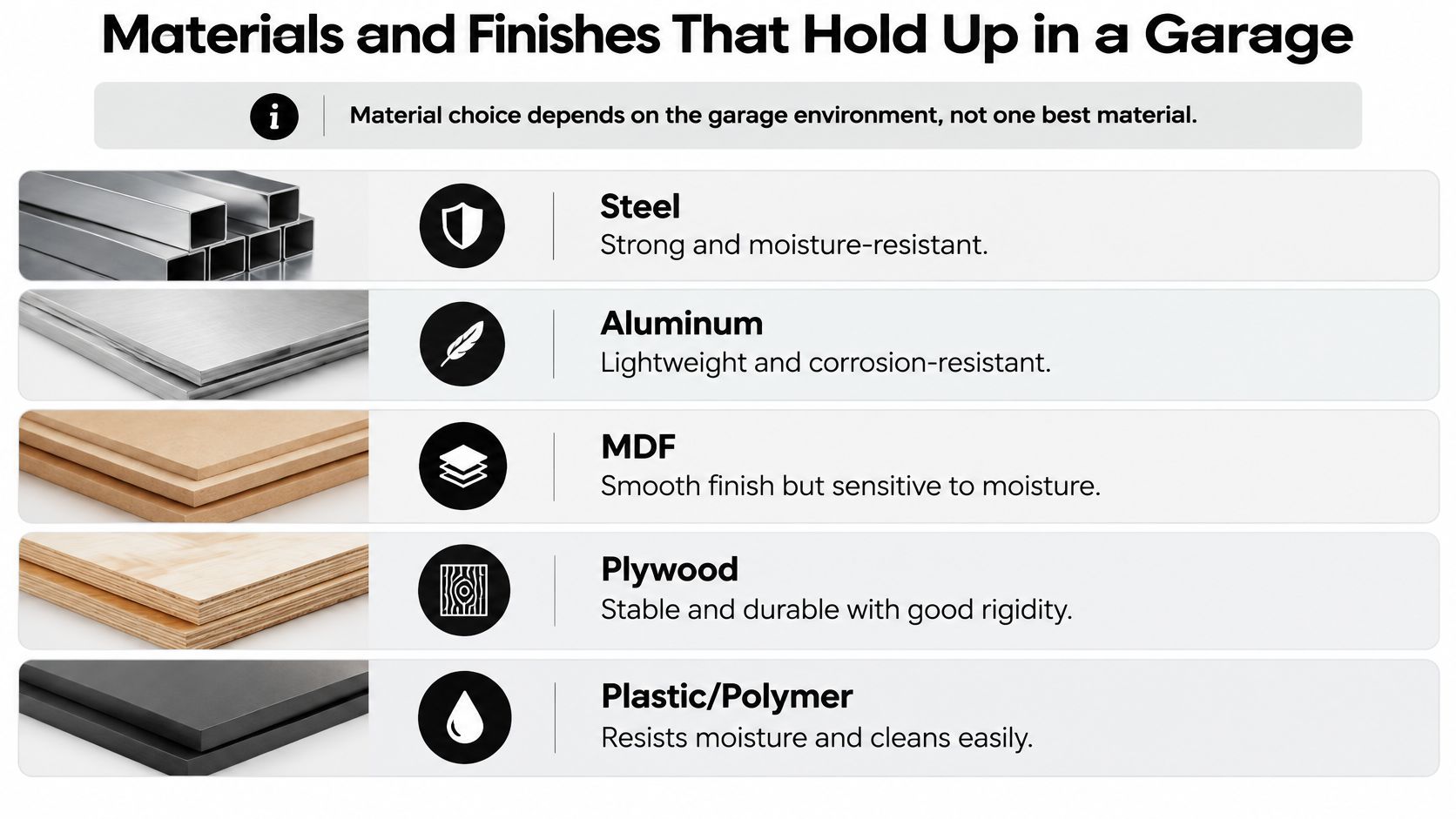
| Material | Strength and load | Moisture tolerance | Emissions documentation | Best garage use |
|---|---|---|---|---|
| Hardwood plywood | High; holds screws and heavy loads | Good when sealed and edges are banded | Required; limit 0.05 ppm | Tool and storage boxes |
| MDF | Good for painted doors; weaker under load | Poor at unsealed edges | Must be TSCA Title VI certified; limit 0.11 ppm | Painted doors in dry garages |
| Particleboard | Lower; sags under weight | Poor; swells when wet | Must be TSCA Title VI certified; limit 0.09 ppm | Light-duty shelves only |
| Banded melamine | Moderate | Good when edges are fully banded | Ask the supplier for panel documentation | Dry inland garages |
| Powder-coated steel | High; handles heavy loads | Good with pretreatment and coated edges | No formaldehyde panel concern | Damp or hot garages and workshops |
Three Rules Behind the Table
First, seal composite panels and document them. MDF takes paint beautifully, but an unsealed edge drinks moisture and swells. Particleboard sags on long spans and fails faster at fastener holes. Either material can have a place, but only with sealed edges and panel paperwork for each substrate in the box, doors, and shelves. A low-VOC topcoat doesn't prove the panel underneath is compliant.
Second, plywood and solid wood carry load and hold screws. That's why they suit tool boxes and tall units. Solid wood moves across the grain as humidity changes, so the finish has to slow that exchange on all faces, including backs and drilled holes. If you're weighing finishes, our guide to the most durable kitchen cabinet finish covers catalyzed coatings that translate well to garage use.
Third, steel only performs as a complete system. Technical guidance on powder coating versus wet paint for sheet metal identifies ASTM B117 salt-spray testing as a common benchmark and stresses that results depend on substrate, pretreatment chemistry, film thickness, edge coverage, and surface preparation. Ask for steel gauge, pretreatment, minimum film build, and the salt-spray target. Treat that target as comparative lab data, not a promise of years in your garage.
Clear Picks by Garage Type
For a dry inland garage, I'd choose sealed plywood boxes with banded melamine interiors. For a coastal garage, choose powder-coated steel with coated cut edges and welds, or well-sealed plywood raised off the floor. For a workshop, steel or plywood with load-rated drawers wins. On sustainability, specify documented low-emission panels, choose steel and hardware that can be recycled later, and favor construction that won't need early replacement.
Layout, Installation and Accessories That Work Together
Start on the floor, not in a catalog. Tape the cabinet footprint to scale with painter's tape, then park the car, open every door, and walk the route from house door to workbench with a bin in your hands.
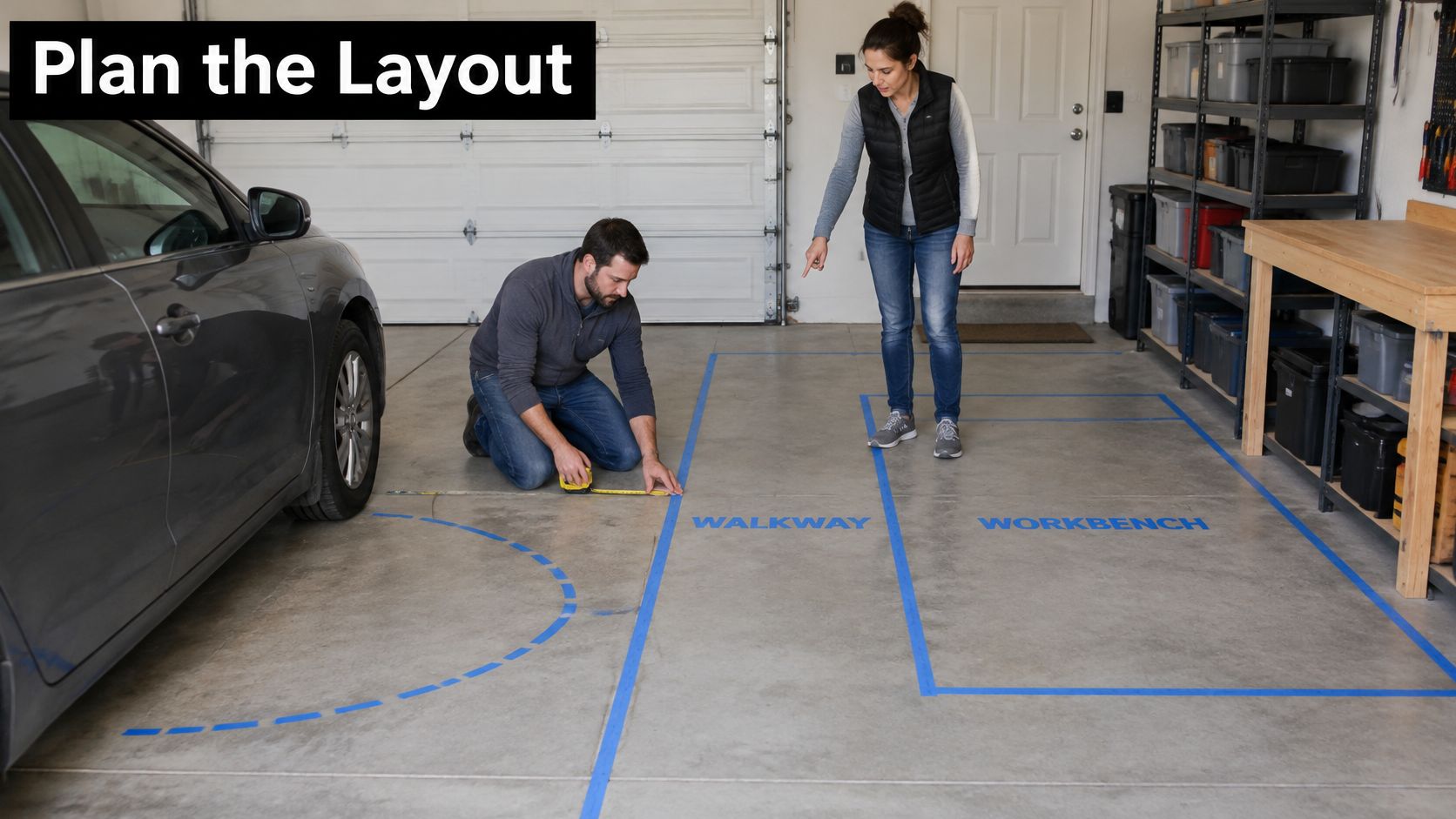
Keep about 36 inches of clear walkway where you can. Mark the garage door tracks, water heater, electrical panel, and steps. Cabinets that block panel access or force you to squeeze past a mirror will annoy you daily, no matter how well they're built.
| Storage zone | Best use | Planning note |
|---|---|---|
| Base cabinets | Heavy tools, bulk bins, workbench support | Keep heavy loads low and close to the bench; leave knee space where you sit |
| Workbench counter | Project work and assembly | Match bench height to user height |
| Wall cabinets | Paints, hardware and small parts | Mount about 18 inches above the bench and check that doors clear the car mirror and roof |
| Tall cabinets | Seasonal gear, ladders and sports equipment | Anchor into wall studs |
| Overhead racks | Bulky seasonal items | Stay clear of garage door tracks and openers |
Installation Details That Decide Service Life
- Raise the bases: Use adjustable feet or a sealed plinth so water, road salt, and wash-downs can't sit against the toe kick.
- Leave expansion gaps: Don't wedge tall units tight between walls. Wood-based panels need room at corners and ceilings.
- Anchor into structure: Tall and wall cabinets go into studs with corrosion-resistant screws, never drywall anchors alone.
- Control humidity: Guidance summarized in the Closet World guide to garage storage cabinets cites the EPA recommendation to keep indoor relative humidity below 60%, ideally 30% to 50%, to reduce moisture and mold problems.
That humidity target matters most in attached garages in hot, humid, or coastal areas, where heat, moisture, and salt air combine. Dry inland garages mainly punish cabinets with heat, which well-sealed melamine, plywood, and powder-coated steel tolerate well.
Accessories Placed by Frequency
Put daily hand tools on pegboard or rails within arm's reach of the bench. Put labeled bins and drawer dividers where you can read them standing up, not crouching. Put LED task lighting over the bench, not over the car. Plan outlets for chargers on the bench wall, away from chemical storage. If a cabinet run feels cramped on paper, our notes on how to maximize cabinet space will help you reclaim wasted depth and corners. Some items don't belong in these cabinets at all, and placement rules for them are stricter than layout preferences.
Which Fits Your Garage
The ordering route decides how well cabinets fit real walls, which are rarely square, plumb, or free of pipes and casings.
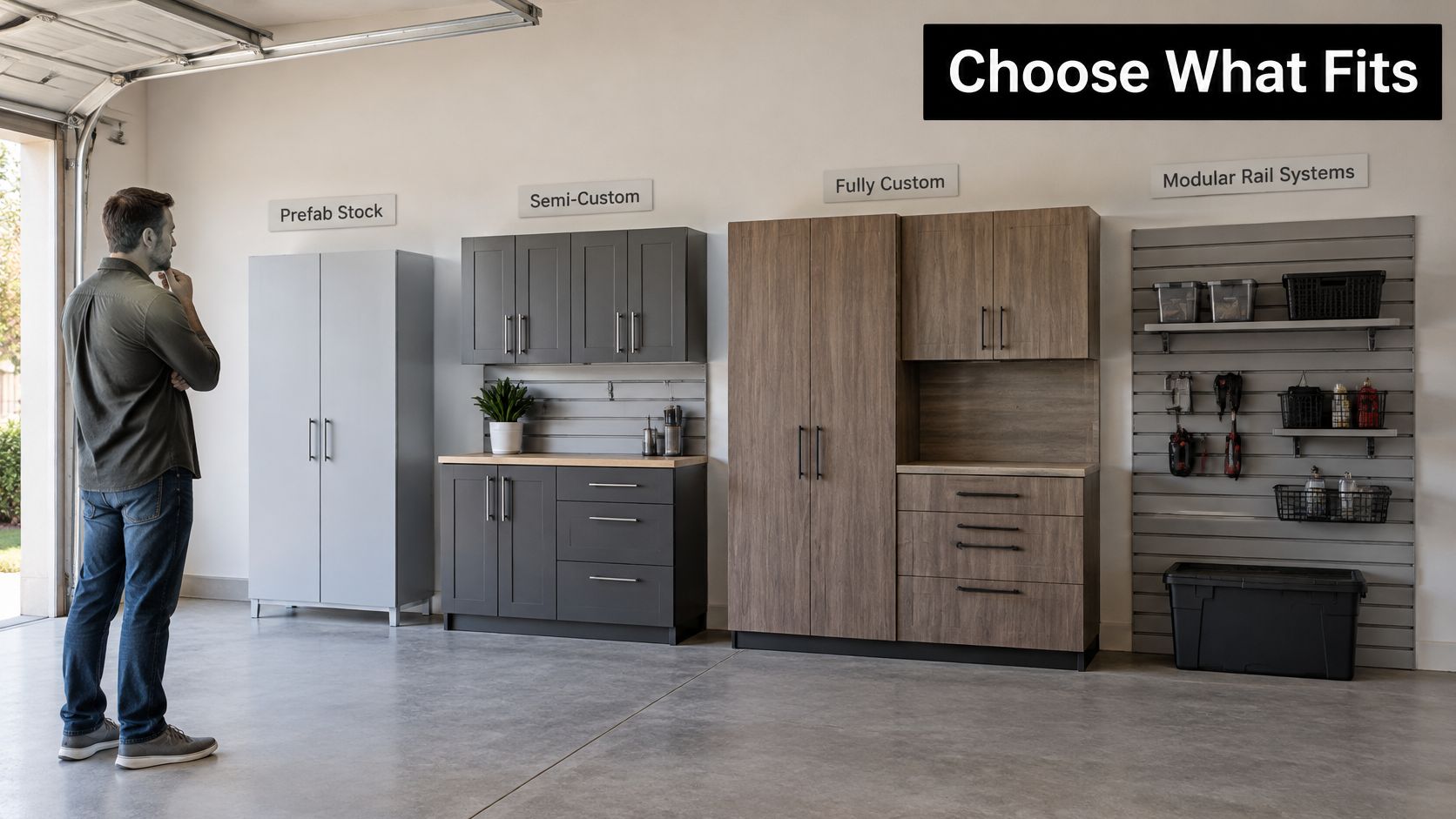
| Route | How it fits the space | Customization | Best for |
|---|---|---|---|
| Prefab stock cabinets | Standard sizes with filler strips at gaps | Limited to catalog options | Simple two-car garages on a tight budget |
| Semi-custom cabinets | Standard boxes with changed depth, height or finish | Moderate | Most homes with one or two awkward walls |
| Fully custom cabinets | Built from measured wall, bay and door dimensions | Full control of materials, finish and hardware | Irregular garages, workshops and designer projects |
| Modular rail systems | Rails and units reconfigure as needs change | Moderate | Renters and homes with changing storage needs |
Prefab is fast and usually cheapest, but standard widths leave gaps at corners and window casings that filler strips only hide. Semi-custom keeps standard boxes while changing depth, height, and finish, which solves most odd walls without a full custom price. Fully custom is measured to each bay and door swing, so it suits sloped ceilings, tall benches, and equipment that needs a specific opening. Modular rails suit renters and anyone whose storage changes often, though they rarely give you the stiff, sealed box a fixed cabinet does.
This walkthrough shows how those formats look side by side in a real bay.
If more than one wall is out of square, or a compressor, safe, or bike needs an exact opening, semi-custom or custom is usually worth the extra cost.
Before ordering from any maker, ask three questions. Who measures the space? Who installs and anchors the cabinets? What happens if a finished wall leaves a dimension half an inch off? The answers tell you who owns the risk.
Flammable Chemicals and What Never Belongs in a Cabinet
A July afternoon pushes the garage well past the temperature inside the house. Gas for the mower sits in a wood base cabinet, thinner is on the shelf above it, and a lithium-ion pack charges against the sun-baked wall. The doors are shut, so the bay looks tidy. Shut doors do not make a furniture cabinet approved chemical storage, and solvent vapor plus heat can drift from that bay into the house.
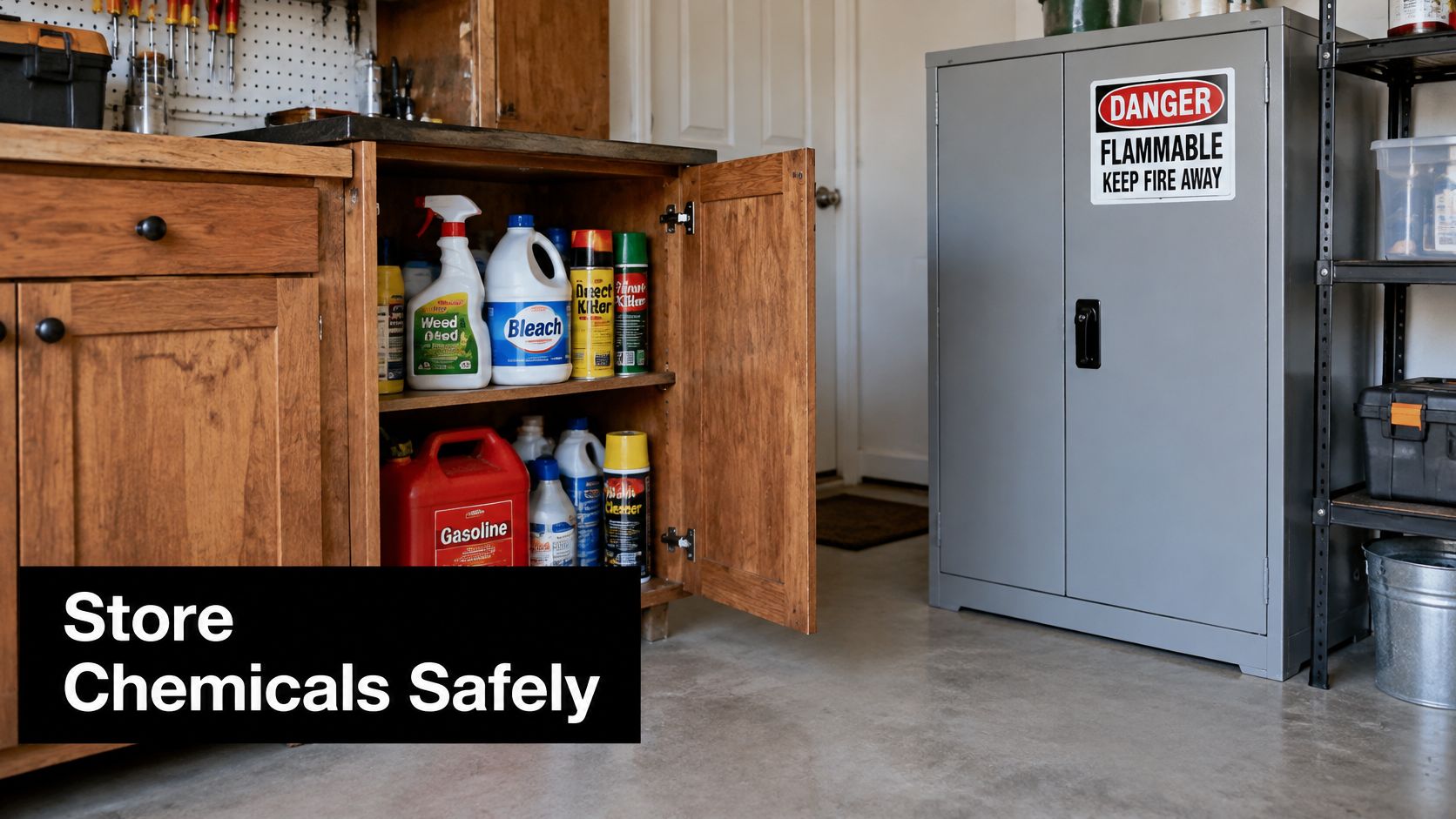
- Ordinary cabinets: Hand tools, fasteners, sealed water-based cleaners, dry goods, and sports gear.
- Listed flammable cabinet: Gasoline, solvents, paint thinners, oil-based finishes, and aerosols, kept within quantity limits and away from ignition sources.
- Never indoors: Propane cylinders belong outside, not in a cabinet, closet, or corner of the garage.
- Heat-sensitive items: Store lithium-ion batteries in a cool place, away from heat sources and chargers. Skip a sun-heated wall, the space beside a heater, and a sealed box sitting over a charger.
The OSHA construction standard for flammable liquids, 29 CFR 1926.152 limits storage outside an approved cabinet to 25 gallons of flammable liquids. An approved cabinet may hold up to 60 gallons of Category 1 to 3 liquids or 120 gallons of Category 4 liquids, with no more than three such cabinets in one storage area. For acceptable wooden cabinets, that standard requires exterior-grade plywood at least 1 inch thick that will not break down or delaminate under standard fire-test conditions. A kitchen-style box is built for humidity and daily use, not that fire test. Your local fire code governs a home garage, so use these figures as a frame for questions, not as permission.
Keep oxidizers such as pool chemicals away from flammables. Keep every chemical away from chargers, space heaters, welding, and grinding, where sparks and heat are routine. Vapors collect in closed, low spaces. A garage is harsher than a kitchen: moisture, temperature swings, and chemical fumes hit the same boxes, and a door into the house can carry those emissions inside.
Three questions before anything goes on a shelf: Is it flammable? Is the quantity over the limit? Does it need a listed cabinet?
If you can't answer all three, leave it out. Read the product label, check your fire code, and buy the listed cabinet before the solvent goes inside. A premium finish will not fix the wrong box.
What High Quality Costs and Where the Money Returns
Price follows the scorecard, not the door profile. Two cabinets can share a color and differ completely in box, hardware, and finish. The table below uses relative cost because firm dollar ranges should come from a written quote for your wall, not a generic range.
| Route | Relative cost | Main price drivers | Expected return |
|---|---|---|---|
| Prefab stock | Lowest | Catalog boxes, basic hardware, self-install | Fast organization, earliest replacement risk |
| Modular rail | Low to moderate | Rail length, number of units, accessories | Flexibility as needs change |
| Semi-custom | Moderate to high | Changed depths and heights, finish, hardware | Better fit on awkward walls |
| Fully custom | Highest | Material, joinery, finish, measured fit, installation | Longest service life and exact fit |
Where the Money Actually Goes
Material and finish cost the most per foot, because thicker panels, real wood, steel pretreatment, and catalyzed coatings take more material and shop time. Box construction, joinery, and drawer slides come next. Hardware and installation complexity follow, then the number of corners, bays, fillers, and custom openings. A long straight wall is cheap to fill. Three short walls with a water heater and a door swing are not. For a sense of how custom work is priced more broadly, see our breakdown of the average cost of custom cabinets, then confirm garage figures in writing.
To compare two quotes fairly, force both onto the same seven scorecard lines. Same box thickness, same slide rating, same finish system, same anchoring. Then compare totals. I'd spend first on boxes, slides, hinges, finish, and fasteners, and save on decorative door styles in a workshop nobody tours.
Be candid about return. Garage cabinets rarely add resale value the way a kitchen does. Their return is daily: tools protected from dust and moisture, floors you can sweep, and a tidy garage buyers notice on a walkthrough. A cheap cabinet that needs hinges, slides, and a swollen base replaced in a few years often costs more than a better one bought once.
Maintenance Routines That Protect Garage Cabinets
Maintenance starts on day one, while the finish is intact and the hardware is aligned. Small checks tied to visible signs beat a yearly overhaul.
- Monthly: Wipe spills on bases and shelves with a damp cloth. Chemical residue left to dry works into finishes and stains melamine.
- Quarterly: Inspect steel coating at cut edges, fastener holes, welds, and scratches. Touch up exposed metal with the kit supplied at purchase before rust starts.
- Twice a year: Check hinges and drawer slides for drift, tighten anchor screws, and readjust doors that have settled.
- Coastal garages: Rinse salt residue from exteriors with fresh water, dry surfaces, and keep floor drains clear so water doesn't pool at the toe kick.
- Humidity: Put a hygrometer on the wall and ventilate to stay in range. Our guide to cabinet humidity control explains how to read the numbers and adjust airflow.
- Early warning signs: Swelling at panel edges or fresh stains on the toe kick mean water exposure. Replace the affected base section promptly, because particleboard and MDF swelling spreads.
- Records: Keep warranty terms, touch-up colors, and hardware part numbers in one drawer so repairs match the original spec.
Finish with a yearly walk-through. Check that tall units still stand plumb, anchors into studs are tight, and expansion gaps at walls haven't closed up with debris.
Confirm Your Checklist Before You Buy
Run this list before you sign anything, with the written quote in front of you.

- Measure twice: Measure walls, bays, and door clearances twice, then confirm those numbers appear on the quote.
- Match material to climate: Use the materials comparison to pick for heat, humidity, and salt, not for showroom looks.
- Get panel paperwork: Emission documentation in writing for every composite panel type in the job.
- Confirm the full spec: Slides with load ratings, adjustable hinges, finish system, and corrosion-resistant fasteners.
- Write the flammable plan: Name which items need a listed cabinet and which items won't be stored indoors.
- Confirm installation: Who installs, levels, and anchors the units, and into what structure.
- Ask about warranty and touch-up: Written warranty terms and a touch-up kit that matches your finish.
The next step is a written quote built on the scorecard. We offer Garage Cabinets among our services, build from 100% real 3/4 inch wood with no press board, laminate, or thermofoil, apply post-catalyzed waterproofing, and handle professional installation of our cabinets. Request those same spec lines, panel documentation, hardware ratings, anchoring method, warranty, and touch-up supply from any maker you consider, then compare the written specs side by side. That comparison, not the showroom finish, tells you which cabinets will still work in ten summers.
Bring your wall measurements, climate concerns, and scorecard to Sinclair Cabinetry inc and ask for a written garage cabinet spec covering box construction, panel documentation, hardware ratings, finish, and installation. We'll build and professionally install cabinets made from 100% real 3/4 inch wood with post-catalyzed waterproofing, matched to your garage layout and storage plan. Start your quote today by visiting Sinclair Cabinetry inc.