

So, what does a new kitchen actually cost? It’s the million-dollar question, isn't it? The honest answer is, it varies—a lot. You could be looking at anywhere from $15,000 for a quick cosmetic refresh to well over $130,000 for a high-end, completely custom overhaul.
The final number on the invoice comes down to three things: the scope of your project, the quality of materials you choose, and the cost of labor in your neck of the woods. This guide will walk you through every piece of the puzzle so you can build a budget that makes sense for you.
Decoding the Price of Your Dream Kitchen
Trying to pin down a single "average cost" for a kitchen remodel is a bit like asking for the price of an "average car." Are we talking about a reliable daily driver or a luxury sports car? The details matter. Your project’s total cost hinges entirely on its scale and complexity.
To bring some clarity to the conversation, the industry usually breaks renovations down into three tiers. Think of this as a starting point—a way to align your vision with a practical budget range before you get lost in the sea of tile samples and faucet finishes.
The Three Tiers of Kitchen Renovation Costs
Getting familiar with these categories is the first step toward building a realistic budget. Each tier represents a significant jump in scope and investment, from simple updates to a full-blown gut job.
- Minor (Cosmetic) Remodel: This is your budget-friendly option, focused on surface-level improvements. Think of it as a facelift for your kitchen. You’re keeping the existing layout and structure but breathing new life into it.
- Mid-Range (Pull-and-Replace) Remodel: This is the sweet spot for most homeowners. It involves swapping out major components like cabinets, countertops, and appliances without knocking down walls or moving plumbing.
- Major (Luxury) Remodel: This is the full-gut renovation. We're talking about reconfiguring the entire layout, moving plumbing and electrical lines, and bringing in high-end custom materials and professional-grade appliances.
A recent analysis for 2025 really drives these distinctions home. A small or cosmetic kitchen remodel typically lands between $10,000 and $25,000. Mid-range renovations usually run from $20,000 up to $65,000. If you're going for a complete luxury remodel, expect to start at $65,000 and often go north of $130,000. You can see a full breakdown of these remodel costs on bathnketchin.justoborn.com.
To make these tiers even clearer, the table below gives a quick snapshot of what you can generally expect to get within each price bracket.
Kitchen Renovation Cost Tiers at a Glance
This table provides a quick summary of typical cost ranges based on the scale of the renovation project, from cosmetic updates to full-scale remodels.
| Renovation Tier | Typical Cost Range | Common Inclusions |
|---|---|---|
| Minor Remodel | $15,000 – $25,000 | Painting cabinets, new hardware, new faucet, modest appliance upgrade. |
| Mid-Range Remodel | $25,000 – $65,000 | New stock/semi-custom cabinets, granite/quartz counters, new flooring. |
| Major Remodel | $65,000 – $130,000+ | Custom cabinetry, high-end appliances, layout changes, moving walls. |
Seeing it laid out like this helps you match your goals to a realistic budget from day one. Now, let's dig into where all that money actually goes.
Breaking Down Your Renovation Budget
Seeing the average total cost for a kitchen renovation is one thing, but the real power comes from knowing exactly where all that money goes. Think of your budget like a pie—a few key ingredients will always take the biggest slices. Every choice you make in these major categories directly shapes your final bill.
The lion's share of your funds, often over 70% of the total cost, gets eaten up by just four things: cabinets, countertops, appliances, and the labor to put it all together. These are the heavy hitters, the core components that define how your new kitchen looks, feels, and functions.
The Big Four Cost Drivers
Let's dig into why these specific items command such a huge piece of the budget. It’s not just about the items themselves, but the complex mix of materials, craftsmanship, and specialized installation that drives up the price tag.
- Cabinetry (30-35%): This is almost always your single biggest expense. Cabinets aren't just boxes on a wall; they're the furniture of your kitchen, setting the entire layout, style, and how much you can store. The price swings wildly depending on whether you go with stock, semi-custom, or fully custom options.
- Labor (25-40%): Never, ever underestimate the cost of skilled professionals. This bucket includes your general contractor, plumbers, electricians, tile setters, and painters. Moving plumbing or electrical lines is where costs can really jump, adding significant hours and complexity to the project.
- Appliances (15-20%): Your appliances are the workhorses, and this is an area where you can spend a little or a lot. A basic package might run a few thousand dollars, but if you've got your heart set on high-end, professional-grade appliances, this line item can easily soar into the five-figure range.
- Countertops (10-15%): Just like cabinets, your countertops have a massive impact on your kitchen’s look and longevity. Costs vary widely by material, from budget-friendly laminate all the way up to premium natural stones like marble or quartzite.
It's all a balancing act. For instance, splurging on gorgeous custom cabinetry might mean you need to choose more modest appliances to stay on track. On the flip side, if that chef-grade range is a non-negotiable for you, maybe you opt for semi-custom cabinets instead of fully bespoke ones to make it work.
Visualizing Your Budget Allocation
Think about planning your kitchen like you’re crafting a custom meal. The cabinetry and countertops are your main course—they form the foundation of the whole dish. Appliances are the essential spices that bring it to life with flavor and function. And finally, labor is the skilled chef who pulls all those ingredients together into something amazing.
This analogy makes it pretty clear where your decisions carry the most financial weight. Changing your mind on a paint color is a minor tweak. But deciding to switch from laminate countertops to granite? That's a major budget shift.
For a more granular look at how your specific choices will stack up, a specialized tool can be a game-changer. You can get a personalized estimate with this handy kitchen remodel cost calculator to see in real-time how different selections affect the bottom line.
Ultimately, understanding this breakdown empowers you to spend with intention. You get to decide where to splurge on that show-stopping feature and where to save with a more practical option, ensuring you create a kitchen you absolutely love—without any nasty financial surprises.
Decoding Material and Appliance Price Ranges
This is where your kitchen vision starts meeting reality—translating those budget percentages into actual costs. The materials and appliances you choose are the biggest levers you can pull to control the final price tag. Understanding the spectrum of what things cost is absolutely crucial for making smart decisions.
Think of it like buying a car. You could go with laminate countertops—the reliable, budget-friendly sedan that gets the job done. Or, you could opt for high-end marble, which is like buying a luxury sports car. Both function, but the price, performance, and feel are worlds apart. This same logic applies to every single finish in your kitchen.
Cabinetry Costs Unpacked
Cabinets are almost always the biggest line item on the invoice, and for good reason. They anchor your kitchen's entire layout and style. Your choices generally boil down to three tiers, each with its own price point.
- Stock Cabinets: These are your off-the-shelf, most budget-friendly option. They come in standard sizes with limited styles. Expect to pay around $100 to $300 per linear foot.
- Semi-Custom Cabinets: This is the happy medium. You get more flexibility in sizes, styles, and finishes, striking a great balance between personalization and cost. Prices typically run from $200 to $750 per linear foot.
- Custom Cabinets: If you can dream it, you can build it. These are made to your exact specs, offering limitless design freedom, but they come at a premium. You're looking at $750 to $1,500+ per linear foot.
This infographic really drives home how cabinetry, along with labor and appliances, eats up the biggest slice of the budget pie.
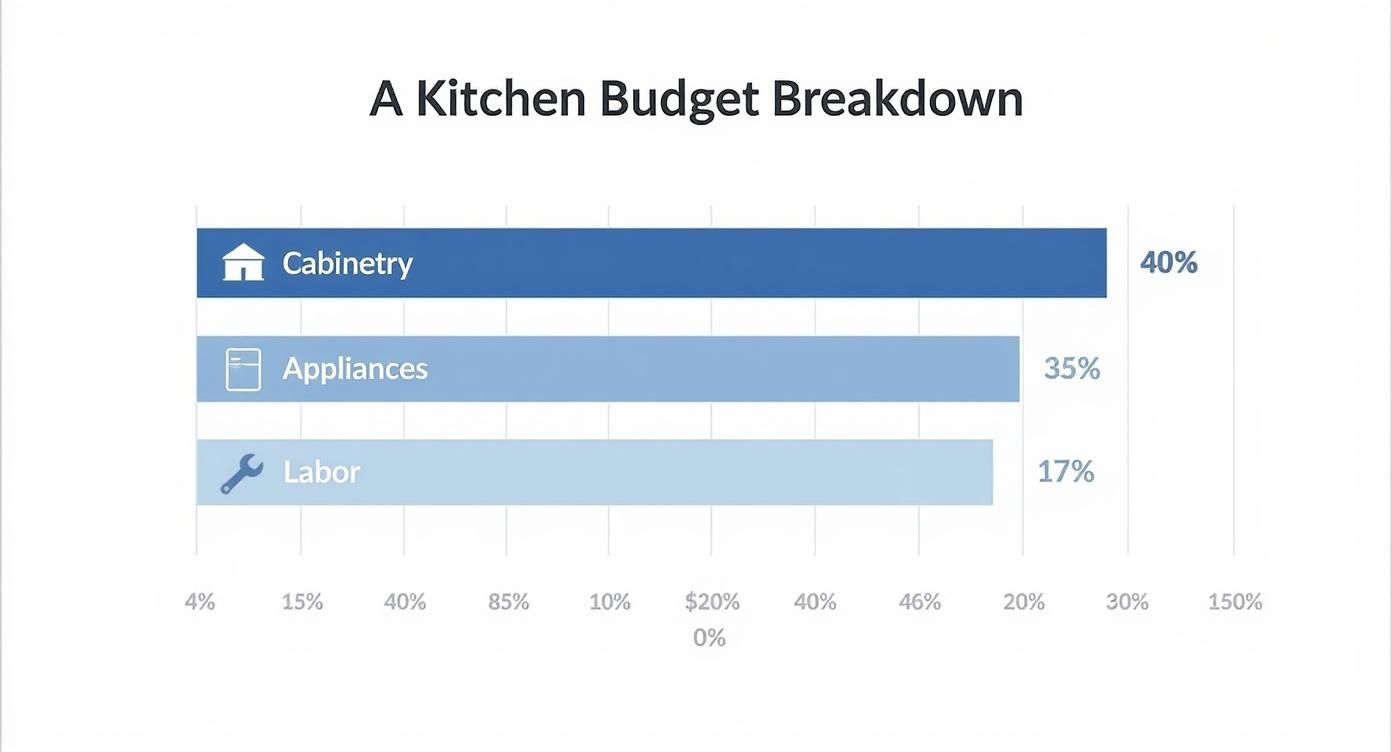
It’s a clear visual reminder that your choices in these key areas will have the biggest ripple effect on your total spending.
Countertops, Flooring, and Other Finishes
Your countertops and flooring are major visual players, and this is another area where material choices can cause huge swings in your budget. It can be tough to visualize how different materials will look and cost, which is where modern tools like AI kitchen design tools can really help you see the possibilities before you spend a dime.
The price gap between materials is honestly staggering. To help you get a clearer picture, here’s a quick breakdown of typical costs for some common kitchen materials.
Typical Costs for Key Kitchen Materials
| Material/Item | Low-End Cost | Mid-Range Cost | High-End Cost |
|---|---|---|---|
| Countertops | $20 – $50 / sq. ft. | $50 – $100 / sq. ft. | $100 – $200+ / sq. ft. |
| Flooring | $2 – $7 / sq. ft. | $7 – $15 / sq. ft. | $15 – $28+ / sq. ft. |
| Backsplash | $5 – $15 / sq. ft. | $15 – $40 / sq. ft. | $40 – $100+ / sq. ft. |
| Sink | $150 – $400 | $400 – $1,000 | $1,000 – $3,000+ |
| Faucet | $100 – $250 | $250 – $600 | $600 – $1,500+ |
As you can see, the difference between a basic finish and a premium one can be tenfold. A smart strategy is to mix high and low—maybe you splurge on a showstopper quartz for your island but go with a more affordable option on the perimeter countertops.
We've all been there, trying to decide between granite, quartz, marble, and a dozen other options. For some guidance on navigating that decision, check out our guide on how to choose kitchen countertops.
Selecting Your Appliance Package
Finally, let's talk appliances. You can get a solid, standard package for a few thousand dollars, or you can easily spend $20,000 or more on professional-grade, built-in models.
This choice really comes down to your lifestyle. If you're an avid home chef, investing in a high-performance range might be worth every penny. If you mostly use the microwave, a budget-friendly brand will serve you just fine. Let your cooking habits guide you here to make sure you get the performance you need without overspending.
Budgeting for Labor and Professional Services
Cabinets, countertops, and appliances are the fun, tangible things you get to pick out, but they’re really only half of the equation. The other, and often underestimated, piece of your budget goes to the skilled pros who actually put it all together. Labor is a massive driver of the average kitchen renovation cost, and getting a handle on it is your ticket to a realistic budget.
Think of your general contractor (GC) as the director of a movie. They aren’t just swinging a hammer; they’re coordinating the entire production. They hire and manage all the specialized tradespeople needed to get the job done right, on time, and up to code. For this critical management role, a GC typically charges between 15% to 25% of the total project cost.
That fee covers a lot more than just their time and expertise. It includes their insurance, licensing, and the peace of mind you get from having a single person responsible for everything. I've seen it happen time and again: trying to skip the GC to save a few bucks can quickly turn into a nightmare of scheduling conflicts, costly mistakes, and failed inspections.
Who Is on the Team?
Your GC is the captain, but they lead a whole team of specialists. Each of these pros plays a specific role, and their rates will vary based on their trade and where you live.
- Electricians: These are the experts who safely wire your new pendant lights, add outlets to your island, and ensure your new appliances have the power they need. The more you move things around, the more hours they'll need.
- Plumbers: From disconnecting the old sink and faucet to running new water and drain lines for a pot filler or an island prep sink, plumbers handle all the wet stuff.
- Drywall and Painters: After the walls are opened up for new wiring and pipes, these are the folks who patch everything up seamlessly and apply the fresh coat of paint that makes the space feel brand new.
- Tile Setters and Flooring Installers: Their meticulous, detailed work is what gives you that perfectly straight backsplash and a durable, level floor that will last for years.
The human element of your renovation is an investment in quality. It's tempting to cut corners on labor, but a poor installation can ruin even the most beautiful materials and end up costing you far more down the road.
Factoring in Permits and Other Hidden Costs
The final piece of the professional services puzzle involves the "behind-the-scenes" costs. Before a single wall is touched, your contractor will need to pull the required building permits from your local city or county. Depending on your project's scope, these fees can run anywhere from a few hundred to a couple of thousand dollars.
Permits aren't just bureaucratic red tape. They ensure your renovation meets local building codes for structural, electrical, and plumbing safety. The process also includes official inspections at key stages of the project, which are covered by the permit fee. It’s a non-negotiable step that protects both the safety and the long-term value of your home. Budgeting for it upfront helps create a complete and honest financial picture.
Maximizing Your Return on Investment
A kitchen renovation isn’t just an expense—it’s a powerful investment in your home's appeal and your own daily enjoyment. Thinking about your project in terms of Return on Investment (ROI) is the key to finding that sweet spot between the dream features you want and the practical choices that actually pay off when you plant a "For Sale" sign in the yard.
Here’s a little secret most people don’t realize: a high ROI isn't about spending the most money. In fact, it’s often the opposite. A massive, luxury overhaul might feel amazing, but it almost never delivers the same financial payback as a more targeted, strategic refresh. The real goal is to make smart, appealing upgrades that resonate with the broadest pool of potential buyers, all without over-customizing or out-pricing your neighborhood.
Minor Upgrades, Major Returns
When it comes to getting your money back, smaller projects pack the biggest punch. The data consistently shows that minor kitchen renovations deliver the best financial returns. These projects are all about high-impact, cosmetic shifts rather than gutting the space and moving walls.
Think of it this way: a minor renovation could involve refacing cabinets, swapping in a new suite of energy-efficient appliances, upgrading countertops, and installing modern fixtures. These changes completely refresh the look and feel of the space. Major remodels, on the other hand, often involve reconfiguring the layout and installing high-end custom features—and while they are beautiful, you'll see a much smaller percentage of that cost back at resale.
A 2024 analysis shows a huge difference in ROI depending on the project's scale. Minor kitchen renovations come out on top, recouping an incredible 96.1% of their cost in added home value. In stark contrast, major remodels typically only yield an ROI of about 49%. You can explore the full 2024 Cost vs. Value Report on thisoldhouse.com.
High-ROI Upgrades to Prioritize
So, where do you get the most bang for your buck? To really maximize your return, you want to focus on improvements that boost both function and modern style without draining your bank account.
- Cabinet Refacing or Repainting: Instead of a full tear-out, giving your existing cabinet boxes a facelift with fresh paint or a new veneer is a game-changer. Add new hardware, and you can completely transform the kitchen for a fraction of the cost of new cabinets.
- Modern Countertops: Upgrading from dated laminate to a durable and universally loved material like quartz gives the room a massive visual lift. It’s one of the first things buyers notice.
- Energy-Efficient Appliances: A matching suite of modern, energy-efficient appliances is a huge selling point. It sends a clear signal to buyers that the kitchen is updated and they won't have to worry about immediate, costly replacements.
At the end of the day, a smart renovation does more than just make your kitchen prettier—it adds real, tangible value to your home. To learn more about making your project a financial home run, check out our detailed guide on understanding your kitchen renovation return on investment.
Smart Strategies to Control Your Renovation Costs

Knowing what drives the average kitchen renovation cost is one thing; getting a handle on those costs is another game entirely. The good news is that with a few proven strategies, you can make your budget work a whole lot harder without giving up the style or function you’re dreaming of.
One of the single most effective ways to save a huge chunk of change is by keeping your current kitchen layout. It’s tempting to imagine knocking down walls or moving the sink under a window, but those kinds of changes send costs soaring. Shifting plumbing, gas lines, and electrical wiring isn't a simple task—it requires specialized pros and can add thousands to your final bill. If you can learn to love your kitchen's existing footprint, your wallet will thank you.
Get Smart with Materials and DIY
Another powerful tactic is what designers call the "high-low" approach. It’s simple: you splurge on one or two high-impact features that really pop, then go with more budget-friendly options for everything else. For instance, you could invest in a stunning slab of quartz for your island countertop—the true centerpiece of the kitchen—while using a more affordable (but still beautiful) material for the counters along the perimeter.
You can also roll up your sleeves and get your hands dirty with some of the more manageable tasks. Leave the plumbing and electrical work to the licensed professionals, always. But you can easily cut down on labor costs by tackling projects like:
- Painting: A fresh coat of paint is probably the most transformative, low-cost update you can make. And you can definitely do it yourself.
- Demolition: With a little care (and the right safety gear), tearing out old cabinets, countertops, or a dated backsplash can save you hundreds in labor.
- Hardware Installation: Swapping out old, grimy cabinet knobs and pulls for new ones is a quick, satisfying job that instantly modernizes the entire room.
Since cabinetry eats up such a huge part of the budget, it's a prime area for savings. A fantastic and affordable DIY upgrade is using vinyl wrap for kitchen cabinets, which can completely change their appearance for a tiny fraction of what new cabinets would cost.
Here's a piece of advice I give every single client: build a contingency fund. This isn't optional. Plan to set aside an extra 10% to 15% of your total budget for the things you can't see coming. It’s the safety net that keeps a small, unexpected issue—like finding old water damage behind a cabinet—from derailing your entire project.
Have a Few Lingering Questions?
Even with a solid plan, a few questions always pop up as you get closer to starting your kitchen remodel. Getting clear answers to these common queries will help you move forward with confidence and sidestep those all-too-common renovation headaches.
Here are a few of the things we hear most often from homeowners just like you.
How Much Should I Budget for Unexpected Costs?
This is a big one. You absolutely need a contingency fund—it's non-negotiable for a smooth project. The industry standard is to set aside a buffer of 10% to 15% of your total project cost.
Think of it as a financial safety net. It’s there for those "uh-oh" moments, like discovering hidden plumbing issues behind a wall or realizing the wiring isn't up to code. This fund keeps surprises from derailing your budget or forcing you to compromise on the design you love.
Which Upgrades Offer the Best Return on Investment?
You don't always need a full gut job to see a great return. In fact, minor, cosmetic upgrades consistently provide the highest ROI. Smart, high-impact changes are where you'll get the most bang for your buck.
Focus on simple updates that pack a visual punch. Things like refacing or painting your existing cabinets, installing modern hardware, and upgrading to a new suite of energy-efficient appliances can completely transform the space and boost your home’s value.
Speaking of appliances, they're a huge part of the equation, with packages running anywhere from $1,300 to over $20,000. New lighting is another smart move, typically accounting for about 8% of the total budget. You can find more great insights into kitchen remodeling costs at floridarealtors.org.
Ready to create the kitchen of your dreams with cabinetry that lasts a lifetime? At Sinclair Cabinetry inc, we combine over 35 years of expert craftsmanship with high-quality materials to build custom solutions for your home. Start designing your perfect kitchen today.