
Most buying advice for custom wood file cabinets starts in the wrong place. You're told to pick a wood species and a stain, as if the label settles the question. It doesn't. A cabinet can wear beautiful solid walnut faces and still hide weak drawer bottoms, uncertified panels, undersized slides, and a layout that fights how you file. Start with workflow and specification, then choose appearance. That's the order that prevents an expensive piece from becoming an awkward one.
What Custom Wood File Cabinets Are and How They Compare
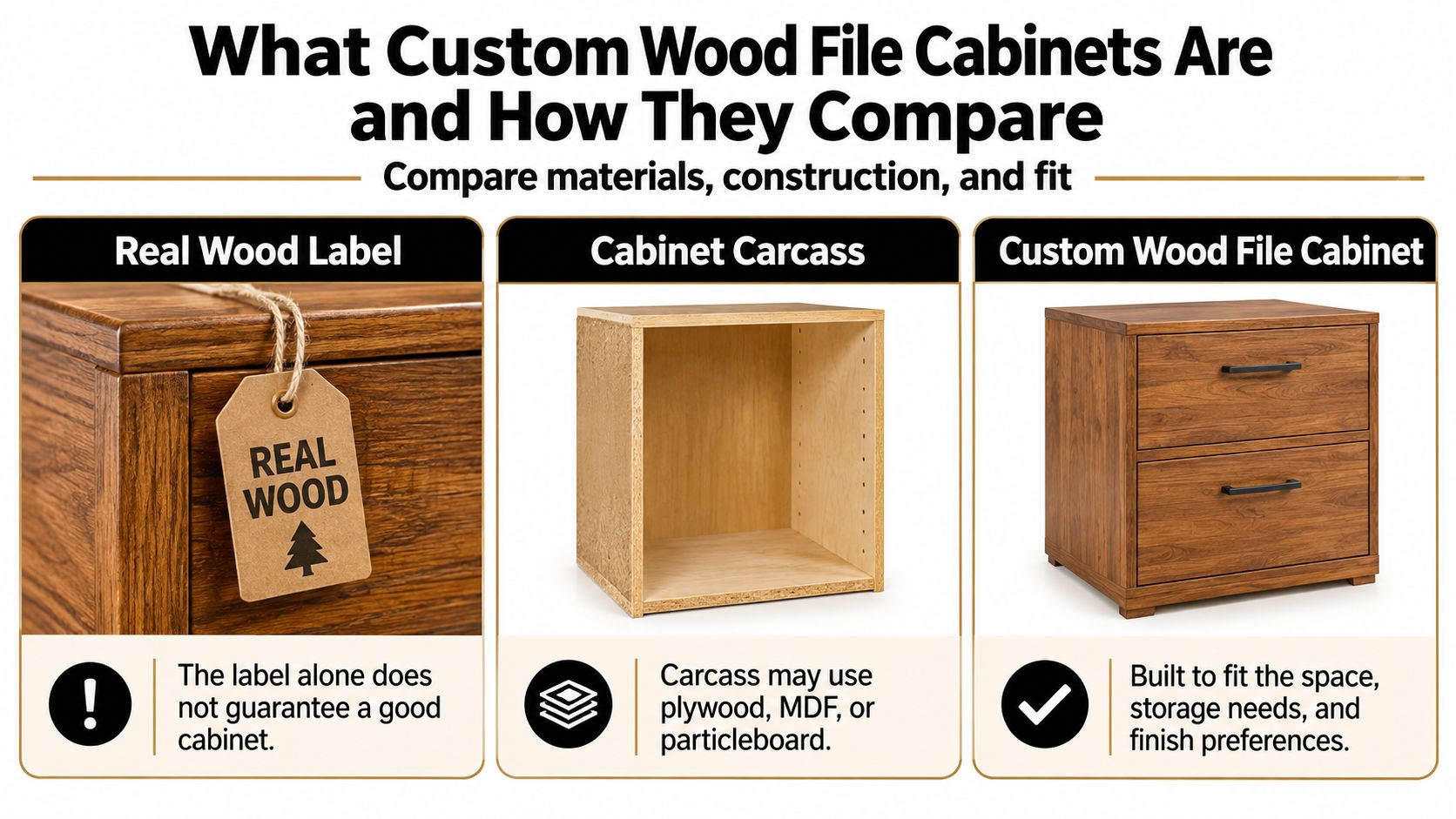
A custom wood file cabinet is a fit-and-function decision before it is a finish choice. It is built to specified dimensions, drawer count, finish, and hardware, rather than selected from fixed catalog sizes. That can solve a tight alcove or match a room, but the value depends on the construction and filing layout you specify.
“Real wood” does not describe the whole cabinet. Drawer fronts may be solid hardwood while the carcass, drawer boxes, backs, and bottoms use plywood, MDF, or particleboard. Those panels can be appropriate in the right locations. Ask the maker to identify each material and how the parts are joined, especially where loaded drawers put stress on the cabinet.
Small workshops are a meaningful part of the U.S. office-furniture market. The U.S. Census Bureau's 2019 Nonemployer Statistics recorded about $1.51 billion in sales or receipts for office-furniture manufacturing businesses without paid employees.
| Option | Sizing | Typical materials | Best for |
|---|---|---|---|
| Custom wood file cabinet | Built to specified dimensions | Solid hardwood, plywood, or specified engineered panels | Alcoves, home offices, and matching interiors |
| Stock wood file cabinet | Fixed standard sizes | Veneered particleboard or MDF with a wood-look finish | Budget storage with simple needs |
| Steel filing cabinet | Standard letter or legal widths | Powder-coated steel | Heavy paper volumes and lockable security |
Compare the options by fit, material transparency, and intended load. A stock cabinet may leave unusable space in an alcove; a wood-look surface does not reveal the panel beneath it or how the drawers are built. For a custom quote, request a written material and construction specification, a dimensioned drawing, and a hardware list before paying.
Rule of thumb: Choose custom when space or appearance is the constraint. Choose stock steel when the job is holding heavy paper at the lowest cost.
Wood Species and Panels to Specify
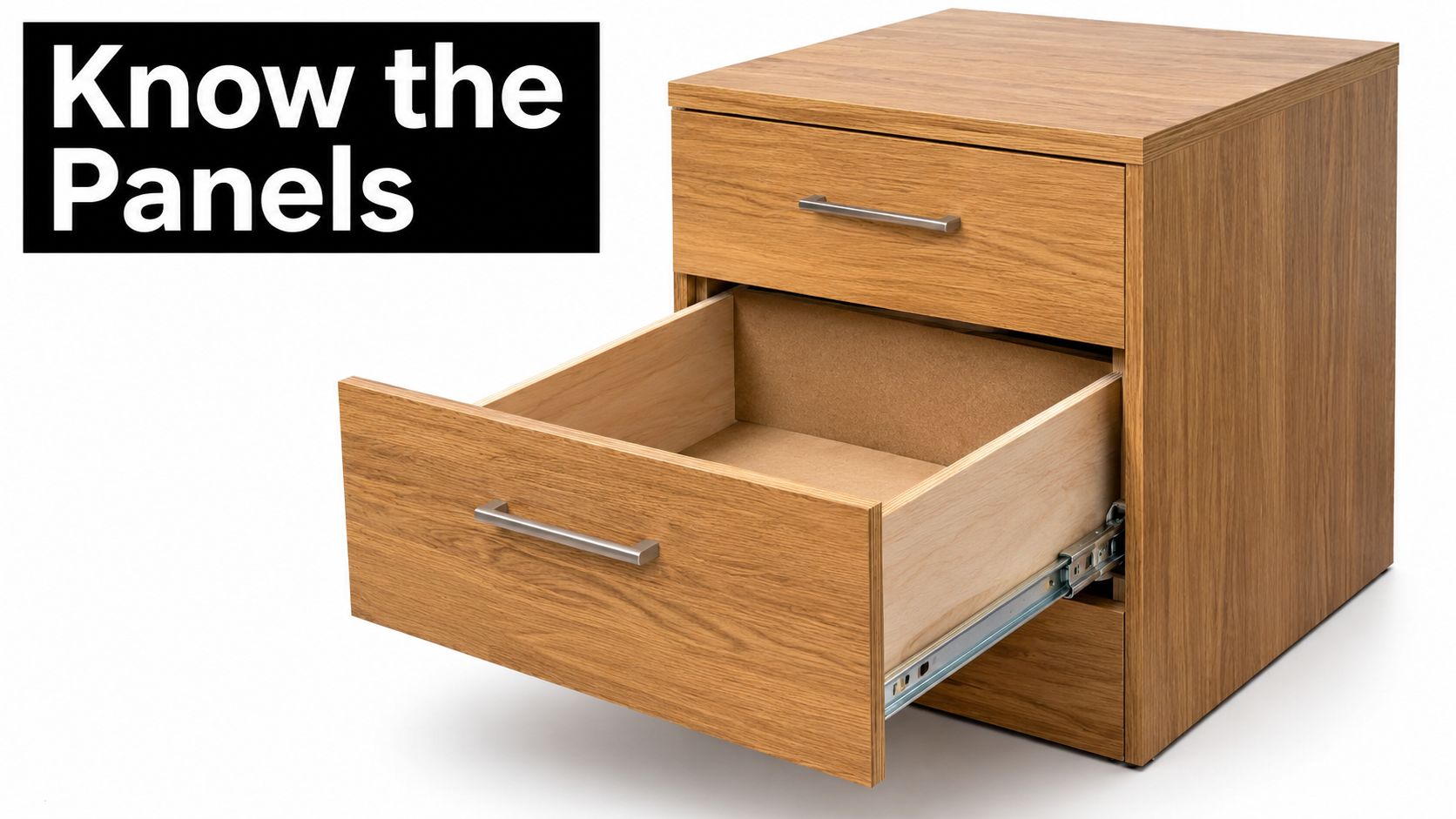
Don't assume solid wood is automatically the healthier or better choice. A well-built cabinet often mixes solid hardwood on visible faces with plywood or MDF in drawer boxes, backs, and bottoms. That's sensible construction if each component is specified properly. It becomes a problem only when the quote says "wood" and leaves you guessing what's inside.
| Material | Stability and strength | Look | Indoor-air note |
|---|---|---|---|
| Red oak | Strong, open grain, moves with humidity | Bold grain, warm tone | Solid wood, no adhesive panel source |
| Hard maple | Very hard, fine grain, stable when quartersawn | Light, clean and even | Solid wood, no adhesive panel source |
| Cherry | Moderate hardness, darkens with age | Smooth and rich | Solid wood, no adhesive panel source |
| Walnut | Strong and stable | Dark and premium | Solid wood, no adhesive panel source |
| Hardwood plywood | Stable panels that resist cupping | Face veneer shows wood grain | Request certification; EPA standard 0.05 ppm |
| Particleboard | Lowest cost, weakest screw holding | Laminate or veneer | Request certification; EPA standard 0.09 ppm |
| MDF | Smooth, paint-ready, weak when wet | Painted or laminate finish | Request certification; EPA standard 0.11 ppm |
What the panel figures actually mean
The EPA guidance on formaldehyde and indoor air quality identifies particleboard, hardwood plywood, and MDF as common indoor sources of formaldehyde because they may use urea-formaldehyde adhesives. Its listed emission standards are 0.05 ppm for hardwood plywood, 0.09 ppm for particleboard, and 0.11 ppm for MDF.
Adhesives and sealing matter as much as the panel name. A certified, fully encapsulated panel with documented emissions can be a more predictable choice than an unspecified build sold on natural appeal. Unsealed edges and drilled holes create paths for emissions and moisture, so don't treat edge treatment as cosmetic.
For a deeper comparison of carcass choices, review the trade-offs in solid wood versus plywood cabinets before you sign a specification.
Request these items in writing
- Panel emission certification: Ask for third-party documentation for every plywood, particleboard, or MDF component, not just the outer case.
- Low-VOC finish system: Specify water-based adhesives and coatings where possible, with the product named in the quote.
- Sealed surfaces: Require encapsulation of faces, edges, backs, and drilled holes.
- Component list: Get drawer boxes, bottoms, backs, tops, and shelves identified by material.
After installation, ventilate the room while the finish settles. That step matters most in tightly sealed homes.
Drawer Layouts, Rails and Locks
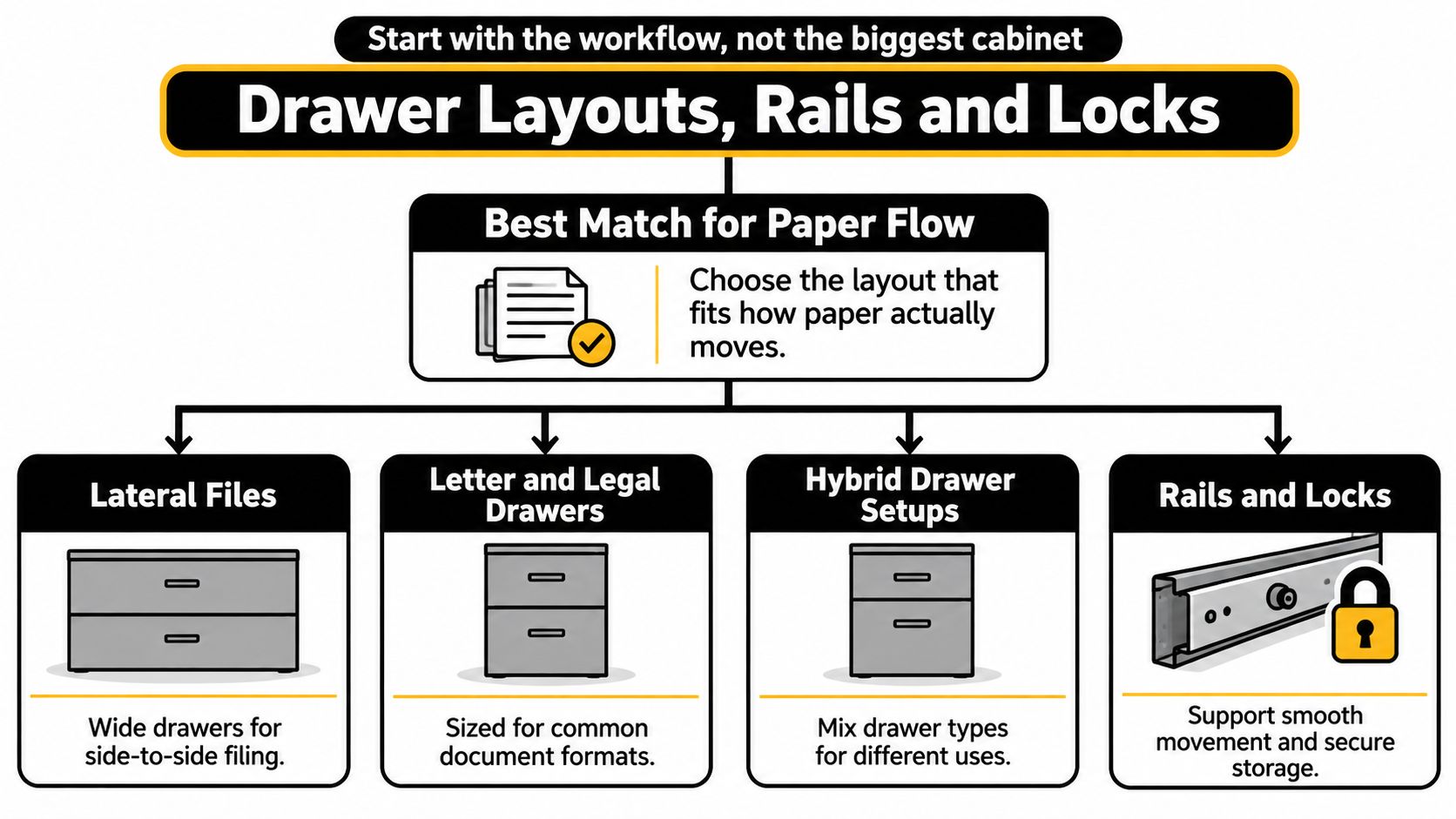
The best file cabinet isn't the largest one. It's the one that matches how paper moves through your day, what you reach for while seated, and what you'll still need after more records go digital.
| Configuration | Best for | Key specification to check |
|---|---|---|
| Lateral files | Wide, shallow folders across a long run | Slide rating and anti-tip device |
| Letter-size drawers, two to four | Standard hanging files | Drawer box sized to hang letter folders front to back |
| Legal-size drawers | Legal documents and wider folders | Full-extension slides rated for loaded weight |
| Hybrid drawer with shelf | Filing plus printer or charging | Shelf height and cable pass-through |
| Lockable drawers | Sensitive records | Whether one key locks all drawers or each drawer separately |
Before you approve a drawing, test four questions against your real files. Do the drawers hold legal-size folders without bending them? Are the slides rated for a fully loaded drawer, not an empty box? Can a seated user reach the back files and the highest pull without standing? Does an anti-tip device stop more than one heavy drawer opening at once, and will a tall unit be anchored?
The video below is useful for visualizing drawer movement and clearances before you commit to a layout.
Storage still matters, but its role is shifting. The Global Market Insights home office furniture analysis reports that storage units and file cabinets represented 16.0% of home-office-furniture revenue in 2025, with the forecast share expected to fall to 14.0% by 2035. I'd read that as a warning against paper-only cabinetry.
Build hybrid storage instead. Pair one or two filing drawers with adjustable shelves, removable organizers, concealed charging, or a printer bay. You keep capacity for active records without locking the room into archive duty.
Accessibility belongs in the drawing, not as an afterthought. Set pull heights within an easy reach range, preserve clear approach space, choose smooth low-force hardware, and use visible labels. The guide to cabinet drawer slide types can help you match hardware to load and travel.
Finally, decide the locking logic. A single gang lock is convenient for one user. Separate locks suit shared offices where different drawers hold different responsibilities.
Use Cases and Common Questions
Say a home office has an awkward alcove under a window. A stock cabinet leaves wasted inches on both sides and sits too high for the sill. A custom two-drawer letter file fills the width, keeps hanging rails at a comfortable height, and adds a hybrid top shelf for a printer. The win isn't the wood. It's usable storage where the room previously had dead space.
A small law office with sensitive records
Legal files need depth, full extension, and controlled access. For that setting, I'd specify a four-drawer legal file with lockable drawers, slides chosen for loaded weight, and a wall anchor. The anchor isn't optional decoration. A tall case with an upper drawer extended changes its balance, so securing it is part of the filing system.
A den that must stay flexible
A family converting a den doesn't need a monument to paper. A built-in wall system with two filing drawers, adjustable shelves, and display space handles school records and tax files now. Later, the same shelves can hold books, games, or charging devices without replacing the whole unit.
A good custom build solves today's filing problem while leaving the room a second life.
How long will a well-built cabinet last? Longevity depends more on joinery, panel quality, finish durability, and whether slides and locks can be repaired or replaced than on the wood name alone. A fashionable species won't rescue weak drawer corners or bargain hardware.
Can drawers be added later? Usually not without rebuilding the interior, because drawer count, slide locations, and case divisions are set during construction. Adjustable shelves and removable organizers are the practical way to adapt, so build in at least one flexible zone from the start.
Estimated Cost Drivers and Lead Times by Build Type
Custom pricing follows the build, not the brand. Drawer count, wood species, panel specification, slide rating, locks, finish work, site measuring, and installation move the price. A simple painted case with two drawers and a walnut wall system with legal files aren't variations of the same job. They're different scopes of labor and materials.
Use these rows as planning estimates for U.S. made-to-order work. Confirm every figure with a written quote, because regional labor and your exact specification set the final number. The breakdown of how much custom cabinets cost explains how those broader cabinetry drivers apply.
| Build type | Typical configuration | Main cost drivers | Typical lead time |
|---|---|---|---|
| Single lateral file | Wide shallow drawers in a single run | Drawer count, wood species, hardware | About 4-6 weeks (est.) |
| Two-drawer letter file with hanging rails | Two letter drawers with hanging rails | Drawer count, slide rating, locks | About 4-6 weeks (est.) |
| Four-drawer legal file with lockable drawers | Full-height run with locking hardware | Lock count, legal-depth slides, panel specification | About 6-8 weeks (est.) |
| Hybrid credenza with filing drawers and open shelves | Credenza with filing drawers and open shelves | Shelf and cable work, joinery, finish | About 6-10 weeks (est.) |
| Built-in wall system with filing and display | Full wall run, measured on site | Site measuring, installation scope, wall anchoring | About 8-12 weeks (est.) |
Lead time grows because each stage waits on the one before it. Drawings need approval before materials are ordered. Joinery comes before finishing, and finishing needs cure time before delivery. A built-in adds field measuring and installation coordination.
Three cost levers you control
- Use solid wood strategically: Put premium hardwood on visible faces and use properly specified panels inside where stability matters more.
- Limit lock complexity: One well-placed lock often serves a home office better than locking every drawer.
- Fix the design early: Every revision can restart approval, material orders, and shop scheduling.
Don't cut slide quality to save money. Paper is heavy, and a failed slide makes an otherwise sound cabinet miserable to use.
Finishes, Hardware and Long-Term Care
Longevity is the most practical sustainability argument you can make for a custom cabinet. The EPA durable goods product-specific data reported that furniture and furnishings generated 12.1 million tons of municipal solid waste in 2018, equal to 4.1 percent of total U.S. municipal solid-waste generation. Wood was the largest material category in furniture. Only about 40,000 tons were reported as recycled, roughly 0.3 percent, while 80.1 percent was landfilled.
Those figures cover U.S. furniture overall, not custom cabinets alone. Still, the lesson is direct. Durable joinery, repairable hardware, refinishing, and adaptable dimensions reduce how often a cabinet gets replaced.
Finish choices
- Clear lacquer or oil: Shows grain and suits oak, maple, cherry, or walnut when the wood is the feature.
- Stain: Helps new cabinetry sit comfortably beside existing desks, floors, or built-ins.
- Painted finish: Gives uniform color and works well on MDF or stable hardwood prepared for paint.
- Water-based low-VOC coatings: Reduce solvent odor and support the indoor-air specification you've already set.
Match the finish to maintenance expectations. Oil can be renewed locally but offers less surface protection. A harder film finish resists daily wear, though repairs may need a more careful blend.
Hardware and routine care
Choose concealed or side-mount slides based on load, available width, and service access. Place edge or bar pulls where a seated user can reach them without twisting. Key locks suit simple control, while electronic locks can help shared offices avoid key management, provided battery access is planned.
- Clean gently: Wipe with a barely damp cloth and dry the surface.
- Control the environment: Keep the cabinet away from direct heat and sharp humidity swings.
- Inspect yearly: Check slides, pulls, locks, levelers, and wall anchors.
- Refinish before replacing: Renew worn faces and tops when the case and drawers remain sound.
Care principle: Protect the finish, keep the hardware working, and repair small wear before it becomes structural neglect.
How to Order and Install Your Cabinet
A clean order process protects both the budget and the finished fit. Each step gives you a chance to catch a problem while it's still a drawing, not a built cabinet standing in the wrong room.
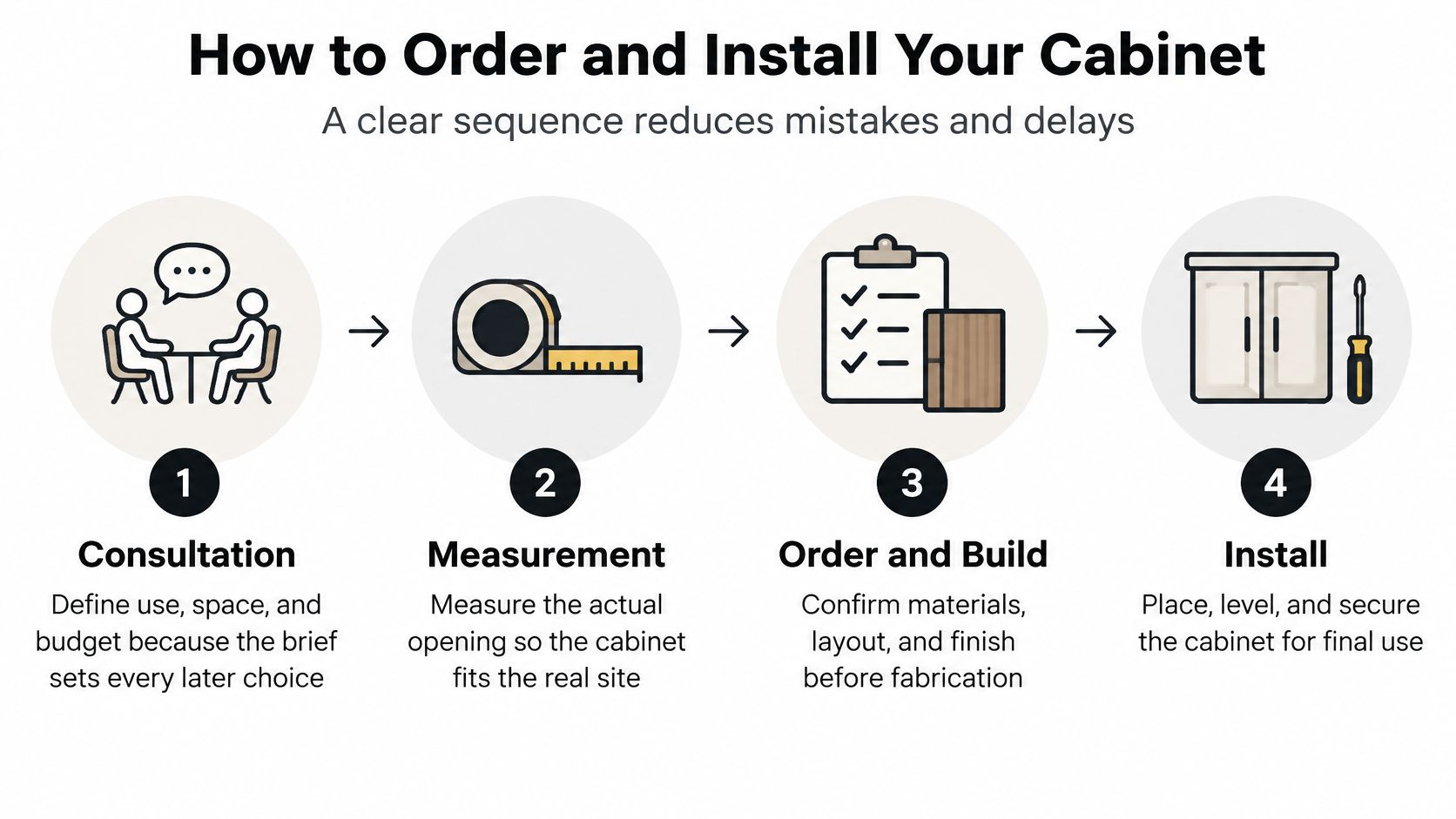
- Consultation: Define use, available space, paper volume, and budget, because the brief sets every later choice. Bring sample folders and measurements of printers or other equipment.
- Measurement: Measure the actual opening, including baseboards, outlets, floor level, and door swing. Walls and floors are rarely square.
- Design: Review the cabinet in design software so drawers, rails, shelves, locks, and cable paths are visible before cutting begins.
- Material and finish selection: Approve species, panels, hardware, and finish against your checklist. Request panel emission certification and finish documentation in writing at this stage, not after delivery.
- Written quote and sign-off: Treat the approved drawing and specification as the reference for price, lead time, and any later change.
- Shop build: The maker builds the case, fits solid-wood faces, installs specified interior panels, and checks drawer travel under the intended configuration.
- Finish, cure and inspect: Allow the coating to cure, then inspect surfaces, edges, slides, locks, and alignment before delivery.
- Professional installation: Level the unit, anchor tall cabinets, adjust drawers, and test every lock and pull before loading files.
One option for this kind of made-to-order work is Sinclair Cabinetry inc, a Cape Coral, Florida custom cabinet manufacturer with over 35 years of experience. It offers real wood cabinetry, customizable designs, design software, and professional installation, which covers the consultation role in step 1 and the installation role in step 8.
Before installation day, review the cabinet installation guide so access, leveling, and anchoring expectations are clear. Don't sign off until drawers run smoothly without files, then test them again partly loaded.
Choose Your Build and Request a Quote
Make the decision in order. First, pick the build type from your filing workflow, not from a desire for the largest cabinet that fits. A single lateral file suits a compact home office. A four-drawer legal file suits active records. A hybrid credenza or wall system suits a room that must change over time.
Second, confirm the specification. Put solid wood on visible faces, use certified panels inside, choose a low-VOC finish, and require sealed edges and drilled holes. If a quote won't name the drawer-box, back, and bottom materials, it isn't detailed enough.
Third, check the interior like a user. Confirm letter or legal sizing, slide rating, anti-tip protection, lock arrangement, reach height, and wall anchoring. If your paper volume may fall, include at least one hybrid drawer, adjustable shelf, printer bay, or removable organizer.
Fourth, ask for a written quote with the approved drawing, material documents, lead time, delivery terms, and installation scope. Fifth, schedule the order at least two to three weeks ahead of your move-in or build-out target beyond the quoted production window, leaving buffer for approval and delivery.
Final sign-off check
- Measurements: Taken from the actual opening and recorded.
- Drawing: Approved with drawer sizes and hardware shown.
- Documents: Panel and finish records received.
- Quote: Signed with lead time and installation scope.
- Installation: Booked with anchoring included for tall units.
Your single next action is simple. Contact Sinclair Cabinetry at sinclaircabinets.com, book a consultation, and start the quote with your room measurements, sample file sizes, and storage priorities in hand.
Bring your measurements, paper sizes, and storage priorities to Sinclair Cabinetry inc to start a custom wood file cabinet designed around your space and workflow. You'll be able to discuss real wood faces, specified interior panels, drawer hardware, locks, finishes, and professional installation before approving a drawing and written quote.