
If a tag says solid wood furniture made in USA, what exactly have you been promised? A piece built from American lumber, a piece assembled in an American shop, a piece with no engineered panels, or a piece that will last? Most shoppers assume the label answers all four questions at once. It doesn't, and that gap is where expensive mistakes happen.
Think of origin, material, and quality as three separate claims. A maker can prove one and still leave the other two unclear. Your job isn't to distrust every label. It's to ask which claim each word is making, then verify the parts that matter for the room, the climate, and the years of use ahead.
What Solid Wood Furniture Made in USA Actually Means
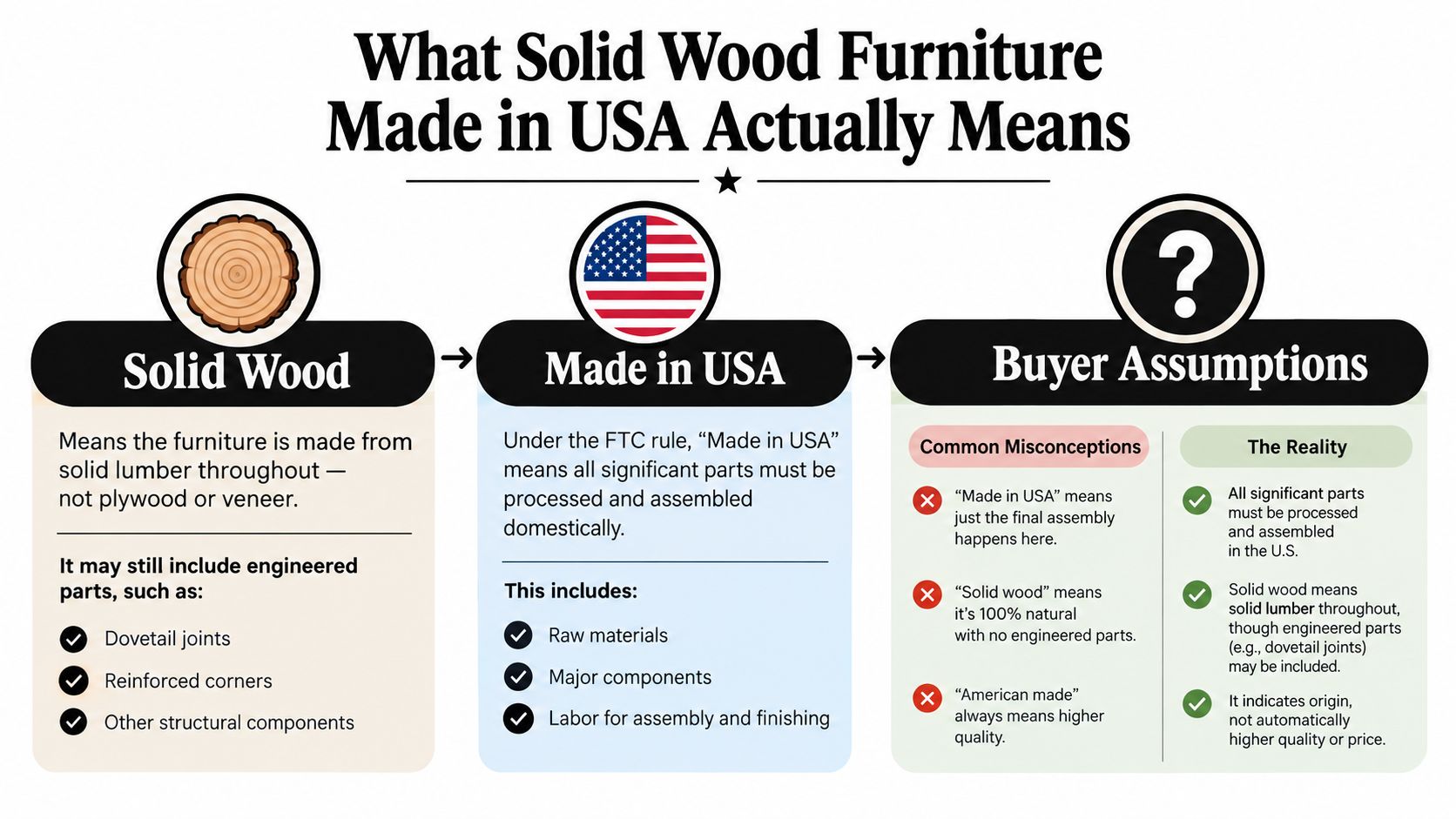
Start with solid wood. In plain shop language, that means solid lumber, boards sawn from a tree and milled into parts, rather than a thin decorative surface over a different core. It doesn't always mean every hidden component is solid. A cabinet described as real wood might have solid doors and face frames, plywood box panels, and an engineered drawer bottom. That can be a sensible build, but it isn't the same as solid lumber throughout, and the product page should tell you which parts are which.
Made in USA answers a different question. It speaks to manufacturing origin, not automatically to where the tree grew, where the hinges were made, or whether the finish and adhesives came from domestic suppliers. A dresser can involve substantial U.S. craftsmanship while still containing imported hardware or other globally sourced inputs. Neither phrase alone proves joinery quality, proper drying, or a durable finish.
Three Claims Buyers Often Merge
- Material claim: Is the part solid lumber, veneer over a core, plywood, or another engineered panel?
- Origin claim: Was the piece manufactured or assembled in the United States, and does that claim also cover significant parts and materials?
- Quality claim: Was the lumber dried correctly, joined to allow movement, and finished for the intended use?
Confusion grows because categories have moved differently. In 2005, imports represented 55% of the wood household furniture consumed in the United States, while imports accounted for 11% of kitchen cabinets, according to USDA Forest Service research on U.S. wood furniture and cabinet markets. Furniture and cabinetry therefore aren't interchangeable examples. Custom cabinets have remained more closely tied to domestic, made-to-order production, while mass-market furniture has faced far greater import penetration.
Practical rule: Read "solid," "American made," and "well built" as separate statements, then ask for evidence for each one.
That vocabulary gives you a cleaner way to shop. You can value domestic labor without assuming domestic lumber, and you can choose an engineered panel where it performs well without pretending it's a solid board.
Wood Species and Construction Details That Define a Quality Piece
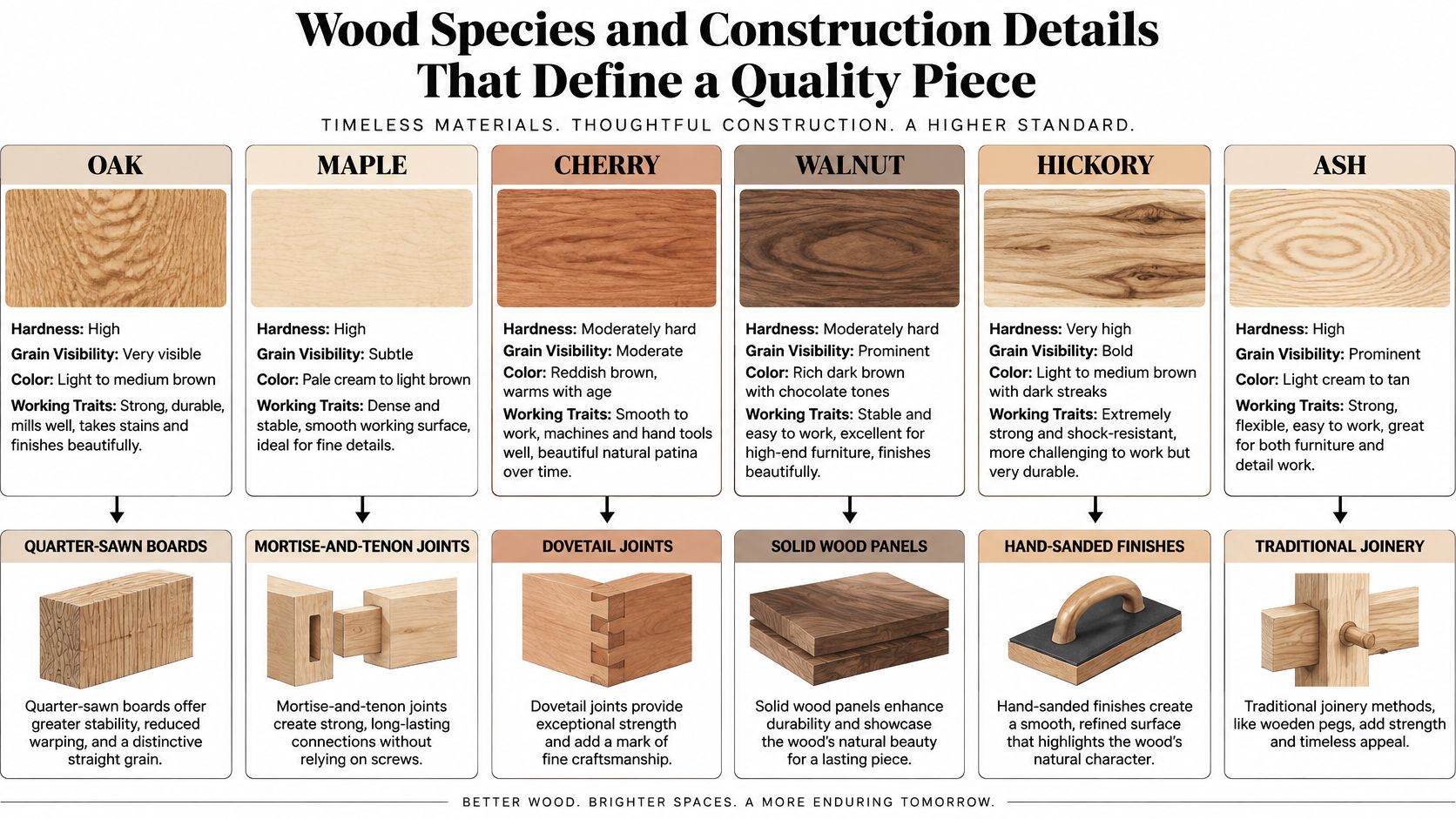
The species list on an American shop quote usually includes oak, maple, cherry, walnut, hickory, and ash. Oak shows pronounced grain and takes hard daily use well. Maple has a cleaner, quieter surface that suits painted or light finishes, while cherry starts warmer and deepens in tone with light exposure. Walnut brings naturally dark color, hickory shows strong contrast between heartwood and sapwood, and ash offers visible grain with a lighter appearance. If you're comparing cabinet applications, Sinclair's guide to wood species for cabinets is a useful place to connect appearance with room conditions.
No species rescues poor drying. The USDA Forest Products Laboratory reports that hardwood lumber used for furniture, cabinetry, and millwork is usually kiln-dried to approximately 6–8% moisture content to keep it close to the equilibrium of conditioned interiors, as explained in USDA guidance on hardwood lumber drying and use. Wood that's too wet will shrink after installation. Wood that's excessively dry can absorb moisture and swell. Because movement is greatest across the grain, the visible results are cupped panels, open joints, split rails, binding doors, and finish defects.
Construction That Works With Movement
Good builders don't try to lock a board completely still. A frame-and-panel door lets the center panel float inside grooves, so seasonal movement doesn't split the panel or force the frame apart. Mortise-and-tenon joinery gives frames mechanical strength, while dovetails interlock drawer corners and resist repeated pulling. Elongated screw holes, figure-eight fasteners, sensible grain orientation, and balanced finishing all serve the same purpose. They acknowledge that wood will move and give it a controlled way to do so.
In a showroom, open the drawers and look at the corners. Check whether doors sit evenly, whether end grain appears where you'd expect a real board edge, and whether the underside is finished and neatly made. Heft matters, but weight alone isn't proof. A thick composite part can feel heavy, while a well designed solid part can feel substantial without being clumsy.
The short demonstration below is worth watching before you inspect a sample door or drawer in person, because small construction details are easier to recognize after you've seen them handled up close.
For humid homes, ask how the shop conditions lumber and verifies it before assembly. A credible answer mentions a calibrated moisture meter and acclimation to the intended indoor environment, not just a species name. That's especially important in Florida, where the target should match the building's expected indoor humidity rather than a number copied from another climate.
Solid Wood Against the Alternatives Buyers Actually Compare
Solid wood isn't the best answer for every component. Plywood can be an excellent cabinet-box material because its cross-laminated layers resist warping and hold fasteners predictably. MDF provides a smooth, uniform surface for painted doors and doesn't telegraph grain through paint. Veneer lets a maker use attractive wood efficiently over a stable core. The problem begins when marketing blurs those materials into one vague promise of wood construction. If you're weighing cabinet boxes specifically, this comparison of solid wood and plywood cabinets helps separate structure from surface.
The emissions discussion also needs precision. EPA TSCA Title VI sets formaldehyde emission limits of 0.05 ppm for hardwood plywood, 0.11 ppm for MDF, 0.13 ppm for thin MDF, and 0.09 ppm for particleboard, none of which apply to solid lumber, under EPA guidance for regulated composite wood products. That doesn't make every engineered panel unsafe. It means regulated panels need compliance documentation, while solid lumber doesn't carry emissions risk from composite-panel binders. Finishes and adhesives still deserve separate questions.
Solid Wood vs Engineered Alternatives
| Material | Dimensional Stability | Repairability | Emissions Risk | Typical Service Life |
|---|---|---|---|---|
| Solid wood | Moves across the grain and needs movement-tolerant joinery | Can often be sanded, repaired, and refinished | No composite-panel binder, finish still matters | Long when dried, built, and maintained well |
| Plywood | Generally stable because layers run in alternating directions | Edges and veneer faces limit deep refinishing | Regulated when it's a covered composite product | Long in protected structural uses |
| MDF | Uniform and smooth, vulnerable to water at exposed edges | Difficult to restore after swelling or major edge damage | Regulated composite panel | Moderate, strongly dependent on moisture exposure |
| Particleboard | Uniform but less resistant to moisture and fastener stress | Limited once corners or screw holds break down | Regulated composite panel | Shorter in demanding or frequently moved pieces |
| Veneered panel | Core dependent, often more stable than a wide solid board | Surface repairs are limited by veneer thickness | Depends on the core and binder system | Varies with core quality and edge protection |
A useful buying rule is to insist on solid lumber where hands, wear, and future refinishing matter most. Door frames, drawer fronts, table edges, chair parts, and other high-contact components benefit from repairability. Large hidden panels and cabinet boxes may perform better in quality plywood. Painted one-piece doors may justify MDF if the maker explains how edges are sealed and provides the required documentation.
Don't ask whether engineered material is present and stop there. Ask where it is, why it was chosen, and what protects it from its known weakness.
That approach keeps you from paying a solid wood price for a mostly composite piece. It also keeps you from rejecting a thoughtful hybrid build that may outperform an all-solid design in a damp or heavily conditioned room.
How to Verify a Made in USA Claim Before You Buy
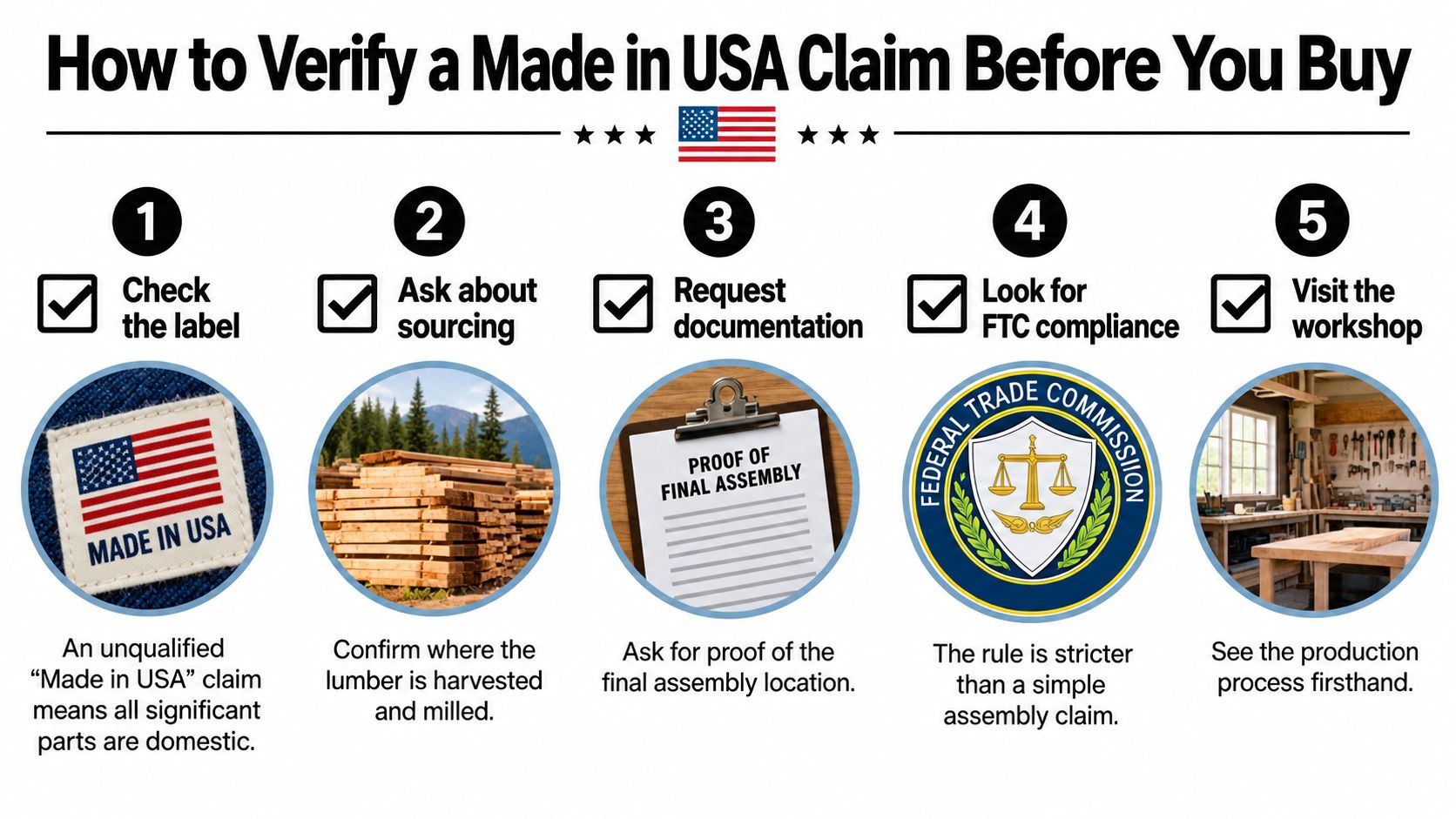
An unqualified claim carries a specific legal meaning. The Federal Trade Commission requires an unqualified Made in USA claim to be supported by evidence that the product is all or virtually all made in the United States, including U.S. final assembly and consideration of significant parts, as set out in FTC guidance on complying with the Made in USA standard. That's stricter than boxing, finishing, or doing minor work domestically. At the same time, most products aren't generally required to disclose a percentage of U.S. content, so a short label can't answer every sourcing question for you.
That's why a qualified claim can be more informative than a sweeping one. Language that identifies U.S. manufacturing with imported hardware, for example, tells you something concrete. Vague phrases such as American crafted, designed in the USA, or built with global materials may be accurate, but they don't carry the same meaning and shouldn't be treated as interchangeable.
A Verification Checklist You Can Send to a Seller
- Request a written material schedule: Ask which components are solid lumber, veneer, plywood, MDF, or particleboard.
- Identify lumber origin: Ask for the species and, where known, where the wood was grown and milled.
- Separate manufacturing from sourcing: Ask whether the claim covers final assembly only, substantial manufacturing, materials, or all three.
- Name the imported parts: Ask about hinges, drawer slides, fasteners, adhesives, finishes, and packaging where origin matters to you.
- Ask for panel documentation: Request TSCA Title VI compliance information for regulated composite components.
- Confirm where key work happens: Ask where milling, joinery, finishing, and final assembly take place, not only where the company is headquartered.
Listen for answers you could put on an invoice. A transparent maker may say the door frames are solid maple, the center panels are a specified engineered material, the cabinet boxes are plywood with documented compliance, and the slides are imported. A vague answer repeats craftsmanship and American quality without identifying a single component.
You don't need to interrogate a small shop like a customs officer. You do need enough specificity to compare two quotes fairly. If domestic sourcing is a core value, put your requirements in writing before deposits and production begin. If U.S. labor matters more than the origin of every screw, say that too. Clear priorities let the maker give you a claim that's both accurate and useful.
Sustainability Beyond the Renewable Label
Wood is renewable, but that fact alone doesn't settle the environmental question. A short-lived solid wood piece that wastes lumber, travels through a long supply chain, and can't be repaired may create more total impact than a longer lasting alternative. Domestic production can shorten some transport legs, yet it doesn't erase the effects of harvesting, milling, kiln drying, finishing, hardware production, or disposal.
A life-cycle assessment review found that sustainability priorities should extend beyond renewability and recyclability to include product life extension, material reduction, and energy reduction, and it identified sawmill and raw-material acquisition as a major source of adverse environmental impact, according to life-cycle research on furniture product eco-design. That finding changes the shopping question. Instead of asking only whether a piece is natural, ask what evidence shows it will stay useful and create less impact over its full life.
Evidence Worth More Than a Green Label
- Expected service life: Is the design sturdy enough for the intended use, and can worn parts be replaced?
- Repair path: Can a local shop refinish the surface, remake a drawer, or replace a hinge without discarding the whole piece?
- Material yield: Does the maker choose board widths and layouts that reduce waste rather than forcing every design from oversized stock?
- Verified sourcing: Can the seller identify species, origin, and any relevant forestry or emissions documentation?
- Finish durability: Will the coating protect the wood long enough to delay refinishing and replacement?
Solid wood can make a strong case. A repairable table or cabinet door gives you options after scratches, water marks, or a change in taste. You can refinish rather than landfill, replace one damaged component rather than the entire run, and adapt hardware without rebuilding the case. Those advantages only count if the original construction supports them. For kitchen projects, Sinclair's guide to eco-friendly kitchen cabinets offers another way to frame material and longevity choices.
Be careful with claims that treat American made, real wood, and sustainable as synonyms. They can overlap, but each needs its own evidence. The most credible sustainability story sounds a little less glamorous. It talks about durable joinery, available replacement parts, efficient lumber use, appropriate finishes, and a design you won't want to replace when trends shift.
Realistic Cost Ranges and Lead Times for American-Made Pieces
Responsible makers hesitate to quote a universal price because specification drives cost more than the flag on the label. Species, board thickness, door complexity, drawer count, interior accessories, finish steps, site conditions, and installation can move two similar looking kitchens far apart. I can't give you a credible dollar range without those details, and you should be cautious when a seller does. A directional price is useful only when it names the materials and scope behind it.
You'll generally meet three levels of production. Ready-to-ship domestic furniture limits choices so the shop can build efficiently and deliver sooner. Semi-custom lines start with standard sizes and construction, then allow selected changes to species, finish, layout, or hardware. Fully custom work begins with the room and the user's needs, so design, engineering, material selection, and fitting take longer. Each model can be legitimate. Problems arise when a buyer expects bespoke flexibility at stock production speed.
Why Lead Time Is Part of the Build
Custom lead times commonly run in weeks rather than days because work must happen in sequence. The shop measures, designs, orders or selects lumber, conditions and machines parts, assembles, sands, finishes, cures, inspects, and schedules installation. Rushing the wrong step creates the failures buyers later blame on the material. Wet lumber, hurried finishing, or skipped acclimation can follow a piece for years.
A longer schedule isn't automatically a sign of quality, though. Ask what the time includes and where your project sits in the queue. A clear maker distinguishes design approval, production, finishing, delivery, and installation rather than giving one soft date.
Before signing, compare quotes with the same questions.
- Pricing structure: Is the quote fixed for the stated scope, or does it depend on time and materials?
- Deposit and milestones: What payment triggers material ordering, production, delivery, and final completion?
- Change orders: How are species, layout, or hardware changes priced and approved after production begins?
- Warranty scope: Does coverage include joinery, finish, hardware, installation, and adjustments, and who performs the service?
- Exclusions: Are demolition, plumbing, electrical work, permits, countertops, and appliance fitting included or separate?
Put allowances in plain language. If one quote assumes solid doors and another substitutes an engineered center panel, the prices aren't comparable yet. The cheapest clear quote may cost more than the cheapest vague one, but it's the only one showing you what you're buying.
Maintenance That Actually Extends the Life of Solid Wood
Most solid wood maintenance is really moisture management. Your furniture was built to settle near the moisture level of a conditioned interior, so repeated swings between damp and very dry air make boards expand and contract. Doors may bind in humid weather, then reveal small gaps when heating dries the house. Keep indoor conditions as steady as your home reasonably allows, and address chronically damp or overheated rooms rather than repeatedly forcing a door or drawer.
Placement matters next. Keep pieces out of prolonged direct sun where possible, because light changes color unevenly and heat stresses finishes. Don't park a cabinet or table tight against a heating vent or a cold exterior wall where condensation can form. Use coasters, pads, and trivets for water and heat, and wipe spills promptly instead of letting liquid search for a seam or end grain.
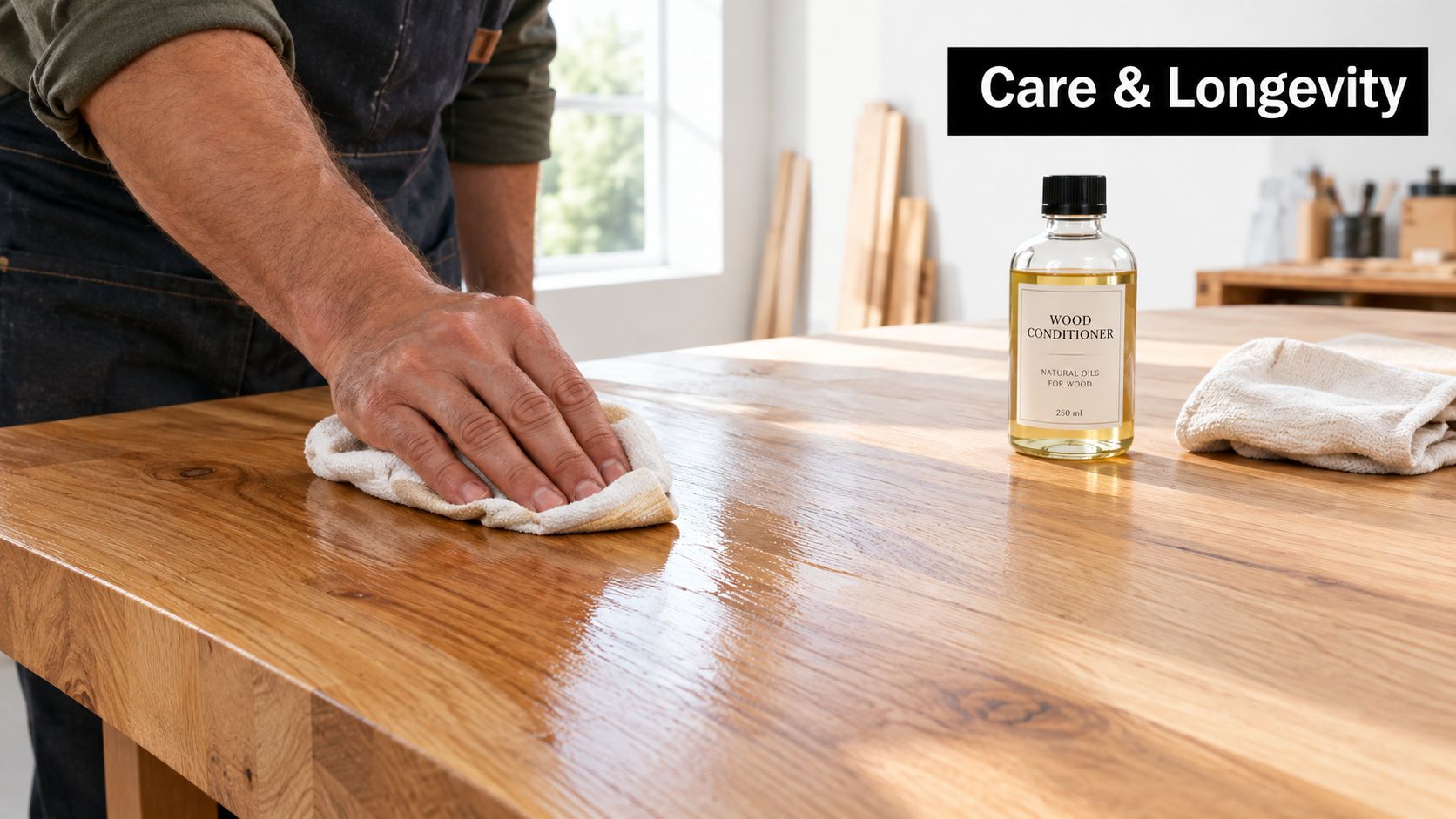
Care That Matches the Finish
Dust with a soft, slightly damp cloth and dry the surface afterward. Avoid harsh cleaners and silicone-heavy sprays unless the maker recommends them, since residue can complicate later repairs. Oil and wax finishes usually need periodic renewal but allow localized touch-ups. Film finishes need less routine feeding and more protection from abrasion, standing water, and solvents. If you don't know which finish you own, ask before applying a product that promises to restore everything.
Small changes deserve early attention. Tighten loose hardware without overtightening into the wood. Watch for a finish that's turning white at a sink edge, a drawer that begins to rub, or a fine seasonal crack that doesn't close when conditions normalize. A maker can often adjust, touch up, or stabilize those issues before moisture reaches bare wood.
Treat maintenance as stewardship rather than polishing. Stable air, quick spill cleanup, and early adjustments do more for longevity than a shelf of specialty products.
Questions to Ask Any Custom Cabinet Maker Including Sinclair Cabinets
Bring the same questions to every consultation, and write down the answers in the same order. Ask which parts are solid, which are engineered, where the lumber and hardware come from, how moisture is checked, and how doors and drawers are joined. Then move to finish type, repairability, lead time, installation responsibility, warranty coverage, and service after the job. If you're comparing local shops, this overview of cabinet makers near you can help you organize the conversation.
A transparent answer names materials, locations, and limits. It might identify a plywood box, explain why it was selected, and provide compliance paperwork. A vague answer leans on words like premium and custom while avoiding the material schedule. Price matters, but it should come after you've established that both makers are quoting the same construction.
As one example to evaluate against this standard, Sinclair Cabinetry inc builds custom real-wood cabinetry in Cape Coral for kitchens, bathrooms, and closets, and offers design visualization and professional installation. Apply the same checklist to that conversation as you would anywhere else. Ask what is solid, what is not, how the work is finished, and what happens if a door needs service later. A good maker should welcome those questions because clear expectations protect both sides.
Bring your material schedule, room measurements, and hardest sourcing questions to Sinclair Cabinetry inc, where you can discuss custom real-wood cabinetry for kitchens, bathrooms, and closets with design and installation support. Ask exactly what's solid, how it's built for Florida interiors, and how the finished work will be serviced, then compare the answers before you commit.