
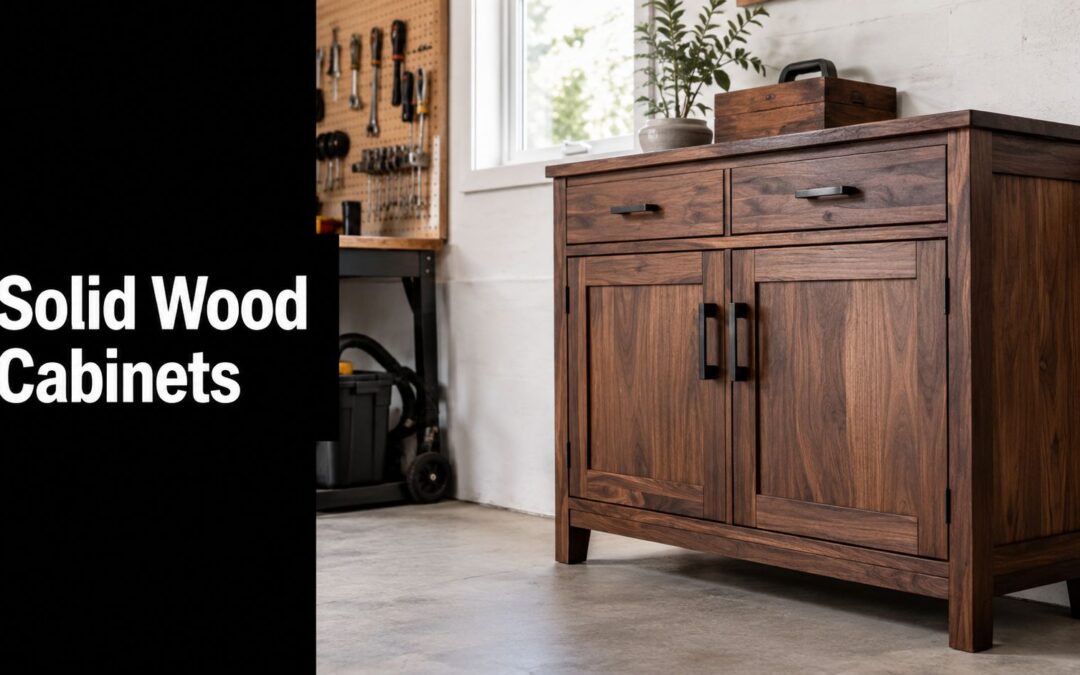
On a damp July morning, the garage tells the truth about your storage plan. You're looking for a drill behind paint cans, garden hoses, and sports gear, while moisture tracked in from the driveway sits on the concrete. The shelves are full, but nothing is protected, accessible, or arranged around the work you do.
That's when homeowners often start searching for solid wood garage cabinets. The right answer isn't a particular species or a handsome finish alone. It's a cabinet system engineered for the garage's humidity, temperature changes, loads, and daily abuse. A custom cabinetmaker should assess those conditions before recommending maple, oak, plywood, or metal.
Why Your Garage Deserves Better Storage
A garage carries more punishment than most rooms in the house. Tools get dropped, fertilizer leaks, wet tires bring in water, and doors open and close through changing weather. Yet many garages still rely on open shelves that leave drills, fasteners, extension cords, and chemicals exposed to dust and moisture.
That clutter affects more than appearance. A blocked floor limits car maintenance, woodworking, cycling, and basic household repairs. You waste time moving boxes to reach a ladder, and small items disappear behind larger ones. Open storage also leaves valuable tools vulnerable to rust, pests, accidental impact, and damp air.

Storage starts with the work
Before choosing a cabinet material, list what the garage must support:
- Daily tools: Hand tools, cordless drills, chargers, and small parts need shallow drawers or organized inserts.
- Bulky equipment: Shop vacuums, compressors, coolers, and seasonal gear need clear vertical storage.
- Hazardous supplies: Paint, solvents, automotive fluids, and pesticides belong in closed, preferably lockable compartments.
- Work surfaces: A proper bench can turn a storage wall into a useful repair station.
A cabinet plan should protect the workflow as much as it stores objects. Put frequently used tools between waist and shoulder height, reserve lower cabinets for heavy items, and keep rarely used bins higher or farther from the main work area. Raise the cabinet base above likely floor moisture and anchor the installation to studs or suitable masonry.
Practical rule: If you can't describe where each major tool will live, you aren't ready to choose the cabinet material.
Solid wood can make a garage feel connected to the rest of the home, especially in a finished garage or a high-end remodel. But the material only earns its place when the maker accounts for the climate. A beautiful cabinet that swells, binds, or cracks is still a poor storage solution.
What Solid Wood Garage Cabinets Actually Are
In cabinetmaking, solid wood means the visible structural parts are milled from natural lumber rather than formed from wood fibers or printed surfacing. A serious build may use hardwood for the face frames, doors, drawer fronts, and selected case components, with joinery such as mortise-and-tenon joints, dovetails, or carefully executed pocket-hole assemblies.
That definition doesn't mean every part must be a single plank. Quality work can include plywood backs, engineered drawer bottoms, and stable cores inside broad panels. Those choices often improve performance. A wide solid-wood panel can move across its grain, while a properly specified plywood panel stays more predictable.
Know what you're comparing
MDF and particleboard provide smooth, uniform surfaces, but exposed edges and moisture remain concerns in a working garage. Thermofoil and melamine are surface systems, not automatically structural materials. Plywood offers layered strength and reliable screw holding, while powder-coated steel handles moisture and heavy abuse without the dimensional movement of wood.
The case construction matters as much as the label. Garage cabinets generally need thicker shelves, reinforced bottoms, full backs, strong mounting rails, and bases that won't absorb water from the slab. A thin residential cabinet box may look similar to a garage cabinet but behave very differently under tool loads.
For a closer explanation of construction differences, review this guide to solid wood versus plywood cabinets.
| Material | Core Structure | Moisture Response | Typical Load per Shelf | Service Life |
|---|---|---|---|---|
| Solid wood | Hardwood lumber, reinforced casework | Moves with humidity and needs a sound finish | Must be engineered for span and supports | Long service life with proper care |
| Plywood | Cross-laminated wood veneers | More dimensionally stable than broad solid panels, but edges need protection | Strong when thickness and supports match the load | Long service life when sealed and maintained |
| MDF or particleboard | Compressed wood fibers or particles | Vulnerable when water reaches edges or damaged surfaces | Better for lighter-duty storage | Shorter in damp, heavily abused settings |
| Powder-coated steel | Formed steel with protective coating | Doesn't swell with humidity, though coating damage can expose metal | Suitable for heavy-duty systems when properly built | Long service life with surface maintenance |
| Melamine or thermofoil | Engineered core with manufactured surface | Surface can resist routine dirt, while core remains vulnerable at seams and edges | Depends on the core and support design | Varies widely by construction and climate |
The phrase solid wood garage cabinets should describe a complete construction approach, not just a door sample. Ask what the cabinet boxes, shelves, backs, drawer parts, mounting rails, and bases are made from.
How Solid Wood Performs Over Time
Solid wood has a strong durability case when the design matches the use. Independent durability references place typical solid-wood cabinet lifespans at 30 to 50 years, with some hardwood cabinets lasting 50 years or more with proper care, as summarized in this cabinet market reference. That's a meaningful service horizon for a built-in garage system, but it isn't a promise that every wood cabinet will reach it.
The garage changes the calculation. Toolboxes, paint cans, machinery, and storage bins create repeated loading cycles, while doors and drawers face frequent opening, slamming, and contamination from dust or grease. The wood may remain sound while shelves sag, hinges loosen, fasteners pull out, or finishes wear through.
Load capacity is an engineering question
A shelf's capacity depends on its span, thickness, depth, support spacing, and service class. The Architectural Woodwork Standards list static load capacities of 50 pounds for residential or light commercial use, 75 pounds for commercial use, and 100 pounds for heavy-duty use in the cited standard (Architectural Woodwork Standards PDF). Other shelving guidance cited in the same verified material gives 40 pounds per square foot for general shelving, while manufacturer guidance references shelves meeting KCMA standards of 15 pounds per square foot.
Those figures aren't interchangeable promises. They show why a cabinetmaker should ask what you're storing and how far each shelf spans. A shelf intended for paint cans shouldn't be designed like one intended for a rolling tool chest.
| Material | Expected Service Life | Max Load per Shelf (lbs) | Failure Mode Over Time |
|---|---|---|---|
| Solid wood | 30 to 50 years, sometimes 50+ with proper care | 50 to 100 when engineered for the service class | Sagging, joint stress, finish failure, or movement |
| Plywood | Long service life when sealed and properly supported | Depends on thickness, span, and supports | Edge damage, delamination, sag, or fastener failure |
| MDF or particleboard | Qualitatively shorter in damp, abusive garages | Best suited to lighter loads | Swelling, crumbling edges, sagging, and weak fastener hold |
| Metal | Long service life with maintained protective coating | Suitable for heavy loads when specified correctly | Dents, coating damage, corrosion at exposed areas, or hardware failure |
| Modular systems | Varies by product and environment | Must follow the manufacturer's rating | Replacement of damaged parts, sagging, or failed hardware |
Full back panels add rigidity and help keep a case square. Shorter shelf spans, thicker stock, and closely spaced supports reduce deflection. I'd rather build a stable plywood carcass with a solid-wood face than use oversized solid panels in the wrong climate.
Matching Wood Species to Garage Conditions
Species selection matters, but it's not the first decision. Hardness affects dents and wear, while dimensional stability, panel width, grain direction, and finish quality determine whether doors and drawers continue to work through seasonal changes.
A common species comparison becomes misleading when it presents exact hardness or cost figures without a verified source. Those numbers vary by grade, supplier, region, and moisture condition. For a garage project, the practical ranking is simpler: choose a species for the environment and use, then design the parts to control movement.
The useful distinctions
Red oak is a practical choice for a tool-heavy garage with relatively stable temperatures. Its pronounced grain hides ordinary wear and gives a workmanlike appearance. Use narrower door components and well-designed frames rather than wide, unsupported solid panels.
Hard maple suits a dry, climate-controlled garage where a clean, light appearance matters. It's hard and attractive, but hardness doesn't stop movement. A maple door can still bind if the maker ignores seasonal expansion.
Birch offers a restrained grain and works well in a controlled garage, particularly when paired with a stable panel construction. It's often more sensible for cabinet interiors and cases than for broad, exposed solid slabs.
Cherry belongs in a conditioned garage where its changing color is part of the design. It can provide a furniture-like appearance, but I wouldn't specify it for an unconditioned utility garage because the sample looks elegant.
Poplar can be useful for painted face frames and secondary parts. It isn't my first choice for exposed, impact-prone surfaces where dents and grime will be obvious.
For more detail on door material selection, see this guide to the best wood choices for cabinet doors.
| Species | Janka Hardness | Stability Rating | Cost per bd ft | Best Garage Setting |
|---|---|---|---|---|
| Red oak | Verify with the supplier for the selected grade | Good when properly designed | Obtain a local quote | Stable, tool-heavy workspace |
| Hard maple | Verify with the supplier for the selected grade | Good, but broad panels still move | Obtain a local quote | Dry, climate-controlled garage |
| Birch | Verify with the supplier for the selected grade | Good in engineered cabinet construction | Obtain a local quote | Controlled garage with clean modern finish |
| Cherry | Verify with the supplier for the selected grade | Good with careful panel design | Obtain a local quote | Conditioned garage where appearance leads |
| Poplar | Verify with the supplier for the selected grade | Suitable for painted secondary parts | Obtain a local quote | Protected, painted applications |
| Plywood with solid-wood faces | Not applicable as a single species rating | Often more predictable for large cases | Obtain a local quote | Garages with variable conditions |
The strongest garage specification is often hybrid. Use solid wood where touch, appearance, and repairability matter, then use stable engineered panels for large boxes, backs, and wide shelves.
The Humidity Question Most Buyers Skip
A garage can ruin solid wood without a single dramatic leak. Concrete releases moisture, wet vehicles add vapor, and an open garage door lets outdoor air exchange with the room. Seasonal cycling matters because wood responds to changing humidity, not just to visible water.
Technical wood-science guidance reports that movement is minimal along the grain, roughly 0.1% to 0.2%, but much larger across the grain, roughly 7% to 9% between oven-dry and fiber-saturation conditions (wood movement technical brief). Those are material movement ranges under defined conditions, not a prediction that your cabinet door will expand by that amount in service. They explain why a broad solid panel can stress a joint, bind against a frame, or crack a finish when moisture conditions change.

Use climate stability as the decision rule
Indoor cabinet guidance commonly frames relative humidity around 30% to 50%, or around 30% to 45%, as noted in this discussion of garage cabinet climate effects. A garage may not stay in that range, particularly if it lacks air conditioning, insulation, or dehumidification.
If you can't keep the garage reasonably stable year-round, don't specify a large amount of exposed solid wood for the cabinet carcasses. Choose plywood boxes with solid-wood faces, seal all edges, improve ventilation or dehumidification, or move to powder-coated metal when moisture is persistent and heavy use is expected.
My decision rule: Species is secondary. A stable garage with careful construction can support solid wood. An unstable garage needs a more forgiving cabinet system.
A responsible custom maker should inspect the slab, look for water intrusion and condensation, ask how often the garage door stays open, review seasonal exposure, and measure the intended cabinet wall. A humidity logger can reveal conditions that a quick visit misses. That assessment should happen before the quote, not after doors begin sticking.
The finish slows moisture exchange, but it doesn't make wood inert. Good design uses narrower staves, floating panels, stable cores for broad flats, and clear allowances at doors and drawers. Read more about cabinet humidity control before committing to an all-solid-wood specification.
Watch the movement principle in action through this cabinetmaking reference:
Customization Options That Change Daily Use
Custom work earns its price when it solves the awkward parts of your garage. Start with interior depth. A cabinet sized for paint cans won't comfortably hold a deep tool case, and an unnecessarily deep cabinet turns small hardware into a dark pile at the back.
Drawers and doors serve different jobs. Drawer banks keep sockets, bits, and measuring tools visible from above. Full-height doors hide tall equipment and create a calmer wall. Split doors can make wide openings easier to use, while lift-up overhead doors keep open panels from blocking a narrow aisle.

Specify the parts you'll touch every day
- Drawer slides: Match the slide rating to the loaded drawer, not the empty box. Heavy tools need substantial full-extension hardware.
- Hinges: Use hinges intended for the door size and expected use. A residential hinge can become the weak point on a tall, frequently opened garage door.
- Locks: Put locks on cabinets containing chemicals, sharp tools, or items that need restricted access.
- Charging drawers: Add ventilation and cord access so chargers stay contained without creating a tangle on the workbench.
- Peg inserts and slatwall backs: Keep frequently used tools visible while closed cabinets handle bulk storage.
- Roll-out trays: Use them for heavy items that would otherwise disappear beneath a fixed shelf.
Finish for abuse, not just appearance
Conversion varnish and catalyzed lacquer can provide a tougher film finish than a basic interior coating, while penetrating oil gives a repairable, tactile surface but may demand more upkeep. The right choice depends on chemical exposure, cleaning habits, sheen, and whether you want scratches repaired locally or hidden under a harder film.
Don't choose an exotic species for an unconditioned garage and assume the finish will solve the climate problem. Finish selection protects the surface. Construction controls movement, and the garage environment determines how hard both must work.
The most expensive mistakes are usually invisible at the showroom. Under-rated slides, weak hinges, shallow drawers, inaccessible outlets, and a workbench at the wrong height will frustrate you every day. Spend first on layout, support, and hardware, then refine the decorative details.
Cost, Value, and the Long-Term Return
A custom garage cabinet quote usually reflects five things: lumber or sheet goods, joinery, finish labor, hardware, and installation. Each line item buys a different kind of performance. A stable box protects function, a durable finish protects appearance, properly rated hardware protects daily use, and professional installation keeps the system anchored and aligned.
The verified material doesn't provide reliable project prices or lifespan figures for every competing system, so a precise cost-per-year comparison would be misleading. Get written quotes instead, and ask each supplier to identify the construction, finish, hardware ratings, installation method, and climate assumptions behind the number.
Compare value by use
A hobbyist storing hand tools, garden supplies, and seasonal bins may not need the same reinforcement as a contractor storing heavy cases, machinery, and chemicals. A metal system can be the rational choice when moisture and impact dominate. A modular system can make sense when you need quick, flexible storage and accept less architectural integration.
Solid wood becomes easier to justify when the garage functions as a workshop, connects visually to the home, or needs a built-in workbench and carefully fitted storage. The value comes from usable layout, repairable materials, durable joinery, and a finish selected for the environment. A premium species in a damp garage adds appearance without fixing the underlying risk.
Cabinetry has also become a major specialized part of residential and commercial interiors. Historical industry data cited by this cabinet market overview shows that U.S. wood cabinet shipments moved from trailing wood household furniture shipments by 170% in 1977 to exceeding them by 78% in 2006. That shift reflects the broader importance of built-in storage, but it doesn't mean every built-in garage deserves the same material specification.
| System Type | Upfront Cost | Expected Lifespan | Maintenance Over 20 Years | Annualized Cost |
|---|---|---|---|---|
| Solid wood | Obtain a project-specific quote | Long service life with climate control and care | Finish care, hardware adjustment, possible refinishing | Calculate from the written quote and maintenance plan |
| Metal | Obtain a project-specific quote | Long service life when coating is maintained | Cleaning, hardware service, coating repairs if damaged | Calculate from the written quote and maintenance plan |
| Modular | Obtain a product-specific quote | Varies by construction and environment | Replacement parts, adjustment, and possible system replacement | Calculate from the written quote and maintenance plan |
The best return is a cabinet system you'll use consistently. Don't pay for visual luxury where climate, access, and load support remain unresolved.
Planning Your Garage Cabinet Project with a Custom Maker
A well-run project begins on site, not in a showroom. The maker should measure walls, ceiling height, door swings, outlets, vehicles, floor conditions, and structural attachment points. They should also ask how the garage behaves through wet and dry seasons, whether it's conditioned, and what happens when the garage door stays open.
Prepare a realistic inventory before the consultation. Group objects by use and size, identify hazardous supplies, note the largest tool cases, and decide whether the workbench needs to support assembly, charging, repairs, or simple household tasks. Clear loose items from the walls and floor so measurements reflect the space you'll build.

The five decisions that shape the quote
- Material plan: Decide where solid wood belongs and where plywood, engineered panels, or metal offer better stability.
- Door and drawer layout: Choose access based on tool frequency, reach, visibility, and available aisle space.
- Finish and sheen: Select a coating that matches chemical exposure, cleaning needs, and the desired appearance.
- Hardware grade: Specify slides, hinges, latches, and locks for the actual loads and opening cycles.
- Accessories: Price roll-outs, charging drawers, pegboard backs, slatwall, lighting provisions, and mobility options separately.
The design proposal should make those choices visible through drawings, renderings, and material samples. Ask where seams will land, how wide solid panels will be, how the cabinet base avoids floor moisture, and how shelves are supported. If the maker can't explain those details clearly, the quote is incomplete.
Custom cabinet companies vary widely in how they measure, design, fabricate, and install. Use this guide to evaluate custom cabinet companies near you and ask for a written scope that identifies materials rather than relying on the phrase “solid wood.”
Fabrication follows approval of the design and finish. Installation should include secure anchoring, level and plumb cabinets, adjusted doors and drawers, tested locks, and confirmation that work surfaces and accessories function as intended. A final walkthrough should cover cleaning instructions, finish care, hardware adjustments, warranty terms, and what to do if seasonal movement changes a door gap.
If you want a custom garage system built around climate assessment, real-wood construction, customized storage, and professional installation, contact Sinclair Cabinetry inc. Share your garage measurements, storage inventory, and humidity concerns so the team can recommend a solid-wood or hybrid construction that fits the space instead of forcing the space to fit the material.