
Real wood is a viable premium choice for bathrooms when you specify a moisture-resistant species such as teak or white oak, use a sealed core, and keep the wood at the 6% to 8% moisture-content target recommended for furniture and cabinet lumber. The material itself isn't the main risk. Unsealed edges, poor substrate selection, trapped humidity, and careless installation cause most avoidable failures.
The popular advice is to avoid real wood entirely and choose MDF or laminate instead. That advice is too blunt to be useful. A bathroom vanity doesn't fail just because it contains wood. It fails when water reaches an exposed cut edge, when a cabinet box moves against a rigid countertop, or when the finish protects the visible face but leaves the underside and joints vulnerable.
The right question isn't “Is wood waterproof?” No wood is. The better question is whether the cabinet has been designed to manage moisture from manufacturing through installation and maintenance. That means checking the species, core, joinery, moisture content, finish, ventilation, and sealing schedule before you approve a design.
Do Real Wood Cabinets Belong in the Bathroom
Real wood belongs in a bathroom when the cabinetmaker treats it as a material that moves, absorbs moisture, and needs protection. Homeowners often assume a painted MDF box is automatically safer than a solid wood vanity, but standard MDF and particleboard can absorb water quickly at damaged or unfinished edges. Once those edges swell, the damage is often difficult to reverse.
Wood has served bathroom storage needs for centuries. Wooden bathroom cabinets appeared in China during the Ming Dynasty as bathing racks, while European households in the 16th and 17th centuries combined washbasins, mirrors, and storage furniture into early cabinet forms, as described in this history of bathroom cabinets. That history doesn't prove that every wood cabinet will survive a wet room, but it does show that wood has long been used where craftsmanship, storage, and refined interiors overlap.
Modern demand points in the same direction. Wood held 51.3% of the bathroom cabinets material share in 2024, while the broader market was valued at USD 65.2 billion that year and is projected to reach USD 120.1 billion by 2034, at a 6.3% CAGR, according to bathroom cabinets market data. Wood isn't a fringe finish chosen only for appearance. It's the leading material category in a substantial residential renovation market.
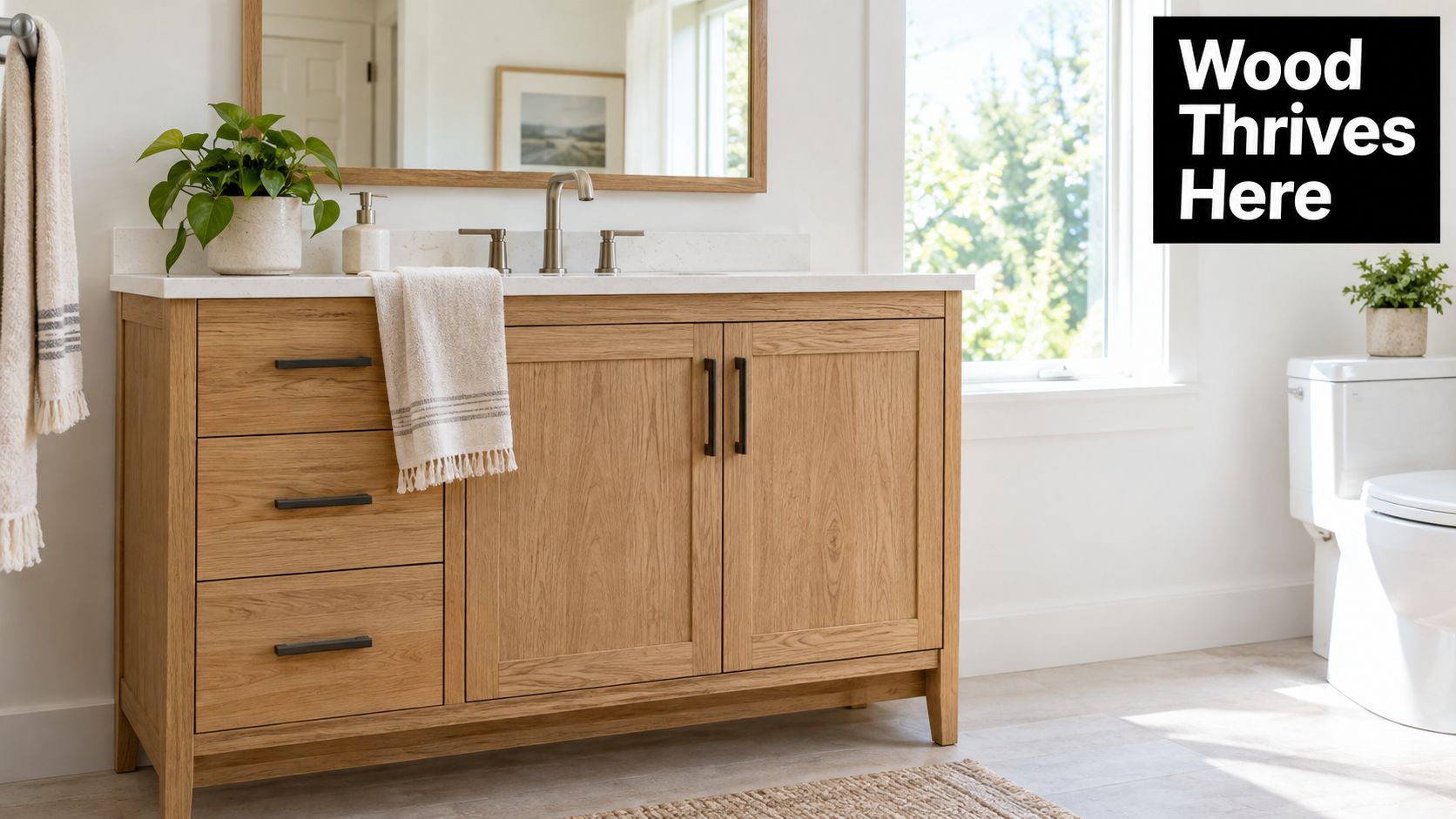
Construction matters more than the label
A solid hardwood front can look excellent while the cabinet behind it remains vulnerable. I pay close attention to the box material, exposed edges, sink cutout, toe-kick, drawer bottoms, and the underside of the countertop. These areas encounter splashes and condensation but receive far less attention than the door finish.
Practical rule: Don't approve a bathroom cabinet based on the species name alone. Ask how every face, seam, and cut edge will be sealed.
A well-built vanity can combine a hardwood exterior with a stable plywood core, sealed on all accessible surfaces. That arrangement often manages movement and moisture more reliably than a cheaper cabinet made from standard panels with an attractive wood-look finish. Real wood isn't automatically the risky option. Unprotected construction is.
Choosing the Right Wood Species and Core Materials
Start with the environment rather than the stain color. A frequently used guest bathroom with good ventilation places different demands on cabinetry than a small bathroom where hot showers leave moisture hanging in the air. The species still matters, but the core and finish determine whether water can reach a vulnerable edge.
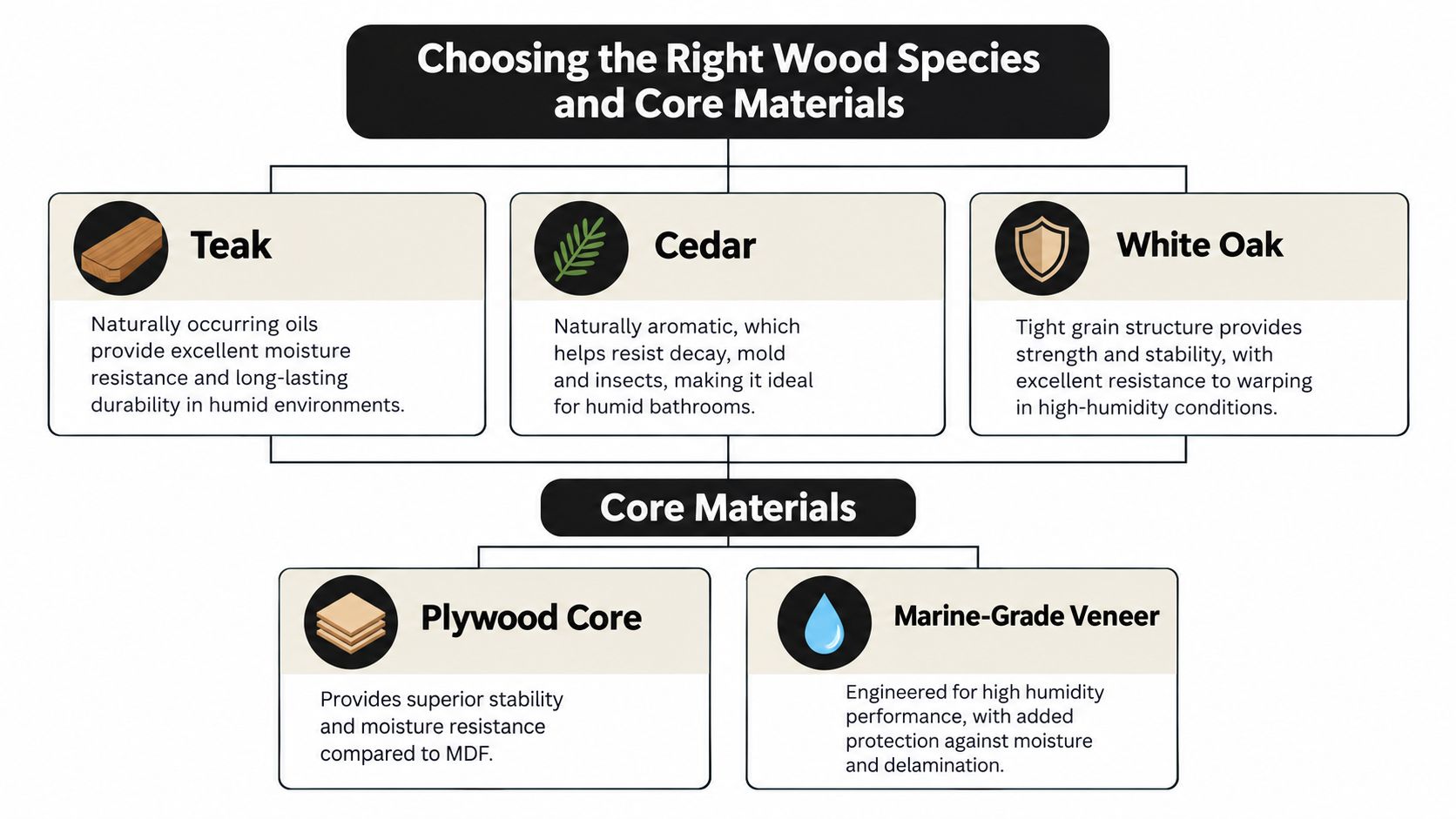
Teak is a strong candidate because its natural oils help it resist moisture and decay. It also gives a vanity a warm, dense appearance, although its availability and cost can make it less practical for every project. Cedar offers natural decay resistance and an aromatic character, but its softer surface may not suit every high-use vanity or hardware detail.
White oak is another dependable choice. Its tight grain and stable feel suit contemporary and traditional cabinetry, and it takes clear and tinted finishes well. Maple, cherry, walnut, birch, and fir can also work in the right build, but they shouldn't be selected solely because the sample looks attractive. The cabinetmaker must still account for movement, finish coverage, and the room's moisture exposure.
Ask what sits behind the finished surface
The cabinet box often matters more than the door. Plywood and other moisture-resistant cores generally provide a stronger foundation than standard MDF or particleboard, particularly when the manufacturer seals all faces and edges. Standard MDF can perform acceptably in controlled conditions, especially when properly treated and kept away from standing water, but a damaged cut edge remains a weak point.
Use this guide to choosing wood for bathroom cabinets as a starting point for comparing species and construction options, then ask the fabricator for the exact panel specification. “Water-resistant” isn't enough. You want to know whether the core is plywood, a moisture-resistant engineered panel, or standard MDF, and whether the finish reaches the hidden surfaces.
Control moisture before the cabinet reaches the site
Wood moisture content at manufacture is one of the most important technical controls. USDA Forest Products Laboratory guidance states that hardwood lumber used for furniture, cabinets, and millwork is usually dried to 6% to 8% moisture content, helping reduce shrinkage, swelling, and joint failure.
Ask whether the lumber was measured before fabrication and whether the shop allows the material to adjust to interior conditions. A cabinetmaker generally wants the wood close to the driest likely indoor condition, so normal bathroom humidity causes modest swelling rather than later shrinkage that opens joints.
Specify these details in writing:
- Species: Choose teak, cedar, white oak, or another species selected for the room's conditions.
- Core: Prefer a stable plywood or moisture-resistant core where appropriate.
- Sealing: Require coverage on faces, backs, undersides, sink openings, and exposed edges.
- Joinery: Ask how rails, stiles, panels, and boxes accommodate seasonal movement.
- Finish: Confirm the product, sheen, repair process, and maintenance requirements.
Stock Versus Custom Bathroom Cabinetry
Stock cabinetry wins on speed and initial simplicity. You select a standard width, door style, finish, and hardware package, then adapt the bathroom around those fixed dimensions. That can work well when the room is straightforward and the vanity fits without fillers, awkward gaps, or interference with plumbing.
Custom cabinetry earns its price through control. The cabinetmaker can work around an off-center drain, a shallow wall, a sloped floor, a radiator, or a countertop that needs an exact overhang. Custom drawers can also be sized around the actual plumbing rather than losing storage to a large standard cutout.
| Feature | Stock Cabinets | Custom Cabinetry |
|---|---|---|
| Dimensions | Standard widths and depths | Built to the room and plumbing |
| Layout | Limited internal configurations | Drawer, shelf, and door placement chosen for use |
| Materials | Manufacturer-defined panels and finishes | Species, core, edge treatment, and finish specified |
| Joinery | Repeated production construction | Joinery selected for the design and material |
| Lead time | Often available quickly | Requires design, approval, fabrication, and finishing |
| Repairability | Replacement parts may be limited | Components can be documented and reproduced |
| Best fit | Simple rooms with flexible dimensions | Tight spaces, unusual layouts, and high-use bathrooms |
A stock cabinet isn't automatically poor quality, and custom doesn't automatically mean durable. I've seen expensive vanities fail because the installer left a raw sink cutout exposed, while a modest factory cabinet performed well because it stayed dry and was installed correctly.
Read this comparison of custom and stock cabinets before you compare quotes. Look beyond the door style and ask whether the proposal identifies the box material, finish system, edge sealing, hardware, adjustment access, and installation responsibility.
Where the extra money pays off
Custom work makes the most sense when wasted space would be expensive, the bathroom has difficult geometry, or you want a particular combination of solid wood fronts and engineered interior components. It also lets you avoid the false economy of buying a standard cabinet, adding fillers, modifying drawers, and then paying for site alterations.
Stock is reasonable when the layout is uncomplicated and the selected cabinet provides sealed edges, suitable hardware, and an appropriate core. The practical decision isn't “cheap versus luxurious.” It's whether the fixed cabinet can meet the room's functional and moisture-management requirements without forced compromises.
Understanding Costs and Production Timelines
Custom cabinet pricing doesn't come from the wood species alone. The final figure reflects design time, site measuring, material preparation, box construction, door and drawer fabrication, finishing, hardware, delivery, and installation. A simple vanity with clean slab doors has a different labor profile from a wall-to-wall unit with integrated lighting, specialty storage, inset doors, and a complex finish.
Premium species can raise material cost, but finish work often creates the larger difference between a quick quote and a refined result. Hand-applied stains, color matching, clear coats, painted interiors, soft-close hardware, custom drawer organization, and careful edge treatment all add operations. If the quote lists only “wood vanity” without identifying these details, you aren't comparing equivalent products.
Build a quote that can be checked
Ask the cabinetmaker to separate the proposal into understandable components:
- Design and field measurement: Confirm whether drawings, revisions, and site verification are included.
- Materials: Identify the face species, box core, veneer, plywood grade, and drawer construction.
- Finish: Specify stain or paint, clear coat, sheen, inside finish, and sealing of hidden edges.
- Hardware: List hinges, slides, pulls, organizers, waste containers, and specialty fittings.
- Installation: Clarify delivery, scribing, leveling, countertop coordination, plumbing access, and cleanup.
- Changes: Establish how approved revisions, site conditions, and replacement parts are handled.
This custom cabinet cost guide can help you frame the questions, but don't rely on a generic estimate to predict your project. A cabinetmaker needs the room dimensions, design, material choices, finish, and hardware schedule before a quote becomes meaningful.
Why bespoke work takes longer
Stock cabinets move through a repeatable production path. Custom work usually involves a design approval, a material order, shop drawings, fabrication, sanding, finishing, inspection, and delivery coordination. The sequence matters because a change after finishing can affect several earlier steps.
Plan the bathroom around the cabinet's actual readiness, not just the date on an initial proposal. Confirm the measurement date, drawing approval date, fabrication status, finish stage, delivery arrangement, and installation appointment. Keep plumbing connections accessible until the cabinet is set, leveled, secured, and inspected.
A rushed cabinet job often hides defects rather than eliminating them. The better approach is to approve the specification early, make changes before fabrication, and leave enough flexibility for the installer to address walls and floors that aren't perfectly square.
Sustainable Sourcing and Eco-Friendly Finishes
“Sustainable” shouldn't be treated as a finish color or a marketing adjective. For custom wood bathroom cabinets, you need a way to verify where the wood came from, what products were applied, and how the cabinetmaker manages waste and replacement parts. Guidance on sustainable bathroom vanities highlights the need for clearer buyer verification around certifications, low-VOC finishes, and responsible sourcing.
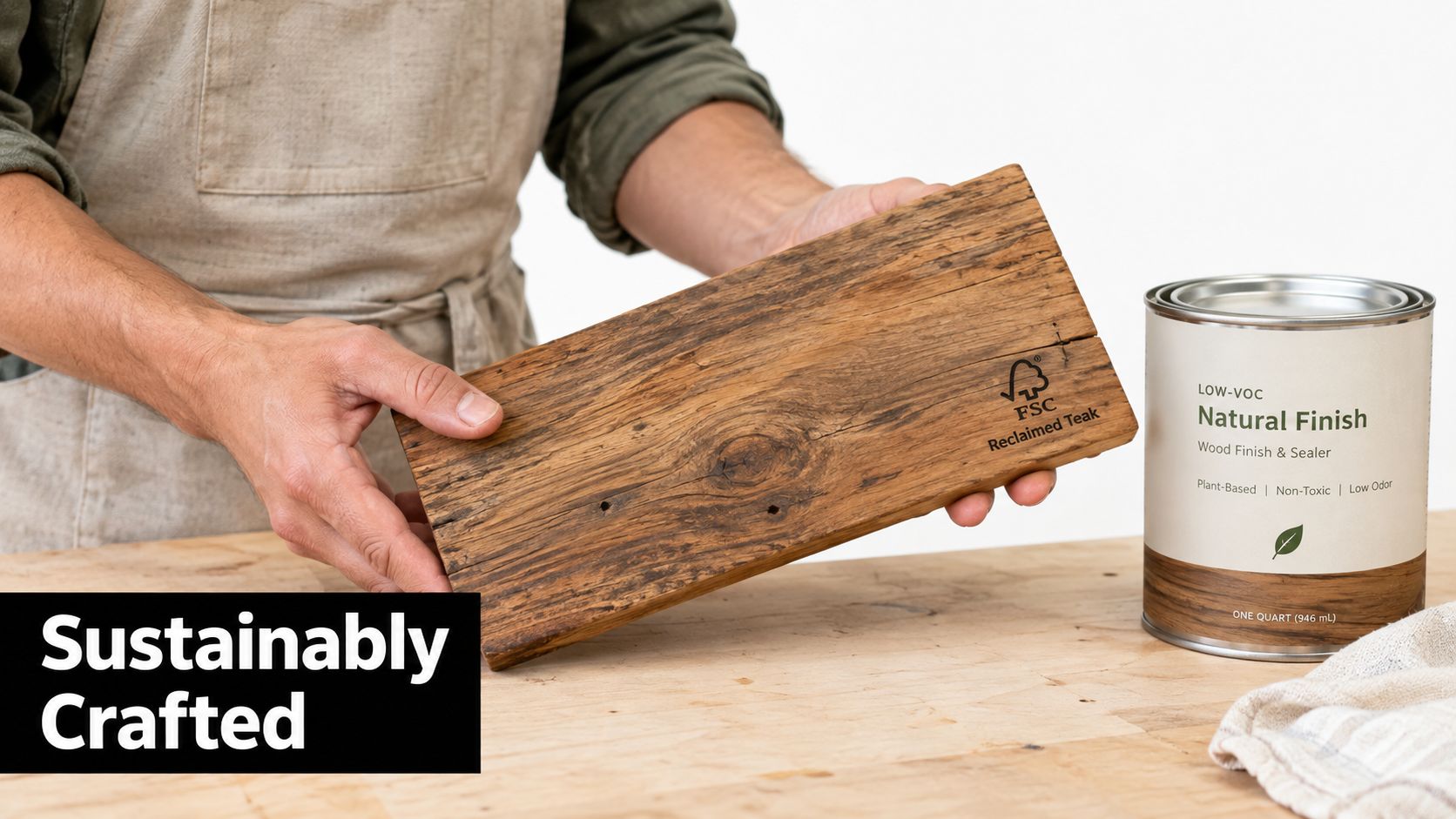
Ask for documentation rather than accepting a broad claim. FSC and PEFC certification can help establish responsible sourcing when the certificate applies to the supplier and product being sold. Reclaimed wood can reduce demand for newly harvested material, but the fabricator should still explain how it was inspected, dried, cleaned, and prepared for a humid interior.
A luxury finish doesn't need to look rustic. Rift-cut white oak, restrained grain, fluted detailing, and a low-sheen clear finish can create a calm, spa-like appearance while using a carefully specified material package. Sustainability and refined design aren't opposing choices. The quality comes from transparent sourcing and controlled fabrication.
Check the finish, not just the timber
Low-VOC finishes may support better indoor-air-quality goals, but “natural” doesn't automatically mean durable in a bathroom. Ask for the product name, technical data sheet, recommended coats, cure requirements, cleaning limits, and repair method. A finish that looks appealing on a sample may not be the right system for repeated splashes and regular cleaning.
A responsible specification should answer practical questions:
- Certification: Which supplier holds the relevant certification, and does it cover this order?
- Origin: Is the wood newly harvested, reclaimed, or veneer over an engineered core?
- Finish chemistry: What low-VOC product will be used, and how will it be applied?
- Longevity: Can the surface be repaired or recoated instead of replaced?
- Waste: Does the shop optimize sheet goods and retain matching material for future repairs?
The video below offers another visual reference for evaluating wood finishing choices in a design context.
Don't pay a premium for an “eco” label that the fabricator can't explain. Request the certificate information and finish specification before you approve the order, and make sure the sustainability claim still includes the construction details that protect the cabinet from moisture.
Maintenance and Professional Installation Guidelines
A well-built cabinet still needs a dry operating environment and a careful installation. Building-industry guidance says moisture-resistant bathroom furniture shouldn't swell, deform, or lose stability during regular exposure to water, humidity, or steam, as explained in this guidance on high-quality bathroom furniture. That performance depends heavily on the substrate and edge sealing, not the species name alone.
Keep water from becoming a routine exposure
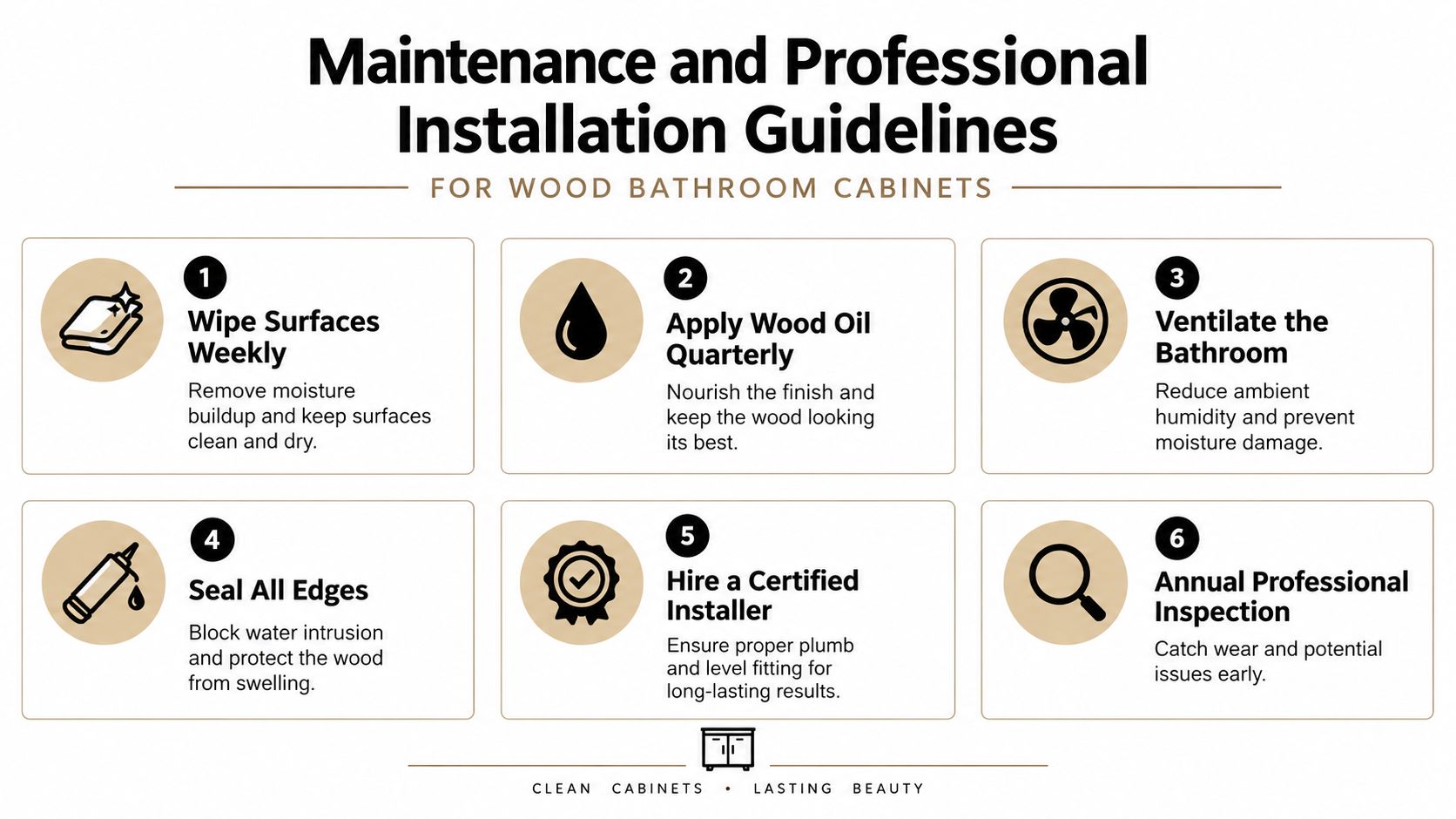
Wipe splashes from the countertop and cabinet faces rather than allowing them to sit. Use a soft cloth and a cleaner approved for the finish, because aggressive solvents or abrasive pads can damage the protective layer and leave the wood more exposed.
Ventilation matters just as much. Run the bathroom exhaust fan during showers and afterward, keep air moving around the vanity, and report leaks at the supply lines, trap, faucet, or countertop immediately. A slow leak inside the sink cabinet can cause more damage than ordinary room humidity.
Periodic maintenance should follow the actual finish system. Some cabinets need a compatible oil or maintenance coat, while others require only cleaning and eventual professional recoating. Don't apply a random oil over a film finish, and don't reseal a surface before confirming that the existing coating and new product are compatible.
Installation details decide the starting condition
The installer should check that the floor and wall can support a level, plumb cabinet. The vanity must sit securely, maintain access to plumbing, and keep water from collecting against the toe-kick or side panels. Sink and countertop cutouts deserve special attention because they expose the cabinet to repeated splashes and condensation.
Before the installer leaves, inspect the following:
- Edges: Look for complete coverage around doors, panels, sink openings, and exposed ends.
- Alignment: Open every drawer and door to check consistent gaps and smooth operation.
- Level: Confirm that the countertop and cabinet don't visibly slope or twist.
- Plumbing: Check connections for leaks while the cabinet interior remains accessible.
- Ventilation: Make sure the cabinet doesn't block the room's air circulation or exhaust path.
- Care instructions: Get the approved cleaner, maintenance product, and repair contact in writing.
Use a qualified cabinet installation service when the vanity includes fitted fillers, wall irregularities, stone coordination, or complicated plumbing. Installation isn't a final formality. It establishes whether the cabinet begins its service life dry, level, supported, and properly sealed.
Sinclair Cabinetry inc designs and manufactures custom bathroom cabinetry with specified wood species, finishes, hardware, and moisture-conscious construction for individual spaces. Visit Sinclair Cabinetry inc to discuss your bathroom dimensions, material preferences, and installation requirements before ordering.