
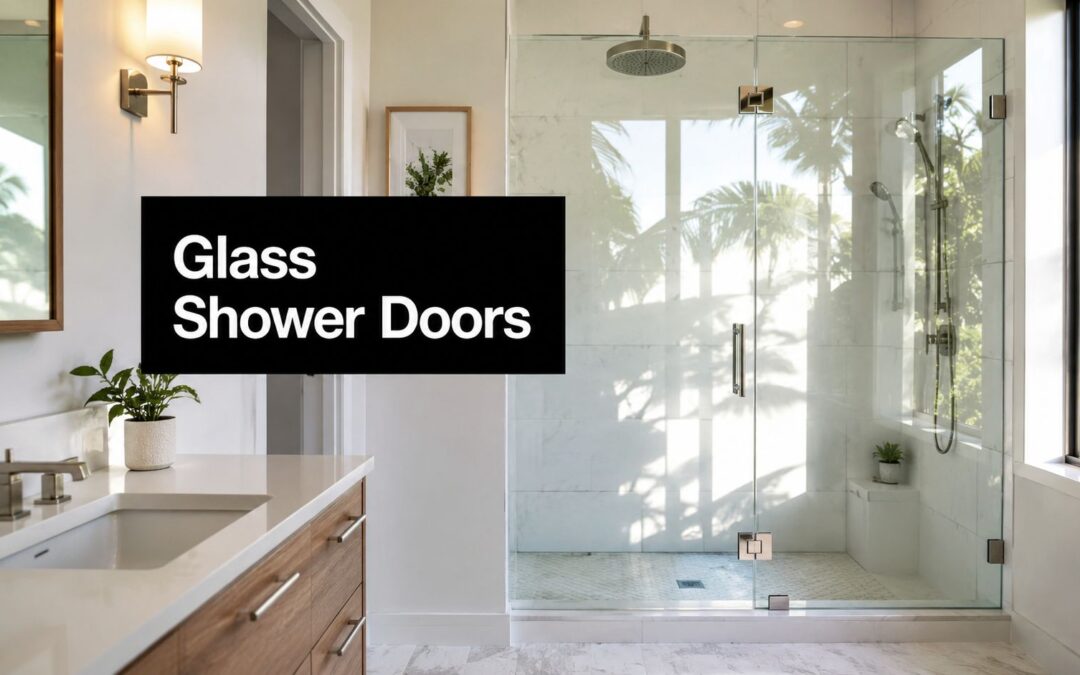
You step into the bathroom on a muggy Fort Myers morning and notice the shower door no longer closes cleanly. The track shows early corrosion, the glass looks cloudy, and the frame has started losing its finish. The door still works, but it already feels like a replacement project waiting to happen.
That outcome usually starts with a reasonable-looking purchase. Homeowners compare glass styles and hardware colors, then overlook the conditions that matter most in Southwest Florida: salt-laden humidity, persistent moisture, mineral buildup, and installation quality. A shower enclosure is a daily-use fixture, not just a decorative feature. The right specification affects cleaning, operation, safety, and the cost of keeping the bathroom in good condition.
For a high-end remodel, focus on lifecycle value rather than the lowest initial quote. Glass thickness, hardware metallurgy, protective coatings, wall support, waterproofing, and code compliance all influence how well the door performs over time. If you're remodeling the entire room, coordinate the enclosure with the layout and cabinetry decisions covered in this Fort Myers bathroom remodeling guide.
Why Your Shower Door Choice Matters in Southwest Florida
A shower door can fail long before the glass itself breaks. Hinges begin to discolor, rollers develop resistance, seals lose flexibility, and tracks collect moisture that never fully dries. In a coastal bathroom, those small problems can turn into a door that drags, leaks, or needs replacement while the tile and vanity still look new.
Salt air is particularly hard on exposed metal. Humidity keeps surfaces damp, while shower products leave residue on hinges, clamps, and channels. Mineral deposits from household water can also dry onto the glass and become increasingly difficult to remove. The result is a fixture that looks neglected even when the homeowner cleans regularly.

Practical rule: In Fort Myers, specify the metal and maintenance plan before you choose the finish.
Look beyond the purchase price
A low-cost framed enclosure may seem attractive because it uses more economical components and standard construction. But more channels, screws, rollers, and seals create more places for water and residue to remain. A premium frameless system usually costs more at the beginning, yet it can reduce exposed metal and simplify cleaning when the installer templates and supports it correctly.
That doesn't mean frameless is automatically the best choice. A poorly installed frameless door can sag, leak, or stress the hardware. A well-specified semi-frameless enclosure may be the smarter choice for a difficult opening, a heavily used family bathroom, or a homeowner who wants additional structure around the edges.
Climate should shape the design
Ask the installer how the proposed system will handle coastal exposure and mineral buildup, not only whether it matches your tile. Request details for hinge material, fasteners, rollers, seals, glass treatment, and cleaning instructions. If those answers are vague, the quote isn't complete.
Fort Myers homeowners also benefit from selecting a door that suits the room's geometry. A clean walk-in opening may support a broad frameless panel, while an alcove tub or neo-angle shower may need strategic framing or more carefully placed supports. The best enclosure is the one that balances appearance with reliable drainage, access, ventilation, and maintenance.
Comparing Frameless, Semi-Frameless, and Framed Options
The three main shower-door categories behave differently in a humid coastal bathroom. Frameless systems minimize metal, semi-frameless designs use metal selectively, and framed doors rely on channels around much of the enclosure. That distinction affects appearance, cleaning, adjustment, and corrosion exposure.
Frameless systems
Frameless doors use substantial tempered glass, commonly 3/8 inch or 1/2 inch, with hinges, clamps, and support hardware instead of a continuous frame. The reduced metal profile gives tile and stone more visual impact, and the open edges are easier to wipe down.
The trade-off is precision. Frameless glass places greater demands on wall alignment, structural backing, threshold slope, hinge placement, and sealing. A walk-in shower with a straight opening is a strong candidate. A large or unusual opening needs an experienced glazier who can account for glass weight and movement.
Semi-frameless systems
Semi-frameless doors retain framing where it provides useful support, often around a fixed panel or along selected edges. This approach can reduce the amount of heavy glass required and give the installer more flexibility around an alcove, tub, or neo-angle layout.
For many Fort Myers bathrooms, semi-frameless is the practical middle ground. It offers a cleaner appearance than a fully framed unit while providing more structure where walls or openings aren't perfectly uniform. Choose corrosion-resistant metal throughout, because the smaller amount of exposed hardware still faces the same humidity and salt air.
Framed enclosures
Framed doors generally offer the most economical path to enclosing a shower. Their channels can help compensate for minor variations in the opening, and they may suit a compact tub enclosure or rental property where the design priority is straightforward function.
The problem is moisture retention. Tracks and channels create seams that collect soap residue, standing water, and mineral deposits. In a coastal environment, that makes cleaning more demanding and gives corrosion more opportunity to develop. A framed system can still perform well when it has quality finishes, proper drainage, and regular care, but don't select it solely because the initial quote is lower.
| Feature | Frameless | Semi-Frameless | Framed |
|---|---|---|---|
| Visual appearance | Minimal, open, high-end | Balanced and adaptable | Traditional and more enclosed |
| Metal exposure | Low, with exposed hinges and clamps | Moderate | Highest, with channels and tracks |
| Cleaning | Generally easier around glass edges | Moderate | More demanding around tracks |
| Best local applications | Walk-in showers and luxury remodels | Alcoves, tubs, and irregular openings | Compact enclosures and practical replacements |
| Coastal priority | Upgrade hinges, fasteners, and coatings | Specify every exposed finish carefully | Demand corrosion-resistant channels and drainage |
Don't choose a style from a showroom display alone. Review the actual opening, the shower's splash pattern, and the amount of hardware that will remain wet after use. A walk-in shower layout guide can help you assess how the enclosure will work with circulation and bathroom clearances.
Navigating Florida Building Code and Safety Glazing
Florida treats shower areas as hazardous locations for glazing. Under the Florida Building Code, glass in shower enclosures and glazing within 60 inches, or 1.5 meters, of a bathtub or shower threshold must be safety glazing. The statewide rule applies to Fort Myers projects, so a local remodel still needs to meet the same baseline used throughout Florida. Florida Building Code safety-glazing provisions provide the governing reference.
Safety glazing generally means tempered or laminated glass designed to reduce injury risk when damaged. Tempered glass receives controlled heat treatment so it breaks into smaller fragments rather than long, sharp shards. That safety feature doesn't make the panel indestructible, and it doesn't excuse poor handling or incorrect installation.

Thickness and panel size matter
The code states that swinging or sliding glass doors without a continuous frame must use fully tempered glass at least 3/8 inch, or 9.5 millimeters, thick. It also classifies glazing in shower and tub enclosures as Category II when the panel exceeds 9 square feet, or 0.84 square meters, in surface area. Those requirements matter when a designer proposes broad frameless panels or a large open entry.
Every compliant panel should carry a permanent manufacturer marking identifying its safety-glazing status. Ask to see that marking before accepting the installation. A professional installer should also be able to explain the glass specification, hardware rating, and installation method in plain language.
Permits and inspection questions
Whether a particular replacement requires a permit depends on the scope of work and the local authority. A simple like-for-like door replacement may be treated differently from a bathroom remodel that changes walls, plumbing, waterproofing, or structural support. Ask the contractor or permitting office to confirm the requirement before work begins, rather than assuming the answer.
Unpermitted or non-compliant work can create problems during inspection, resale, or an insurance review. Keep the contract, product documentation, manufacturer markings, and permit records with your renovation files. Good documentation gives you a clear record of what was installed and how the project met applicable requirements.
Selecting Hardware and Coatings for Coastal Durability
In a Fort Myers shower, the glass panel is only one part of the durability equation. Hinges, rollers, clamps, handles, screws, and towel bars experience repeated wetting, cleaning chemicals, and humid air. If the hardware corrodes or loosens, even intact glass can become difficult to operate and hard to seal.
Start by asking what metal sits beneath the visible finish. 316 stainless steel is a strong choice for coastal exposure, particularly where salt air reaches the bathroom. 304 stainless steel can perform well in many residential settings, especially with an appropriate protective finish, but don't accept a vague description such as “stainless look.” Brass hardware with a durable PVD finish can also be suitable when the manufacturer specifies its construction and care requirements.
Independent salt-spray benchmarks describe 96 hours as a standard grade for high-humidity commercial environments and recommend 240 hours for coastal or marine settings. Those ratings, along with the association of higher ratings with 316 stainless steel or PVD-coated 304 hardware, are summarized in this coastal shower-hardware guidance.
Compare the hardware, not just the color
| Material Type | Corrosion Resistance | Expected Lifespan | Maintenance Level | Relative Cost |
|---|---|---|---|---|
| 316 stainless steel | Strong choice for salt-air exposure | Long-term when maintained | Moderate | Higher |
| PVD-coated 304 hardware | Good when the coating and core are specified properly | Long-term with appropriate care | Moderate | Moderate to higher |
| Standard 304 stainless steel | Suitable for many interiors, less specialized for marine exposure | Dependent on finish and environment | Moderate | Moderate |
| Finished brass | Varies by alloy and protective finish | Dependent on coating quality | Moderate | Moderate |
| Basic plated or painted hardware | More vulnerable when the finish is damaged | Shorter in demanding wet environments | High | Lower |
Use a soft microfiber cloth and dry the hardware after cleaning. Don't spray harsh chemicals directly onto hinges or handles, and don't use abrasive pads on coated glass. A soft rubber squeegee after each shower limits mineral residue, while periodic inspection catches loose fasteners, stiff rollers, and failing seals before they affect the door.
Glass coatings can help reduce water spotting and soap adhesion, but they aren't a substitute for maintenance. Ask whether the coating is factory-applied or installed on-site, which products are approved, and what cleaning agents could void the warranty. For related finish-selection decisions elsewhere in the bathroom, this cabinet hardware finish guide offers useful terminology.
The Professional Installation Process and Timeline
Custom shower-door installation starts with the opening, not the catalog. Walls may be slightly out of plumb, thresholds may slope unevenly, and tile surfaces may change the final dimensions. A reputable Fort Myers glazier measures the completed opening and creates a template before ordering glass.
Five phases to expect
Consultation and templating: The installer checks the opening, hinge locations, threshold, wall construction, and door swing. Ask how the crew will verify backing before drilling.
Fabrication: The shop cuts, finishes, and tempers the glass to the approved dimensions. Custom work requires coordination, so a promise of immediate installation deserves scrutiny.
Delivery and staging: Large panels must arrive protected from edge damage and be staged safely near the bathroom. The crew should inspect the glass and hardware before installation.
Installation: The team sets the panels, attaches hinges or rollers, aligns the door, installs seals, and applies wet-area silicone. Frameless systems demand careful leveling and controlled fastening because the glass has little tolerance for sloppy placement.
Inspection and handover: The installer checks swing, latch, clearances, seals, and drainage, then explains cleaning and adjustment requirements. The bathroom shouldn't return to full water use until the sealant has cured according to the product instructions.

Watch for installation shortcuts
A crew that skips on-site templating, drills before confirming wall support, or offers same-day completion for a complex custom enclosure is creating risk. Ask what structural backing supports the hinges, how the threshold sheds water, and which silicone is rated for a continually humid environment.
Plan for the shower to be unavailable during installation and curing. The exact schedule depends on the enclosure, site condition, fabrication requirements, and sealant instructions. Coordinate the work with the broader remodel schedule using a realistic bathroom renovation timeline so the glass isn't installed before tile, waterproofing, and trim work are ready.
Why Professional Glaziers Outperform Handyman Services
A shower door isn't a standard pre-hung interior door. The installer is handling safety glass, concentrated hardware loads, wet-area seals, and a product whose warranty may depend on approved installation. That combination calls for a specialist.
A professional glazier understands how to select and install safety glazing for a hazardous location. The crew should know how to verify wall backing, position hinges without damaging tile or waterproofing, and align the door so the seals work without excessive pressure. Those details determine whether the enclosure operates smoothly after the initial installation visit.
The cheapest installation is the one that doesn't require a second installation.
Where handyman work often falls short
A general handyman may be experienced with bathroom repairs but lack specialized glass equipment, manufacturer training, or the insurance coverage appropriate for handling large panels. If a panel breaks during handling, or if a misaligned door damages tile and leaks at the threshold, the homeowner may face costs that weren't visible in the original bid.
Warranty language matters, too. Some manufacturers require installation by approved or qualified professionals. Ask for the warranty in writing and confirm whether it covers glass, hardware, finish, seals, and workmanship separately.
Verify the installer
Before signing, request:
- License and business details: Confirm the contractor's applicable Florida credentials and local business information.
- Insurance documentation: Ask for current liability coverage and clarification about glass breakage during installation.
- Manufacturer experience: Find out whether the installer is trained or approved for the selected hardware and enclosure system.
- Recent local references: Request references from Fort Myers or nearby coastal projects completed recently enough to inspect the installation's current condition.
- Written scope: Make sure the quote identifies measurement, fabrication, delivery, installation, sealing, cleanup, and warranty responsibilities.
The licensed glazier comparison infographic captures the central distinction. A specialist sells more than labor. They provide a controlled process for managing safety, fit, moisture, and long-term accountability.

Next Steps for Requesting Quotes and Scheduling Consultations
Start with an in-home consultation, not a phone estimate. A contractor can't properly judge wall alignment, threshold slope, tile condition, hardware backing, door clearance, or splash control from a few measurements sent by text.
Request an itemized proposal that separates glass, hardware, coatings, labor, delivery, removal, and related preparation. The quote should identify glass type and thickness, hardware material and finish, coating brand if applicable, sealant, warranty coverage, and the expected work sequence. If a proposal only says “custom shower door” with one total price, you don't have enough information to compare it.
Questions to ask every installer
- Code knowledge: How will the design meet Florida safety-glazing requirements for the shower location?
- Glass specification: What type, thickness, edge finish, and manufacturer marking will the panel have?
- Coastal hardware: What stainless grade, PVD finish, or other corrosion protection is included?
- Maintenance: What should be wiped, squeegeed, or avoided, and which products protect the warranty?
- Water management: How will the threshold, seals, and door swing control leakage?
- Structural support: What backing is required for hinges, clamps, or support bars?
- Schedule: When will measuring, fabrication, installation, and curing occur?
- Warranty: Which party covers installation defects, hardware failure, finish deterioration, and glass issues?
Use response quality as part of the evaluation. A reliable glazier answers technical questions directly, documents the scope, arrives prepared to measure, and explains trade-offs instead of pushing the most expensive style. Be cautious with an unusually low bid that omits corrosion-resistant hardware, coating details, proper preparation, or qualified installation.

Schedule at least three in-home consultations so you can compare specifications, not just totals. The right glass shower doors for Fort Myers should suit your layout, meet Florida code, resist the coastal environment, and remain practical to maintain after the remodel crew leaves.
Sinclair Cabinetry inc can help coordinate a high-end bathroom remodel around durable glass shower doors, custom cabinetry, hardware, and practical storage. Visit Sinclair Cabinetry inc to discuss your Fort Myers-area project and plan a bathroom that looks refined while working hard in the coastal climate.