

You're halfway through a kitchen remodel, the old doors are already off, and every cabinet showroom is presenting the same choice as if it were obvious: replace everything with something newer. But the boxes may still be square, the layout may still work, and the wood may be better than what you'd buy today. The most expensive mistake often happens before you choose a door style. It happens when you assume full replacement is the only serious option.
The best cabinets for a kitchen remodel depend first on what should remain. Decide between replacing all cabinets, upgrading only part of the room, or refinishing the existing cabinetry. Then judge material, construction, hardware, and cabinet tier against that decision. Wood remains a dominant foundation for kitchen cabinetry, accounting for 60.15% of global kitchen-cabinet revenue in 2025 according to global kitchen cabinet market data, but a durable existing cabinet can be more valuable than a fashionable replacement.
Starting With the Real First Decision
A homeowner I'll call Dana had a familiar problem. The kitchen felt cramped, the doors looked dated, and the sink base showed water damage. The cabinet salesperson immediately began discussing painted maple, inset doors, and custom storage. Dana wanted those details, but the first question was simpler: did the kitchen need new boxes, or did it need a better arrangement of the boxes already there?
Three paths deserve an honest comparison before any product discussion.
| Remodeling path | Best fit | Main advantage | Main risk |
|---|---|---|---|
| Full replacement | New layout, damaged boxes, major resale renovation | Complete control over storage and appearance | Highest disruption and material waste |
| Partial upgrade | Sound existing boxes with a few problem areas | Preserves useful cabinetry while improving function | Matching finishes and dimensions can be difficult |
| Refinish or reface | Strong boxes and a workable layout | Changes the appearance without rebuilding the room | Cannot solve poor storage or structural damage |
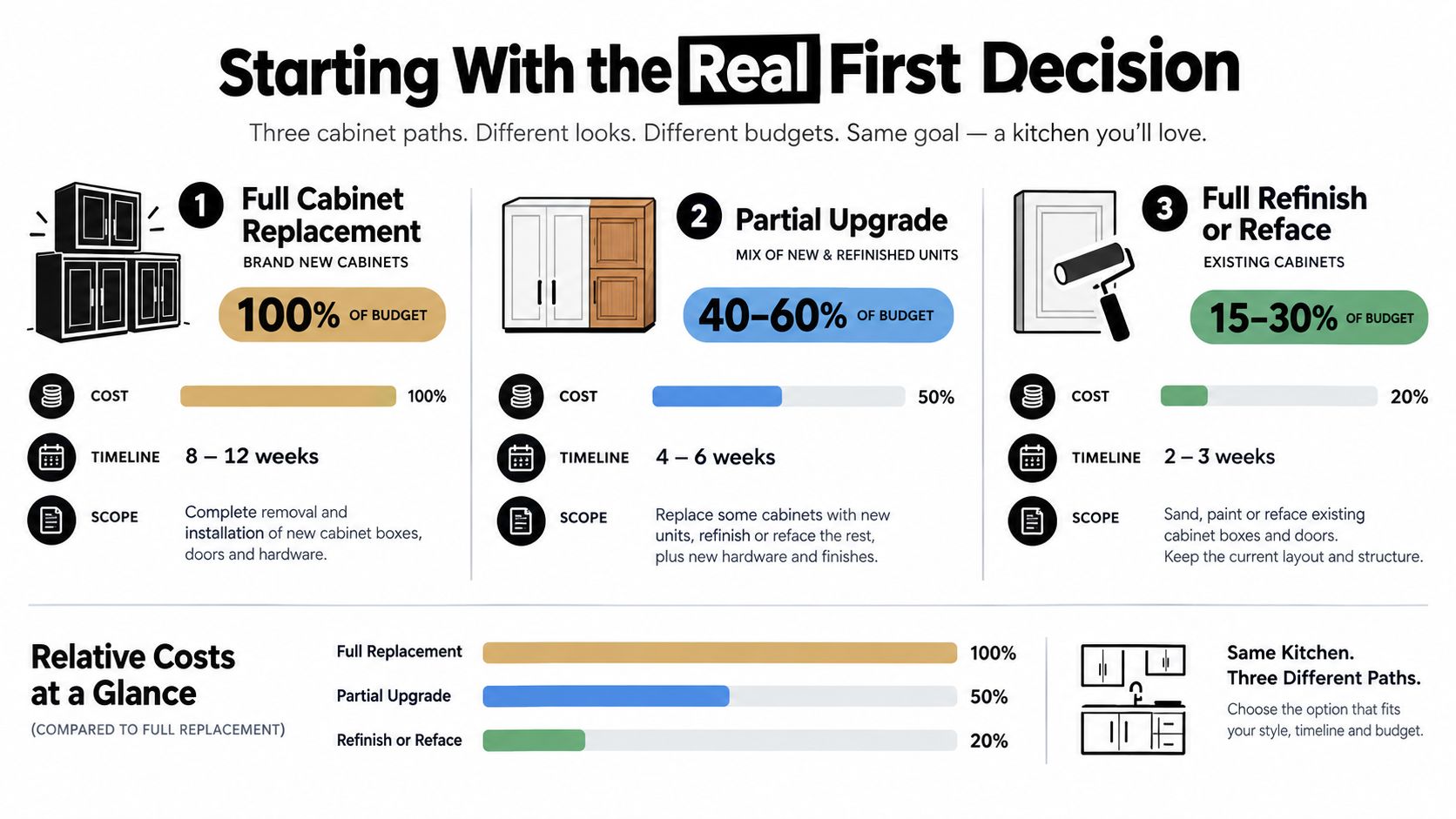
Full replacement makes sense when walls move, appliances change position, cabinet boxes have swollen or separated, or the room needs a completely different storage plan. It's also the cleanest route when the kitchen is being renovated for resale and inconsistent old and new components would weaken the finished impression.
Partial upgrading works when the main run is solid but a sink base, pantry, island, or appliance section needs rebuilding. You might retain well-built wall cabinets, replace lower cabinets, and reface the remaining doors. This route requires careful matching, so request finish samples and a written compatibility plan before ordering.
Refinishing or refacing is the right call when the layout works and the boxes remain square, dry, and firmly attached. Forbes identifies refinishing quality wood cabinetry as a cost-efficient upgrade when natural wood is returning to favor, a position that fits the current preference for warmer cabinet finishes as discussed in this cabinet remodeling guidance.
Quick self-check: Keep the existing boxes only if they're structurally sound, the layout supports how you cook, and the cost of correction won't approach the value of a new cabinet plan.
Before meeting a dealer, inspect the cabinet interiors, photograph damaged areas, mark the appliances that must move, and decide whether your biggest complaint is appearance, storage, or structure. Use this kitchen cabinet selection guide to organize the questions, but make the replacement decision before comparing door samples.
Custom, Semi-Custom, and Stock Compared
Cabinet tier is not a quality ranking by itself. It's a response to the shape of the room, the deadline, and the amount of control you need.
| Tier | Cost per Linear Foot Installed | Lead Time | Fit Flexibility | Design Flexibility |
|---|---|---|---|---|
| Custom | Premium pricing that varies by material, finish, and detailing | Longest | Exact wall-to-wall fit and non-standard sizing | Highest control over species, profiles, storage, and construction |
| Semi-custom | Mid-range pricing with added charges for modifications | Moderate | Factory modifications accommodate many difficult spaces | Broad selection with controlled customization |
| Stock | Lowest entry price | Shortest when inventory is available | Limited to manufactured sizes and standard fillers | Restricted door styles, finishes, and interior options |
Custom cabinets earn their premium when the room contains angled walls, unusual ceiling transitions, integrated appliances, furniture-style panels, or a narrow space that can't tolerate filler strips. They also make sense when you care about matching the wood species, finish sheen, door profile, drawer configuration, and interior accessories as one coordinated system.
Semi-custom cabinets suit the homeowner who wants a refined result without commissioning every component from scratch. Factory modifications can solve awkward widths, specialty storage, and selected height changes. This is often the sensible middle ground when the layout is mostly conventional but stock sizes would leave visible gaps or waste useful space.
Stock cabinets work best in straightforward rooms where the plan can be designed around available sizes. They can deliver a clean appearance when the installer handles fillers, end panels, scribe pieces, and leveling carefully. They become a poor bargain when the room needs extensive modifications, because repeated field alterations can reduce consistency and consume the time saved by buying stock.
The binding constraint decides the tier. If the wall is irregular, choose fit. If the project has a hard completion date, choose availability. If the budget ceiling is firm, choose a simpler cabinet line and spend selectively on drawer hardware, sink-base protection, and the storage features you'll use every day.
Read this custom versus semi-custom cabinet comparison before accepting a dealer's label as proof of value. Ask which parts are genuinely modified, which are standard components, and whether installation, finished ends, fillers, and hardware appear in the same quote.
Cabinet Materials That Make a Difference
Solid wood sounds reassuring, but a cabinet is a system of materials. Specify each component for its job, rather than treating “all wood” as a quality grade. The box, door, shelf, drawer, and back panel can need different materials to perform well.
| Material | Best Used For | Avoid For | Durability Note |
|---|---|---|---|
| Solid wood | Doors, face frames, trim, selected drawer parts | Large flat panels without proper movement planning | Attractive, machinable, and repairable, but expands and contracts with moisture |
| Furniture-grade plywood | Cabinet boxes, shelves, drawer bodies, structural panels | Very exposed decorative surfaces when grain matching matters | Cross-laminated layers hold fasteners well and resist sag better than many fiber panels |
| MDF | Painted door centers, routed profiles, thermofoil substrates | Unprotected sink bases or areas exposed to standing water | Smooth and stable under paint, but swelling is a serious failure mode after water intrusion |
Solid wood earns its place on doors, face frames, and visible trim, where grain, repairability, and shaped profiles have practical value. Wide solid-wood panels still require room for seasonal movement as humidity changes. A poorly designed wood door can crack or warp despite the material's appeal.
Plywood is the practical workhorse for cabinet boxes and shelves. Choose furniture-grade cabinet plywood or all-veneer construction instead of relying on a vague “wood cabinet” description. Its layered structure holds screws reliably and helps shelves resist gradual sag when heavy cookware remains in one position.
MDF performs well under painted finishes. Its uniform surface prevents wood grain from showing through the paint, and its consistency supports clean routed profiles. Keep it out of wet-prone structural areas unless the manufacturer provides suitable protection. Particleboard also has a legitimate place in some cabinet components, but its water vulnerability makes the sink base a poor location for unprotected panels.
The material schedule deserves more attention than the door sample.
Ask for the cut sheet, not the slogan. It should identify the box, shelf, door, drawer, and back-panel materials separately.
Formaldehyde compliance matters most in composite components, including plywood, particleboard, MDF, boxes, shelves, doors, and toe-kicks. California's Composite Wood Products Program covers these materials and establishes emission standards and labeling requirements for products sold or used in California. Ask whether the proposed components meet applicable emission requirements and whether the documentation covers the complete cabinet, rather than only one panel type.
Use this expert guide to kitchen cabinet materials to compare the construction schedule, not just the finish sample. A plywood box paired with a carefully selected MDF painted door can be a stronger specification than an “all-wood” cabinet that hides vulnerable particleboard components. Material choice should follow exposure, load, finish, and repair needs, then fit the remodel budget.
Construction and Hardware Quality
A full cabinet replacement is not always the right answer. If the existing boxes are square, dry, and firmly anchored, a partial upgrade may make more sense. Replace damaged sink bases or weak drawer components, then judge the remaining construction before spending on new doors and finishes. For any cabinet you keep or specify, inspect it open, closed, loaded, and adjusted.
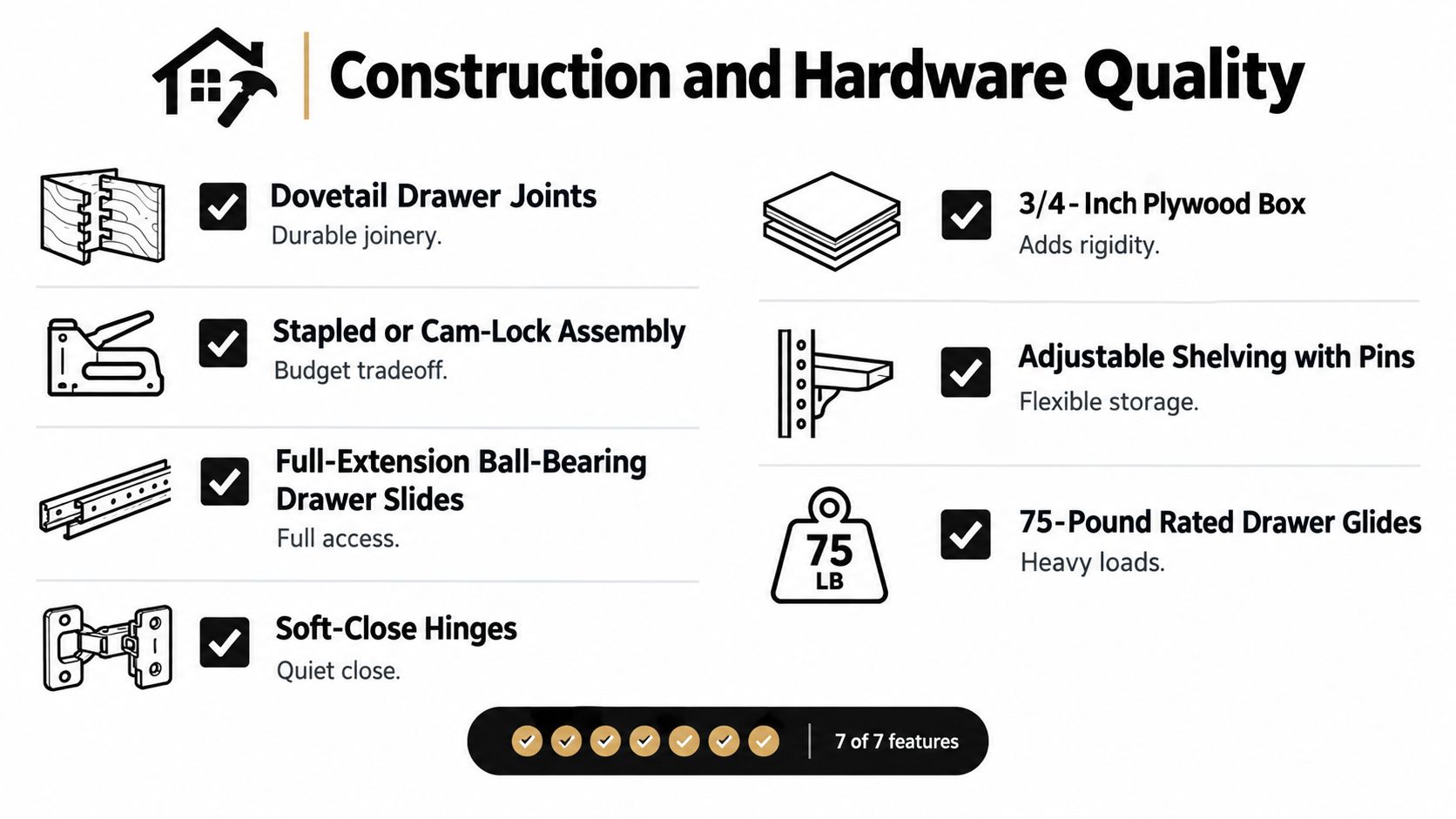
Dovetail drawer joints are my preferred choice for frequently used drawers. Their interlocking corners resist separation and create a rigid connection. Stapled or cam-lock assembly can work in a budget project when the box is square and the warranty is clear, but I would not specify it for heavy pot drawers or a premium remodel.
Drawer slides need a stated load rating. Common kitchen slide classes include about 75 pounds for epoxy side-mount rollers, 100 pounds for Blum TANDEM, and 125 pounds for Blum MOVENTO and LEGRABOX, with heavy-duty versions reaching 170 pounds, according to this drawer-slide performance guide. The rating applies to the slide, not the drawer box. Match cookware storage and appliance pull-outs with hardware designed for sustained loads.
What to verify in the showroom
- Joinery: Pull the drawer fully open. Inspect the corners, bottom capture, and fasteners.
- Extension: Full-extension slides expose the rear of the drawer. Three-quarter travel leaves useful storage out of reach.
- Hinges: Soft-close hinges should close smoothly without slamming. Check the opening angle and confirm that adjacent doors and interior storage remain clear.
- Box thickness: Half-inch plywood can work in some applications, while three-quarter-inch plywood provides greater rigidity at sink bases and wide openings.
- Shelving: Look for thick adjustable shelves, secure shelf pins, and a system that supports future repositioning.
- Reinforcement: Inspect corner braces, back attachment, and the method used to secure the cabinet to the wall.
- Warranty: Ask whether the moving parts and cabinet box have separate warranty terms.
Face-frame cabinets add a traditional front structure and suit furniture-style kitchens. Frameless, full-access cabinets expose more interior width and make drawers easier to maximize, but installation must be precise because alignment errors are more visible. Review these cabinet construction details before choosing a style. Select the construction that supports the storage plan, whether you are replacing every box or upgrading only the weak points.
Understanding Cabinet Costs
A cabinet quote can look affordable until delivery, installation, panels, and modifications appear as separate charges. Before comparing prices, require a complete specification that shows what the kitchen needs to function properly.
| Cabinet tier | Per Linear Foot | 10×10 Kitchen Total | Typical Lead Time |
|---|---|---|---|
| Stock | Lower entry pricing, subject to finish and accessories | Lower project range when the layout uses standard sizes | Shortest when inventory is available |
| Semi-custom | Mid-range pricing, with modifications priced separately | Mid-range project range with more storage and fit control | Moderate |
| Custom | Premium pricing based on detailing and material selection | Broadest project range because every major choice affects the quote | Longest |
The room's footprint does not set the price by itself. Wall cabinets, tall pantries, drawer bases, appliance panels, and corner units require different levels of material and labor. Door construction, finish complexity, specialty inserts, finished ends, fillers, crown molding, toe-kicks, and cabinet modifications can shift the quote substantially.
Installation deserves its own line item. The work includes leveling, scribing, securing boxes, aligning doors, fitting panels, adjusting drawers, and preparing for the countertop. A low cabinet price can rise quickly after the dealer adds delivery, installation, decorative panels, hardware, and layout changes.
Read the quote line by line
Ask for separate prices for cabinet boxes, doors, finished ends, fillers, moldings, hardware, delivery, installation, demolition, and disposal. Compare the hardware package as closely as the door style. Builder-grade hinges and slides may seem acceptable in a showroom, while better hardware can make the same layout easier and more comfortable to use every day.
Keep money available for conditions hidden behind the existing kitchen. Uneven walls, plumbing conflicts, damaged subflooring, and wiring changes may require adjustments after demolition. Confirm that the room can accept the cabinet plan before committing the full allowance to decorative upgrades.
If the project is a partial upgrade rather than a full replacement, price the work required to make old and new components function together. Matching finishes, replacing weak drawer systems, and modifying fillers can cost more than expected. Compare that total with refinishing or replacing the affected cabinet sections before approving the order.
My pricing rule: Protect the parts that are difficult to replace later, including cabinet boxes, drawer systems, sink-base construction, and installation accuracy. Decorative inserts can wait.
Market figures provide context, not a project budget. One U.S. market report places wood at 60.88% of kitchen furniture market value in 2025 and projects the broader kitchen furniture market to grow from USD 28.24 billion in 2026 to USD 35.99 billion by 2031, as reported in this cabinet market overview. Those figures describe the wider market, so base your decision on the itemized quote and the work your kitchen requires.
Sustainability and Indoor Air Quality
A cabinet choice affects the amount of material sent to landfill and the air your household lives with every day. Start by reviewing the composite parts, including boxes, shelves, doors, and toe-kicks. Plywood, MDF, and particleboard can differ in emissions, durability, and moisture performance, so ask for product documentation instead of relying on an “eco-friendly” label.
Request written information on low-emission materials and finishes. EPA Indoor airPLUS guidance points to certified component materials and low-emission cabinetry programs for homeowners who want indoor-air considerations included in the specification. Treat that documentation as part of the cabinet quote, not as an optional marketing detail.
Material health needs a complete specification
Solid wood can reduce reliance on composite components, but responsible forestry and finish choices still matter. Plywood can provide dependable structure when its emissions documentation is clear. MDF creates a smooth painted surface, yet it needs careful placement and protected edges near sinks, dishwashers, and other leak-prone areas.
Finish selection affects indoor air quality as well. Ask whether the finish has low volatile organic compound emissions, whether it is factory applied, and how the manufacturer handles curing and ventilation. Factory application often produces more consistent coverage than an improvised site finish, but the actual product specification matters more than the phrase “factory finished.”
Long service life is the strongest sustainability argument for many remodels. Cabinets that can be repaired, refinished, or fitted with replacement doors can delay a full tear-out when the layout still works. Houzz reports that 79% of renovating homeowners choose custom or semi-custom cabinets, while 76% include built-in features, indicating strong interest in cabinetry designed for lasting function, according to the 2026 Houzz U.S. Kitchen Trends Report.
Specify low-emission materials, durable finishes, repairable hardware, and a layout that will serve your household for years. That combination usually delivers more value than choosing one material and calling the entire kitchen sustainable.
Measuring, Timeline, and Installation
Before ordering cabinets, decide whether the room needs a full replacement, a partial upgrade, or a refinish. That choice affects what you measure and preserve. If the layout works and the existing boxes are sound, document them carefully before removing anything. If the layout must change, measure the entire room before designing around a catalog.
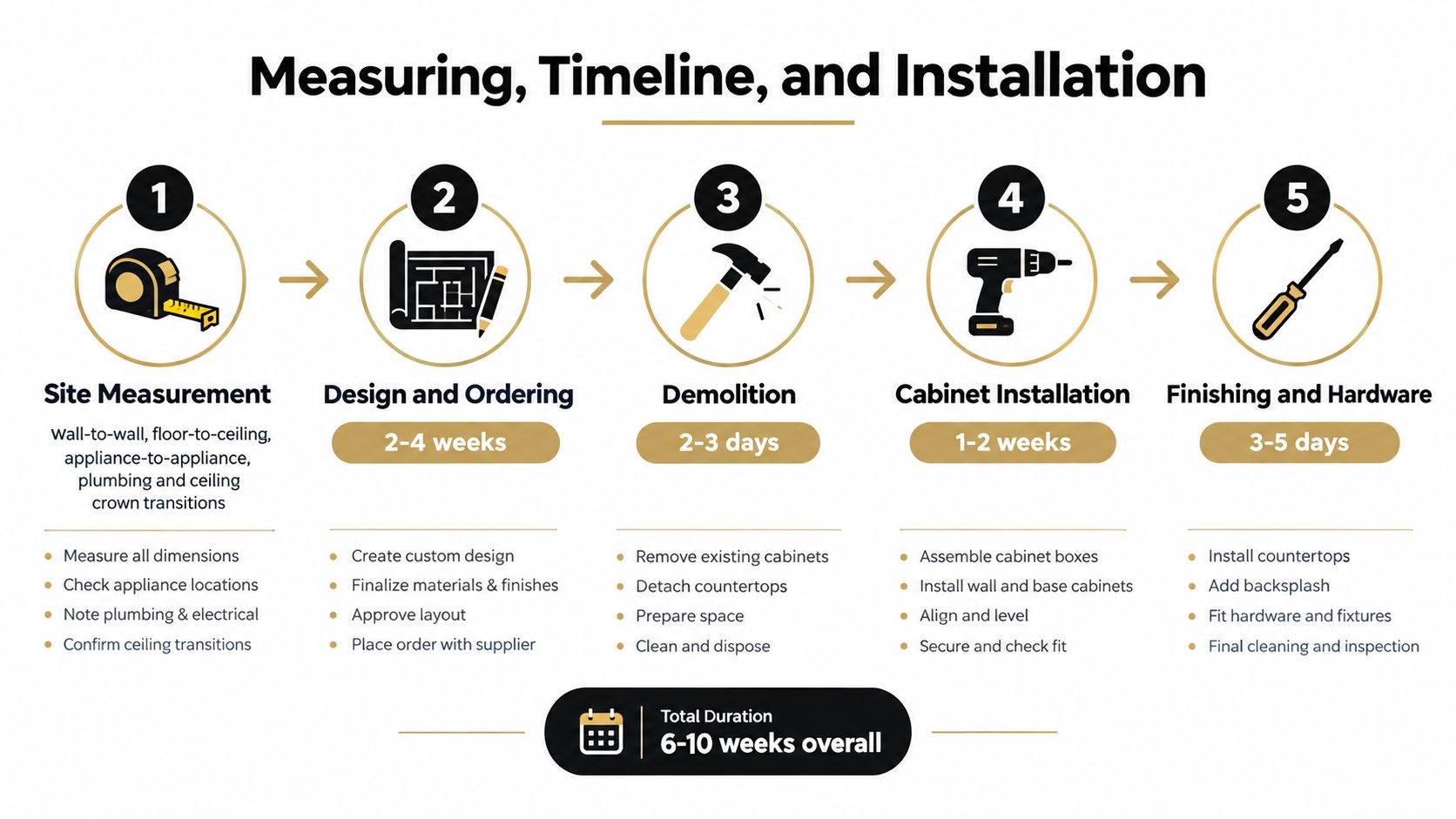
Record wall-to-wall dimensions, floor-to-ceiling heights, appliance clearances, window and door openings, plumbing, electrical outlets, vents, soffits, and ceiling crown transitions. Measure in several places. Floors and walls rarely stay perfectly straight.
Use this sequence:
- Site measurement: Record the room, openings, utilities, appliance specifications, and obstructions.
- Design and verification: Build the layout, check door swings and drawer clearances, and confirm finished-panel requirements.
- Order approval: Review the cabinet schedule, finish, hardware, accessories, and delivery conditions before signing.
- Demolition and preparation: Remove old cabinets, inspect walls and flooring, and correct conditions that would prevent a level installation.
- Delivery inspection: Count boxes, inspect doors and panels, and document damage before installation begins.
- Installation and adjustment: Level and secure the boxes, fit fillers and panels, align doors, and test every drawer.
- Finishing: Install hardware, moldings, toe-kicks, appliance panels, and final adjustments.
RTA cabinets shift more assembly and fitting work to the homeowner or installer. Pre-assembled cabinets reduce box construction on site, but they still require accurate leveling and scribing. Full custom cabinetry adds design coordination and manufacturing time. It can also reduce awkward field modifications when the room has unusual geometry.
Schedule the countertop template only after the base cabinets are installed, leveled, and secured. Appliance delivery should not determine the cabinet layout after the order is placed. Confirm refrigerator depth, range clearance, dishwasher opening, ventilation, and finished side panels before production.
Watch a kitchen cabinet installation video with those practical questions in mind. A capable installer should explain how the wall will be shimmed, how the boxes will be joined, and how the completed run will be protected from moisture.
An established custom manufacturer earns its premium when you need non-standard sizes, integrated appliance panels, complex corner angles, coordinated millwork, or one accountable party from design through installation. Sinclair Cabinetry provides custom kitchen cabinetry, design consultation, 3D planning support, and professional installation. Those services are most useful when coordination matters as much as the cabinet door.
Matching Cabinets to Your Remodel Goals
The right recommendation changes with the homeowner's priorities. A cabinet that's sensible for a tight budget can be the wrong choice for a complicated luxury layout, while a highly customized build may waste money in a simple kitchen with sound existing boxes.
| Remodel Goal | Best Cabinet Type | Best Material Pairing | Non-Negotiable Check |
|---|---|---|---|
| Budget-conscious update | Quality stock or straightforward semi-custom | Durable plywood components with a simple painted or wood door | Confirm complete installed scope and inspect hardware ratings |
| Luxury remodel | Custom cabinetry | Selected solid wood doors and trim with engineered structural panels | Approve shop drawings, samples, appliance panels, and finish details |
| Eco-conscious remodel | Semi-custom or custom with retained sound boxes where practical | Low-emission plywood or MDF components with responsibly sourced visible wood | Request emissions documentation and specify repairable, durable parts |
The budget-conscious homeowner should avoid spending the entire allowance on decorative moldings. Choose a cabinet line that fits the room without excessive fillers, then prioritize full-extension drawers, a protected sink base, and reliable soft-close hardware. Verify that installation, finished ends, panels, and delivery are included before comparing bids.
The luxury remodeler should commission custom work when the kitchen has unusual proportions or must coordinate with surrounding millwork. Approve the drawings before production, inspect a finish sample in the actual room lighting, and confirm how integrated refrigerators, dishwashers, panels, and ventilation will align.
The eco-focused homeowner should first ask whether every cabinet needs replacement. If the existing boxes are sound, refinishing or selective replacement can preserve useful material. For new components, request certified low-emission plywood or MDF systems, responsibly sourced visible wood where appropriate, and finishes selected for lower emissions and long service life.
Houzz's 2026 findings show wood cabinets chosen by 29% of renovating homeowners, up from the previous year, while white cabinets fell to 28%. The same study reports that 68% replace all cabinets and 27% choose partial cabinet upgrades, reinforcing the point that full replacement is common but not the only serious route, as documented in Houzz's 2026 kitchen remodeling trends.
If you're planning a kitchen remodel, Sinclair Cabinetry inc can help you evaluate custom layouts, wood species, finishes, hardware, and installation requirements before you commit to a cabinet order. Visit the company to discuss whether a full replacement, partial upgrade, or custom cabinet plan fits your room and remodeling goals.