

Your bathroom's layout is more than just where the fixtures go; it's the blueprint for daily function, flow, and feeling. A well-designed layout can transform a cramped, awkward space into a functional, spa-like retreat, while a poor one can lead to daily frustration. Choosing the right plan is the single most important decision in any bathroom remodel, impacting everything from plumbing costs to storage potential and overall comfort. An effective layout establishes the foundation, ensuring that every square foot serves a purpose.
In this guide, we move beyond the generic to offer a detailed exploration of nine distinct bathroom layout ideas. We will break down the specific pros, cons, and implementation tips for each configuration, from open-concept designs to highly compartmentalized plans. This practical approach will empower you to select a layout that is not only beautiful but perfectly tailored to your home and lifestyle. Once the core structure is set, thoughtful details can complete the vision. For instance, incorporating elements like stylish bathroom window treatment ideas can significantly enhance privacy and aesthetics, tying the entire room together. Let's explore the foundational plans that will make your ideal bathroom a reality.
1. Open Floor Plan Bathroom Layout
An open floor plan bathroom layout is one of the most transformative bathroom layout ideas, breaking down traditional walls to create a unified, expansive space. This approach, heavily influenced by modern Scandinavian designers and architectural pioneers like Tadao Ando, merges the shower, vanity, and sometimes even the toilet area into a single, flowing environment. The result is a spa-like retreat that feels larger, brighter, and more luxurious.
This design eliminates visual clutter and physical barriers, allowing natural light to travel unobstructed throughout the room. It’s a popular choice in high-end hotels and contemporary apartments where maximizing the sense of space is a priority. While it may seem unconventional, the open layout promotes a sense of calm and continuity, turning a purely functional room into an experiential sanctuary.
Key Characteristics
The defining features of an open plan bathroom create its signature seamless look. This infographic highlights the core principles that make this layout unique.
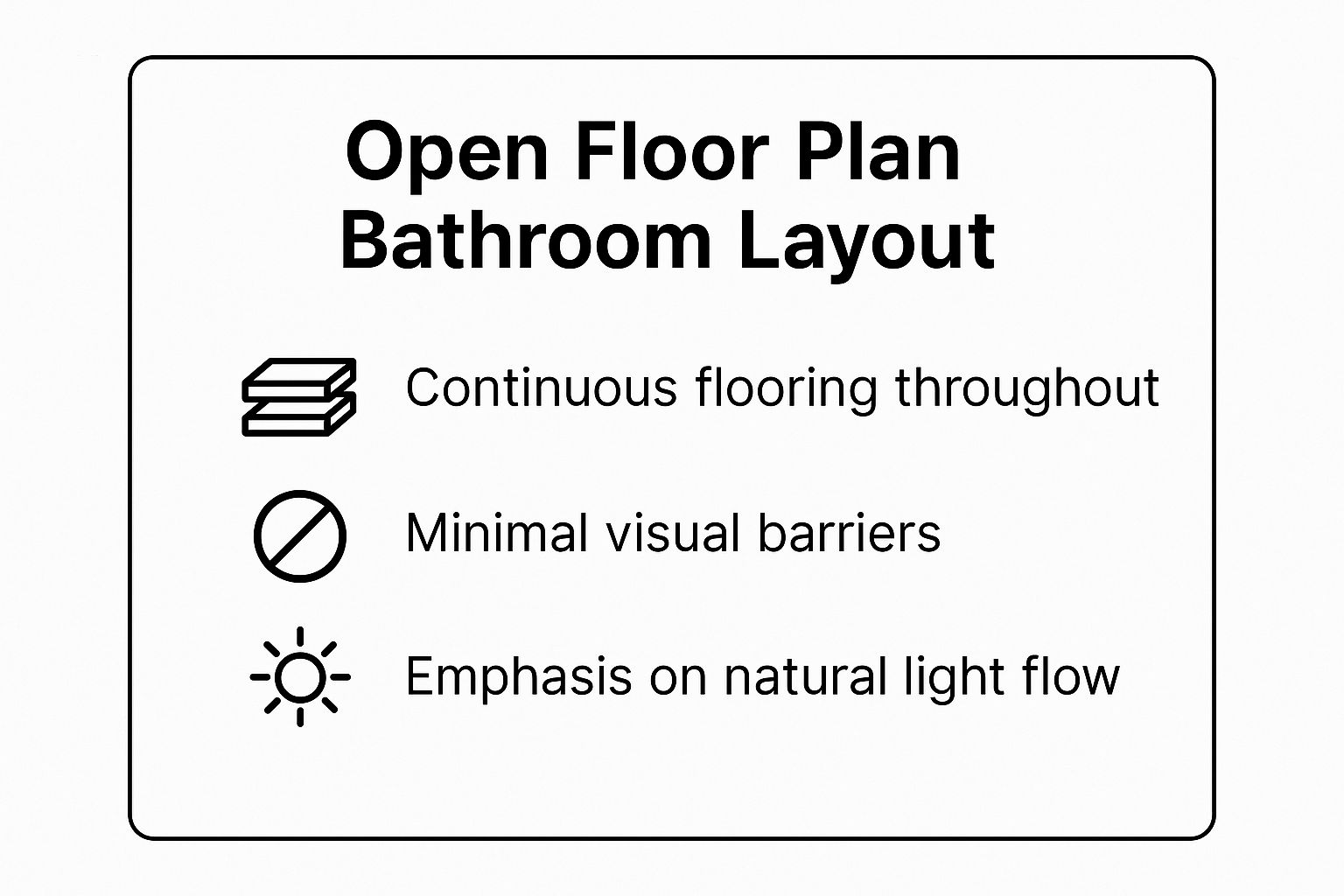
As the summary shows, the design relies on continuous flooring, minimal barriers, and abundant light to achieve its open, airy feel. This visual integration is what sets it apart from more conventional, compartmentalized layouts.
Implementation Tips
To successfully implement an open concept, thoughtful planning is essential.
- Privacy Solutions: Use frosted glass panels, partial walls, or strategically placed furniture to shield the toilet area without closing it off completely.
- Ventilation: A powerful, high-capacity ventilation system is non-negotiable to manage moisture and humidity effectively in a larger, open space.
- Heated Floors: Since there's no shower curb to contain water, a wet-room style floor with a central drain is common. Heated flooring makes the entire surface comfortable and helps water evaporate faster.
- Material Cohesion: Use consistent materials for flooring and walls to enhance the sense of a single, unified space. Pair this with a streamlined vanity to maintain the minimalist aesthetic. You can explore a variety of modern bathroom cabinet ideas that complement this style.
See It In Action
This video showcases a modern open-plan bathroom, providing a clear visual of how these elements come together to create a cohesive and functional space.
2. Linear Galley Bathroom Layout
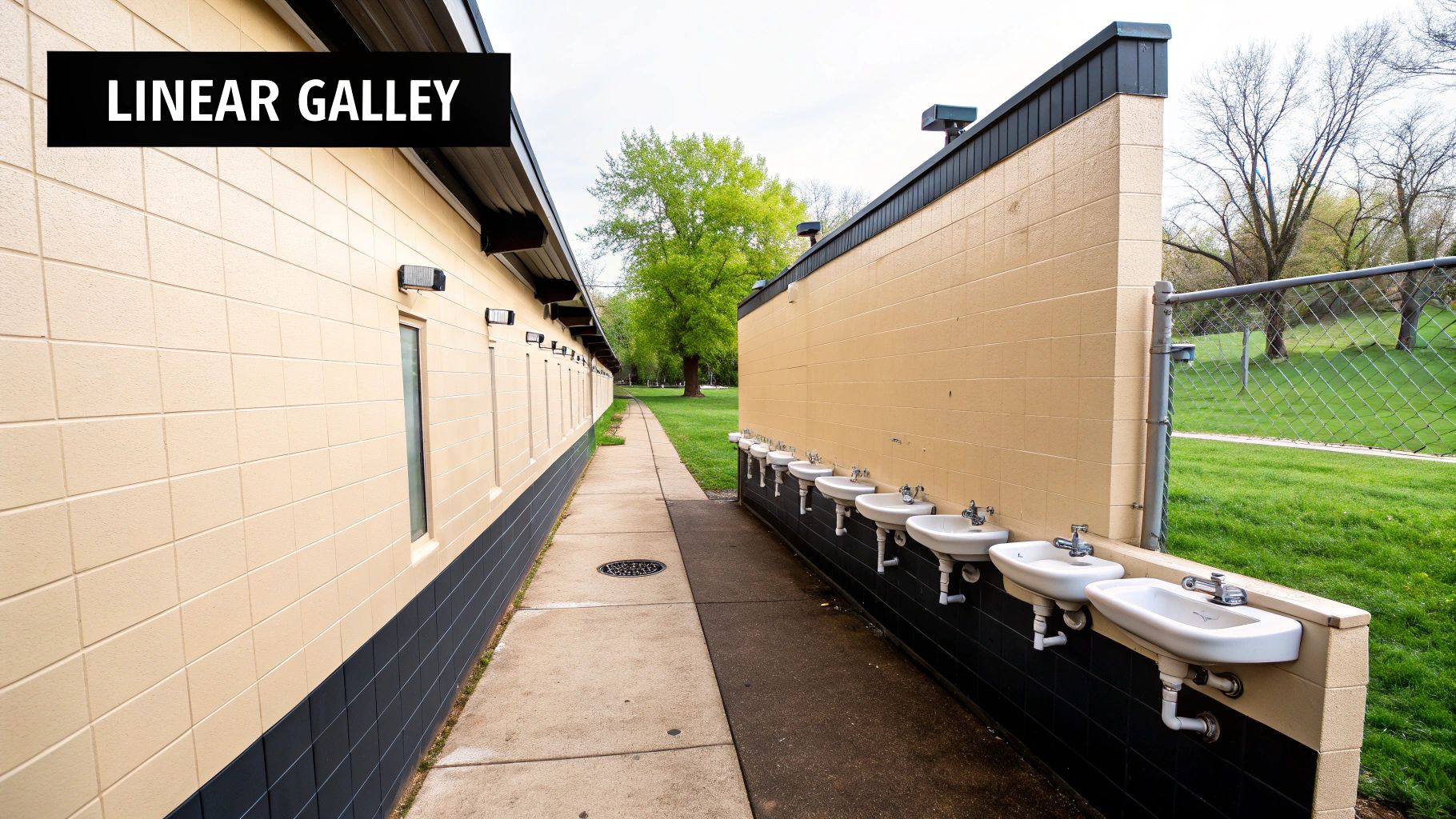
The linear galley bathroom layout is a highly efficient design that arranges all fixtures, such as the toilet, sink, and shower, along a single wall. This approach, heavily influenced by the streamlined functionality of ship galleys and modern small-space design principles, is one of the most practical bathroom layout ideas for narrow or rectangular rooms. It maximizes usable floor space by creating a clear, unobstructed pathway.
This layout is a go-to solution for urban apartment renovations, basement bathroom additions, and narrow powder rooms where every inch counts. By consolidating plumbing to one wall, it can also simplify construction and potentially reduce costs. The result is a clean, uncluttered, and highly functional space that feels organized and easy to navigate despite its compact footprint.
Key Characteristics
The defining feature of a galley layout is its single-wall configuration, which optimizes flow and function in tight quarters. The primary goals are maximizing floor area and creating an intuitive, linear progression from one fixture to the next. This minimalist arrangement avoids the cramped feeling that can occur when fixtures are placed on opposing walls in a narrow room.
This layout’s strength lies in its simplicity. By keeping all functional elements aligned, it establishes a strong visual line that makes the space feel longer and more orderly. It’s a testament to how thoughtful placement can overcome spatial limitations.
Implementation Tips
To execute a successful linear galley layout, strategic choices are key to enhancing the feeling of spaciousness.
- Wall-Mounted Fixtures: Use a wall-mounted toilet and vanity to free up floor space. This creates an uninterrupted floor plane, making the room appear larger and easier to clean.
- Mirrors and Lighting: Install a large, wide mirror above the vanity to reflect light and create an illusion of depth. Pair this with layered lighting to eliminate shadows and brighten the entire corridor.
- Space-Saving Doors: Replace traditional swing doors with a pocket door or a barn door. This reclaims the floor area that would otherwise be needed for the door's swing arc.
- Vertical Storage: Take advantage of wall height with tall, narrow shelving units or recessed medicine cabinets to provide ample storage without encroaching on the walkway.
3. L-Shaped Corner Bathroom Layout
An L-shaped corner layout is one of the most practical bathroom layout ideas for optimizing tricky corner spaces. This design efficiently utilizes two perpendicular walls, arranging fixtures in an “L” formation. Typically, a shower or bathtub is placed along one wall, while the vanity and toilet occupy the adjacent wall, creating a natural and functional workflow.
This layout is a favorite among residential architects and home renovators because it inherently creates distinct zones for wet and dry activities. The separation enhances functionality and prevents the space from feeling cramped, even in smaller bathrooms. It is an excellent solution for master en-suites, basement bathrooms, or any space where the bathroom must be tucked into a corner of the floor plan.
Key Characteristics
The L-shaped layout is defined by its strategic use of a corner to organize fixtures and maximize floor space. It divides the room into clear functional areas without needing physical walls.
This design often places the shower/tub combo in one arm of the L and the vanity/toilet in the other. This creates an open central area that improves traffic flow and makes the bathroom feel more spacious. The layout is versatile enough for both small and large bathrooms, adapting easily to different room dimensions.
Implementation Tips
To make the most of an L-shaped layout, careful planning of each zone is crucial.
- Corner Storage: Maximize the corner by using custom corner vanities, open shelving, or a tall linen cabinet to reclaim what would otherwise be dead space.
- Zone Lighting: Install dedicated lighting for each area. Use bright, focused task lighting over the vanity and softer, ambient lighting in the shower or bathing area.
- Curved Enclosures: A curved or neo-angle shower enclosure can soften the corner's sharp angle and free up valuable floor space in the central part of the room.
- Flooring Continuity: Using the same flooring throughout the entire bathroom will visually connect the two arms of the L, making the space feel larger and more cohesive.
4. Compartmentalized Bathroom Layout
A compartmentalized bathroom layout is a highly functional and practical design that divides the bathroom into separate, enclosed zones. This approach, heavily utilized by European designers and prominent in Victorian-era architecture, typically places the toilet in its own small room, often called a water closet. This separation allows multiple people to use different parts of the bathroom simultaneously while maximizing privacy.
This is one of the most family-friendly bathroom layout ideas, as it resolves the common issue of bathroom access during busy morning routines. By isolating functions, it enhances hygiene and creates a more orderly, multi-use space. It is a hallmark of luxury hotel suites and large family homes where efficiency and discretion are paramount.
Key Characteristics
The defining feature of a compartmentalized layout is its use of full walls and doors to create distinct functional areas. This infographic outlines the core principles that make this layout so effective for shared spaces.
As the summary shows, this design prioritizes privacy and multi-user functionality through physical separation. This structural division is what distinguishes it from more open and integrated bathroom designs.
Implementation Tips
To execute a compartmentalized bathroom layout effectively, careful planning of each zone is crucial.
- Ventilation: Each compartment, especially the water closet, must have its own dedicated ventilation fan to manage moisture and odors properly.
- Consistent Design: Use the same flooring, color palette, and fixture styles across all compartments to create a cohesive and unified aesthetic, despite the physical separation.
- Lighting Strategy: Install adequate, task-specific lighting in each zone. For instance, bright lighting is needed at the vanity, while softer, ambient light might be suitable for the toilet area.
- Smart Storage: With space divided, efficient storage becomes critical. You can explore a variety of bathroom cabinet organization ideas to ensure each compartment remains tidy and functional.
- Sound Insulation: Consider adding sound-dampening insulation to the interior walls to further enhance privacy between the compartments.
See It In Action
This video tour demonstrates a well-designed compartmentalized bathroom, showing how a water closet and separate vanity area can improve the flow and usability of a shared family bathroom.
5. U-Shaped Bathroom Layout
The U-shaped bathroom layout is one of the more luxurious and functional bathroom layout ideas, wrapping fixtures and storage around the user on three sides. Popularized by spa designers and custom home architects, this layout creates an immersive, cocoon-like environment. It effectively utilizes all available wall space for vanities, storage, and amenities, resulting in a highly efficient and well-organized room.
This design is ideal for larger, more rectangular spaces where it can form a natural and intuitive workflow. By placing the vanity, toilet, and shower or tub along three contiguous walls, it creates a private and encompassing sanctuary. The U-shape maximizes counter space and storage potential, making it a top choice for master suites and high-end bathroom renovations where comfort and utility are paramount.
Key Characteristics
The defining features of a U-shaped layout center on its comprehensive use of space and a sense of enclosure. It creates a distinct zone for each primary function, all within easy reach.
The layout’s strength lies in its ability to offer extensive countertops and cabinetry. This makes it perfect for shared bathrooms or for anyone who desires a well-appointed, clutter-free environment. Its enveloping nature provides an inherent sense of privacy and luxury that is difficult to achieve with other configurations.
Implementation Tips
To execute a successful U-shaped layout, careful planning is required to avoid a cramped or dim atmosphere.
- Strategic Lighting: Ensure ample lighting by layering ambient, task, and accent lights. Consider a central statement fixture or a skylight to brighten the space and prevent it from feeling enclosed.
- Color Palette: Use light and neutral colors for walls and floors to make the room feel larger and more open. This visually counteracts the enveloping nature of the three-wall design.
- Visual Breaks: Incorporate different materials, textures, or tile patterns to create visual interest and break up the continuous cabinetry. A contrasting backsplash or floor tile can add depth.
- Cabinet Dimensions: Proper vanity and cabinet sizing is crucial to maintain comfortable clearances and an open feel. You can find detailed guidance in this complete guide to bathroom vanity cabinet dimensions to ensure a perfect fit.
See It In Action
This video tour demonstrates how a U-shaped layout can be implemented to create a spa-like master bathroom, showcasing the balance between expansive storage and an open, luxurious feel.
6. Single-Wall Bathroom Layout
The single-wall bathroom layout is one of the most efficient and space-saving bathroom layout ideas, consolidating all major fixtures, the toilet, sink, and shower or tub, along a single wall. This linear arrangement minimizes plumbing complexity and maximizes open floor space, making it a go-to solution for narrow or small areas. It’s an incredibly practical design often seen in studio apartments, guest suites, and tiny homes.
Popularized by the tiny house movement and minimalist designers, this layout streamlines construction and reduces costs. By keeping all plumbing lines contained within one wall, it simplifies installation and future maintenance. The result is a highly functional, uncluttered bathroom that feels surprisingly open despite its compact footprint, proving that great design can thrive even in the smallest of spaces.
Key Characteristics
The defining feature of a single-wall layout is its linear efficiency. The toilet, sink, and shower are placed side-by-side, creating a clear and logical flow. This arrangement is the most compact way to organize a full or half-bath, making it ideal for converting closets or narrow hallways into functional bathrooms. Its simplicity is its greatest strength, offering a clean, organized aesthetic without sacrificing essential functions.
Implementation Tips
To execute a single-wall layout effectively, every inch must be used strategically.
- Wall-Mounted Fixtures: Choose a wall-mounted toilet and a floating vanity to free up floor space. This creates an illusion of a larger room by allowing the flooring to extend underneath, enhancing the sense of openness.
- Vertical Storage: With limited horizontal space, build upwards. Install tall, narrow shelving units, recessed medicine cabinets, or over-the-toilet storage to keep essentials organized without cluttering the countertop.
- Compact Fixtures: Opt for fixtures designed for small spaces, such as a narrow-profile toilet, a smaller sink, or a corner shower if it helps the linear flow.
- Large Mirrors: A large, wall-to-wall mirror can dramatically expand the perceived size of the room by reflecting light and creating an illusion of depth.
- Sliding or Pocket Doors: A traditional swing door can consume valuable floor space. A sliding barn door or a pocket door is an excellent alternative that saves room and enhances the layout’s efficiency.
7. Split Bathroom Layout
A split bathroom layout is a highly practical and efficient design that physically separates bathroom fixtures into two or more distinct zones. This approach typically isolates the toilet and sometimes a small sink in one compartment, while the main vanity, shower, and bathtub reside in a separate, larger area. Popularized by family home architects and shared housing designers, this layout maximizes functionality for busy households.
The core benefit of this design is that it allows multiple people to use the bathroom simultaneously without sacrificing privacy. One person can use the toilet while another brushes their teeth or takes a shower, a common scenario in master suites or shared family bathrooms. This compartmentalization makes it one of the most functional bathroom layout ideas for optimizing daily routines and reducing morning bottlenecks.
Key Characteristics
The defining feature of a split layout is its strategic division of space. The design prioritizes privacy and concurrent use by creating separate, functional zones within the overall bathroom footprint.
A split layout is ideal for Jack-and-Jill bathrooms connecting two bedrooms or for master suites where partners have different schedules. It enhances efficiency by preventing the entire bathroom from being occupied by a single user, making it a smart solution for high-traffic areas.
Implementation Tips
To execute a split bathroom layout effectively, careful planning of both zones is crucial.
- Plan Dual-Zone Storage: Ensure both the toilet compartment and the main vanity area have adequate storage. The toilet room needs space for toilet paper and cleaning supplies, while the main area requires storage for towels, toiletries, and other essentials.
- Prioritize Ventilation: The enclosed toilet and shower/tub areas must have powerful, independent ventilation fans to manage moisture and odors effectively.
- Maintain Design Cohesion: Use consistent flooring, color palettes, and fixture styles across both zones to create a unified, harmonious look despite the physical separation.
- Consider Accessibility: Ensure doorways are wide enough and that there is sufficient clearance in both compartments, particularly in the toilet area, to accommodate users of all mobility levels.
8. Circular/Curved Bathroom Layout
A circular or curved bathroom layout is one of the more artistic and unconventional bathroom layout ideas, trading sharp, linear angles for soft, flowing curves. This approach, championed by visionary architects like Zaha Hadid, creates a dynamic and organic space by incorporating curved walls, rounded vanities, and circular showers. The result is a highly sculptural environment that feels both futuristic and soothingly natural.
This design moves away from the standard box-like room, fostering a unique sense of movement and elegance. It excels in luxury homes and boutique hotels where making a bold architectural statement is key. By eliminating harsh corners, a curved layout can make a space feel more open and inviting, guiding the eye and foot traffic smoothly through the room.
Key Characteristics
The defining features of a circular bathroom are its non-linear forms and custom-built elements. These components work together to create a space that is as much a work of art as it is a functional room. The emphasis is on seamless transitions and organic shapes that defy traditional construction norms.
This layout prioritizes aesthetic impact and a fluid user experience. It often requires bespoke fixtures and meticulous craftsmanship to achieve its signature look, making it a true standout among bathroom design concepts.
Implementation Tips
Successfully executing a curved layout requires specialized skills and careful planning.
- Expert Construction: Work with builders and contractors experienced in curved wall construction and plastering. Standard techniques won't apply, and a flawless finish is essential.
- Custom Storage: Plan for custom-built cabinetry and shelving that conforms to the curved walls. Standard, straight-edged vanities and storage units will disrupt the layout’s flow.
- Flexible Materials: Use materials that can bend or be applied to curved surfaces, such as mosaic tiles, tadelakt plaster, or flexible wall panels. This ensures a seamless look.
- Strategic Lighting: Integrate lighting that accentuates the curves. LED strips tucked into coves or recessed lights placed along the curved path can highlight the unique architecture beautifully.
See It In Action
This video tour of Zaha Hadid's "City of Dreams" hotel showcases how curved forms can be applied on a grand scale, offering inspiration for how these concepts can be adapted into a residential bathroom setting.
9. Accessibility-Focused Universal Design Layout
An accessibility-focused universal design layout is one of the most thoughtful and future-proof bathroom layout ideas available. This approach transcends simple aesthetics, prioritizing safety, comfort, and usability for everyone, regardless of age, size, or physical ability. Championed by aging-in-place advocates and codified in standards like the Americans with Disabilities Act (ADA), this layout is about creating an inclusive environment that can adapt to changing needs over a lifetime.
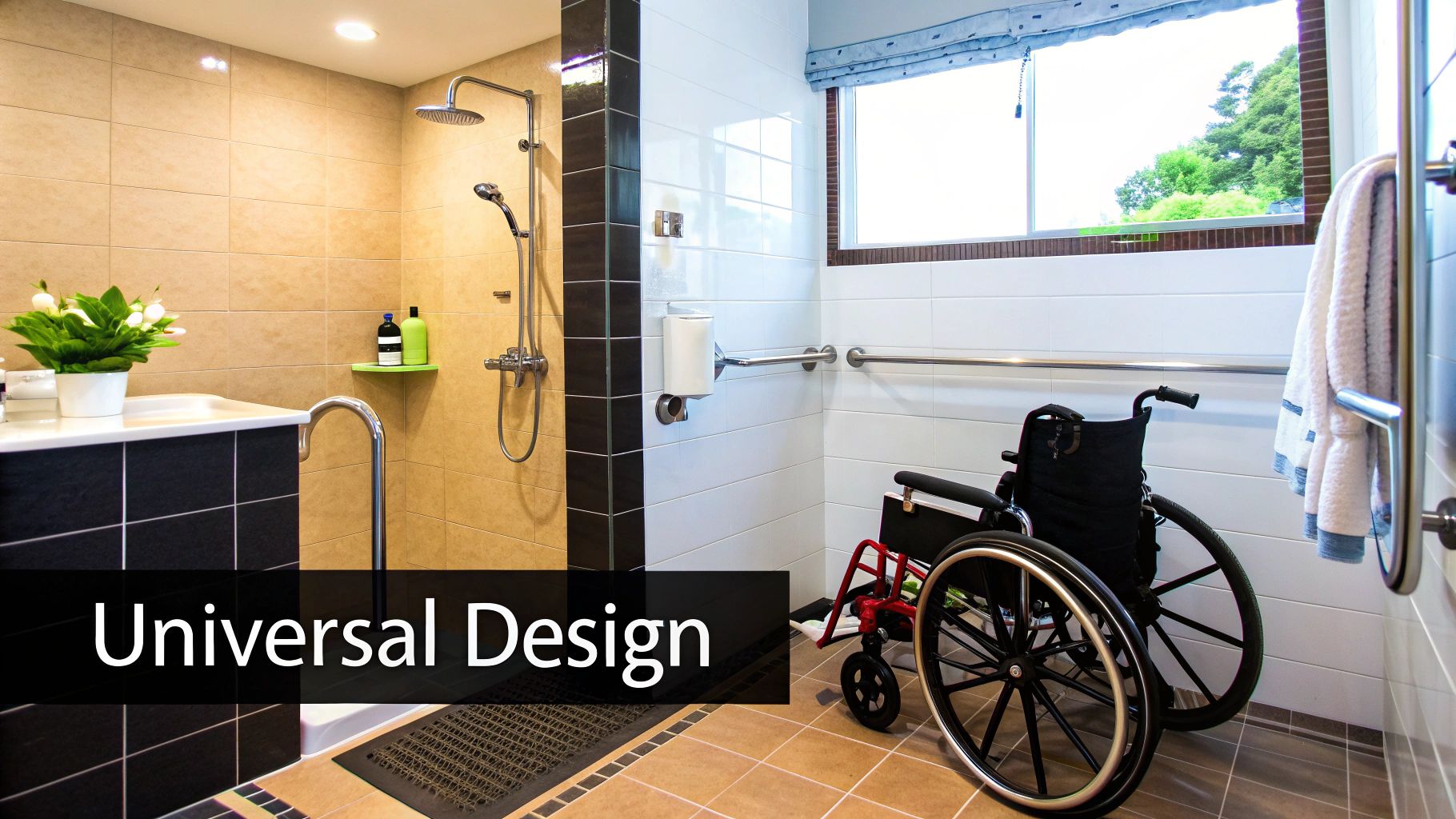
The core principle is to eliminate physical barriers. This means wider doorways for wheelchair access, curbless or "zero-entry" showers, and ample clearance around fixtures. It’s a design philosophy that marries function with form, proving that a safe bathroom can also be a beautiful and modern one. This layout is a standard in senior living facilities and rehabilitation centers, but it's increasingly popular in residential homes for forward-thinking renovations.
Key Characteristics
Universal design bathrooms are defined by their user-centric features that enhance independence and safety. These elements are seamlessly integrated into the design to feel intentional rather than institutional. A spacious turning radius for wheelchairs, reachable controls, and non-slip surfaces are foundational. The goal is to create a space that doesn’t require modification as a person's mobility needs evolve.
This layout ensures every user can navigate the space with dignity and ease. It replaces tight corners with open pathways and standard tubs with accessible, walk-in showers, making it a truly universal solution for any household.
Implementation Tips
Successfully creating a universal design bathroom requires careful planning and attention to detail.
- Consult ADA Guidelines: While residential homes aren't required to be ADA-compliant, the guidelines offer a proven framework for clearances, grab bar placement, and fixture heights.
- Plan for the Future: Think about potential future needs. Incorporate reinforced walls (blocking) where grab bars might be installed later, even if they aren't needed now.
- Use Attractive Safety Fixtures: Safety doesn't have to be sterile. Many brands now offer stylish, designer grab bars, shower seats, and faucets that blend beautifully with modern decor.
- Ensure Adequate Lighting: A well-lit bathroom is a safer bathroom. Combine ambient overhead lighting with task lighting at the vanity and in the shower. Use rocker-style light switches, which are easier to operate than toggles.
- Consider Emergency Access: Ensure the door swings outward rather than inward. This prevents a person who has fallen from blocking the entrance and allows for easier emergency access.
Bathroom Layout Ideas Comparison Matrix
| Bathroom Layout | Implementation Complexity 🔄 | Resource Requirements ⚡ | Expected Outcomes 📊 | Ideal Use Cases 💡 | Key Advantages ⭐ |
|---|---|---|---|---|---|
| Open Floor Plan Bathroom Layout | Medium – requires strategic dividers and ventilation | Moderate – good materials, ventilation, heating | Spacious feel, natural light, modern aesthetic | Luxury hotels, modern residential, spas | Larger space illusion, accessibility, light flow |
| Linear Galley Bathroom Layout | Low – simple alignment along walls | Low – efficient plumbing | Efficient use of narrow space, streamlined | Narrow apartments, boats, powder rooms | Space efficiency, cost-effective plumbing |
| L-Shaped Corner Bathroom Layout | Medium – corner optimization and zoning | Moderate – plumbing and lighting planning | Natural separation, flexible layout | Ensuite bathrooms, basements, small rooms | Good traffic flow, privacy, zoning |
| Compartmentalized Bathroom Layout | High – multiple enclosed zones, ventilation needs | High – more space, doors, ventilation | Maximum privacy, simultaneous use | Large family homes, luxury hotels, European style | Privacy, hygiene separation, noise isolation |
| U-Shaped Bathroom Layout | High – complex plumbing, three-wall usage | High – extensive materials and labor | Luxurious, ample storage, cocooned feel | Master suites, luxury, spas | Storage, luxury, efficient wall use |
| Single-Wall Bathroom Layout | Low – all fixtures on one wall | Low – minimal plumbing complexity | Ultra-compact, open floor space | Powder rooms, tiny houses, studios | Space efficiency, easy maintenance |
| Split Bathroom Layout | High – separate zones with duplicated needs | High – complex plumbing, separate ventilation | Privacy, simultaneous use | Family homes, Jack-and-Jill baths | Privacy, versatility, reduced humidity spread |
| Circular/Curved Bathroom Layout | Very High – custom shapes and fixtures | Very High – specialized construction | Unique, luxurious, smooth traffic flow | Luxury homes, spas, boutique hotels | Aesthetic uniqueness, safety, space maximization |
| Accessibility-Focused Universal Design Layout | Medium-High – compliance with ADA and safety standards | Moderate-High – reinforced structures and fixtures | Safe, accessible, future-proof | Aging-in-place, public restrooms, rehab centers | Universal access, safety, legal compliance |
Bringing Your Vision to Life with Premier Craftsmanship
Selecting the perfect bathroom layout is the foundational decision that dictates your daily routine, comfort, and the overall aesthetic of your home. As we've explored, the possibilities are as varied as your needs, ranging from the efficient Single-Wall design for compact spaces to the luxurious and expansive Open Floor Plan layout. Each option presents a unique blueprint for functionality.
The journey from a blueprint to a breathtaking reality, however, hinges on the details of implementation. A well-considered layout, whether it's an L-Shaped Corner or a highly organized Compartmentalized design, only reaches its full potential when supported by intelligent, high-quality components. This is where the synergy between layout and craftsmanship becomes paramount.
From Concept to Completion: The Role of Customization
The true success of any of these bathroom layout ideas lies in how effectively the space is utilized. This means moving beyond standard, off-the-shelf solutions and embracing customization that aligns with your chosen plan.
- Maximizing Space: A Linear Galley or U-Shaped layout can feel either cramped or spacious depending entirely on the storage solutions. Custom floating vanities can create an illusion of a larger room, while tailored tower cabinets can leverage vertical space without encroaching on essential traffic paths.
- Enhancing Functionality: For specialized designs like the Split Bathroom Layout or an Accessibility-Focused Universal Design, custom cabinetry is not just a luxury, it is a necessity. It allows for precise counter heights, accessible storage solutions, and integrated features that cater to specific user needs, ensuring the layout is practical and safe.
- Achieving a Cohesive Aesthetic: The beauty of a unique Circular/Curved Layout can be lost if the cabinetry fights against its organic lines. Custom-built cabinets can be designed to follow the curve of a wall, creating a seamless and integrated look that enhances the architectural vision.
Ultimately, the most impactful bathroom layout ideas are those that are executed with precision and a deep understanding of spatial dynamics. The transition from a promising floor plan to a functional, beautiful sanctuary is achieved when every element, especially the cabinetry, is thoughtfully designed to support the layout’s core strengths. Investing in quality craftsmanship ensures that your new bathroom is not only a visual masterpiece but also a lasting testament to smart design.
Ready to transform your chosen bathroom layout from a concept into a stunning reality? The experts at Sinclair Cabinetry inc specialize in creating custom, real-wood cabinetry that perfectly complements any design, from compact galleys to luxurious open-plan bathrooms. Explore our gallery and see how premier craftsmanship can elevate your project at Sinclair Cabinetry inc.