
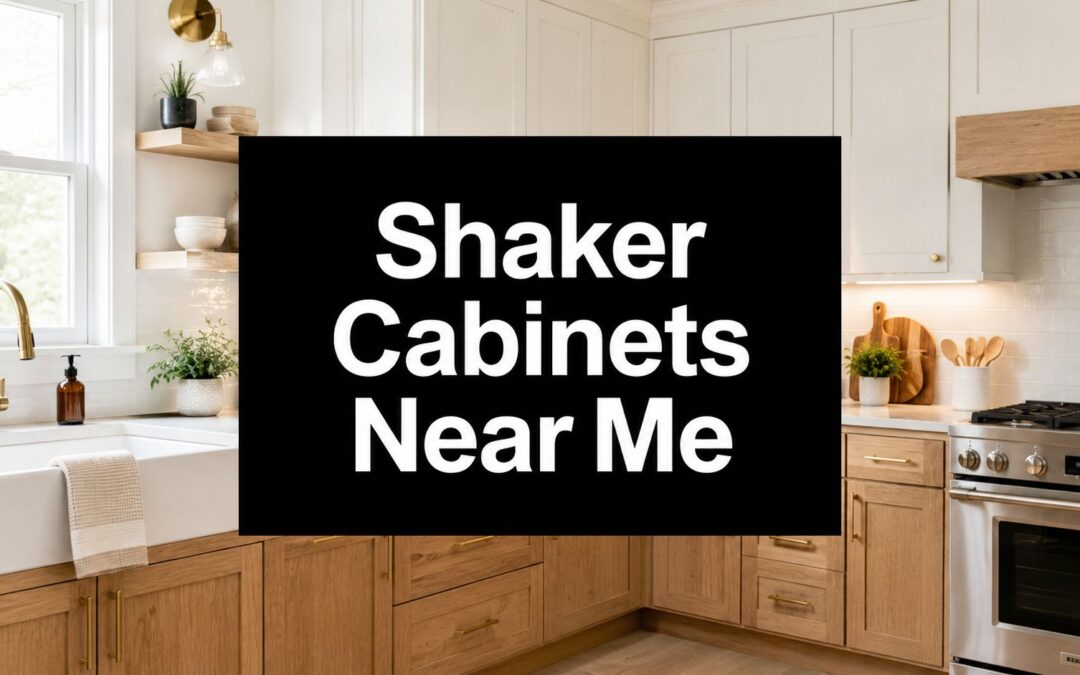
You're probably staring at a few browser tabs right now. One showroom promises “custom Shaker cabinets.” Another offers a lower quote that looks almost identical in the photos. A third says local, but the details are thin, and everything starts to blur together.
That's the problem with searching for Shaker cabinets near me. The style is easy to recognize, but the quality differences are buried underneath the door front, inside the drawer box, and behind the finish schedule. Two kitchens can look similar on day one and age very differently after a few years of cooking, humidity, cleaning, and daily use.
After decades in cabinet work, I can tell you this much. Homeowners rarely regret asking harder questions before they buy. They do regret paying for a “custom look” that turns out to be a standard box with a trendy door.
Why Shaker Cabinets Dominate Kitchen Design
There's a reason so many homeowners keep coming back to Shaker. Shaker cabinets remain the dominant cabinet door style in the United States, with 58% of homeowners selecting them for new or upgraded kitchen installations in 2026, according to the 2026 Houzz Kitchen Trends Study, as noted by Boss Design Center's summary of the Houzz Kitchen Trends Study.
That kind of staying power doesn't happen by accident. Shaker works because it doesn't fight the rest of the kitchen. It gives you clean structure without looking severe, and it can lean traditional, transitional, farmhouse, coastal, or modern depending on the wood, paint, hardware, and surrounding details.

What a Shaker cabinet actually is
A lot of buyers use “Shaker” as if it means a color or a whole cabinet system. It doesn't. It's a door style.
The classic Shaker door is a five-piece construction. It's similar to a picture frame built around a center panel. You have four outside frame parts and one recessed middle panel. That simple layout is what gives Shaker its crisp lines and quiet depth.
If you want a broader look at how Shaker compares with other profiles, this guide to kitchen cabinet door styles is useful because it helps separate door design from cabinet construction.
Why the style keeps working
Shaker survives trend cycles because it leaves room for the rest of the kitchen to speak. Ornate doors demand attention. Ultra-flat slab fronts can feel cold in the wrong room. Shaker sits in the middle.
That balance matters in real homes.
- It handles change well. New hardware, a new backsplash, or different countertops can shift the room without forcing a cabinet replacement.
- It fits painted and natural finishes. The profile is just as comfortable in white paint as it is in stained oak or walnut.
- It doesn't date quickly. Clean lines age better than fussy detailing.
Practical rule: If a cabinet style looks tied to one narrow trend, expect it to date faster than a simple five-piece Shaker profile.
When homeowners search for Shaker cabinets near me, they're usually asking for more than a door shape. They're asking for a kitchen that still looks right years from now. That's where style ends and craftsmanship begins.
Beyond the Look Materials and Finishes That Last
The biggest mistake I see is judging a cabinet by the face alone. A smooth painted door in a showroom can hide weak construction, poor finishing, and materials that won't hold up.
For painted Shaker doors, the material recipe matters. For painted Shaker cabinets to achieve long-term durability without cracking, the industry-standard material specification requires solid hardwood frames combined with HDF or MDF center panels, paired with a 2K polyurethane finish that provides essential flexibility to accommodate thermal expansion and humidity fluctuations, according to IST Cabinets on materials for durable Shaker cabinets.
That specification exists for a reason. Wood moves. It expands and contracts with changes in temperature and moisture. When a painted center panel is made from the wrong material, the finish often tells the story first.

What works in painted Shaker doors
A strong painted Shaker door usually combines the strengths of different materials instead of forcing one material to do every job.
Here's the practical breakdown:
- Solid hardwood frame gives the door strength where the joinery matters most.
- HDF or MDF center panel gives the paint a more stable surface in the middle field of the door.
- 2K polyurethane finish adds flexibility and toughness that basic field-applied paint often can't match.
What doesn't work as well is pretending that “all wood” automatically means better. For stained cabinetry, visible solid wood may be the right move. For painted Shaker, an all-solid-wood center panel can create movement that telegraphs through the finish over time.
Drawer boxes tell the truth
If I want to know whether a cabinet line is built seriously, I pull out a drawer.
A good drawer should feel firm, square, and confident under load. It shouldn't rack when you tug it from one corner. It shouldn't sound hollow. It shouldn't feel like thin material stapled together because that's often exactly what it is.
Premium Shaker drawer construction mandates 5/8-inch thick solid hardwood sides with dovetail joinery featuring pin angles between 7 and 14 degrees, as explained by IST Cabinets in its Shaker cabinet craftsmanship checklist. That detail matters because dovetails mechanically lock the drawer parts together instead of relying mainly on fasteners or glue.
A cabinet showroom can hide weak boxes behind attractive doors. A drawer box usually can't hide what it's made of.
What to inspect in person
Before you sign anything, look past the finish sample and inspect the cabinet like a craftsperson would.
| Quality marker | What you want to see | What raises concern |
|---|---|---|
| Door frame | Solid hardwood frame, tight joints | Open seams, rough corners |
| Center panel | Smooth stable panel suited for paint | Movement, telegraphed lines, waviness |
| Drawer box | Thick hardwood sides, dovetails | Thin sides, staples, loose fit |
| Finish | Even sheen, clean edges, no heavy buildup | Drips, orange peel, sharp paint ridges |
| Interior fit | Consistent reveals, aligned fronts | Crooked spacing, rubbing doors |
For buyers comparing options, this guide to the best materials for kitchen cabinets can help you connect showroom language to real performance.
A cabinet that lasts isn't just “wood.” It's the right wood in the right place, stable panel material where it belongs, and a finish system built for a lived-in kitchen.
Stock Custom or Something in Between
A lot of local cabinet shopping goes sideways. Homeowners hear “stock,” “semi-custom,” and “custom,” but many quotes don't explain what those labels mean. That leaves buyers comparing price tags instead of comparing what they're getting.
The first thing to understand is that Shaker is a style, not a quality level. Shaker-style doors cost the same as any other style per linear foot, ranging from $100 to $1,200, because the style itself is a door design, not a material difference, according to HomeAdvisor's cabinet cost guide. A high Shaker quote can represent premium hardwood construction, or it can represent an expensive semi-custom line with a less impressive cabinet box.

How the three categories differ
The simplest way to sort them is by flexibility.
| Cabinet type | Best for | Limitations |
|---|---|---|
| Stock | Tight timelines, straightforward layouts | Fixed sizes, fewer finish and accessory choices |
| Semi-custom | Buyers who want some modification without full custom build | You're still working within a manufacturer's system |
| Custom | Irregular spaces, design freedom, specific material and construction requirements | Longer lead times, more decisions, higher cost potential |
Stock cabinets are manufactured in preset sizes and limited configurations. If your kitchen layout fits the catalog well, stock can be perfectly serviceable. If your walls are out of square, your appliances are unusual, or you want precise alignment and proportions, stock often forces fillers and compromises.
Semi-custom lives in the middle. You get more finish choices, more sizing flexibility, and more add-ons. But many semi-custom lines still revolve around standard box rules.
Custom is where a shop builds to the room instead of asking the room to adapt to the catalog.
Why price per foot can mislead you
Linear-foot pricing is popular because it sounds simple. It isn't.
That number often hides the details that matter most:
- Cabinet box material
- Drawer box construction
- Door material
- Finish system
- Interior accessories
- Installation scope
A quote at the top end of the range doesn't prove it's custom. It may just mean the dealer added upgrades to a standard line. For a clearer comparison, this article on custom vs stock cabinets is worth reading before you review estimates.
Questions that expose the difference
When a local company says “custom,” ask these directly:
- Are the cabinet boxes built to my room, or selected from standard sizes?
- What is the box material?
- Are the drawer boxes dovetailed hardwood or another construction?
- Who applies the finish, and what finish system is used?
- How much of the project is modified from standard catalog offerings?
If the seller keeps bringing the conversation back to the door style but avoids the box, drawer, and finish details, you're not hearing the whole story.
There's nothing wrong with stock or semi-custom when the project and budget call for it. The problem starts when a buyer pays custom money for catalog cabinetry dressed up in a Shaker front.
How to Find and Vet Local Cabinet Makers
A smart search for Shaker cabinets near me starts online, but it should never end there. Photos can be flattering. Descriptions can be vague. You need a way to separate polished marketing from real cabinet work.
Start with the basic legwork. Look at project galleries. Read reviews with an eye for patterns, not just praise. Check whether the company talks clearly about materials, joinery, finish process, and installation. If everything is about “beautiful kitchens” and nothing is about how the cabinets are built, take note.

What to do before the showroom visit
Bring a little order to the process before you start collecting quotes.
- Measure the room roughly. Note wall lengths, ceiling height, window placement, door swings, and appliance locations.
- Save examples carefully. Don't just save “pretty kitchens.” Save details you like, such as inset look, painted finish, natural oak island, full-height pantry, or deep drawer stacks.
- Write down your pain points. Poor storage, wasted corners, not enough drawer space, awkward trash placement, weak pantry function.
Those notes help a cabinet maker design around how you live instead of handing you a generic layout.
Here's a useful video to watch before consultations:
What to inspect when you're there
Once you're in a showroom or shop, stop looking at the room as a whole and start isolating parts.
Open and close everything. Pull drawers all the way out. Look underneath shelves. Run your hand under face frames and on the back side of doors. Good cabinet work feels clean even where most buyers never look.
Premium Shaker drawer construction mandates 5/8-inch thick solid hardwood sides with dovetail joinery featuring pin angles between 7 and 14 degrees, which is why the drawer box deserves close attention during any showroom visit. You're checking for a joint that locks together mechanically, not a shortcut assembly that depends on staples and hope.
The questions that matter most
Ask questions that force specifics.
On door construction
“What are the frame and center panel materials on your painted Shaker doors?”On drawers
“Are the drawer sides solid hardwood, and are they dovetailed?”On finish
“Is this a factory-applied finish, and what product system is being used?”On installation
“Who installs the cabinets, and who handles adjustments after install if doors settle or reveals shift?”On scope
“What exactly is included in this quote, and what isn't?”On service after the sale
“If I have a finish or alignment problem later, who do I call, and what happens next?”
Don't ask, “Are these high quality?” Every seller says yes. Ask what the door is made of, how the drawer is joined, and who finishes the cabinet.
How to compare local bids without getting lost
When the estimates come in, put them side by side and compare the hidden parts, not just the headline number.
Look for these differences:
| Comparison point | Why it matters |
|---|---|
| Box material | Affects rigidity, screw holding, and lifespan |
| Drawer construction | Daily wear shows up here first |
| Finish process | Determines how the paint holds up in a working kitchen |
| Customization level | Tells you whether the kitchen fits the room or the catalog |
| Installation responsibility | Poor install can ruin good cabinets |
The local cabinet maker worth hiring won't get irritated by careful questions. They'll welcome them, because serious work stands up to inspection.
The Sinclair Advantage Craftsmanship in Cape Coral
In Southwest Florida, cabinet work has to do more than look good under showroom lighting. It has to survive day-to-day use in a climate that punishes weak materials and rushed finishing.
That's why experienced buyers look for builders who understand not only the Shaker profile, but also the construction choices underneath it. The strongest local shops don't treat cabinetry like boxed furniture. They treat it like built work, designed for a specific room, a specific use pattern, and a specific finish outcome.

What distinguishes a serious custom cabinet shop
A real custom approach usually shows up in a few places right away:
- Design control instead of forcing every layout into standard increments
- Material transparency so the buyer knows what is solid wood, what is engineered, and why
- Consistent build standards across doors, boxes, drawers, and finish work
- Installation discipline because even excellent cabinets can be spoiled by careless fitting
Those are not small distinctions. They're the difference between a kitchen that feels custom-made and one that feels assembled from available parts.
Why modern Shaker isn't just one thing anymore
A lot of local content still treats Shaker as if it only means painted white maple. That's outdated.
According to Vevano's guide to Shaker-style cabinets, local search content often misses the growing trend toward hybrid Shaker designs that use sustainable, non-traditional materials such as reclaimed wood or low-VOC composites while keeping the five-piece profile. That matters for buyers who want the classic look but don't want to be boxed into one material story.
Some homeowners want real wood grain and natural variation. Others want a painted finish with more panel stability. Some want a mix, such as a painted perimeter with a natural wood island. Eco-conscious buyers may also want to ask how a shop handles engineered components, reclaimed material options, and low-VOC choices without sacrificing cabinet integrity.
For those evaluating established local builders, this background on Sinclair Cabinets of Cape Coral Florida and its cabinet building approach in Southwest Florida gives useful context on what a long-standing custom shop can offer in this market.
The best Shaker kitchen isn't the one with the trendiest color. It's the one built with materials and methods that still feel solid after years of use.
Cape Coral homeowners, designers, and builders usually benefit most from a cabinet partner that can handle custom dimensions, real material conversations, and installation with accountability. In a market full of lookalikes, craftsmanship still separates the field.
Your Shaker Cabinet Project Checklist
If you're narrowing down options now, keep the process simple and disciplined. A good cabinet decision doesn't come from falling in love with one display kitchen. It comes from checking the parts that determine how the kitchen will perform after the novelty wears off.
Use this shortlist before you approve any order:
- Confirm the style first. Make sure you want a true five-piece Shaker door and not a loose imitation with a similar face.
- Ask about door construction. Painted Shaker doors need the right mix of frame material, center panel stability, and a durable finish system.
- Inspect the drawers. Open them, lift them slightly, and look at the joinery. A drawer is one of the fastest tells in the room.
- Clarify the cabinet category. Find out whether you're buying stock, semi-custom, or true custom built to your room.
- Compare quotes by construction, not just price. The cheaper bid may leave out material quality, finish quality, or installation details.
- Visit in person when possible. Photos don't show reveal consistency, finish texture, or drawer feel.
- Get precise about service. Know who measures, who builds, who installs, and who fixes issues if something needs adjustment.
A good Shaker kitchen should do two things at once. It should look calm and timeless, and it should hold up to real family use without constant excuses for why something is cracking, rubbing, sagging, or wearing too soon.
If you use your search for Shaker cabinets near me to ask better questions instead of chasing the nicest photo, you'll make a far better decision.
If you want help turning those quality checkpoints into a real kitchen plan, Sinclair Cabinetry inc can walk you through materials, construction options, and custom design choices without the usual showroom fog. It's a good next step if you'd like a clear conversation about what's being built for your home.