

Designing a home wine cellar is a delicate balance of art and science. It’s about creating a space that not only protects your collection but also says something about you. This goes way beyond just putting up some shelves; it means getting serious about location, climate control, custom cabinetry, and the right lighting to let your wines age gracefully.
Your Home Wine Cellar Design Journey
Building a proper wine cellar is a real investment—in your collection, yes, but also in your home. Unlike a simple wine fridge, a well-designed cellar creates a perfectly stable environment, which is absolutely critical for preserving the intricate flavors and aromas of fine wines for years, even decades. It turns a passion for wine into a beautiful, tangible part of your home. We'll walk you through the core pillars of creating a space that’s as functional as it is stunning.
While it might feel like a huge undertaking, the process really breaks down into four key areas:
- Choosing the Right Location: Where you decide to build your cellar sets the stage for everything else.
- Mastering Climate Control: This is the heart of your cellar, the engine that protects your investment from spoiling.
- Selecting Custom Cabinetry: The racking and cabinetry are what give the cellar its unique look and organizational flow.
- Implementing Perfect Lighting: The right lighting sets the mood and shows off your collection without harming the wine.
More Than Just Storage
A thoughtfully designed wine cellar becomes a personal sanctuary, a tasting room, and a showpiece for entertaining friends and family. It’s no surprise that more and more people are investing in these specialized spaces. The global wine cellar market was valued at USD 0.81 billion in 2024 and is expected to grow to USD 1.19 billion by 2033, fueled by a growing appreciation for premium wines. You can see more data on this trend from the folks at Business Research Insights. This growth just goes to show that homeowners are really starting to see the value in high-quality, dedicated wine storage.
A great wine cellar does more than store bottles; it creates an experience. It’s about crafting a destination within your home that celebrates the story of each wine in your collection.
For those of us who also want to build a space that’s as beautiful as it is responsible, there are plenty of sustainable practices to consider. If you're looking for a deep dive into creating an eco-friendly and efficient cellar, check out this excellent guide to designing a sustainable wine cellar.
Whether you’re dreaming of a sprawling basement conversion or a sleek, modern wine wall, getting these core principles right is the first step to making it a reality.
Choosing the Perfect Location for Your Cellar
The success of your entire home wine cellar rests on one big decision: where to put it. The right spot naturally works against the biggest threats to your wine—temperature spikes, humidity swings, light, and vibration. Getting this right from the start saves a ton of money and headaches later on.
The classic choice is always the basement, and for good reason. It’s usually underground, which gives it natural insulation and keeps it consistently cool and dark. This stable environment gives your cooling unit a huge head start in maintaining that perfect 55°F.
Evaluating Potential Spaces
But let’s be real, not everyone has a basement ready to go. Plenty of incredible wine cellars are built in some pretty unconventional spots. The trick is to look at each potential space and understand its built-in pros and cons.
Here are a few common spots we see transformed all the time:
- Under the Stairs: This is often dead space just waiting for a purpose. We can turn it into a compact, beautiful cellar, often with a custom glass enclosure that makes it a real showpiece.
- A Converted Closet: A walk-in closet or even a decent-sized hall closet can be a great candidate, as long as it's properly insulated and sealed off from your home's main HVAC system.
- An Unused Room: That spare bedroom that never gets used? Or maybe a section of a large pantry? We can frame it out and insulate it to create a totally dedicated wine environment.
When you’re scouting locations, you have to be ruthless about environmental factors. A window with direct sunlight is a deal-breaker—UV rays will absolutely ruin your wine. You also need to steer clear of heat sources like a furnace, water heater, or even the laundry room. These appliances create the kind of temperature spikes your cooling system will constantly have to fight against.
Think of your potential location as a partner in the project. A cool, dark, stable space is your best friend. A warm, bright, or vibrating area is going to make your climate control system work overtime, driving up costs and causing unnecessary wear and tear.
Spotting Hidden Problems
Beyond the obvious, you need to look for the subtle issues that can quietly sabotage your collection. Vibration is one of those sneaky culprits. A spot near a busy staircase or a wall that backs up to a washing machine can gently disturb the sediment in your aging wines over time.
Here’s a simple test that tells you a lot: grab a digital thermometer and hygrometer, place them in the potential spot, and just track the readings for a week. The data you collect will show you exactly what kind of daily temperature and humidity swings you’re up against. A space with wild fluctuations is going to demand much beefier insulation and a more powerful cooling unit. This little bit of homework is a crucial first step in protecting your investment for the long haul.
Mastering Climate Control for Optimal Aging
If your home wine cellar has a heart, it’s the climate control system. This is far more than a luxury—it’s the engine that actively protects your wine from oxidizing, aging too quickly, or losing its delicate flavors. The entire goal is to recreate the cool, damp, and incredibly stable conditions of a classic underground wine cave.
To get there, you need to nail two critical environmental factors:
- Stable Temperature: The sweet spot for long-term aging is right around 55°F (13°C). But honestly, the exact number is less important than consistency. Wild temperature swings cause the wine to expand and contract in the bottle, which can weaken the cork's seal and let in tiny amounts of damaging oxygen.
- Consistent Humidity: You’re aiming for a relative humidity between 50-70%. If it gets too dry, corks can shrink and become brittle, eventually failing. On the flip side, humidity creeping above 70% invites mold and can destroy your labels. For a closer look at managing moisture, our guide on cabinet humidity control has some great insights.
This decision tree infographic is a great way to visualize how to size up a potential location based on environmental red flags like heat, light, and vibrations.

As you can see, avoiding spaces with a lot of environmental instability is your first and most important step toward an efficient climate control strategy.
Choosing Your Cooling System
To create this perfect, stable environment, you need a dedicated cooling unit—and no, it’s not just an air conditioner. These are specialized machines engineered to cool the air while maintaining the right amount of humidity. There are three main types, and the right one for you really depends on your cellar's size and design.
To make it easier, here’s a quick breakdown of how the three main types of cooling systems stack up against each other. Each has its place, depending on your budget, cellar size, and how much you care about noise and aesthetics.
Comparing Wine Cellar Cooling Systems
| System Type | Best For | Installation Complexity | Cost | Key Feature |
|---|---|---|---|---|
| Self-Contained | Smaller cellars, DIY projects, and budget-conscious builds. | Low | $ | All-in-one unit that mounts through the wall, venting heat into an adjacent space. |
| Split System | Medium to large cellars where noise and aesthetics are important. | Medium (Requires HVAC pro) | $$ | The noisy condenser is placed outside the cellar, connected by a line set to a quiet evaporator inside. |
| Ducted System | Large, high-end cellars where the equipment must be completely hidden. | High (Requires HVAC pro) | $$$ | The entire unit is located remotely and delivers cool air via insulated ductwork, offering silent operation. |
Choosing the right system is a huge step, but it’s only half the battle. Now you have to make sure it can do its job efficiently.
The Supporting Cast: Insulation and Sealing
Your cooling unit can't do its job alone. Think of it like trying to cool your house with the windows open—it’s just not going to work. The cellar needs to be a sealed, insulated envelope.
This starts with proper insulation, which is measured in R-value. The higher the R-value, the better it resists heat transfer. We recommend a bare minimum of R-19 for the walls and R-30 for the ceiling.
A common mistake I see is people treating the cellar like any other room in the house. You have to create a completely airtight box. That means using closed-cell spray foam insulation, installing a vapor barrier on the "warm" side of the walls, and meticulously sealing every single gap around outlets, lights, and ductwork.
Finally, let’s talk about the door. It’s a critical component that’s often overlooked. A standard interior, hollow-core door offers almost no insulation. You absolutely need an exterior-grade, fully sealed door to prevent that precious cool air from escaping. When you close it, you should feel a noticeable seal, which tells you the integrity of your controlled environment is intact.
Designing Your Custom Cabinetry and Racking
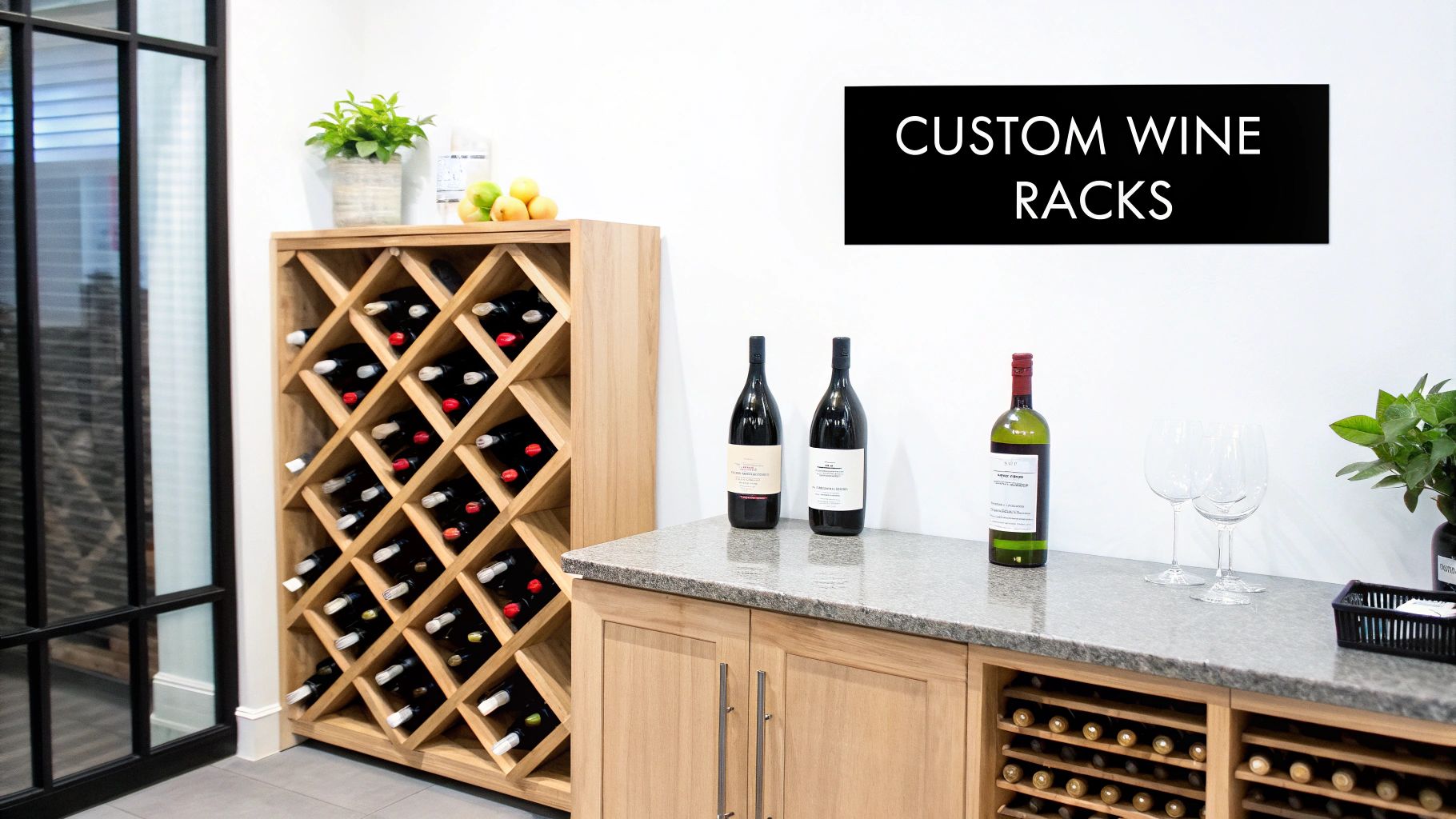
This is where the magic really happens. The cabinetry and racking are the visual heart of your wine cellar, turning a climate-controlled room into a stunning showcase for your collection. It’s the point where your personal style meets the practical demands of wine storage, creating a system that not only looks incredible but also makes finding that perfect bottle an absolute pleasure.
Let’s face it, every collection is different. You’ve got different bottle sizes, different aging timelines, and different ways you like to organize things. A one-size-fits-all approach from a big-box store just isn’t going to cut it. The beauty of going custom is that we can design a solution that works for you, making sure every square inch is put to good use.
Choosing Your Racking Style
How you display your wine says everything about you as a collector. The best cellars I’ve seen mix and match different racking styles to create a layout that’s both practical for storing cases and beautiful for showcasing those prized bottles.
Here are a few of the go-to options we work with:
- Individual Bottle Racking: This is the classic, workhorse style you see in most cellars. The single-bottle slots keep corks moist and make it easy to see your labels at a glance.
- High-Density Diamond Bins: Have a favorite wine you buy by the case? This is for you. Diamond bins are brilliant for maximizing capacity for a single varietal.
- High-Reveal Display Rows: These angled rows are your cellar’s spotlight, designed specifically to show off your best labels. They turn your most special bottles into works of art.
- Case Storage: Sometimes, simple is best. Sturdy, straightforward shelves designed to hold original wooden cases or cardboard boxes are perfect for collectors who like to keep wines in their original packaging.
The right combination of racking transforms your cellar from mere storage into a dynamic library of your collection. A well-placed display row can break up the visual monotony of standard racking and create a beautiful focal point.
This kind of detailed planning is what elevates a good cellar to a great one. It's no surprise that the global market for home wine cellar storage was valued at around USD 1.5 billion in 2025 and is only expected to grow. People want sophisticated, personalized storage that goes beyond just holding bottles.
Selecting the Right Materials
The materials you choose have a massive impact on both the look and longevity of your cellar. Traditional woods like redwood and mahogany are always popular, and for good reason—they’re naturally resistant to the high humidity and cool temperatures of a cellar environment.
But you’re not limited to wood. Sleek metal systems can give a space a sharp, contemporary edge, while acrylic racking creates an almost invisible, floating effect that puts all the focus squarely on the wine itself. At Sinclair Cabinets, we specialize in crafting solutions from high-quality, durable materials that are built to last. Our approach to custom cabinet design gives you a good sense of the possibilities.
Beyond Storage: Integrating Functional Spaces
A truly exceptional cellar is more than just racking. You have to think about how you’ll actually use the space. Adding a small tasting table or a built-in decanting counter can transform the room into an inviting spot to share a bottle with friends.
We often integrate custom cabinetry to hold glassware, decanters, corkscrews, and other accessories. This creates a cohesive, seamless look and ensures everything you need is right where you need it. If you're struggling to picture how it all comes together, a 3ds Max interior design guide can be a fantastic resource for creating photorealistic renderings. Thinking about these functional zones from the very beginning is the key to creating a space you’ll genuinely love spending time in.
Illuminating Your Collection with Perfect Lighting
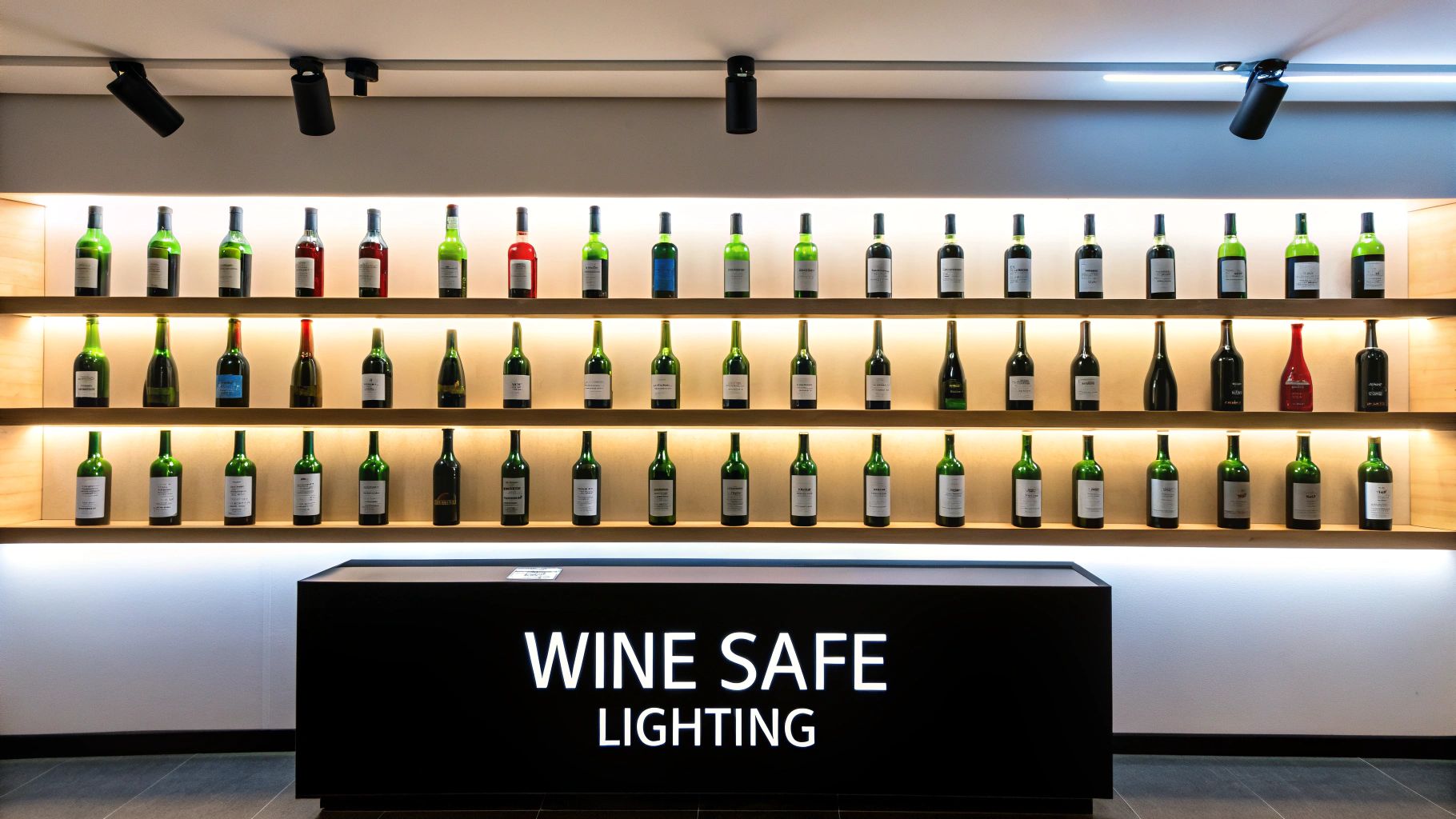
Great lighting can completely transform a home wine cellar, elevating it from a simple storage room into a breathtaking gallery. It’s that final, artistic touch that sets the mood, spotlights your favorite bottles, and makes the whole space feel inviting. But cellar lighting has a far more critical job than just looking good: it has to protect your wine from harm.
The truth is, traditional incandescent and halogen bulbs are the enemies of a healthy cellar. They kick out a surprising amount of heat, which can slowly cook nearby bottles and compromise your climate control. Even worse, many of them emit small amounts of UV light, which degrades the delicate organic compounds in wine, leading to premature aging and off-flavors.
The Superiority of LED Lighting
This is exactly why low-heat, UV-free LED lighting is the undisputed champion for any serious wine cellar. LEDs produce almost no heat and emit zero ultraviolet radiation. That makes them the safest, most energy-efficient choice for showing off your collection without putting it at risk.
The real goal is to create a layered lighting plan that’s both functional and dramatic. This usually means combining a few different types of fixtures, each with a specific purpose.
Here are a few strategies we use all the time to build a stunning lighting scheme:
- Accent Lighting: This is perfect for drawing the eye to specific parts of your collection. We often use discreet LED tape or puck lights to illuminate high-reveal display rows, making those prized labels really pop.
- Backlighting: For a truly show-stopping effect, we can install backlighting panels behind the racking. This creates a beautiful, ambient glow that silhouettes the bottles, adding a sense of depth and luxury to the entire room.
- Ambient Lighting: Finally, some general, low-level lighting from ceiling-mounted fixtures ensures you can safely navigate the cellar and read labels without flooding the space with harsh, damaging light.
Smart Controls for Ambiance and Protection
To really dial in the design, smart controls are a must. Installing dimmer switches on all your fixtures gives you complete control over the intensity, letting you create the perfect ambiance for any occasion—from a quiet evening selection to showing off the cellar to friends.
Remember, wine is happiest in the dark. The best lighting plan is one that is used sparingly and intentionally. Your cellar lights should only be on when you are in the room enjoying or selecting your wine.
A simple yet brilliant solution is to install motion sensors. This ensures the lights turn on automatically the moment you enter and, more importantly, turn off when you leave. It’s a foolproof way to protect your collection from accidental, prolonged light exposure. By layering these techniques, you get a visually stunning environment that is, first and foremost, a safe and stable home for your wine.
Finishing Touches That Define Your Cellar
With the main structure of your cellar built, it’s time for the details that bring the space to life. These are the finishing touches that transform a functional storage room into a true sanctuary for any wine lover, injecting your personal style into every corner.
Flooring is a perfect example of where you need to balance beautiful design with hardcore function. Of course, you want it to look great, but the material has to hold up in a cool, humid environment without warping or growing mold.
Sealed concrete is a bulletproof option and a great base, but many of our clients want something with a warmer, more inviting feel. We’ve seen incredible character added with materials like cork, tile, and even reclaimed wood sourced from old wine barrels. The absolute non-negotiable rule here is that any porous material, especially wood, must be sealed on all sides to lock out moisture. Skimp on this, and you're asking for trouble down the road.
The Critical Role of Your Cellar Door
Think of your cellar door as the gatekeeper to your collection. It’s far more than just a pretty entryway; it's a vital part of your climate control system. A standard, hollow-core interior door just won't cut it—it has virtually zero insulation and will bleed cool air, making your cooling unit work overtime.
You must, without question, use an exterior-grade, fully insulated door fitted with heavy-duty weatherstripping. When you shut it, you should feel a bit of resistance as the seal engages. That's how you know you've created the airtight environment your wine needs to age gracefully. Many designs incorporate glass for a sneak peek inside, but it has to be at least double-paned and UV-protected to prevent temperature fluctuations.
A properly sealed door is the final piece of the climate-control puzzle. If you can't feel the seal engage when you close the door, your cooling unit is constantly fighting a losing battle. That means higher energy bills and a shorter lifespan for your equipment.
Integrating Functional Elegance
A truly exceptional cellar isn't just for storage—it's designed for enjoyment. This is where you get to integrate functional elements that turn the space into an experience, and it's an area where custom solutions from Sinclair Cabinets really shine.
Think about incorporating features that fit how you live and entertain:
- A Tasting Station: This could be as simple as a small countertop for decanting or a full-blown bar area complete with a sink. It gives you a dedicated spot to pour, sample, and savor your collection without leaving the cellar's unique atmosphere.
- Glassware and Accessory Storage: We often design custom cabinets with elegant glass-front doors to show off your favorite stemware. We also include drawers specifically sized for corkscrews, decanters, and other essential tools.
- Integrated Humidors: For those who appreciate a fine cigar as much as a fine wine, we can build a Spanish cedar-lined humidor right into the cabinetry. It seamlessly integrates another passion into the space while maintaining perfect humidity levels.
These are the elements that let the personality of your home wine cellar design come through. The right cabinet finishing techniques can tie the whole look together, creating a cohesive style from the wine racks to the tasting table. It’s these thoughtful additions that make your cellar not just a place to keep wine, but a destination to truly savor it.
Got Questions About Your Future Wine Cellar?
Even the most buttoned-up plan is going to spark a few questions. It’s only natural. Thinking through the common unknowns—from budget and timelines to what happens after the build—is how you move forward without any second-guessing. Let's tackle some of the big ones we hear all the time.
So, what’s this going to cost? It's the first thing everyone wants to know. While pinning down an exact number without a blueprint is impossible, a properly built custom wine cellar is a real investment. You can expect to start in the low five figures, and the sky's the limit from there. The final number really comes down to the cellar's size, how complex the climate control system needs to be, and the level of custom cabinetry you envision.
How Long Does a Wine Cellar Project Take?
The timeline for designing and building a home wine cellar can really vary. A straightforward conversion of a small closet might be wrapped up in a few weeks. But if you're dreaming of a large, fully custom basement cellar with intricate cabinetry and a ducted cooling system, you could be looking at several months from the first sketch to the final bottle.
A few key things will shape your schedule:
- Design Complexity: The more detailed and unique you get with the racking, lighting, and finishes, the more time we'll need for design and fabrication.
- Permitting: Your local codes might require building permits, especially for bigger projects. That process can add some waiting time to the front end.
- Lead Times: Custom pieces like cellar doors, specialized cooling units, and, of course, handcrafted cabinetry all have their own production schedules that we need to juggle.
One of the biggest mistakes we see is rushing the foundational work. Proper framing, insulation, and installing a vapor barrier are painstaking steps. They're also the non-negotiable bedrock of a cellar that will actually protect your wine for the long haul.
How Much Maintenance Are We Talking About?
Good news. Once your cellar is built, the upkeep is pretty minimal, but it is important for protecting your collection. The number one task is getting your cooling unit serviced regularly. Think of it like your home's HVAC system—an annual check-up keeps it running efficiently and holding that perfect 55°F.
Beyond that, you’re mostly just keeping an eye on things. Check the door seal every so often to make sure it’s still airtight. Glance at your hygrometer to confirm humidity levels are staying where they should be. With a quality build, the cellar itself—from the insulated walls to the Sinclair Cabinets racking—is designed to perform for a lifetime with very little fuss. It's all about being proactive so your cellar can be a source of pride and enjoyment for decades.
Ready to stop dreaming and start designing? The experts at Sinclair Cabinets can help you create a custom wine cellar that perfectly balances function and style. Visit us to schedule your consultation today.