
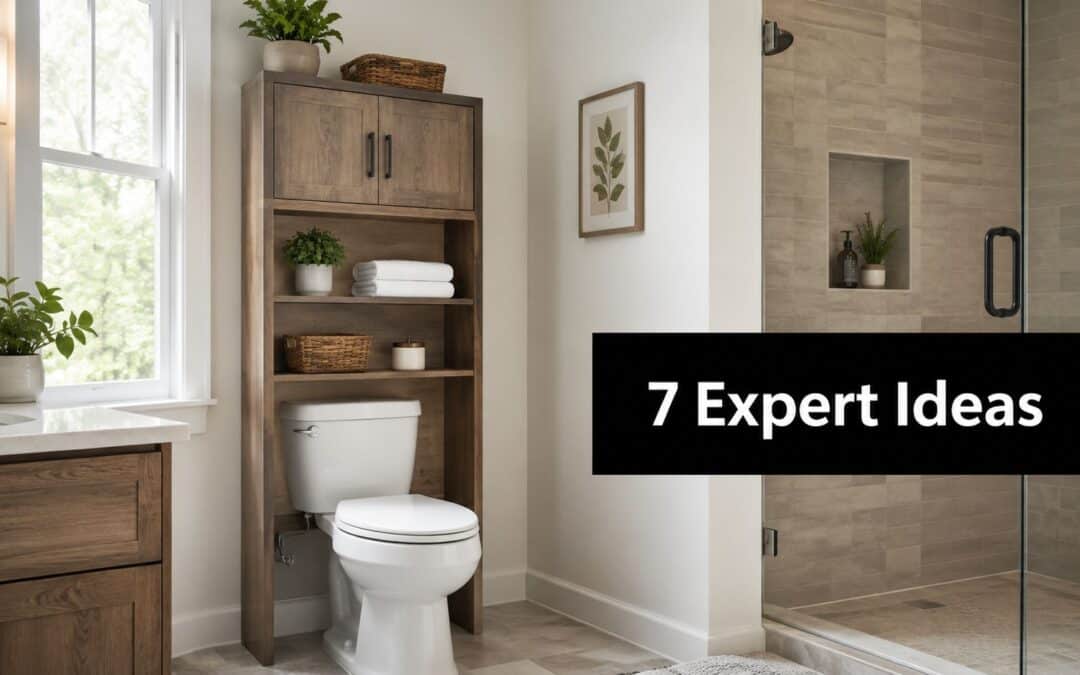
That empty wall over the toilet usually stays blank until the bathroom starts overflowing with backup toilet paper, extra hand towels, cleaning supplies, and all the small daily items that don't fit in the vanity. Then the problem becomes obvious. You need storage, but you can't afford a solution that feels bulky, collects dust, or makes a tight bathroom even tighter.
That's why smart bathroom cabinet ideas over toilet work so well. In the United States, over 60% of homes have bathrooms under 40 square feet, and 78% of interior designers recommend maximizing vertical space in compact bathrooms to improve function, according to Driven by Decor's bathroom storage overview. The space above the toilet is often one of the few usable zones left.
A good cabinet in that spot does two jobs at once. It stores what you need close at hand, and it finishes the room so the toilet wall looks intentional instead of forgotten. A bad one does the opposite. It crowds your headspace, traps moisture, and turns into visual clutter.
The best solutions come down to fit, depth, material choice, and installation method. Some bathrooms need a shallow built-in that disappears into the wall. Others need a tall enclosed tower, a floating cabinet, or a custom wood unit that matches the vanity and trim. When the fit has to be exact, custom work usually wins because it solves the awkward dimensions that off-the-shelf pieces ignore.
1. Custom Real Wood Over-Toilet Cabinet with Open Shelving

If you want one idea that consistently outperforms basic store-bought organizers, this is it. A custom real wood cabinet with doors above and one or two open shelves below gives you the right split between hidden storage and display space. It keeps everyday bathroom stock tucked away while still leaving room for rolled towels, a small plant, or a tray for decorative bottles.
This style works especially well in bathrooms that already have a vanity worth matching. If the room has shaker doors, natural oak, painted maple, or a marble top, the over-toilet cabinet should look like it belonged there from the beginning. That's where real wood bathroom cabinets from Sinclair Cabinetry make sense as a premium option. The finish, wood grain, and door profile can be carried across the room instead of patched together with a near match.
How to size it so it feels built in
The biggest mistake is building too deep. Clearance matters more than people expect when they're standing up from the toilet or cleaning around it. Install height matters too. Over-the-toilet cabinets are typically placed 18 to 24 inches above the toilet tank for comfortable access while preserving headroom, according to the bathroom storage guidance at Backsplash.
Practical rule: Match the cabinet depth to the vanity depth only if the room can handle it. In many small bathrooms, shallower is better even when a deeper box would technically fit.
Use the closed upper section for unattractive essentials. Put extra paper products, wipes, backups, and travel-size toiletries behind the doors. Keep the open shelf restrained. One basket, one folded towel stack, one accent piece. More than that starts to look like overflow storage instead of design.
Real wood also holds up better in a bathroom when it's finished correctly and paired with decent ventilation. Cheap composite units often look tired fast around steam and daily cleaning. If you're investing in a bathroom remodel, this is one of those areas where material quality shows.
2. Recessed Over-Toilet Medicine Cabinet with Mirror Integration
You notice the problem the first time you use a small bathroom after a remodel. The vanity looks good, the toilet fits, but the wall above it still feels busy once a standard cabinet starts projecting into the room. A recessed medicine cabinet solves that by putting storage inside the wall instead of in your path.
That matters most in guest baths, powder rooms, and narrow primary bathrooms where every inch of projection changes how the room feels. A mirrored front earns its keep twice. It hides daily-use items and gives you a reflective surface that helps the room read larger and brighter.

Where this idea works best
The wall has to cooperate. Recessed cabinets fit best in an interior wall with a clear stud bay and no drain line, vent stack, supply lines, or major electrical run in the target area. Exterior walls are harder because insulation depth and vapor control matter, and older homes often hide surprises once the drywall opens.
Depth is the first practical decision. Many recessed medicine cabinets are limited by standard stud depth, so storage capacity depends more on smart interior layout than on making the box deeper. Before ordering, compare your opening and rough framing against standard medicine cabinet proportions and bathroom cabinet dimension guidelines for real-world sizing. That step prevents a common mistake. Choosing a unit that fits the wall cavity but looks undersized above the toilet.
Mirror style should match the rest of the room, not fight it:
- Frameless mirror fronts fit modern baths with flat-panel vanities and minimal hardware.
- Wood-framed mirrors tie in better when the vanity has a face frame, molding, or a painted furniture look.
- Adjustable glass shelves and interior lighting make a shallow cabinet more usable because small items stay visible instead of getting lost in the back.
Closed storage also stays cleaner than open shelving in a bathroom. The National Library of Medicine notes that flushing can disperse aerosol particles and contaminate nearby surfaces, which is one reason I prefer doors over exposed shelves above a toilet in working bathrooms, as discussed in this review of bioaerosols and toilet plume exposure.
For readers who want to see one installation approach in action, this walkthrough is useful before you commit to measurements or framing changes:
Custom work is often the better route here because recessed installations punish sloppy tolerances. If the mirror is slightly off-center over the toilet, if the face frame misses the tile lines, or if the door swing fights a side wall or sconce, the whole installation looks improvised. A custom recessed cabinet lets you tune width, reveal, frame style, mirror size, and interior storage to the exact wall conditions, which is how you get a built-in result instead of a medicine cabinet that happens to fit.
3. Tall Narrow Over-Toilet Cabinet Tower for Compact Bathrooms
Some bathrooms don't need a wide cabinet. They need a vertical one. A tall narrow tower makes sense when the wall over the toilet is limited, but the ceiling height gives you room to build upward.
This is one of the strongest bathroom cabinet ideas over toilet for apartments, narrow powder rooms, and secondary baths where floor space is scarce. In modern award-winning bathroom designs for 2026, experts highlighted a shift toward vertical floor-to-ceiling storage and pullout mechanisms over static shelving, according to Houzz's best bathroom storage ideas feature. That direction makes sense in real homes because it gets storage off the floor and reduces visual sprawl.

Why towers outperform short cabinets in small rooms
A short cabinet often leaves awkward dead space above it. A tower turns that same wall into a full storage zone. Put less-used items high, eye-level items in the middle, and bulky backups lower down where they're easy to reach.
The details matter:
- Closed doors first: In a tight room, hidden storage always looks calmer than exposed stacks of products.
- Pullout interiors help: Shelves at the back of a deep tower are hard to use. Pullout trays or drawers fix that.
- Light finishes expand the room: White oak, painted white, and pale taupe all keep the tower from feeling heavy.
Before designing one, check proportions against the room and toilet placement. A good starting point is to compare the cabinet footprint with standard fixture spacing and usable wall area. Sinclair's standard bathroom cabinet dimensions guide is useful for understanding how cabinet sizing relates to real bathroom constraints.
Taller storage works only when the lower section doesn't crowd the user. Height is an asset. Bulk isn't.
I'd use this style in a one-bedroom condo, a guest bath with no linen closet, or a family bathroom where paper goods and towels need a dedicated home. It's practical, and when it's built to the ceiling, it looks intentional instead of temporary.
4. Corner Over-Toilet Cabinet with Diagonal Configuration
Bathrooms with corner toilets can be frustrating because standard cabinets don't respect the geometry. They either leave gaps, force awkward door swings, or crowd the room in the wrong direction. A diagonal corner cabinet solves that by using the dead angle instead of fighting it.
This is a custom problem, not an off-the-shelf one. If the toilet sits in a corner of a period home, a powder room addition, or an unusual primary bath layout, the cabinet needs to be shaped around the room's exact angle and surrounding trim. That's why this idea tends to work best when it's designed from scratch.
What makes a corner cabinet usable
A triangular cabinet can look clever and still be annoying to use. The inside has to be planned as carefully as the outside. Good corner cabinets often need narrower shelves, door opening limits, or specialty interior hardware so contents aren't lost in the back.
For some layouts, I prefer one diagonal door with simple interior shelving. For others, a split-door face or rotating interior accessory makes more sense. It depends on how close the side walls are and whether the user needs quick access or bulk storage.
Expert guidance on built-in bathroom storage also points toward shallow cabinetry that maintains visual continuity with nearby vanity proportions, especially when the toilet is exposed in the main bathroom rather than enclosed in a separate water closet. It also notes that specialized internal configurations can help when plumbing or adjacent fixtures create obstructions, as outlined in Suzette Gebhardt's built-in bathroom storage ideas.
If your bathroom has this kind of awkward footprint, custom corner work is the difference between “it fits” and “it belongs.” Sinclair's custom corner cabinets show the kind of customized approach these layouts require.
The right corner cabinet should make the toilet wall feel resolved. If it still looks accidental after installation, the proportions were wrong.
This style suits boutique, design-forward bathrooms where every inch needs to earn its keep. It's also one of the few ways to turn a strange toilet placement into a finished architectural feature.
5. Over-Toilet Cabinet with Integrated Towel Bar and Hooks
When wall space is limited, combining functions is usually better than adding more separate accessories. An over-toilet cabinet with a towel bar below and hooks on the side or underside puts storage and daily-use hardware into one compact unit. That keeps the room cleaner visually and reduces the patchwork look that happens when bars, hooks, shelves, and cabinets all compete for different wall spots.
This style works especially well in family baths, guest baths, and smaller primary bathrooms where towels otherwise end up on the door or the back of the toilet.
The hardware choices make or break it
The cabinet itself may be simple. The success of the piece depends on where the bar sits, how the hooks project, and whether the metal finish matches the rest of the room. If the bathroom has polished nickel faucets, matte black shower hardware, or unlacquered brass lighting, the cabinet hardware should support that choice rather than introduce a fourth finish.
Use the integrated bar for hand towels or lightweight bath towels only if there's enough circulation around them. Hooks are often better for robes, cleaning cloths, or spare hand towels.
A few practical choices matter here:
- Match the finish family: Pulls, hooks, and towel bars should relate to the faucet and lighting.
- Protect the wood: Any area near damp towels needs a durable finish and sealed edges.
- Keep hooks disciplined: Too many hooks turn the cabinet into a catchall.
For coordinating those details, Sinclair's guide to cabinet hardware finishes is a helpful reference when you're trying to unify wood tone, metal finish, and bathroom style.

A modern farmhouse bathroom might use a painted shaker cabinet with dark bronze hooks. A spa-style primary bath could use rift-cut white oak with brushed nickel hardware and a slim towel rail below. The idea is less about ornament and more about reducing clutter by making one element do more than one job.
6. Floating Over-Toilet Cabinet with Hidden Wall Mounting
A floating cabinet is the best choice when you want the room to feel lighter. Because the unit doesn't visually touch the floor and the mounting is concealed, the wall reads as cleaner and more architectural. In modern bathrooms, that can be enough to make the toilet area feel designed instead of purely utilitarian.
But this isn't the forgiving option. Floating units demand proper structure, careful weight planning, and disciplined sizing.
What works and what doesn't
A floating cabinet works when the wall framing is solid, the cabinet stays relatively shallow, and the contents are predictable. It fails when someone installs a heavy box on weak anchors and then packs it with bulk products. That's where wobble, wall damage, and long-term sagging start.
There's also a practical divide between homeowners and renters. Data from 2025 to 2026 cited in a home design discussion indicates that 68% of small bathroom remodelers in urban markets prefer freestanding units with doors, in part because many DIY guides assume permanent stud anchoring that renters can't always do, according to this bathroom storage discussion reference. That's a real trade-off. Floating storage looks sharp, but it isn't always the most adaptable answer.
Use a floating cabinet when the bathroom is owner-occupied, the wall can support the installation, and the style of the room leans modern or minimalist. Keep the lines simple. Slab doors, integrated pulls, or very restrained hardware usually suit this look best.
A floating cabinet should feel effortless after installation. Getting it there usually isn't effortless at all.
In high-rise condos and newer homes, this style often looks right because the architecture is already clean-lined. In older homes with ornate trim or uneven plaster, the cabinet needs especially careful detailing or it can look disconnected from the rest of the room.
7. Over-Toilet Cabinet with Decorative Crown Molding and Trim Details
When the bathroom has traditional bones, a plain box over the toilet looks underdressed. Crown molding, face-frame detailing, furniture-style panels, and finished side trim help the cabinet read as built-in millwork instead of added storage. This approach is ideal for transitional baths, classic primary suites, and homes where the vanity, casing, and baseboards already have architectural presence.
Done well, this style turns the toilet wall into part of the room's cabinetry story. Done poorly, it becomes a top-heavy cabinet with too much decoration in too little space.
How to make decorative cabinetry look tailored
The trim has to respect scale. Wide crown in a low-ceiling bath can feel oppressive, while undersized trim in a larger bath can look cheap. The cabinet should usually align with other architectural cues in the room, including door casing thickness, vanity stile width, and baseboard profile.
Depth matters even more when adding decorative faces. In 2025, 62% of small bathroom users in the US and EU reported head strikes or cramped movement due to overly deep cabinets above 10 inches, while emerging preferences favored shallower 8-inch-deep units, according to The DIY Playbook's over-the-toilet storage analysis. That's a strong argument for restraint. Decorative doesn't mean bulky.
A few design moves keep this style polished:
- Run crown cleanly: If the cabinet goes near the ceiling, the molding transition should look deliberate, not patched.
- Repeat details: Match the cabinet door profile to the vanity or nearby linen storage.
- Choose hardware carefully: Traditional cabinets benefit from hardware with some character, but it still needs to suit the room.
Craftsmanship is immediately evident. Uneven reveals, sloppy scribe work, and misaligned trim are obvious in a detailed cabinet. On the other hand, when the molding, doors, and finish all line up, the cabinet looks like permanent architecture rather than bathroom storage.
7-Option Over-Toilet Cabinet Comparison
| Item | 🔄 Implementation Complexity | ⚡ Resource Requirements | ⭐ Expected Outcomes | 📊 Ideal Use Cases | 💡 Key Advantages |
|---|---|---|---|---|---|
| Custom Real Wood Over-Toilet Cabinet with Open Shelving | High, custom measurements, plumbing considerations, pro install | High, solid wood, skilled labor, longer lead time | ⭐⭐⭐⭐, premium aesthetics, durable, adds home value | Upscale bathroom remodels; matching vanities; luxury homes | Custom finishes; blends display + concealed storage; use water‑resistant finishes |
| Recessed Over-Toilet Medicine Cabinet with Mirror Integration | High, wall framing, stud placement, possible reinforcement | Medium‑High, mirror, specialized install, optional lighting | ⭐⭐⭐⭐, sleek profile; mirror + hidden storage improves function | Small/medium bathrooms; new construction; minimalist designs | Saves space; choose anti‑fog mirror and LED lighting |
| Tall Narrow Over-Toilet Cabinet Tower for Compact Bathrooms | Medium, standard wall mounting, easier install | Medium, prefab or custom options; generally affordable | ⭐⭐⭐, maximizes vertical storage in tight footprints | Apartments; powder rooms; budget‑conscious renovations | Simple install; use baskets; light finishes to enlarge space visually |
| Corner Over-Toilet Cabinet with Diagonal Configuration | High, specialized measurements and custom angles | High, custom manufacturing, limited off‑the‑shelf options | ⭐⭐⭐, efficient corner use; adds architectural interest | Bathrooms with corner toilets; irregular layouts; boutique projects | Consider pull‑out or rotating shelves for corner access; hire pro measurer |
| Over-Toilet Cabinet with Integrated Towel Bar and Hooks | Medium‑High, integrated hardware, may need reinforcement | Medium‑High, added hardware increases cost and complexity | ⭐⭐⭐⭐, consolidates functions; reduces wall clutter | Small remodels needing multi‑function; luxury bathrooms | Match hardware finishes; position bars for accessibility; ensure sturdy mounts |
| Floating Over-Toilet Cabinet with Hidden Wall Mounting | High, concealed mounting, structural support required | High, heavy‑duty brackets, pro installation, material limits | ⭐⭐⭐⭐, minimalist aesthetic; makes room feel larger | Contemporary/modern renovations; condos; designer bathrooms | Verify studs/brackets; avoid overloading; coordinate sleek finishes |
| Over-Toilet Cabinet with Decorative Crown Molding and Trim Details | High, detailed carpentry, precise finishing, pro install | High, premium wood, craftsmanship, longer lead time | ⭐⭐⭐⭐, timeless, elegant focal point; increases perceived value | Traditional/transitional luxury homes; whole‑home remodels | Match wood species and extend molding to ceiling; expect higher maintenance |
Crafting Your Perfect Over-Toilet Cabinet Solution
The best bathroom cabinet ideas over toilet aren't about filling a blank wall with something convenient. They're about solving the specific problem your bathroom has. Maybe the vanity is too small. Maybe the room feels cluttered because everything is out in the open. Maybe the layout is awkward and standard sizes don't fit cleanly. The right cabinet answers those issues without creating new ones.
That usually means making a few decisions early. First, decide whether you need hidden storage, display space, or both. Closed cabinets are usually the better choice for bathrooms because they keep supplies out of sight and reduce dust exposure. Open shelving still has a place, but it works best as a controlled accent, not as the main storage strategy.
Second, get serious about depth and installation. A cabinet can look beautiful in a photo and still be wrong for the room. If it sits too low, too deep, or too far off the proportions of the vanity and trim, the bathroom will feel tighter instead of better organized. That's why exact measuring matters so much above a toilet. Headroom, door swing, stud location, and moisture exposure all affect what will work.
Third, choose materials that belong in a bathroom. Real wood with a proper finish, quality hinges, stable construction, and thoughtful internal storage will hold up better than the lightweight options people often buy as a quick fix. You see that difference in the way the cabinet ages, the way the doors close, and the way the whole room feels after the remodel is done.
Custom cabinetry stands apart because it solves the fit problem directly. It can match the vanity, work around unusual walls, respect ceiling height, and incorporate the exact shelf, drawer, or door configuration the room needs. That's especially valuable in bathrooms where every inch matters and compromise becomes visible fast.
Sinclair Cabinetry brings that level of precision to the process. With over 35 years of experience described in the company profile provided for this article, Sinclair focuses on real wood construction, durable finishes, and customized solutions that look integrated rather than improvised. If you want an over-toilet cabinet that feels like part of the home, not an accessory bolted onto it later, custom is the right path.
If you want a bathroom storage solution that fits cleanly, matches your style, and holds up to daily use, Sinclair Cabinetry inc can help you design it the right way. Their team builds custom real wood cabinetry for bathrooms, kitchens, closets, and whole-home remodeling projects, with craftsmanship focused on long-term durability and a finished look that off-the-shelf pieces rarely achieve.