

Let's get straight to the point. Quarter sawn lumber isn't just wood; it's a specific way of milling a log that produces exceptionally stable and beautiful boards. A log is first quartered lengthwise, and then each quarter is sawn perpendicular to the growth rings.
The result? Boards with an incredibly straight, tight grain that are far less prone to warping, twisting, or cupping than lumber cut using more common methods. It’s the kind of material you choose when you’re building something to last.
Understanding Quarter Sawn in One Minute
Walk into any lumberyard and you'll see stacks of wood, but the story of how each board was cut from the log is what determines its character, stability, and price. Most of the lumber you see is plain sawn (also called flat sawn) because it's the most efficient way to get the maximum number of boards from a single log.
Think about slicing a loaf of bread. Plain sawing is like making one simple slice after another down the length of the loaf. It's fast, minimizes waste, and gives you that classic wavy or "cathedral" grain pattern you see on most wood surfaces.
Quarter sawing is a much more deliberate process. Imagine cutting that same loaf of bread into four long quarters first. Then, you'd slice each quarter from the center-point outwards. It’s a slower, more complex method that yields fewer boards and creates more waste, which naturally drives up the cost. But what you get in return is well worth it.
The Superiority of the Cut
The real payoff with quarter sawn lumber is how the grain is oriented. Because the cuts are made radially across the log's growth rings, those rings end up hitting the face of the board at a steep 60- to 90-degree angle.
This vertical grain structure is the secret sauce behind its legendary stability. It dramatically limits the wood's natural tendency to expand, shrink, or warp when the humidity changes. It just stays put.
This infographic gives you a clear visual of how a log becomes a finished, stable board through this method.
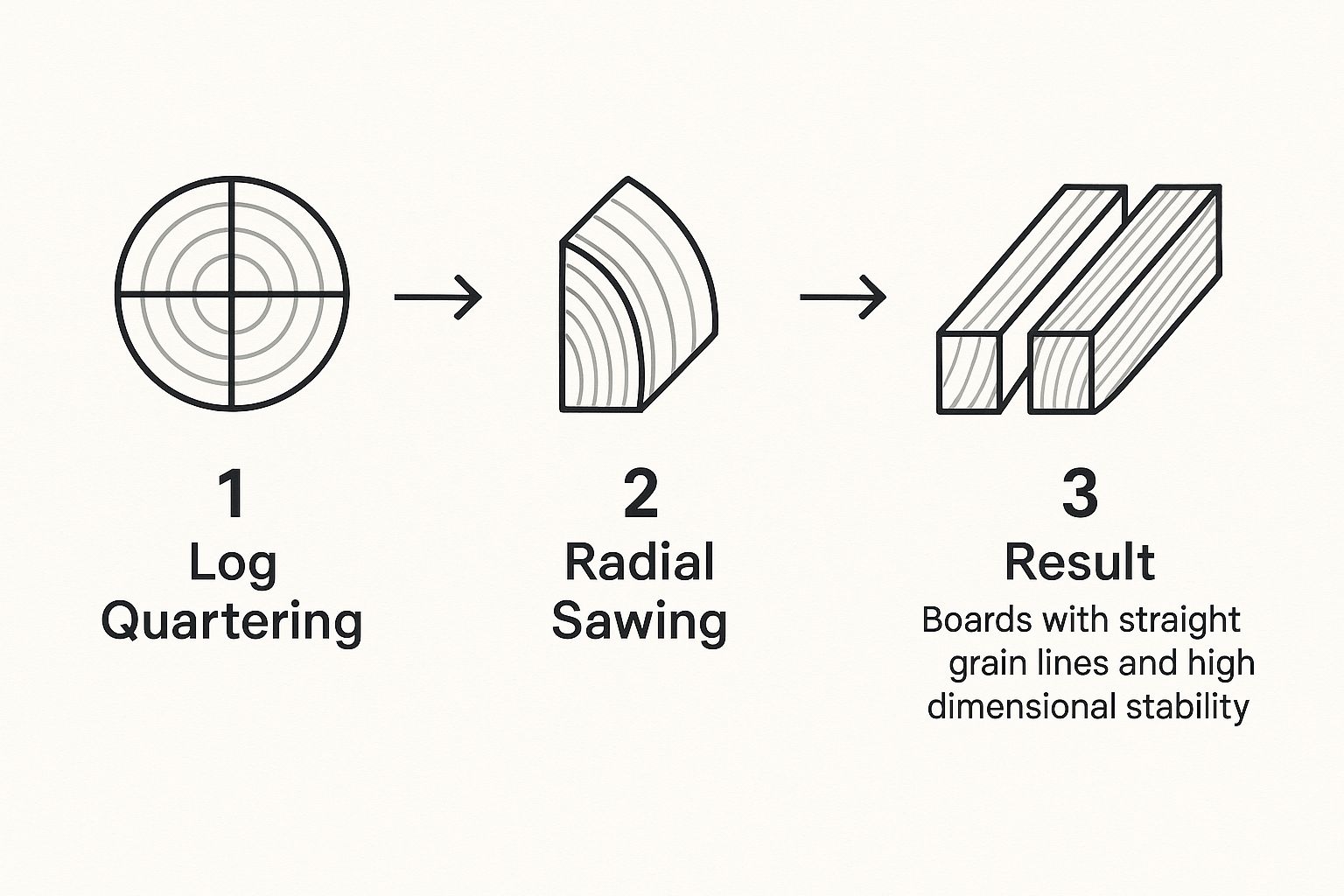
As you can see, the entire process is designed to prioritize the quality and grain of each board, not just the sheer number of boards you can get from a log. This is precisely why it’s so sought-after for high-end work.
The result is a board with a straight, linear grain pattern that's not only beautiful but also incredibly durable. For homeowners investing in lasting quality, understanding the benefits of different materials is key. You can learn more about how material choices impact the longevity of wooden kitchen cabinets in our detailed guide.
This combination of rock-solid stability and a refined look makes quarter sawn lumber the go-to choice for artisans building heirloom furniture, fine cabinetry, and even musical instruments—projects where performance and consistency are absolutely critical. It’s an investment, but one that pays off in both beauty and longevity.
How Quarter Sawn Wood Is Milled
Getting a quarter sawn board isn't as simple as slicing a log from one side to the other. That’s plain sawing, and it's fast. Quarter sawing, on the other hand, is a much more deliberate and skillful process. It's about prioritizing quality over quantity.
Think of it like a butcher preparing a prime cut of beef. You don’t just start hacking away. Every cut is precise and intentional to get the best possible result. That's the mindset at the sawmill when producing quarter sawn lumber—it takes more time, more handling, and a lot more skill.
The First Cut: Quartering the Log
It all starts with the name: quarter sawn lumber. The very first step is to slice the log lengthwise into four equal wedges, or quarters. The sawyer makes a cut straight through the center of the log, then rotates it 90 degrees and does it again.
This initial division is everything. It sets up every cut that follows and is the key to getting that beautiful, straight grain. Imagine cutting a pizza—you start by making those two big cuts to get four equal sections. It’s the same basic principle, just with a massive log.
Today's sawmills have brought incredible precision to this step. Some use a 120º high-tech scanner to map the log's internal grain before a single cut is made, ensuring they get the most out of every piece of wood. After the log is quartered, the wedges often go onto a carousel that systematically slices them for maximum yield. To get a closer look at how this technology works, check out the detailed quarter sawn process at Frank Miller Lumber.
Sawing Each Quarter into Boards
With the log in four pieces, the real work begins. Each wedge is positioned on the saw carriage so the cuts can be made perpendicular to the log's growth rings. The sawyer slices a board off, rotates the wedge, and slices again, working from the center of the log (the point of the wedge) out toward the bark.
This method is far more labor-intensive and creates more waste than plain sawing, but it's the only way to get the grain oriented just right. By cutting radially across the growth rings, the grain pattern on the resulting board is forced to run straight and vertical.
This image from a sawmill shows exactly how the log goes from a round cylinder to perfectly cut boards.
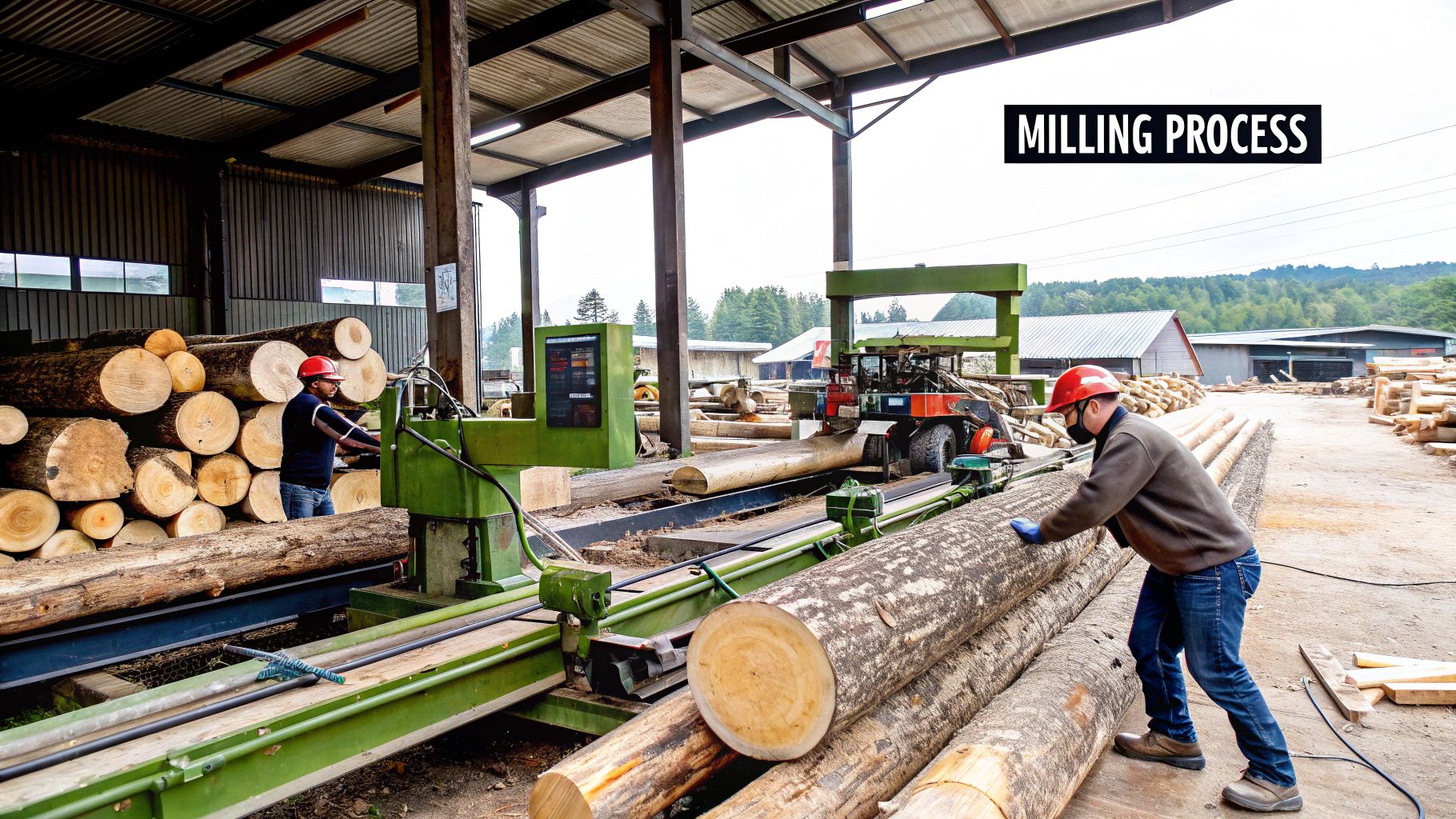
You can clearly see how the wedge is cut at an angle to produce that distinctive straight-grained lumber.
This careful technique ensures the annual growth rings hit the face of the board at a very steep angle, somewhere between 60 and 90 degrees. That specific orientation is the secret behind the wood’s legendary stability.
By forcing the grain to be nearly vertical, the milling process fundamentally changes how the wood behaves. It locks the wood fibers in place, making the board incredibly resistant to the natural tendency to cup, warp, or twist with changes in humidity.
The Final Result
What you get from all this effort is lumber with a distinct look and feel. The boards have a remarkably straight, linear grain that's both elegant and strong. In woods like oak, this cutting method also exposes the medullary rays—cellular structures that radiate from the center of the log—creating a stunning fleck or ribbon pattern across the surface.
This process is a classic case of form following function. The cutting technique isn't just for looks; it's a deliberate choice to create a higher-performing, more stable product. The extra labor and waste explain why quarter sawn lumber costs more, but for any project where stability and longevity are critical, it's an investment that truly pays off.
Why Stability Is the Ultimate Advantage
If you hang around woodworkers long enough, you'll hear them talk about quarter sawn lumber with a certain reverence. The word that always comes up? Dimensional stability. But what does that actually mean for your cabinets or furniture?
Simply put, it’s the wood's superpower to resist changing its shape and size, even when humidity levels swing.
All wood is alive, in a sense. It’s a porous material that breathes, soaking up moisture from the air and releasing it. This natural process causes it to swell and shrink, leading to headaches like cupping, twisting, and warping. Quarter sawn lumber, however, keeps this movement to an absolute minimum.
Think of it like a book. You can easily bend the pages (that’s like the grain in plain sawn wood), but the spine stays straight and rigid. Quarter sawn wood is the spine of the woodworking world—strong, stable, and built to hold its form.

This incredible stability isn't a happy accident. It’s a direct result of how the log is milled. By orienting the growth rings perpendicular to the face of the board, the sawyer unlocks a level of structural integrity that other cuts just can't touch.
How Perpendicular Grain Resists Movement
The magic is all in the direction wood moves. It expands and contracts the most tangentially—that is, along the curve of the growth rings. It moves far less radially, or across the rings from the center of the tree outwards.
Here's how that plays out:
- Plain Sawn: With growth rings running nearly parallel to the face, a plain sawn board's primary movement is across its width. This is what causes cupping, where the edges curl up.
- Quarter Sawn: With growth rings running vertically through the board, the major movement is across its thickness. This change is so minimal it's often unnoticeable, meaning the board stays flat and true.
The difference is huge. We're talking about a board that's up to 50% more stable than its plain sawn counterpart. That’s why it’s the only real choice for applications where a flat, predictable surface isn't just nice to have—it's essential.
For a project like custom cabinetry, this stability is everything. Cabinet doors have to hang perfectly flush and drawer fronts need to stay flat to glide smoothly for decades, especially in humid spaces like kitchens and bathrooms.
This built-in resistance to movement is a true game-changer, particularly in climates with big seasonal swings. While other woods might protest a humid summer by warping or a dry winter by gapping, quarter sawn lumber just takes it in stride. Of course, managing your home's environment is still key, and you can learn more in our guide to cabinet humidity control.
Practical Benefits Beyond Flatness
The perks of dimensional stability go well beyond just preventing warping. This reliable consistency trickles down to improve the quality of the entire project.
For starters, a stable board offers a much smoother, more uniform surface. Without the pronounced peaks and valleys you see in plain sawn grain, it sands out to a flawless, glass-like finish with less effort.
This smoothness also affects how the wood takes a finish. The tight, vertical grain absorbs stains and oils more evenly, preventing the blotchiness that can plague wilder grain patterns. The result is a richer, deeper color and a truly professional look.
Finally, this stability is a direct line to long-term durability. A board that stays flat wears evenly over its lifespan. On a tabletop or hardwood floor, that means no high spots that wear down faster than the rest. This uniform wear protects the beauty and integrity of the piece for generations, making quarter sawn lumber a wise investment for any project you want to last.
Identifying The Unique Beauty Of The Grain
While stability is the practical reason to choose quarter sawn lumber, its incredible beauty is what really makes it stand out. This isn't just a strong piece of wood; it has a unique and captivating look that plain sawn boards simply can't match. Learning to spot its signature grain is like learning to read the tree's history, told through straight lines and shimmering flecks.
The first thing you’ll probably notice is the remarkably straight, parallel grain pattern. Forget the big, sweeping "cathedral" patterns you see on typical boards. Here, the grain is tight, linear, and consistent. This clean look brings a sense of calm and order, which is why it's so popular for elegant, high-end designs.

This straight-line pattern is a direct result of how the log is milled. The saw cuts across the tree's growth rings from the center out, almost like slicing a pie. This method showcases the tree's annual growth in a clean, vertical profile, giving the wood a refined appearance that's easy to recognize once you know what to look for.
The Magic Of Medullary Rays
But the real showstopper? That would be the medullary rays. These are tiny, cellular channels that run from the core of the tree out to the bark, acting like a nutrient delivery system. Think of them as the spokes on a wheel, running perpendicular to the main growth rings.
On most cuts of wood, these rays are sliced at odd angles and are basically invisible. But the quarter sawn technique slices right through them, exposing them on the face of the board. The result is a stunning visual effect that woodworkers call "fleck," "figure," or "ribbon."
This fleck looks like shimmering, silvery ribbons that seem to dance across the wood's surface, catching the light and creating incredible depth. The effect is especially dramatic in certain species, with Red and White Oak being famous for their spectacular ray fleck.
Medullary rays are the signature of authentic quarter sawn lumber. Their presence is not a defect or a stain; it is the hallmark of a premium milling technique that reveals the hidden inner beauty of the wood.
How To Spot Quarter Sawn Lumber
Once you get the hang of it, you can confidently pick out quarter sawn boards at the lumberyard or in finished furniture. You're really just looking for a couple of key visual clues.
Here’s what to check for:
- Look for a Straight, Parallel Grain: First, scan the face of the board. The grain lines should run straight down its length with almost no arches or wavy patterns.
- Search for the Shimmering Fleck: Next, tilt the board back and forth in the light. Look for those iridescent, ribbon-like markings that run across the straight grain. That's the telltale sign of exposed medullary rays.
- Check the End Grain: If you can, take a look at the end of the board. The growth rings should hit the face at a very steep angle, usually between 60 and 90 degrees.
When you see all these features together, you can be sure you're looking at genuine quarter sawn lumber. Its unique appearance does more than just look good on its own; it also transforms how finishes look when applied. For anyone wanting a truly one-of-a-kind result, learning how a custom stained finish from a local cabinet finish shop can bring out this natural beauty is a game-changer. It means you're choosing a material that's not just stable, but one with a visual story unlike any other.
When to Use Quarter Sawn Lumber
Knowing the "what" and "why" of quarter sawn lumber is a great start, but the real magic happens when you know where to use it. Choosing the right cut for the right job is what separates a good project from a truly exceptional one. Quarter sawn lumber isn't the go-to for every situation, but for those special applications where looks and performance are non-negotiable, nothing else comes close.
This premium cut really proves its worth in projects that demand absolute flatness and long-term durability. We're talking about those high-visibility surfaces you see and touch every day, where even the slightest warp or cup would stick out like a sore thumb. This is where quarter sawn wood earns its price tag, buying you peace of mind right along with its incredible beauty.
Fine Furniture and Custom Cabinetry
Nowhere is dimensional stability more critical than in fine furniture and custom cabinets. These aren't just objects; they're investments meant to be passed down through generations, and quarter sawn lumber is the key to ensuring they stand the test of time.
- Tabletops and Desks: Big, flat surfaces like a dining room table are prime candidates for warping with other cuts. A quarter sawn tabletop, however, will stay dead flat, giving you a reliable and beautiful surface for decades of use.
- Cabinet Doors and Drawer Fronts: These moving parts have to stay perfectly true to work right. Warped doors lead to uneven gaps, and twisted drawer fronts will bind and stick, making for a frustrating experience every time you open them.
- Frame and Panel Construction: The rails and stiles that make up the skeleton of a cabinet door or furniture panel are the perfect application for quarter sawn wood. Its stability prevents the whole assembly from twisting out of shape as the years go by.
In custom homes, where the smallest architectural details matter, the stability and unique look of quarter sawn lumber make it an excellent choice. If you're curious about the broader considerations for high-end finishes, this Florida Custom Trim and Molding Guide offers some great insights.
High-Performance Flooring
Flooring is another area where quarter sawn lumber really excels, especially in rooms with big swings in humidity or a lot of foot traffic. Its straight grain and inherent stability give it a serious edge over more common wood cuts.
A quarter sawn floor wears incredibly evenly because the dense, vertical growth rings are exposed to the surface, resisting crushing and splintering far better. This makes it a fantastic option for busy areas like entryways, hallways, and kitchens. On top of that, its resistance to expansion and contraction means you'll see tighter seams and fewer gaps between the boards as the seasons change.
Architectural Millwork and Musical Instruments
The Arts and Crafts movement, with its deep appreciation for honest craftsmanship and natural materials, fell in love with quarter sawn oak. That straight, clean grain and those dramatic medullary rays became a signature of the style. To this day, it’s the only real choice for creating authentic architectural millwork, from trim and molding to wall paneling, in that iconic style.
This isn't just a modern preference; it has deep historical roots. Quarter sawn lumber was once a major part of high-end hardwood production, sought after for the finest furniture and interior work in both America and Europe. As furniture making and construction have grown, the demand for this premium material has steadily climbed right along with it.
The very same stability that keeps a cabinet door perfectly flat is what makes quarter sawn wood essential for crafting musical instruments. The necks of high-end guitars and violins are often carved from quarter sawn maple specifically to resist bowing under the immense tension of the strings, ensuring the instrument stays in tune and plays beautifully.
At the end of the day, choosing quarter sawn lumber is a conscious decision to prioritize quality and longevity. Whether it's a tabletop that never cups or a set of cabinet doors that hang perfectly for decades, its superior properties deliver a foundation of pure reliability. When your project demands the absolute best in both form and function, this remarkable cut of wood is the undisputed answer.
A Few Common Questions About Quarter Sawn Lumber
Even after you get the hang of how quarter sawn lumber is milled and why it's so special, a few practical questions always pop up. It's one thing to understand the theory, but another to be standing in the lumberyard trying to decide what to buy. Let's clear up some of the common things people ask.
The first question is almost always about the price. And yes, quarter sawn lumber costs quite a bit more than your standard plain sawn boards—often double the price, if not more. That price hike isn't just for show; it's a direct result of the extra labor, tricky handling, and lower yield you get from each log. You're paying for that incredible stability and unique look.
Availability is another big one. You won’t find it stacked as high as plain sawn boards at every big box store, but any decent hardwood dealer or specialty lumberyard will have it. You'll most commonly find it in White and Red Oak, but you can definitely track it down in species like Cherry, Maple, and Walnut. A quick phone call to your local yard is always a good first step.
Is It Really Stronger Than Plain Sawn Wood?
People often assume "better" means stronger, but that's not quite the case here. The real superstar quality of quarter sawn wood is its dimensional stability, not its raw strength.
If you test their bending strength or hardness, both cuts are pretty similar. The magic of quarter sawn lumber is how that vertical grain orientation makes it incredibly resistant to cupping, twisting, and warping as humidity changes.
So, while it won't necessarily hold more weight, it will hold its shape far more reliably. That's why it’s the go-to choice for things that absolutely must stay flat, like frame-and-panel cabinet doors, big tabletops, or fine furniture.
Think of it this way: "stronger" in the world of quarter sawn wood means it's stronger against its own internal movement and the forces of nature. It’s about lasting integrity, not just breaking point.
Can You Mix and Match It With Other Cuts?
You bet. In fact, it’s a smart and common practice for cabinet makers and woodworkers. A classic example is using quarter sawn lumber for the parts you see and touch—like cabinet doors and drawer fronts—while using the more budget-friendly plain sawn wood for the cabinet boxes and shelves hidden inside.
This hybrid approach gives you the best of everything:
- A High-End Look: The beautiful, straight grain of quarter sawn wood is featured right where it counts.
- Cost Savings: You aren't spending top dollar on parts of the project no one will ever see.
- Rock-Solid Stability: The most visible and critical components get the superior stability they need to prevent warping.
It's a clever way to get the premium benefits of quarter sawn wood precisely where you need them, without blowing your entire budget. You end up with a project that looks fantastic and is truly built to last.
When your project calls for the perfect blend of beauty and long-term stability, experience matters. Sinclair Cabinetry inc has spent over 35 years building custom real wood cabinets designed to last a lifetime. See what we can create for you by exploring our custom cabinetry solutions.