
When you’re planning a kitchen remodel, the numbers you absolutely need to know are the standard kitchen cabinet sizes. Think of these as the building blocks of your entire design. As a general rule, base cabinets are 34.5 inches tall and 24 inches deep. Wall cabinets are typically 12 inches deep, but their height can range from 30 to 42 inches. Pantry or tall cabinets usually stand 84 to 96 inches high.
Your Quick Reference for Standard Cabinet Sizes
Understanding the industry-standard dimensions for kitchen cabinets is your first step toward a layout that's functional, looks great, and won't break the bank. These aren't just random numbers; they’ve been fine-tuned over years to ensure ergonomic comfort, seamless appliance integration, and much simpler installation.
Because manufacturers stick to these benchmarks, they can produce modular cabinets that fit predictably into most homes. What does that mean for you? It saves a ton of time and money.
Quick Lookup Chart for Standard Kitchen Cabinet Dimensions
For a quick overview, I’ve put together this chart summarizing the most common dimensions you'll encounter. It’s the perfect go-to reference when you’re sketching out ideas or starting to shop for cabinets.
| Cabinet Type | Standard Height | Standard Depth | Common Widths (Inches) |
|---|---|---|---|
| Base Cabinets | 34.5" (without countertop) | 24" | 9" to 48" |
| Wall Cabinets | 12" to 42" | 12" | 9" to 36" |
| Tall Cabinets | 84", 90", or 96" | 12" or 24" | 18", 24", or 36" |
This table gives you a solid foundation for your project. One thing you'll notice is that widths usually come in 3-inch increments. This smart sizing allows you to combine different units to fill just about any wall length you have.
The image below gives you a great visual of how these three main cabinet types relate to each other in a real kitchen setting.
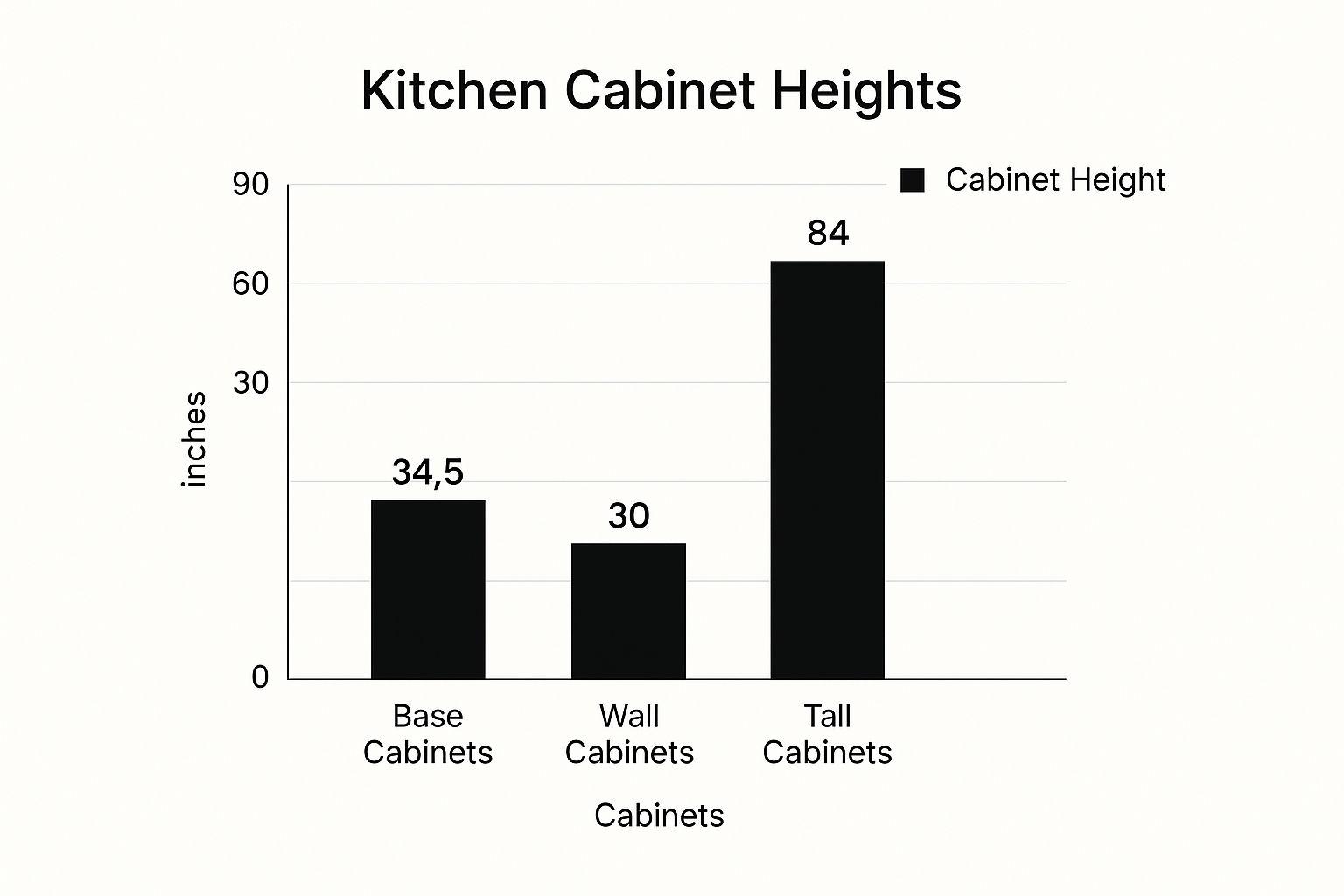
As you can see, tall cabinets are designed to create that coveted floor-to-ceiling storage, while the base and wall cabinets define your main work zone. Getting these standardized heights right is what makes a kitchen feel balanced and comfortable for all your daily tasks, from chopping veggies to unloading the dishwasher.
Why Cabinet Standards Will Simplify Your Kitchen Design
Ever walked into a kitchen and just felt like everything fit? That's not an accident. The entire kitchen industry—from cabinet makers to appliance manufacturers—relies on standard cabinet sizes to bring a sense of order and predictability to what can be a very complex project.
Following these established dimensions makes nearly every part of a kitchen remodel easier. When you work within this proven framework, you create a modular system where planning is simpler, installation is smoother, and everything just lines up perfectly. It's the secret to keeping your project on track and on budget.
The Core Benefits of Standardization
Working with standard sizes isn’t just about convenience; it gives you some serious advantages that directly impact your wallet and your project's timeline. It's the main reason stock and semi-custom cabinets are such a popular choice for homeowners and builders.
- Cost-Effectiveness: When manufacturers can mass-produce cabinets in common dimensions, it dramatically lowers their costs. Those savings get passed right on to you.
- Widespread Availability: Need to replace a door or add one more cabinet down the road? Standard sizes are stocked by countless suppliers, so finding a match is easy and you won't be stuck waiting weeks for a custom piece.
- Simplified Installation: Installation becomes a much more straightforward puzzle when your cabinets, countertops, and appliances are all playing by the same dimensional rules. Fewer surprises mean fewer headaches.
- Appliance Compatibility: Your dishwasher, slide-in range, and refrigerator are all built to slot into openings made by standard base cabinets. This gives you that clean, integrated look without any funky gaps.
Historical Roots and Ergonomic Design
Standardized kitchen dimensions aren't a new fad. They have deep roots in making kitchens more efficient and comfortable to work in, a concept that really took hold in the mid-20th century. Designers figured out that a base cabinet height of 34.5 inches topped with a 1.5-inch counter created a 36-inch high work surface—the sweet spot for the average person.
This focus on ergonomics is a game-changer. A 36-inch countertop height is designed to minimize strain on your back and shoulders whether you're chopping vegetables or loading the dishwasher. It turns the kitchen into a space that’s truly a pleasure to use.
From there, everything else falls into place. Wall cabinets are typically kept at a shallower 12 inches deep so you can still use your full countertop without bonking your head. It’s a thoughtful system where every dimension is designed to work together. You can get a deeper understanding by exploring our detailed guide on kitchen cabinet standards and their practical applications. When you understand these principles, you can make smarter layout decisions for a kitchen that is both beautiful and built for real life.
Mastering Base and Wall Cabinet Dimensions
When you're mapping out a kitchen, the base and wall cabinets are your building blocks. They form the backbone of your work and storage areas, and getting their dimensions right is the secret to a design that just works. These two cabinet types are a team, defining everything from the room's ergonomics to its visual flow.
Let's dig into the specific numbers for each. Understanding the standard ranges for height, depth, and width will give you the confidence to mix and match units like a pro, making sure every inch of your kitchen serves a purpose.
Base Cabinet Dimensions Unpacked
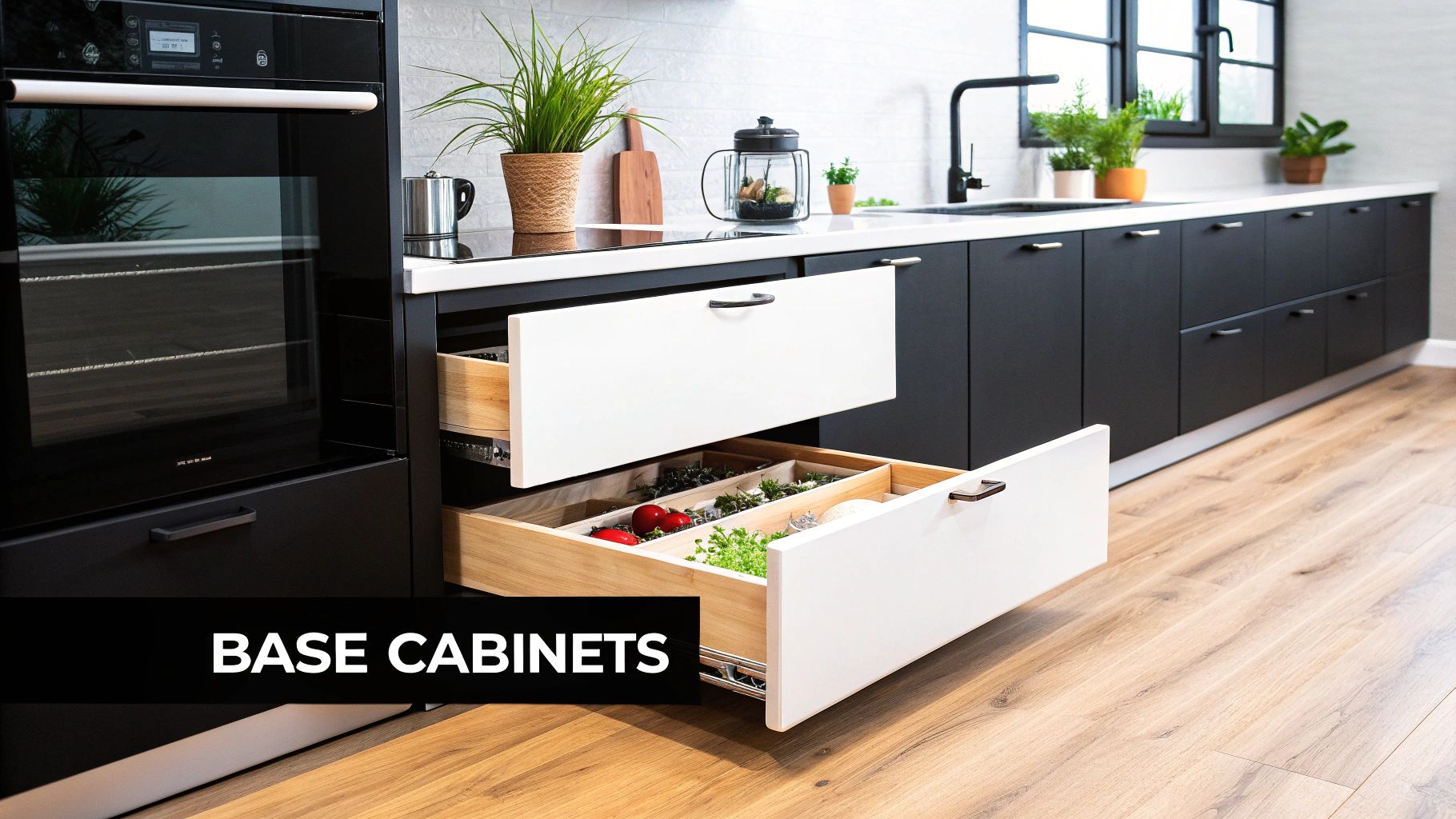
Think of base cabinets as the foundation of your kitchen. They do the heavy lifting, supporting your countertops and housing bulky appliances or your favorite set of pots and pans. For practical reasons, their dimensions are the most standardized, setting the stage for the kitchen's primary work surface.
The standard height for a base cabinet is a firm 34.5 inches from the floor to the top of the cabinet box. Once you add a typical 1.5-inch countertop, you land at the industry-standard work surface height of 36 inches. This isn't just a random number—it's ergonomically designed to be comfortable for most people, minimizing back strain and awkward bending.
The standard depth is 24 inches from the front of the cabinet to the wall. This measurement is critical because it's engineered to sit flush with major appliances like dishwashers and slide-in ranges. The result is that clean, seamless look every great kitchen has.
Pro Tip: That 24-inch depth isn't just for looks. It's the sweet spot that lets you easily grab items from the very back of the cabinet while still providing plenty of countertop space for prep work.
While height and depth are pretty much set in stone, width is where you get to play. Base cabinet widths are available in 3-inch increments, which gives you the flexibility to fit a run of cabinetry perfectly along almost any wall length.
- 9 to 18 inches: These slim cabinets are workhorses for specific jobs, like pull-out spice racks, tray dividers for cookie sheets, or small filler spaces.
- 24 to 30 inches: This is your go-to size for versatile storage, whether you prefer drawers, doors, or a combination.
- 33 to 36 inches: You'll typically see these widths used for sink base cabinets, giving you enough room for a single or double-basin sink and plumbing.
- 36 to 48 inches: These larger units are often reserved for spacious corner solutions (like a Lazy Susan) or extra-wide drawer bases for pots and pans.
Wall Cabinet Dimensions Explained
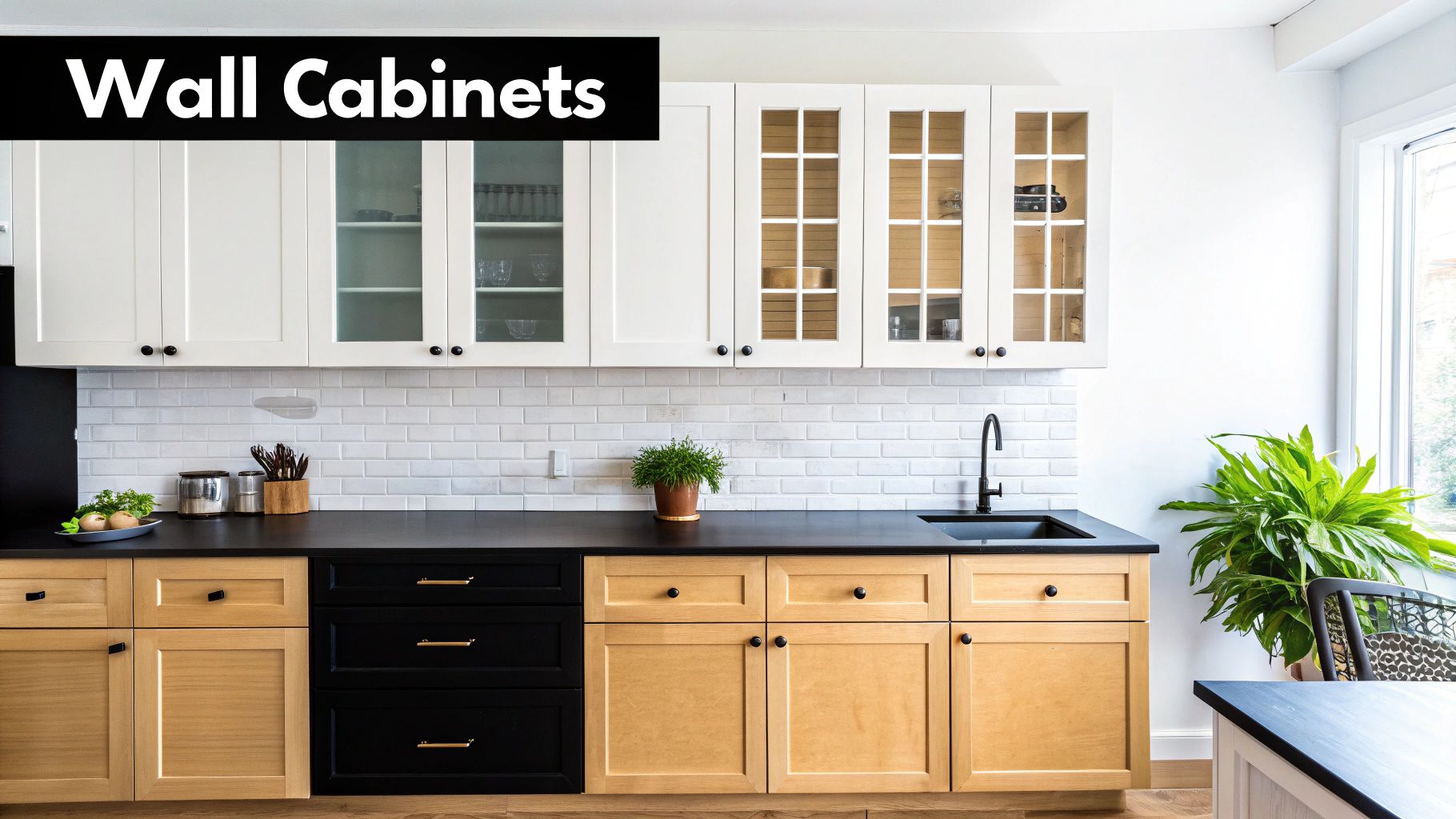
Wall cabinets are all about accessible, eye-level storage for the items you use daily—plates, glasses, coffee mugs, and pantry staples. Their dimensions are much more flexible, especially their height, which allows you to customize the look based on your ceiling height and personal taste.
The most important dimension here is the depth. The standard wall cabinet depth is 12 inches, though some specialized options go up to 15 inches or even 24 inches (often placed over a refrigerator). This shallower depth is completely intentional. It keeps the upper cabinets from jutting into your workspace, so you won't feel crowded or bump your head while you're using the countertop below.
Wall cabinet widths follow the same logic as base cabinets, usually running from 9 to 36 inches in 3-inch increments. This modular system makes it easy to create a balanced, symmetrical look by aligning uppers directly over your base units. If you want to dive deeper, you can explore the full range of typical cabinet sizes and see how they all fit together.
Cabinet height is where you have the most freedom to tailor the design to your kitchen's unique scale. The most common heights include:
- 12 to 18 inches: These are often used as shorter "filler" cabinets above refrigerators or over-the-range microwaves.
- 30 inches: This is a very popular and versatile height that works beautifully with standard 8-foot ceilings.
- 36 inches: A taller option that provides extra storage and helps draw the eye upward, making the room feel more spacious.
- 42 inches: This is the tallest standard height, designed to reach the ceiling in kitchens with 8-foot ceilings for that high-end, custom built-in appearance.
Integrating Tall Cabinets and Pantries
Tall cabinets are the storage workhorses of any kitchen. Extending from the floor to (or near) the ceiling, they offer an incredible amount of space for everything from pantry staples to brooms and mops. If you want to keep your kitchen organized and clutter-free, understanding how to integrate these units is a must.
Unlike base and wall cabinets, which work together as a pair, tall cabinets are generally standalone giants. Their primary job is to provide maximum storage while creating a clean, built-in look. This means they are designed to match the depth of your base cabinets and align visually with your uppers. Getting these dimensions right is the secret to a high-end, functional design.
Standard Tall Cabinet Heights
The height of your tall cabinets is almost always dictated by your ceiling and the height of your other wall cabinets. The main goal here is to create a seamless, uniform line across the top of all your cabinetry for a polished, professional look.
You’ll typically run into three industry-standard heights:
- 84 inches: This is by far the most common height. It’s designed to line up perfectly with standard 30-inch wall cabinets, which sit 54 inches off the floor.
- 90 inches: If you're using taller 36-inch wall cabinets, this is your go-to option. It creates a more elevated and impressive feel.
- 96 inches: As the tallest standard choice, a 96-inch cabinet reaches the top of a standard 8-foot ceiling. This is the perfect partner for 42-inch wall cabinets if you're looking to squeeze out every last inch of vertical storage.
Choosing the right height is critical for visual harmony. An 84-inch pantry standing next to 42-inch wall cabinets would create a jarring, uneven sightline, instantly throwing off your kitchen's entire aesthetic.
Standard Depth and Width for Tall Cabinets
While you have a few options for height, the depth and width of tall cabinets are a bit more straightforward. These dimensions are all about function and seamless integration with the rest of your kitchen.
The standard depth for a tall cabinet is 24 inches. That’s no accident—it’s designed to match the depth of your base cabinets. This alignment ensures the front faces of all your lower and full-height cabinets line up perfectly, creating a smooth, uninterrupted run. You can sometimes find a shallower 12-inch depth, which is great for smaller pantry units or tight spaces.
A 24-inch depth isn't just for looks; it’s incredibly practical. It's deep enough to house roll-out trays, internal drawers, or even hide small appliances, making it a truly versatile storage hub.
When it comes to width, tall cabinets come in a few common sizes to fit different kitchen layouts and storage needs. The most popular widths you'll find are:
- 18 inches: A slim, efficient option that’s perfect for a dedicated broom closet or a narrow pantry in a smaller kitchen.
- 24 inches: A very popular choice. It offers a good amount of storage without dominating the space.
- 30 to 36 inches: These wider units are true pantry powerhouses. They often feature double doors and can be outfitted with extensive internal organization systems, like pull-out shelves and deep drawers.
Functional Configurations for Tall Cabinets
The real magic of a tall cabinet is what you can do with the inside. Beyond just shelves, these units can be configured for highly specific tasks. A very common setup is an oven cabinet, which has a large cutout to house a wall oven and often a microwave right above it. These are typically built in 30-inch or 33-inch widths to fit standard appliance models.
By getting a handle on these standard dimensions, you're well on your way to planning a kitchen that’s not just beautiful, but exceptionally functional.
How Appliance Dimensions Shape Your Cabinet Plan
A truly successful kitchen design is a perfect marriage between your cabinets and your appliances. I can't stress this enough: before you even think about finalizing a cabinet order, you absolutely must know the exact dimensions of your major appliances. Taking this single step is the best way to prevent costly mistakes and achieve that clean, integrated look that defines a professionally designed kitchen.
Sure, appliance manufacturers generally design their products to fit within the framework of standard cabinet sizes for kitchen layouts. But even with these standards, you'll find small but critical variations in dimensions, ventilation requirements, and door swing clearances between different models and brands. Always, always, always refer to the manufacturer's specification sheet—that little piece of paper is your roadmap.
Dishwashers and Base Cabinets
Let's start with an easy one. Dishwashers are probably the most straightforward appliance to plan for. The vast majority of models are specifically designed to slide into a standard 24-inch wide opening in a run of base cabinets. This near-universal sizing makes planning relatively painless.
The standard base cabinet height of 34.5 inches is also set with dishwashers in mind. Once you install a 1.5-inch thick countertop, the appliance fits neatly underneath, creating a perfectly flush and seamless look. Your main job here is simple: just leave that dedicated 24-inch gap between two base cabinets.
Planning for Refrigerators
Refrigerators, on the other hand, require a lot more careful thought because of their size and, just as importantly, their ventilation needs. While many standard-depth fridges are about 30 to 36 inches wide, the rough opening you need is always going to be slightly larger.
You have to account for airspace on the sides, top, and back to allow for proper air circulation. This isn't just for looks; it's essential for the fridge's efficiency and lifespan.
- Width: For a 36-inch wide refrigerator, you'll want to plan for a 37-inch or even a 37.5-inch opening.
- Height: A standard refrigerator might be 70 inches tall, but the cabinet opening should be at least 72 inches to give it room to breathe.
- Depth: This is a common oversight. A "counter-depth" model is designed to sit nearly flush with your 24-inch deep base cabinets. A standard-depth model will stick out by several inches, which can disrupt the flow of your kitchen if you haven't planned for it.
A critical factor that often gets missed is the door swing clearance. Make sure there’s enough room for the refrigerator doors to open completely without banging into an adjacent wall or cabinet. This is especially crucial for accessing the interior drawers.
Integrating Cooktops and Wall Ovens
Cooktops and wall ovens demand precise cabinet cutouts—there's no room for error here. A cooktop drops into your countertop, which means the base cabinet below has to be modified to accommodate its depth and utility connections, whether gas or electric.
For example, a 30-inch cooktop will typically require a 30-inch wide base cabinet. Your countertop fabricator will then use the cooktop's spec sheet to make the precise cut.
Wall ovens are built to be housed within tall cabinets, often just called oven cabinets. These come in standard widths, most commonly 30 or 33 inches, to match popular oven sizes. The cabinet itself provides pre-cut openings and the structural support needed to hold a very heavy appliance securely. Having your oven's spec sheet in hand when you order ensures your cabinet arrives with the correct cutout size, preventing a huge and costly mismatch.
Translating Standard Sizes into a Functional Layout
Knowing the numbers is one thing, but turning those dimensions into a real-world kitchen plan is where the magic really happens. This is the point where you take your understanding of standard cabinet sizes for kitchen layouts and blend it with your room’s unique footprint to build a truly functional design. It all begins with a tape measure and a clear vision.
The first step is always to get an accurate measurement of your kitchen. Once you know the total length of a wall, you can start piecing together a "cabinet run" using a mix of standard widths. For instance, to fill a 10-foot (120-inch) wall, you might combine a 36-inch sink base, an 18-inch drawer base, a 24-inch standard base, a 30-inch base, and a 12-inch spice pull-out to fit the space perfectly.
From Measurements to Functional Zones
A great kitchen layout is about so much more than just filling space—it’s about creating smart, efficient work zones. As you lay things out, think about your daily routines and group your cabinets and appliances to match how you move and work. This is a foundational principle of creating an effortlessly stylish and functional kitchen, where every single element has a clear purpose.
- Prep Zone: This area needs plenty of counter space, ideally positioned between your sink and refrigerator. Plan for wide drawer bases here to keep mixing bowls, cutting boards, and prep utensils right where you need them.
- Cooking Zone: Center this zone around your range or cooktop. The cabinets nearby should hold pots, pans, and cooking spices. Narrow 9-inch or 12-inch pull-out cabinets are fantastic for oils and spices in this spot.
- Cleaning Zone: This zone is anchored by the sink and dishwasher. A standard 33-inch or 36-inch sink base is the cornerstone, with a dedicated 24-inch opening right next to it for the dishwasher.
What About Awkward Gaps?
It's rare for a wall to be perfectly divisible by the standard 3-inch cabinet increments. When you’re left with a small, awkward gap, the solution is filler strips. These are simply matching pieces of wood used to close gaps from 1 to 6 inches wide, giving your cabinets a seamless, built-in look.
Following Key Design Guidelines
To make sure your new layout is not just fitted but also safe and comfortable to work in, it’s smart to follow established industry guidelines for clearances. The National Kitchen & Bath Association (NKBA) recommends a walkway clearance of at least 42 inches for a one-cook kitchen and 48 inches if multiple cooks will be using the space at once. Sticking to these rules helps you avoid a cramped, frustrating workspace.
For a deeper dive into these strategies, our guide on how to plan kitchen cabinets provides a detailed, step-by-step approach.
These standardized approaches are a huge part of what drives the industry. The global kitchen cabinet market, valued at roughly USD 160 billion in 2023, is set for major growth, largely fueled by homeowners remodeling their spaces to prioritize functional, modern designs built on these exact principles. When you combine standard sizes with smart zoning and proper clearances, you’re on your way to designing a kitchen that’s beautiful, efficient, and a true joy to use every single day.
Answers to Your Top Cabinet Size Questions
Even when you think you have a bulletproof plan, questions always seem to pop up during a kitchen remodel. That’s just part of the process! Here, we’ve tackled some of the most common questions we hear from renovators about standard cabinet sizes for kitchen layouts. These quick answers should help you finalize your design with total confidence.
What’s the Standard Space Between a Countertop and Wall Cabinets?
The industry standard here is 18 inches. This measurement is taken from the top of your countertop to the bottom of your upper wall cabinets. It’s a sweet spot that gives you plenty of clearance for small appliances—think coffee makers, stand mixers, and blenders—without pushing the wall cabinets too high to reach comfortably.
This 18-inch gap isn't just a random number; it's a critical part of creating an ergonomic and functional kitchen. It ensures your work surface is clear and usable while keeping the contents of your upper cabinets easily accessible.
How Do I Deal with Awkward Gaps or Non-Standard Spaces?
Let's be realistic—walls are almost never a perfect multiple of standard cabinet widths. It’s incredibly common to end up with a small, awkward gap. The professional solution for this is using filler strips.
These are simply matching pieces of finished wood, usually between 1 to 6 inches wide, that are cut on-site to perfectly fill any leftover space. Fillers are what give your kitchen that seamless, truly built-in look, closing any unsightly gaps between a cabinet and a wall or in a tight corner.
Can I Mix and Match Different Wall Cabinet Heights in My Kitchen?
Absolutely! In fact, varying the height of your wall cabinets is a popular design trick used to create visual interest and accommodate specific kitchen features. For instance, you might use shorter 15-inch or 18-inch high cabinets above your refrigerator or an over-the-range microwave.
Using different heights can break up the visual monotony of a long, uniform run of cabinets, giving your kitchen a more dynamic, custom-designed feel. The key is to make sure the changes feel intentional and balanced, not just random.
Standard cabinet sizes are the backbone of the global kitchen cabinet market. As of 2024, this industry was valued at around USD 100.79 billion and is expected to climb to USD 183.53 billion by 2032. This impressive growth highlights how much consumers value modular, cost-effective cabinetry solutions built around these established dimensions. To learn more about these market trends, you can explore detailed kitchen cabinet market analysis.
Whether you're working with standard sizes or need a completely custom creation, Sinclair Cabinetry inc has the expertise to bring your vision to life with high-quality, real wood cabinetry. Explore our custom kitchen solutions at sinclaircabinets.com