

Embarking on a home renovation, whether it's a full kitchen remodel, a bathroom upgrade, or a significant new construction project, is a major investment of both time and money. The success of this venture hinges almost entirely on one critical decision: choosing the right general contractor. The person you hire will be responsible for turning your vision into a reality, managing budgets, coordinating trades, and ensuring the final result meets your standards. Making the wrong choice can lead to costly delays, poor workmanship, and immense stress.
This guide provides a comprehensive list of essential questions to ask a general contractor before signing any contract. It's designed to be your blueprint for a thorough vetting process, moving beyond simple price comparisons to assess a contractor's professionalism, reliability, and expertise. By asking these specific, targeted questions, you can gain a clear understanding of their processes, from handling change orders and managing timelines to ensuring job site safety.
Think of this interview process as building the foundation for a successful partnership. The insights you gain will empower you to make an informed decision, safeguarding your investment and ensuring your project runs smoothly. As part of your blueprint for hiring the right professional, consider broader principles for selecting a reputable service provider to round out your evaluation. Let's dive into the key questions that will help you find the perfect contractor for your home.
1. What is your license number and insurance coverage?
This is the first and arguably most critical question to ask a general contractor. It’s not just a formality; it's a fundamental check that verifies their legal right to operate and protects you from significant financial and legal risk. An unlicensed or uninsured contractor can expose you to liability for accidents, shoddy work, and unfinished projects with no clear path to resolution.

A valid license indicates the contractor has met specific state or local requirements, which often include passing exams, proving experience, and undergoing background checks. Insurance, on the other hand, acts as a financial safety net for everyone involved. For a comprehensive overview of contractor credentials, you can learn more about selecting a home renovation contractor.
Why This Question is Non-Negotiable
Asking for credentials sets a professional tone and weeds out unqualified individuals immediately. A legitimate contractor will readily provide this information. Any hesitation or refusal is a major red flag, signaling you should walk away.
There are two primary types of insurance to confirm:
- General Liability Insurance: This covers property damage and third-party injuries. For example, if a crew member accidentally damages your neighbor’s fence or a pipe bursts and floods your kitchen, this policy protects you from footing the bill. Most reputable contractors carry policies ranging from $1 million to $2 million in coverage.
- Workers' Compensation Insurance: This protects you if a worker is injured on your property. Without it, you could be held personally liable for their medical bills and lost wages.
Actionable Steps for Verification
Don't just take their word for it. Due diligence is essential.
- Verify the License Online: Every state with licensing requirements has an online database. For instance, California's CSLB (Contractors State License Board) allows you to check a license status in seconds.
- Request a Certificate of Insurance (COI): Ask for the COI to be sent to you directly from their insurance provider. This ensures the policy is active and hasn't been altered.
- Check Coverage Dates: Confirm the policy is valid for the entire duration of your project. An expired policy offers zero protection.
- Confirm Subcontractor Coverage: Ensure the general contractor’s workers' compensation policy covers all employees and any subcontractors they plan to hire. If not, you must verify that each subcontractor has their own coverage.
2. Can you provide references from recent projects?
While a license confirms legality, references reveal the actual client experience. This question offers a direct look into the contractor's work quality, communication style, professionalism, and ability to manage a project from start to finish. Speaking with past clients is one of the most reliable ways to predict what your own experience will be like.

A confident contractor with a history of satisfied customers will be happy to connect you with them. These firsthand accounts provide insights that a portfolio or a sales pitch simply cannot. They help you understand how the contractor behaves when unforeseen challenges arise and whether their finished work stands the test of time.
Why This Question is Non-Negotiable
Checking references helps you move beyond the highlight reel. A contractor’s portfolio will only show their best work, but a conversation with a former client reveals the day-to-day reality. Any hesitation to provide recent references is a significant warning sign, suggesting they may have unhappy clients or a lack of recent, relevant experience.
You should aim to speak with at least three recent references for projects similar in scope and scale to your own. For example:
- A kitchen remodel client can speak to the contractor’s attention to detail and their process for managing complex plumbing and electrical work.
- An addition project reference can confirm if the team stuck to the budget and timeline for a large-scale job.
- A bathroom renovation client can discuss how the contractor handled waterproofing, tile work, and problem-solving in a confined space.
Actionable Steps for Verification
Don’t just ask for a list; follow through with in-depth conversations.
- Request Recent and Relevant References: Specify that you want to talk to clients from the last 12 months whose projects were similar to yours.
- Prepare Specific Questions: Go beyond "Were you happy?" Ask about communication, cleanliness of the job site, how change orders were handled, and if the project finished on time and on budget.
- Inquire About Problems: No project is perfect. Ask the reference what went wrong and, more importantly, how the contractor resolved the issue.
- Ask the Ultimate Question: "Would you hire this contractor again?" The answer to this is often the most telling.
- Check Online Reviews: Supplement your reference checks by looking at reviews on Google, Houzz, and the Better Business Bureau (BBB) to spot any recurring patterns of praise or complaints.
3. What is the detailed timeline for this project?
Beyond the total cost, the project timeline is one of the most important factors for your peace of mind and daily life. A comprehensive timeline reveals a contractor's planning abilities, project management skills, and whether they have realistic expectations. It helps you prepare for disruptions, coordinate other aspects of your life around the construction schedule, and manage your own expectations.
A vague answer like "a few weeks" is not enough. A professional contractor should be able to provide a phase-by-phase breakdown of the entire project, from demolition to the final walkthrough. For example, a standard kitchen remodel might take 3-4 weeks, broken down into specific tasks like demolition (2 days), plumbing and electrical work (4 days), and cabinet installation (5 days). For a more in-depth look, you can explore a detailed kitchen remodel timeline.
Why This Question is Non-Negotiable
A detailed schedule is your roadmap for the project. It holds the contractor accountable and gives you clear milestones to track progress. Without it, you are left in the dark, unable to determine if the project is on track, falling behind, or completely stalled. This lack of clarity is a major source of stress and disputes between homeowners and contractors.
The timeline also forces a conversation about potential obstacles. By discussing the schedule, you can address factors that could cause delays, such as permit approvals, material lead times, or the availability of specialized subcontractors. This proactive planning is a hallmark of an experienced and organized general contractor.
This infographic provides a simplified look at the key phases of a remodeling project timeline.
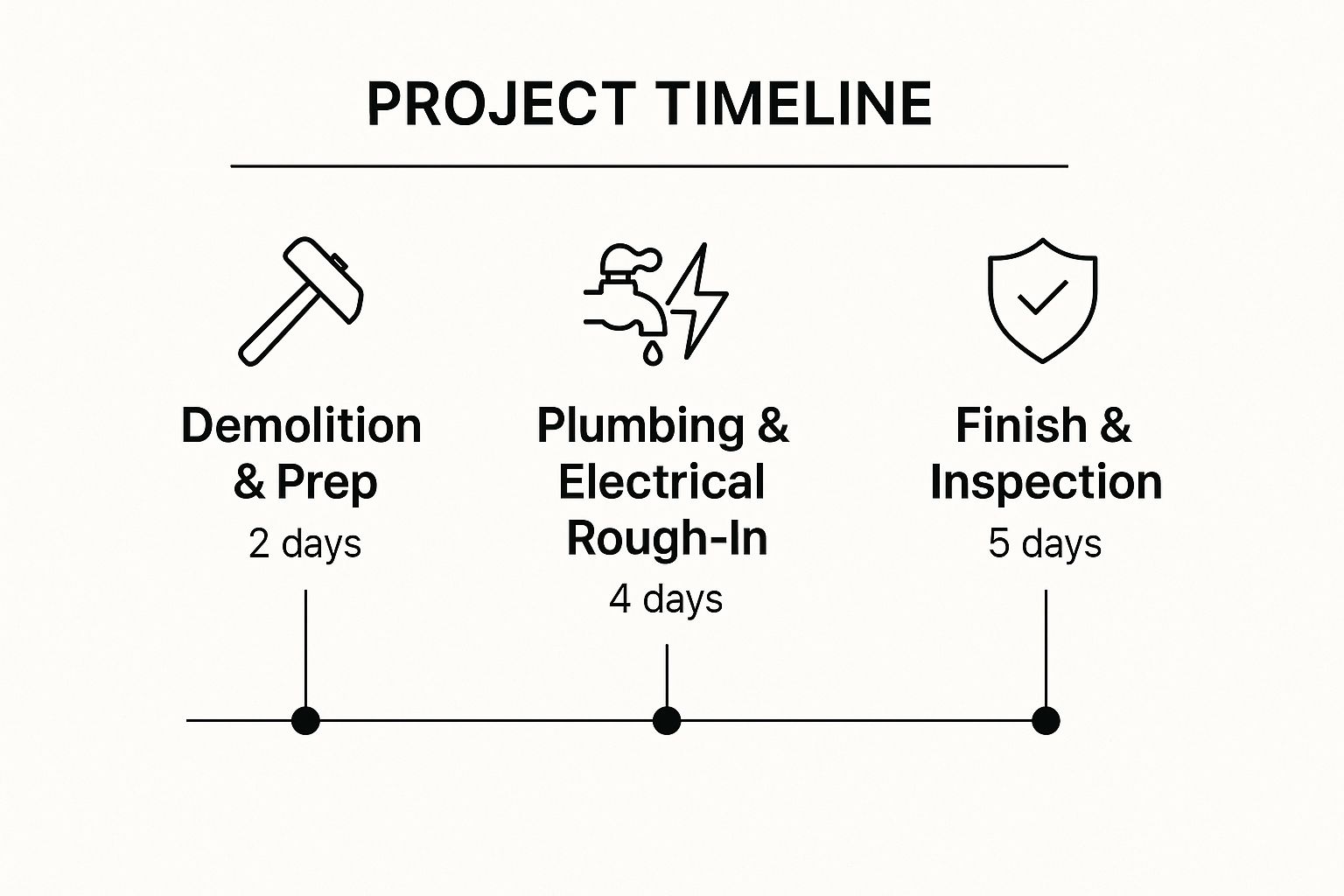
Visualizing the project in distinct stages helps clarify how each phase builds upon the last, leading to the final finished space.
Actionable Steps for Verification
A timeline is only useful if it's realistic and agreed upon. Use these steps to solidify the schedule.
- Request a Written, Phased Schedule: Ask for a document outlining each stage of the project and its estimated duration. Key phases should include demolition, structural work, plumbing/electrical rough-ins, drywall, painting, flooring, and final finishes.
- Discuss Potential Delays: Ask what factors could push the timeline back. Common issues include weather, special-order material delivery, or unforeseen problems discovered after demolition.
- Clarify the Consequence of Delays: Understand what happens if the project extends beyond the agreed-upon completion date. Will the contractor dedicate more resources? Is there a penalty clause in the contract?
- Establish a Communication Plan: Agree on a schedule for progress updates, such as a weekly check-in call or email, to review what was completed and what’s next on the schedule.
4. How do you handle change orders and cost overruns?
Even the best-laid plans can change, and this is especially true in construction. A "change order" is a formal document that amends the original contract, detailing modifications to the scope of work. Understanding a contractor's process for handling these changes is one of the most important questions to ask a general contractor, as it directly impacts your budget and timeline.
A transparent and well-defined change order process protects you from unexpected bills and ensures all project modifications are mutually agreed upon. It addresses everything from discovering unforeseen issues, like outdated electrical wiring behind a wall, to a client-initiated request, such as upgrading from laminate to quartz countertops mid-project.
Why This Question is Non-Negotiable
Discussing change orders upfront establishes clear communication protocols and prevents misunderstandings later. A contractor with a flimsy or verbal-only process can lead to significant cost overruns and disputes. A professional will have a clear, documented system that requires written approval before any additional work or expense is incurred.
This process should be fair and transparent. For example, if a structural issue is uncovered during demolition, the contractor should present a detailed change order explaining the problem, the proposed solution, the cost breakdown for materials and labor, and the impact on the project schedule. This prevents you from being blindsided by a large, unexplained charge on your final invoice.
Actionable Steps for Verification
Ensure their process aligns with best practices to protect your interests.
- Insist on Written Approval: Your contract should state that no change order is valid unless documented in writing and signed by you. Never agree to verbal changes.
- Request Detailed Breakdowns: A proper change order isn't just a new total. It should itemize costs for labor, materials, and any markup, so you know exactly what you are paying for.
- Discuss Contingency: Ask how they recommend you approach a contingency fund. Professionals typically advise setting aside 10-20% of the total project cost to cover unforeseen issues or desired upgrades.
- Clarify the Timeline Impact: Every change, no matter how small, can affect the project schedule. Ensure the change order specifies any adjustments to the completion date.
5. What does your warranty cover and for how long?
A contractor’s warranty is a written promise that they stand behind the quality of their craftsmanship. This is one of the most important questions to ask a general contractor because it provides a clear safety net for you after the final payment is made. It demonstrates their confidence in their work and outlines your recourse if materials fail or workmanship issues arise down the line. A strong warranty is a sign of a professional who builds to last, not just to finish.
A contractor who offers a clear, comprehensive warranty is signaling their long-term commitment to your project's success. Vague promises or the absence of a written warranty should be considered a significant red flag, as it leaves you vulnerable to costly repairs for issues that should have been covered.
Why This Question is Non-Negotiable
Understanding the warranty helps you differentiate between a contractor merely completing a job and one building a lasting relationship based on quality. It sets clear expectations for what happens if a cabinet door warps, a tile comes loose, or a paint job starts to peel prematurely. Without this in writing, you're relying on goodwill, which isn't a reliable strategy.
There are two primary types of warranties to clarify:
- Workmanship Warranty: This is the contractor's direct guarantee on their labor and installation quality. It typically covers issues resulting from improper installation or defects in the work performed by their crew. For example, a one-year workmanship warranty might cover fixing a leaky faucet they installed.
- Material or Manufacturer's Warranty: This covers the actual products and materials used, like windows, appliances, or roofing shingles. The contractor facilitates this, but the guarantee comes from the product manufacturer. It’s crucial to know how the contractor handles claims under these warranties.
Actionable Steps for Verification
Don’t settle for a verbal agreement. A handshake warranty is not enforceable.
- Get It in Writing: The warranty terms, including what is covered, the duration, and any exclusions, must be explicitly detailed in your signed contract.
- Clarify the Duration for Different Work: Warranties are often tiered. For instance, you might get a one-year warranty on general workmanship, a two-year warranty on major systems like plumbing, and a longer structural warranty.
- Understand What Voids the Warranty: Ask what actions could nullify the agreement. Unauthorized repairs, DIY modifications, or failure to perform routine maintenance can sometimes void a contractor's warranty.
- Document the Claims Process: Ask about the procedure for filing a claim. Who do you contact? What is their expected response time? Knowing this upfront prevents confusion and frustration later.
6. Who will be doing the actual work on my project?
This question is crucial because it pulls back the curtain on your general contractor's operational model. The answer reveals whether they have an in-house team of employees, rely exclusively on a network of subcontractors, or use a hybrid approach. Understanding this structure is key to managing expectations around project timelines, communication, quality control, and accountability.
A contractor who self-performs work with their own crew offers direct supervision, while one who subcontracts leverages specialized expertise for different trades. Neither approach is inherently better, but knowing the plan from the start helps you understand who is responsible for each phase of your project, from framing and plumbing to electrical and finishing touches.
Why This Question is Non-Negotiable
Knowing who is physically on your property is a matter of both quality and security. The general contractor is your primary point of contact, but the skill and professionalism of the individual tradespeople, whether employees or subcontractors, will directly impact the final outcome. A contractor who cannot clearly name their team or seems hesitant to discuss their subcontractors may lack a stable, reliable workforce.
This question also clarifies the chain of command. If an issue arises with the plumbing, do you talk to the general contractor, who then relays the message, or do you have a direct line to the plumbing foreman? Defining these roles prevents confusion and delays.
Actionable Steps for Verification
Don't stop at just getting names. Dig deeper to ensure every person on your job site is qualified and professional.
- Ask for a Roster: Request a list of the primary subcontractors who will be involved, such as the electrician, plumber, and HVAC specialist. A reputable contractor will have established relationships with trusted professionals.
- Verify Subcontractor Credentials: Just as you verified the general contractor's license and insurance, you should confirm that each primary subcontractor holds their own valid license and carries both general liability and workers' compensation insurance.
- Inquire About Supervision: Ask how the general contractor oversees the subcontractors. Will they or a dedicated project manager be on-site daily to coordinate tasks and inspect the work?
- Confirm Communication Protocols: Clarify how you should communicate about specific trades. Should all questions go through the general contractor, or will you be introduced to the lead of each crew?
7. What permits are required and who obtains them?
Navigating the world of building permits can be confusing, but it's a non-negotiable step for most renovation projects. Permits are your official authorization from the local municipality to proceed with construction, ensuring that all work adheres to critical safety standards, zoning rules, and building codes. Failing to secure the right permits can result in hefty fines, forced tear-outs of completed work, and significant issues when you try to sell your home.
This question clarifies one of the most important administrative responsibilities of a project. A reputable contractor will be well-versed in local permit requirements and should manage the entire process, from application to final inspection. This is a key part of their job and a clear indicator of their professionalism and experience in your area. For a complete list of project steps, including permits, you can use a detailed home renovation checklist.
Why This Question is Non-Negotiable
A contractor who suggests skipping permits to save money is putting you at tremendous risk. The permit process triggers official inspections at various project stages, which act as a third-party check on the quality and safety of the work being done. This protects you from cut corners and ensures structural, electrical, and plumbing work is up to code.
Common projects that almost always require a permit include:
- Structural Changes: Moving walls, adding windows, or constructing an addition.
- Electrical Work: Upgrading an electrical panel, adding new circuits, or rerouting wiring.
- Plumbing Modifications: Relocating sinks or toilets, or altering supply and drain lines.
- HVAC Systems: Installing a new furnace or central air conditioning system.
Actionable Steps for Verification
Clarity on the permit process before signing a contract is essential.
- Confirm Responsibility in Writing: The contract should explicitly state that the general contractor is responsible for obtaining all necessary permits.
- Ask for Permit Cost Estimates: Permit fees vary by municipality and project scope. Ask the contractor to include an allowance for these fees in the budget.
- Understand the Inspection Schedule: Inquire about the points in the project timeline when inspections will occur (e.g., after framing, before drywall).
- Keep Copies: Once a permit is issued, ask for a copy for your records and ensure it is posted visibly at the job site as required by local law.
8. How do you handle cleanup and job site safety?
A contractor's approach to cleanup and safety speaks volumes about their professionalism and respect for your home. This question helps you understand what to expect daily, ensuring your living space remains tolerable and safe throughout the project. It clarifies how they will manage dust, debris, and potential hazards, which is especially important if you plan to live in the home during renovations.
A tidy and secure work site isn't a luxury; it's a key indicator of a well-managed project. It shows the contractor is organized, considerate, and committed to minimizing disruption to your family's life. Neglecting these details can lead to a chaotic, hazardous environment and unnecessary stress.
Why This Question is Non-Negotiable
Asking about daily procedures sets clear expectations for tidiness and risk management. A contractor who can detail their safety and cleanup plan is more likely to run an efficient and respectful operation. Ambiguous answers or a dismissive attitude are significant red flags, suggesting a lack of organization that could affect the project's quality and timeline.
Key areas to discuss include:
- Daily Cleanup: Will they sweep, vacuum, and organize tools at the end of each day? A "broom-clean" standard should be the minimum expectation.
- Dust and Debris Containment: How will they protect the rest of your home? This often involves plastic sheeting, sealing off vents, and using dust extractors connected to their tools.
- Safety Protocols: What measures are in place to protect your family, especially if children or pets are present? This includes securing tools, managing hazardous materials, and ensuring a safe path of travel. When discussing job site safety, it's crucial to understand their commitment to industry standards. Ask how they approach this, and for a deeper dive into regulatory adherence, consider reviewing a complete guide to OSHA training for construction.
Actionable Steps for Verification
Establish a clear agreement on these points before signing the contract.
- Define "Clean" in the Contract: Specify cleanup expectations in your written agreement. Include details like daily sweeping, end-of-project professional cleaning, and debris removal schedules.
- Clarify Debris Disposal: Ask who is responsible for hauling away construction waste and if the associated dumpster or disposal fees are included in their quote.
- Discuss Dust Control Methods: For interior renovations, confirm they will use plastic barriers to seal off the work area and protect furniture and flooring in adjacent rooms.
- Establish Site Rules: If you have children or pets, set firm rules about closing gates, locking doors, and storing dangerous tools and materials out of reach at the end of each day.
Key Questions Comparison for General Contractors
| Item | Implementation Complexity 🔄 | Resource Requirements ⚡ | Expected Outcomes 📊 | Ideal Use Cases 💡 | Key Advantages ⭐ |
|---|---|---|---|---|---|
| What is your license number and insurance coverage? | Moderate: verifying licenses and insurance documentation | Legal records check, insurance certificates needed | Ensures legal compliance and liability protection | Anytime hiring contractors for construction | Protects homeowner legally and financially; ensures professionalism |
| Can you provide references from recent projects? | Low: contacting and interviewing past clients | Time to reach clients and review feedback | Insight into contractor quality and communication | Selecting trustworthy contractors | Reveals real-world performance and client satisfaction |
| What is the detailed timeline for this project? | Moderate: requires project planning and scheduling | Planning tools and milestone tracking | Clear schedule, better project coordination | Projects with strict deadlines or multiple phases | Enables preparation and progress monitoring |
| How do you handle change orders and cost overruns? | Moderate to high: requires documented process and approvals | Written documentation, communication protocols | Transparent handling of scope changes and costs | Projects prone to changes or unexpected issues | Prevents surprise costs; controls project scope |
| What does your warranty cover and for how long? | Low to moderate: defining warranty terms and conditions | Written contracts specifying coverage | Peace of mind and defect coverage post-completion | All construction projects needing quality assurance | Protects against defects; enhances confidence in work |
| Who will be doing the actual work on my project? | Moderate: identification and management of workforce | Coordination of subs, supervision resources | Clarity on workforce roles and quality control | Projects with multiple trades or subcontractors | Clarifies responsibility and improves accountability |
| What permits are required and who obtains them? | Moderate to high: involves bureaucratic process | Permit applications, inspections, fees | Legal compliance and code adherence | Projects requiring structural or system changes | Ensures legality and avoids code violations |
| How do you handle cleanup and job site safety? | Low to moderate: daily routines and safety protocols | Labor resources, safety equipment | Safe work environment and minimal disruption | Occupied homes or sensitive environments | Maintains livability and reduces hazards |
Building Confidence in Your Renovation Partner
Embarking on a renovation is a significant investment of your time, money, and trust. The list of questions provided in this guide is more than just a simple checklist; it is your foundational framework for building a strong, transparent, and successful relationship with your general contractor. By asking these critical questions, you move from being a passive observer to an empowered, informed partner in your own home’s transformation.
The process of thoroughly interviewing potential candidates is your first, and most important, quality control measure. It allows you to vet their professionalism, experience, and communication style long before the first hammer swings. A contractor who openly and comprehensively answers questions about licensing, insurance, timelines, and change orders is one who values transparency and is likely to maintain that standard throughout the project. Conversely, hesitation or vague responses can be a significant red flag, saving you from potential headaches, budget blowouts, and disappointing results down the line.
Your Blueprint for a Successful Partnership
The ultimate goal of this detailed inquiry is to eliminate assumptions. Misunderstandings about project scope, who is responsible for pulling permits, or how unforeseen issues will be handled are the primary sources of conflict in construction. A detailed conversation guided by these questions ensures you and your contractor are operating from the same blueprint, both literally and figuratively.
Remember these key takeaways as you move forward:
- Documentation is Paramount: Never rely on verbal agreements. Get everything in writing, from the initial bid and contract to every single change order. This includes the warranty details, payment schedule, and project timeline.
- Communication is a Two-Way Street: A great contractor will not only answer your questions but will also ask many of their own. They should be just as invested in understanding your vision and expectations as you are in understanding their process.
- Trust Your Instincts: After you've reviewed the proposals, checked the references, and confirmed the credentials, take a moment to consider how you feel about the contractor. Do you trust them to be in your home? Do you feel comfortable bringing up concerns? This intangible element is often just as crucial as the technical qualifications.
Mastering this list of questions to ask a general contractor transforms a potentially stressful process into a structured, predictable, and even enjoyable journey. It provides you with the confidence that you’ve chosen the right professional to bring your vision to life, ensuring the final result is a space you love, built on a foundation of clear communication and mutual respect.
As you plan the details of your kitchen or bathroom renovation, remember that high-quality cabinetry is often the centerpiece of the project. For custom solutions that blend impeccable craftsmanship with functional design, consider partnering with Sinclair Cabinetry inc. We work seamlessly with homeowners and their chosen general contractors to create and install bespoke cabinetry that elevates any space. Visit Sinclair Cabinetry inc to explore our portfolio and see how we can contribute to your project’s success.