

Embarking on a home remodel or cabinetry project is an exciting endeavor, but its ultimate success hinges on one crucial step: choosing the right professional. The difference between a dream renovation and a costly, stressful ordeal often comes down to the quality of the questions you ask before signing any contract. A great contractor not only expects but welcomes these detailed inquiries; it signals that you are an engaged and serious partner in the process. This comprehensive listicle provides the essential questions for contractors that you must ask to properly vet potential candidates.
We will cover everything from credentials and insurance to detailed project timelines, cost breakdowns, and communication protocols. Whether you're planning a full kitchen overhaul or installing custom cabinets, asking these questions provides the clarity needed to avoid misunderstandings and future problems. Selecting the right partner is a foundational step, similar to ensuring you have a solid structure for your home; for specialized projects like roofing, you can learn more in this expert guide on choosing a roofing contractor. By using this guide, you can confidently select a trustworthy professional, ensuring your vision is executed with transparency, skill, and accountability from start to finish.
1. Are you licensed, bonded, and insured?
This is the first and most crucial of all questions for contractors you should ask. The answer determines if a professional is legally and financially equipped to work on your property. It’s a three-part shield that protects you from shoddy work, financial loss, and liability. Never skip this foundational step.

Why It's Non-Negotiable
Each component serves a distinct purpose:
- Licensing: This proves the contractor has met state or local competency standards. For example, California requires contractors to hold a valid CSLB license for any project valued at $500 or more. It’s a baseline indicator of professionalism and knowledge.
- Bonding: A surety bond protects you if the contractor fails to complete the job, doesn't pay for permits, or neglects to pay subcontractors. If a bonded contractor abandons your kitchen remodel, you can file a claim against the bond to recover your losses.
- Insurance: This is your primary financial protection. It typically includes General Liability, which covers property damage, and Workers' Compensation, which covers injuries to the contractor's employees on your site. Without it, you could be personally liable for accidents.
Actionable Verification Steps
Don't just take their word for it. Proper verification is key.
Pro Tip: Ask for the contractor’s license number and the names of their insurance and bond carriers. A legitimate professional will provide this information without hesitation.
Follow these steps to ensure you’re protected:
- Verify the License: Visit your state’s contractor licensing board website. You can look up the license number to check for its status, any complaints, or violations.
- Confirm Insurance: Request a certificate of insurance. Call the insurance company directly using the number on their official website (not the one on the certificate) to confirm the policy is active and coverage limits are adequate.
- Check the Bond: Ask for a copy of the surety bond and verify its validity with the bonding company.
2. Can you provide references from recent similar projects?
While licensing confirms a contractor's legitimacy, references reveal their real-world performance. This question helps you evaluate their track record, reliability, and work quality through the eyes of past clients. It provides invaluable insights into their communication, timeliness, and problem-solving abilities on projects comparable to yours.

Why It's Non-Negotiable
References offer a transparent look at what it's like to work with a contractor. They answer the crucial question: "Do they deliver on their promises?"
- Relevance is Key: Asking for references from similar projects is vital. A contractor who excels at bathroom remodels may not have the specific expertise for a complex kitchen cabinet installation.
- Reveals Patterns: One bad review might be an outlier, but reference calls can reveal consistent issues. For instance, you might learn a contractor consistently runs weeks behind schedule or frequently issues unexpected change orders.
- Assesses Professionalism: The willingness and speed with which a contractor provides references is a test in itself. Hesitation or an inability to produce recent contacts should be considered a major red flag.
Actionable Verification Steps
A list of names and numbers is just the starting point. Diligent follow-up is essential to getting the full picture.
Pro Tip: Ask references specific, open-ended questions like, "What was the biggest challenge during the project, and how did the contractor handle it?" The answer reveals their problem-solving skills under pressure.
Follow these steps to get the most from your calls:
- Prepare Your Questions: Go into the call with a prepared list. Ask about budget and timeline adherence, communication, site cleanliness, and the quality of the final product. The most important question is always: "Would you hire them again?"
- Request a Visit: For larger projects, ask a reference if you can briefly see the completed work. Seeing the craftsmanship in person is far more telling than photos.
- Check Public Reviews: In addition to direct references, it's wise to get a broader perspective. You can read customer reviews on public platforms to see what a wider range of clients has experienced.
- Ask for Older References: Inquire about a project completed one or two years ago. This helps you assess the long-term durability and quality of their work. A deeper understanding of this process is crucial when you're deciding how to choose a kitchen remodeling contractor.
3. What is the detailed timeline for this project?
Understanding the project schedule is one of the most vital questions for contractors, as it helps you plan your life around the work, set realistic expectations, and hold the contractor accountable. A vague answer is a red flag. A professional will provide a detailed timeline breaking the project into phases with start and completion dates for each major milestone, from demolition to final inspection.
This question reveals how organized and experienced a contractor is. Seasoned professionals can provide a realistic, detailed schedule that accounts for material lead times, permit approvals, inspections, and even potential delays. This transparency is crucial for a smooth and low-stress renovation.
Why It's Non-Negotiable
A detailed timeline is your project's roadmap. It prevents misunderstandings and provides a framework for tracking progress. Without it, a six-week project can easily stretch into six months.
- Sets Clear Expectations: Knowing the sequence of events helps you prepare. For example, you'll know exactly when you need to be without a kitchen or when to expect loud demolition work.
- Provides Accountability: A written schedule is a tool for accountability. If the project falls significantly behind without a valid reason (like a major material delay or homeowner change order), you have a basis for discussion.
- Reveals Planning Skills: A contractor who can produce a comprehensive timeline demonstrates foresight and good project management skills, indicating they can handle the complexities of your renovation.
This sample infographic visualizes a simplified timeline for a typical kitchen remodel, breaking it down into distinct phases.
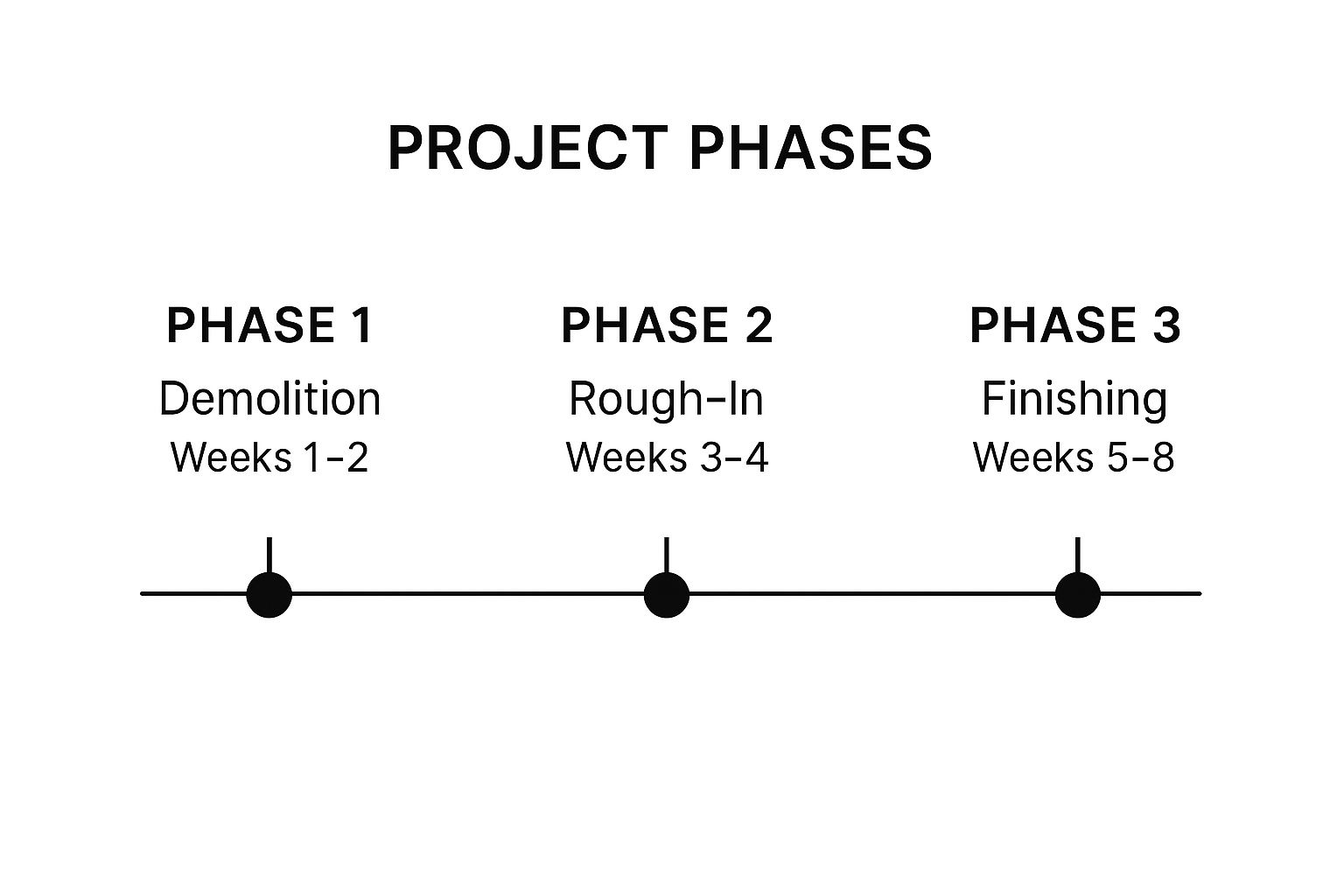
The visualization illustrates how a project logically progresses from disruptive early stages to the final installation and finishing touches.
Actionable Verification Steps
Don't accept a verbal estimate. A detailed, written timeline is essential for protecting your investment and sanity.
Pro Tip: Ask what percentage of their projects finish on the original timeline and how they handle unforeseen delays. Their answer will reveal their honesty and problem-solving abilities.
Follow these steps to get the clarity you need:
- Request the Timeline in Writing: The schedule should be an official part of your contract.
- Identify Critical Milestones: Ensure the timeline includes key stages like permit approval, demolition, rough-ins, inspections, and installation of major components like cabinets and countertops. For a more in-depth look, you can learn more about a kitchen remodel timeline on sinclaircabinets.com.
- Discuss Potential Delays: Ask how they manage issues like weather, material backorders, or subcontractor scheduling conflicts.
- Clarify Responsibilities: Understand who is responsible for delays. Delays caused by the contractor should have different implications than those caused by your decisions to change materials mid-project.
4. What is included in the estimate, and how do you handle change orders?
This is one of the most important financial questions for contractors because it reveals their transparency and business practices. A detailed estimate clarifies exactly what you are paying for, while a formal change order process prevents budget overruns and disputes. Understanding these two components protects you from hidden costs and ensures everyone is on the same page.

Why It's Non-Negotiable
A vague estimate is a red flag. A proper bid should itemize every cost, and a clear change order system provides a roadmap for handling the unexpected.
- Estimate Clarity: A comprehensive estimate breaks down costs for labor, materials, permits, and fees. For example, one basement remodel estimate might include permit fees and inspections, while another omits them, explaining a $3,000 price difference. Without this detail, you can't accurately compare bids.
- Change Order Process: Remodels often uncover surprises. A good contractor has a formal process for "change orders" to document new work. For instance, if opening a wall reveals extensive termite damage, a change order would outline the required repairs and the additional $8,000 cost for your written approval before work proceeds.
- Allowances: Estimates often include "allowances" for items you will select later, like fixtures or tiles. Clear allowances, such as $1,500 for lighting and $3,000 for tile, prevent misunderstandings if your selections are more expensive than the budgeted amount.
Actionable Verification Steps
Dive deep into the numbers and processes before you sign anything. Protect your budget by demanding clarity upfront.
Pro Tip: Ask what is not included in the estimate. This simple question can expose potential hidden costs for things like final cleaning, dumpster rental, or appliance hookups.
Follow these steps for financial peace of mind:
- Request an Itemized Bid: Insist on a line-item estimate detailing all costs. This includes labor, specific material grades, permit fees, and waste disposal.
- Clarify Allowances: Ask for a list of all allowances and what they cover. Understand that if you choose items that cost more, you will pay the difference.
- Review the Change Order Process: Ask for a sample change order form. Ensure all changes, no matter how small, will be documented in writing with costs and approved by you before the additional work begins.
- Understand the Payment Schedule: Confirm the payment schedule and never agree to pay the full project cost upfront. Payments should be tied to project milestones.
5. Will you or your subcontractors be doing the work?
This is one of the most revealing questions for contractors because it clarifies who will actually be on your property performing the work. The answer establishes the chain of command and responsibility. It’s standard practice for a general contractor to subcontract specialized work like plumbing or electrical, but you need to understand their team structure to gauge their project management capabilities.
Why It's Non-Negotiable
Knowing who is responsible for each part of the project is crucial for quality control, communication, and liability. A great general contractor’s value often lies in their network of skilled, reliable subcontractors.
- Accountability: Your contract is with the general contractor. They are ultimately responsible for the quality of all work, including that of their subcontractors. Clarifying this upfront prevents finger-pointing if issues arise.
- Quality Control: A contractor with long-standing relationships with their subcontractors often produces higher-quality, more coordinated work. For example, a seamless kitchen remodel depends on the plumber, electrician, and cabinet installer working in perfect harmony.
- Liability: Every person working on your property must be insured. You need to ensure both the general contractor and any subcontractors carry their own general liability and workers' compensation insurance to protect you from financial risk.
Actionable Verification Steps
Don't assume the general contractor’s insurance covers everyone. Ask for details about their team and process.
Pro Tip: Ask your general contractor to provide proof of insurance for any key subcontractors before they begin work on your property. This ensures everyone is covered.
Follow these steps to understand the project team:
- Request a List: Ask for a list of the primary subcontractors they plan to use for your project, especially for critical trades like electrical and plumbing.
- Inquire About Relationships: Ask how long they have worked with these subcontractors. Established relationships are a good indicator of reliability and teamwork.
- Clarify On-Site Supervision: Determine who from the general contractor’s team will be on-site daily to manage the subcontractors and oversee the quality of the work.
- Discuss Lien Waivers: Ensure your contract states that the general contractor is responsible for paying all subcontractors. You can also request lien waivers from subcontractors upon payment to prevent them from placing a lien on your property if they aren't paid.
6. What permits are required, and who will obtain them?
This is one of the most revealing questions for contractors because it directly addresses legal compliance, safety, and responsibility. Permits are non-negotiable legal requirements for most significant remodeling work, ensuring the project adheres to local building codes. A contractor’s answer will tell you a lot about their professionalism and whether they prioritize safety and long-term value over cutting corners.
Why It's Non-Negotiable
Ignoring permits can lead to severe consequences, from hefty fines to being forced to tear out completed work. Here’s why this question is so important:
- Legal Compliance: Building permits are legal authorizations to begin construction. Proceeding without one is illegal and can halt your project or create major issues when you try to sell your home. For example, unpermitted electrical work discovered during a home sale inspection can lead to costly fines and mandated repairs.
- Safety Assurance: Permits trigger inspections at critical stages of a project. An inspector verifies that work, such as framing, electrical, and plumbing, meets safety standards. This process can catch dangerous errors, like improper structural supports, before they become hidden problems.
- Accountability: The person who pulls the permit is legally responsible for ensuring the work meets code. If the contractor pulls the permit, they are accountable. If they ask you to pull it as a homeowner, the liability shifts entirely to you.
Actionable Verification Steps
A professional contractor will manage the entire permitting process. Your job is to ensure they are doing it correctly and transparently.
Pro Tip: Never agree to pull permits in your own name to "save money." This is a major red flag that indicates the contractor may be unlicensed or trying to evade responsibility for their work.
Follow these steps to manage the permit process:
- Get It in Writing: The contract should explicitly state that the contractor is responsible for identifying, obtaining, and paying for all necessary permits.
- Verify Costs: Ask for the permit fees to be itemized in your project estimate or contract. This prevents surprise costs later on.
- Track the Permit: Ask for the permit number once it has been issued. You can often use this number to look up the permit status and inspection results on your local municipality’s website.
- Confirm Final Sign-Off: Ensure a final inspection is completed and the permit is officially closed out by the city before you make your final payment. This confirms the work has been approved.
Understanding the permitting process is a key part of any successful renovation. For a complete guide to planning your project, see this detailed home remodel checklist.
7. What warranties do you offer on your work?
A warranty is your long-term protection and a direct reflection of a contractor's confidence in their craftsmanship. This question reveals what guarantees are in place should defects arise after the final payment is made. It distinguishes between the contractor’s promise on their labor and the manufacturer’s promise on materials, giving you crucial post-project security.
Why It's Non-Negotiable
A strong warranty provides peace of mind and financial recourse. Here’s how it protects your investment:
- Workmanship Warranty: This is the contractor's personal guarantee on their installation and labor. For example, if deck boards warp six months after installation due to improper fastening, this warranty would cover the repair. Most reputable professionals offer at least a one-year workmanship warranty.
- Manufacturer Warranty: This covers the physical products used, such as cabinets, fixtures, or shingles. A roofing contractor might offer a 10-year workmanship warranty alongside the manufacturer's 25-year shingle warranty.
- Clarity on Exclusions: Understanding what is not covered is as important as knowing what is. A bathroom remodel warranty might exclude tile cracking caused by normal house settlement but will cover any plumbing leaks resulting from installation errors.
Actionable Verification Steps
Never assume a warranty is standard; get all details in writing before signing the contract.
Pro Tip: Ask your contractor how many warranty claims they typically handle in a year. A low number and a clear, efficient resolution process are excellent indicators of high-quality work.
Follow these steps to ensure your warranty is solid:
- Get it in Writing: Demand that all warranty terms, including duration, coverage, and exclusions, are explicitly detailed in the final contract.
- Differentiate Warranties: Ask the contractor to clearly separate their workmanship warranty from the manufacturer warranties for the products they are installing.
- Understand the Process: Clarify the exact steps for filing a claim. Who do you contact? What is the expected response time? A clear process prevents frustration later.
8. How do you handle communication and updates during the project?
Even with the best contractor, a project can derail due to poor communication. This is one of the most critical questions for contractors because it sets the precedent for transparency and partnership. A clear communication plan prevents the number one complaint homeowners have: feeling left in the dark about their own homes.
Why It's Non-Negotiable
A remodeling project involves dozens of decisions, unexpected issues, and schedule adjustments. Without a defined communication process, small misunderstandings can quickly escalate into major frustrations and costly mistakes.
- Establishes Expectations: Knowing who, when, and how you will receive information eliminates anxiety. Will you get a daily text, a weekly email, or a call only when a decision is needed? Clarifying this upfront ensures everyone is on the same page.
- Creates Accountability: A structured update process keeps the project on track. For example, a weekly walk-through ensures progress is reviewed regularly, allowing you to spot issues before they become significant problems.
- Builds Trust: Proactive communication, even about delays or problems, demonstrates professionalism and respect for your time and investment. It shows the contractor views you as a partner in the project.
Actionable Verification Steps
Don't settle for a vague "we'll keep you in touch." Dig into the specifics of their process.
Pro Tip: Ask who your single point of contact will be. Knowing whether to call the project manager, the site foreman, or the owner directly streamlines every interaction and prevents mixed signals.
Follow these steps to build a solid communication plan:
- Define the Method and Frequency: Agree on the primary communication channel (e.g., text, email, a project management app like CoConstruct) and the frequency of updates (e.g., end-of-day photos, a Friday morning summary call).
- Establish Response Times: Ask about their typical response time for non-urgent questions. Also, clarify what constitutes an emergency that warrants an immediate call.
- Clarify Decision Timelines: Discuss how quickly they need your approval on materials or change orders to avoid holding up the project. A good contractor will give you a clear "decision-by" date.
8 Key Contractor Questions Comparison
| Question | Implementation Complexity 🔄 | Resource Requirements ⚡ | Expected Outcomes 📊 | Ideal Use Cases 💡 | Key Advantages ⭐ |
|---|---|---|---|---|---|
| Are you licensed, bonded, and insured? | Moderate – Requires verification of legal credentials | Requires valid licenses, bonding, and insurance coverage | Legal protection and financial liability coverage | Projects requiring legal compliance and homeowner protection | Ensures legitimacy and safeguards against liabilities |
| Can you provide references from recent similar projects? | Low – Requesting and contacting references | Needs access to recent client contacts | Insight into contractor reliability and quality | Evaluating contractor track record and professionalism | Unbiased feedback and realistic project expectations |
| What is the detailed timeline for this project? | Moderate to High – Needs detailed phased schedule | Coordination with subcontractors and suppliers | Clear project milestones and planning ability | Projects with strict scheduling needs or coordination | Accountability and better planning capability |
| What is included in the estimate, and how do you handle change orders? | Moderate – Preparing detailed line-item estimate | Time to gather itemized costs and define process | Transparent pricing and budget control | Budget-sensitive projects and complex scopes | Prevents surprises and sets clear financial expectations |
| Will you or your subcontractors be doing the work? | Moderate – Clarifies labor assignments and oversight | Requires managing subcontractors and licenses | Knowledge of work responsibility and quality control | Projects requiring specialized trades | Access to expert subcontractors and efficient management |
| What permits are required, and who will obtain them? | Moderate – Involves navigating local regulations | Time and cost for permit applications and inspections | Code compliance and legal protection | Major renovations involving structural, electrical, or plumbing work | Ensures safety, legality, and reduces future risks |
| What warranties do you offer on your work? | Low to Moderate – Requires clear warranty policies | Documentation and claims management resources | Post-completion defect protection and peace of mind | Long-term investment protection | Demonstrates contractor confidence and provides recourse |
| How do you handle communication and updates during the project? | Low to Moderate – Establishes communication protocols | Tools for updates, calls, and documentation | Reduces misunderstandings and builds trust | Projects needing regular updates and client involvement | Enhances transparency and proactive problem-solving |
Turning Your Vision into Reality with the Right Partner
Navigating a home renovation or custom cabinetry project can feel like a monumental task, but it doesn't have to be overwhelming. The comprehensive list of questions for contractors provided in this guide serves as your strategic roadmap. It moves your hiring process beyond a simple price comparison and into a deep, holistic evaluation of potential partners. By asking about licensing, communication protocols, change order processes, and warranties, you transform from a passive client into an empowered project manager.
This diligence is not about being difficult; it's about establishing a foundation of clarity, trust, and mutual respect. A professional, high-caliber contractor will welcome your detailed inquiries. They understand that a well-informed client is an essential part of a successful partnership. Your thoroughness signals that you are serious about your investment and committed to a collaborative process, which is precisely the kind of client they want to work with.
From Questions to Confidence
The ultimate goal of this process is to hire with unwavering confidence. When you have clear answers, you can mitigate common renovation frustrations before they ever arise.
- Financial Clarity: Understanding the estimate's scope and the change order process prevents budget overruns and financial surprises.
- Timeline Assurance: A detailed project schedule, complete with milestones, gives you a realistic understanding of the disruption and a clear finish line to look forward to.
- Quality Guarantee: Inquiring about warranties and material sourcing ensures the final product is not only beautiful but also durable and protected.
- Partnership Dynamics: Knowing who will be in your home and how you will receive updates ensures a smooth, transparent, and respectful working relationship.
Mastering these questions for contractors is the single most impactful step you can take to safeguard your investment of time, money, and emotional energy. It empowers you to select a professional who is not just building or remodeling a space, but who is a true partner in bringing your vision to life. The right contractor will transform a potentially stressful experience into an exciting and rewarding journey, culminating in a space that perfectly reflects your style and enhances your daily life.
At Sinclair Cabinetry inc, we believe that an informed client is our best partner, and we welcome these critical questions. With over 35 years of experience in creating exquisite custom cabinetry and managing full-scale renovations, we are built on a foundation of transparency, craftsmanship, and unparalleled customer service. We invite you to begin a conversation with us and see how our commitment to excellence can turn your dream project into a stunning reality.