

Starting a home renovation is an exciting journey, but the success of your project hinges on one critical decision: choosing the right contractor. Whether you're planning a full kitchen overhaul with custom cabinetry or a simple bathroom update, the professional you hire can make the difference between a dream result and a costly nightmare. Rushing this decision is one of the biggest mistakes a homeowner can make. To protect your investment, your home, and your peace of mind, it is crucial to conduct a thorough vetting process.
This guide moves beyond the basics to provide the essential framework for a confident and informed hiring decision. We have compiled the most important questions for a contractor that will help you evaluate their credentials, work processes, and financial stability. By asking these specific, insightful questions, you will uncover a contractor's true professionalism, experience, and commitment to quality. This ensures your project starts on a solid foundation, minimizing surprises and maximizing the potential for a successful outcome. Think of this list as your pre-hiring checklist, designed to give you clarity and control before you commit to a contract.
1. Are you licensed, bonded, and insured?
This is the non-negotiable first question for a contractor, as it forms the bedrock of your protection as a homeowner. These three credentials are not just formalities; they represent distinct layers of security that safeguard your finances, your property, and your peace of mind throughout a cabinetry or remodeling project. A positive answer is the first green light to a professional and secure partnership.

Neglecting this step can lead to disastrous consequences. For example, an unlicensed contractor’s worker injury cost one homeowner over $150,000 in a legal battle that could have been avoided entirely. In another case, a Florida homeowner was saved from a $30,000 loss when their bonded contractor went bankrupt mid-project, as the surety bond covered the cost of hiring a new team to finish the job.
Why It’s a Critical First Step
Each component offers a specific type of protection, and understanding them is crucial when evaluating potential contractors.
- Licensing: Confirms the contractor has met state or local requirements, which often include passing competency exams and background checks. For instance, California requires a CSLB license for any project over $500, ensuring a baseline level of expertise.
- Bonding: This is a surety bond that protects you if the contractor fails to complete the job, doesn't pay subcontractors, or violates building codes. It’s your financial backup against non-performance.
- Insurance: This is twofold. General liability covers property damage caused by the contractor, while workers' compensation covers injuries to the contractor or their employees on your property, protecting you from being held liable.
Actionable Verification Tips
Never take a contractor's word for it. Always verify their credentials independently.
- Request Physical Copies: Ask for copies of the license, bond certificate, and insurance certificates.
- Verify Online: Use your state’s licensing board website to confirm their license is active and in good standing.
- Call the Insurer: Contact the insurance company directly to confirm the policy is current and the coverage limits are adequate for your project’s scope.
- Become an Additional Insured: Request a certificate of insurance (COI) that lists you as an "additional insured." This ensures you are notified if the policy is canceled.
2. Can you provide references from recent similar projects?
Beyond credentials, a contractor's reputation is built on their finished work and client satisfaction. Asking for references is your direct line to verifying their track record, not just from their perspective, but from homeowners who have stood exactly where you are now. This question moves past promises on paper to real-world performance, offering unfiltered insights into their process, quality, and professionalism.
The insights gained are invaluable. For instance, a Seattle homeowner discovered through reference calls that a particular contractor consistently ran three to four weeks behind schedule, a critical piece of information not found in any proposal. Conversely, another reference revealed a contractor’s exceptional problem-solving skills when unexpected structural issues arose in a similar home, giving the prospective client confidence in their ability to handle unforeseen challenges.
Why It’s a Critical First Step
References provide a comprehensive picture of what it's like to work with the contractor day-to-day, from communication to crisis management. A portfolio shows the final product, but references tell the story of how they got there.
- Verifies Quality and Skill: Speaking with past clients confirms the contractor can deliver the level of craftsmanship you expect, especially on projects similar in scope to yours.
- Reveals Communication Style: You’ll learn how they handle updates, answer questions, and manage expectations. Were they responsive and clear, or difficult to reach?
- Exposes Hidden Issues: References can shed light on aspects like budget adherence, punctuality, and job site cleanliness, details that are rarely included in a formal contract.
- Assesses Problem-Solving: Every project has hiccups. References can tell you how the contractor managed unexpected problems, which is a true test of their professionalism.
Actionable Verification Tips
A good contractor will be proud of their work and happy to provide references. Be wary of anyone who hesitates or can only provide old contacts.
- Ask for Recent, Relevant Projects: Request contact information for at least three clients with projects completed in the last 1-2 years that are similar to yours.
- Prepare Specific Questions: Go beyond "Were you happy?" Ask: Did they stay on budget? Did they finish on schedule? How did they handle disagreements or changes?
- Inquire About the Crew: Ask about the professionalism, skill, and courtesy of the subcontractors and on-site crew.
- Request a Site Visit: If possible, ask a reference if you can briefly see the completed work in person. This offers a level of verification that photos cannot match.
3. What is the detailed timeline and project schedule?
A vague "a few weeks" isn't a timeline; it's a guess. This question for a contractor demands a comprehensive schedule that outlines the start date, sequence of tasks, key milestones, and a firm completion date. This document is your roadmap, helping you plan around household disruptions and hold the contractor accountable to a defined plan. A detailed timeline reveals the contractor's organizational skills and whether they have realistically factored in potential delays.
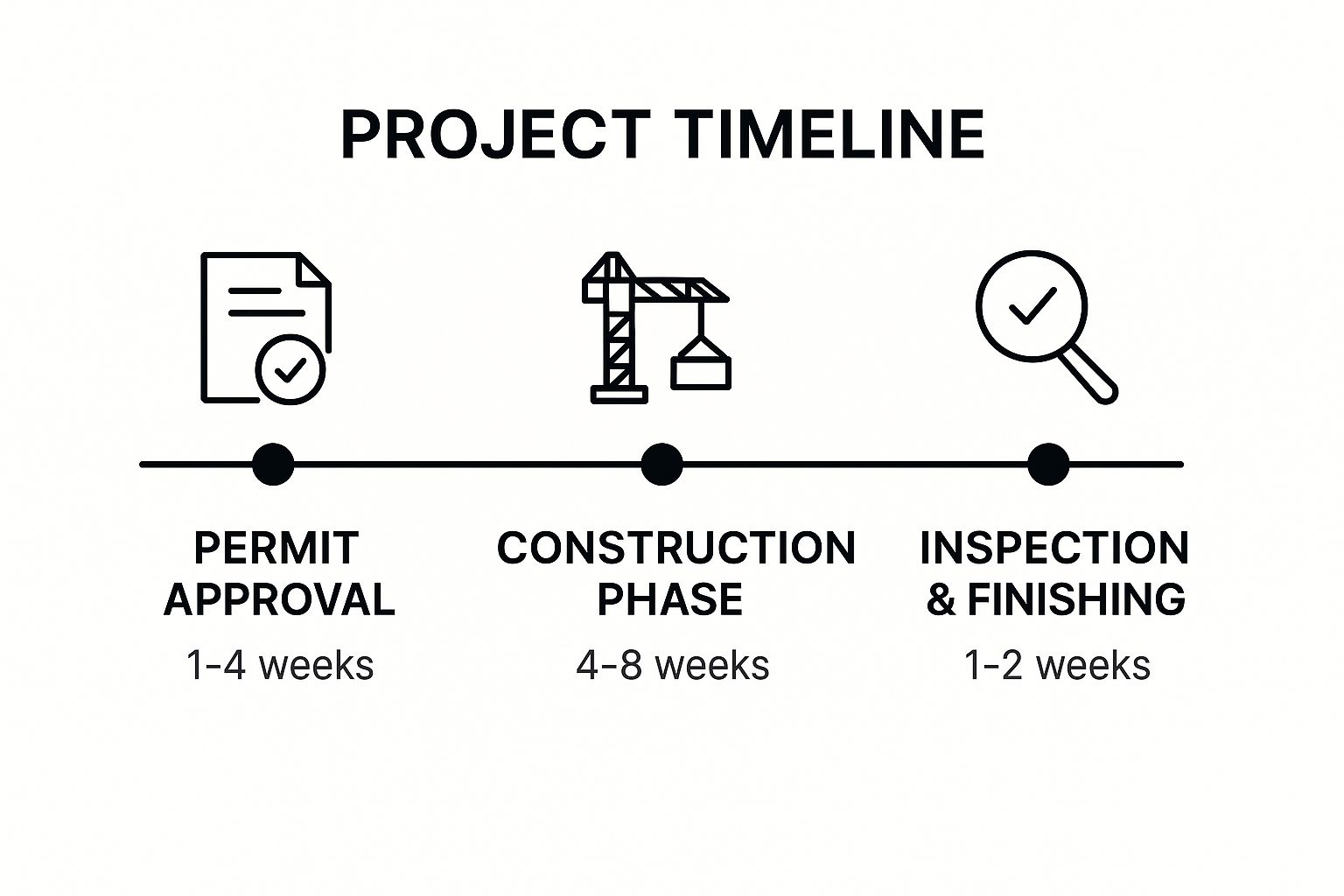
The timeline above visualizes a typical remodeling project, breaking it down into three distinct phases: initial permitting, the core construction work, and final inspections. This overview helps you see that "construction" is just one part of a larger process, with significant time allocated to administrative and finishing stages.
For example, an Atlanta contractor building a deck in the spring wisely added a two-week buffer for common rain delays. Another Chicago-based firm scheduled a bathroom renovation around the homeowners' holiday hosting plans, setting specific milestone dates for plumbing rough-in and tile installation to ensure the main work was completed before guests arrived. These examples show foresight and client-centric planning.
Why It’s a Critical First Step
A project without a clear schedule is a project without direction. Understanding the flow of work is crucial for managing your expectations and the project's logistics.
- Sets Clear Expectations: It aligns your vision with the contractor's execution plan, preventing misunderstandings about when things will happen.
- Aids in Planning: A detailed schedule allows you to coordinate other activities, such as appliance deliveries, temporary living arrangements, or taking time off work for key decisions.
- Creates Accountability: It provides a tangible document to measure progress against. If the project falls behind, you have a baseline for discussion. You can learn more about a typical kitchen remodel timeline to better understand these phases.
Actionable Verification Tips
A good timeline is more than just a start and end date. Ensure it is a useful tool by taking these steps.
- Request a Written Schedule: Insist the timeline be included as a formal part of the contract.
- Discuss Potential Delays: Ask what percentage of their projects finish on time and what the most common reasons for delays are.
- Clarify Update Frequency: Ask how and when you will receive schedule updates. Many modern contractors use project management software for daily or weekly progress reports.
- Define "Completion": Ensure the timeline includes the final punch list, all cleanup work, and obtaining the final occupancy certificate if required.
4. What is included in the written estimate and what are potential additional costs?
This is a critical question for a contractor that moves beyond verbal promises into documented specifics. A detailed written estimate is your project’s financial roadmap, breaking down every anticipated cost, from labor and materials to permits and fees. Understanding precisely what is covered versus what could incur extra charges is the key to preventing budget overruns, misunderstandings, and disputes down the road.

Neglecting to clarify the fine print can be costly. For example, a homeowner’s “all-inclusive” bathroom remodel estimate didn't include upgrading the outdated electrical panel, leading to an unexpected $2,500 expense. In another scenario, a seemingly low bid for a basement project was missing the dumpster rental and debris removal fee, which another contractor had transparently included. A thorough estimate prevents these expensive surprises.
Why It’s a Critical First Step
A vague estimate is a red flag. A professional contractor provides a comprehensive document that serves as a foundation for your contract.
- Clarity on Scope: The estimate should specify material grades, brand names, and quantities. An itemized list prevents a contractor from substituting cheaper, lower-quality materials to increase their profit margin.
- Identifies Hidden Costs: This question forces a conversation about what isn't included. It uncovers potential extra costs for things like discovering hidden rot during demolition, structural issues, or necessary code upgrades.
- Manages Expectations: Understanding how "allowances" work is vital. An estimate might include a $2,000 tile allowance, but if your preferred selection costs $3,500, you are responsible for the difference. For more insight into budgeting, you can use a kitchen remodel cost calculator.
Actionable Verification Tips
Treat the estimate as a blueprint for your financial commitment. Dig into the details before you sign anything.
- Compare Line by Line: Get at least three written estimates and compare them item by item, not just by the final price.
- Question Lump Sums: If you see a large, vague line item like “electrical work – $5,000,” ask for a detailed breakdown.
- Understand Change Orders: Ask how scope changes are handled. What is the process for a change order, and how are additional costs calculated?
- Clarify Allowances: Discuss what happens if you go over or under the specified allowance amounts for items like fixtures, tile, or countertops. To ensure you're getting a fair and transparent deal, especially when navigating complex pricing structures, you might find it useful to consult a guide to finding affordable services and understanding hidden costs.
5. How will you handle permits, inspections, and code compliance?
This is a critical question that reveals a contractor’s professionalism and knowledge of local regulations. The permitting process is not red tape; it's a system designed to ensure your remodeling project is safe, structurally sound, and meets legal standards. A competent contractor should navigate this entire process for you, treating it as an integral part of the job.
Skipping permits can have severe repercussions. For instance, a homeowner who allowed a contractor to "save money" by skipping permits for an addition was later hit with an $8,000 fine and forced to tear down the unsafe structure. Conversely, a Portland contractor’s deep knowledge of local seismic codes ensured the project was permitted and built correctly from the start, preventing costly redesigns and delays.
Why It’s a Critical Step
Proper handling of permits, inspections, and codes protects your investment, your safety, and the future value of your home.
- Permits: This is official permission from your local building authority to proceed with the construction or remodel. It confirms the project plans comply with zoning laws, building codes, and safety standards.
- Inspections: These are mandatory checkpoints during the project where a city inspector verifies that work has been completed correctly according to the approved plans and code. Common inspections include foundation, framing, electrical, and plumbing.
- Code Compliance: This ensures all aspects of the project, from electrical wiring to structural supports, meet the minimum safety standards set by local and national building codes.
Actionable Verification Tips
A professional contractor will be transparent about this process. Here is how to ensure it’s handled correctly.
- Confirm Who Pulls the Permit: The contractor should always pull the permit under their own license. If they ask you to pull an "owner-builder" permit, it is a major red flag.
- Request Copies: Ask for a copy of the approved permit before work begins and copies of all passed inspection reports as the project progresses.
- Discuss Inspection Points: Ask the contractor to outline the key inspection milestones for your project so you know what to expect. This is a key part of any comprehensive home remodel checklist.
- Clarify Responsibility for Failures: Confirm in writing that if any part of the work fails an inspection, the contractor is responsible for correcting the issue at their own expense and scheduling a re-inspection.
6. Who will be working on my project and how will you manage subcontractors?
Understanding who will physically be in your home is a critical question for a contractor, directly impacting project quality, security, and timeline management. A general contractor is often more of a project manager, coordinating a team of specialized subcontractors for tasks like plumbing, electrical, and drywall. Knowing how this team is assembled and supervised is essential for a smooth and successful remodel.
The difference between well-managed and poorly managed subcontractors can be dramatic. One homeowner's kitchen remodel proceeded flawlessly because the general contractor's daily supervision ensured seamless coordination between five different trade crews. Conversely, another project suffered a three-week delay when poor subcontractor management led to scheduling conflicts between the HVAC and framing teams, highlighting the importance of a strong management plan.
Why It’s a Critical First Step
A contractor’s answer reveals their organizational skills and commitment to quality control. A well-defined system for vetting and managing subcontractors protects you from shoddy work, project delays, and potential liability issues.
- Quality Control: A contractor who uses a consistent team of trusted, vetted subcontractors is more likely to deliver high-quality, reliable work. For example, a contractor who has used the same licensed electrician for 10 years brings predictable excellence to your project.
- Accountability: Clarifying who is responsible for a subcontractor’s work is vital. If a sub-par plumbing job causes a leak, you need to know that your general contractor takes full responsibility for the correction and any resulting damages.
- Security and Communication: Knowing who has access to your home provides peace of mind. A single point of contact (the general contractor or a designated site foreman) streamlines communication and prevents confusion.
Actionable Verification Tips
Go beyond a simple "yes" and dig into the contractor's specific management processes to ensure they have a solid plan.
- Ask About On-Site Presence: Inquire how often the general contractor or a dedicated project manager will be on-site to supervise the work.
- Discuss the Vetting Process: Ask how they select and vet new subcontractors. Do they verify licenses, insurance, and references?
- Verify Subcontractor Insurance: Confirm that the contractor requires all subcontractors to carry their own liability and workers' compensation insurance.
- Establish a Point of Contact: Designate a single person as your daily point of contact to streamline communication and resolve issues quickly.
- Request Crew Consistency: Ask if the same core team will work on your project from start to finish to ensure consistency and familiarity.
7. What does your warranty cover and for how long?
A contractor’s warranty is your long-term protection against defects and installation errors after the final payment is made. This crucial question for a contractor clarifies what they stand behind, for how long, and what is excluded. It separates professionals who are confident in their work from those who may disappear once a project is complete, leaving you to handle any subsequent issues.
The difference is significant. One homeowner’s roofing contractor offered a 10-year workmanship warranty, which covered the cost of repairing a flashing leak discovered in year three. Conversely, another homeowner's bathroom tile warranty didn't cover grout discoloration, which the contractor classified as a maintenance issue, not a defect. Understanding these nuances upfront prevents future disputes and unexpected expenses.
Why It’s a Critical First Step
A warranty reveals a contractor's commitment to quality and their process for handling post-project problems. It's not just about a time frame; it’s about the scope of coverage.
- Workmanship Warranty: This is the contractor's guarantee on their own labor and installation quality. It covers issues arising from improper installation, such as a cabinet door that becomes misaligned or a tile that comes loose.
- Material Warranty: These are provided by the manufacturers of the products used, like cabinets, countertops, or appliances. The contractor should facilitate these, but the manufacturer is ultimately responsible.
- Exclusions: Pay close attention to what is not covered. Common exclusions include normal wear and tear, damage caused by the homeowner, or problems resulting from a lack of routine maintenance.
Actionable Verification Tips
A verbal promise is not enough. Ensure the warranty is a clear, actionable part of your agreement.
- Get It in Writing: The warranty terms, including duration, coverage details, and exclusions, must be explicitly detailed in your signed contract.
- Differentiate Warranties: Ask the contractor to clarify the difference between their workmanship warranty and the manufacturer's material warranties. Who is your point of contact for each?
- Understand the Claims Process: Ask how to file a claim. What is the expected response time? Who performs the repair work?
- Inquire About Transferability: If you plan to sell your home, ask if the warranty is transferable to the new owner. This can be a valuable selling point.
8. What is your payment schedule and what protections do I have?
A contractor’s payment structure is a direct reflection of their financial stability and professional integrity. This question is vital because it outlines how and when your money changes hands, ensuring the process is fair and protects you from financial loss. A transparent, milestone-based schedule incentivizes progress and quality, while a risky one can leave you without leverage if problems arise.
Failing to clarify this can be devastating. For example, a homeowner who paid 50% upfront lost $25,000 when their contractor abandoned the project after the initial demolition. Conversely, another homeowner successfully tied payments to specific completion stages, like foundation, framing, and drywall. This ensured each phase met their standards before they released the next payment, keeping the project on track and accountable.
Why It’s a Critical First Step
A well-defined payment schedule protects both parties. It ensures the contractor has the cash flow to purchase materials and pay labor, while you retain control and ensure work is completed to your satisfaction before releasing the full funds.
- Initial Deposit: This should be a small percentage, typically 10-25%, to cover initial material orders and mobilization. Be wary of large upfront demands.
- Progress Payments: These should be tied to tangible, verifiable project milestones (e.g., "cabinet installation complete"), not arbitrary dates.
- Final Payment & Retainage: The final payment, often 10-20% of the total cost, should be withheld until every item on the final "punch list" is completed perfectly. This is your leverage to ensure the last details are finished.
Actionable Verification Tips
Your contract is the ultimate tool for defining and enforcing the payment schedule.
- Insist on Milestone Payments: Ensure the contract clearly lists each payment trigger. For example, “Payment 3 due upon successful inspection of electrical rough-in.”
- Never Pay in Full Upfront: Legitimate contractors have sufficient credit and capital to start a project without a massive initial investment from you.
- Request Lien Waivers: With each payment, require the contractor and major subcontractors to sign a lien waiver, which is a receipt stating they have been paid and waive their right to place a lien on your property.
- Use Secure Payment Methods: Pay with a credit card for the deposit if possible, as it offers fraud protection. Avoid paying in cash or writing checks to an individual instead of the business name.
8-Point Contractor Question Comparison
| Aspect | Are you licensed, bonded, and insured? | Can you provide references from recent similar projects? | What is the detailed timeline and project schedule? | What is included in the written estimate and potential additional costs? | How will you handle permits, inspections, and code compliance? | Who will be working on my project and how will you manage subcontractors? | What does your warranty cover and for how long? | What is your payment schedule and what protections do I have? |
|---|---|---|---|---|---|---|---|---|
| Implementation Complexity 🔄 | Moderate; requires verification of legal documents | Low; gathering references involves contacting clients | High; detailed planning and scheduling needed | Moderate; requires detailed cost breakdown | High; involves navigating local regulations and scheduling inspections | Moderate; managing multiple subcontractors and site supervision | Moderate; clear documentation and processes needed | Moderate; writing clear schedules and safeguards |
| Resource Requirements ⚡ | Requires access to licensing boards and insurance contacts | Requires time to contact and speak with multiple references | Needs contractor’s planning tools and communication skills | Needs detailed project info, cost analysis | Access to permitting offices and inspection coordination | Coordination tools and supervisory staff needed | Documentation and communication systems | Contract drafting and monitoring payments |
| Expected Outcomes 📊 | Legal protection and validated professionalism | Insight into contractor’s quality, reliability, and communication | Clear expectations on project duration and milestones | Transparent budgeting and cost control | Code-compliant, safe project with required approvals | Better quality control and accountability | Post-project defect coverage and peace of mind | Financial protection and payment clarity |
| Ideal Use Cases 💡 | Verifying contractor credentials before hiring | Evaluating track record for similar project scope | Planning complex or time-sensitive projects | Comparing bids and budgeting accurately | Projects requiring permits and inspections | Projects involving multiple trades or specialized subcontractors | Projects where workmanship longevity is important | Projects needing structured payment flow and legal safeguards |
| Key Advantages ⭐ | Protects homeowner legally and financially | Reveals real client experiences and potential issues | Holds contractor accountable to schedule | Prevents budget surprises | Ensures regulatory compliance and prevents legal risks | Improves project coordination and security | Contractor accountability after completion | Protects homeowner from overpayment and abandonment |
Partnering with the Right Professional for Your Home
Choosing the right contractor is less like hiring a service and more like entering a strategic partnership. Your home, often your most significant asset, is placed in their hands. The journey from a conceptual vision to a beautifully realized space depends almost entirely on the competence, communication, and integrity of the professional you select. Armed with the comprehensive list of questions for a contractor detailed in this article, you are now equipped to navigate this critical decision-making process with confidence and clarity.
Moving beyond a simple price comparison is the single most important shift in mindset you can make. While budget is undeniably a crucial factor, the true cost of a project is measured not just in dollars, but in peace of mind, quality of life, and the long-term value of the finished work. A contractor who readily provides proof of licensing and insurance, offers a portfolio of glowing references, and presents a transparent, detailed timeline isn't just checking boxes; they are demonstrating a commitment to professionalism and respect for your investment.
From Questions to Confidence: Your Actionable Next Steps
The true power of these questions lies in their application. Don't just ask them; actively listen to the answers and evaluate the quality of the documentation provided. A confident, experienced contractor will welcome your diligence. They will see it as a sign of a serious and engaged client, which is the foundation of any successful collaboration.
Your next steps should be methodical:
- Shortlist Your Candidates: Based on initial research and recommendations, identify three to four potential contractors for your project.
- Conduct the Interviews: Schedule a dedicated time to discuss your project and systematically go through these essential questions with each candidate. Take detailed notes.
- Analyze and Compare: Don't just compare the final bid numbers. Compare the quality of the responses. Who offered the most detailed breakdown of costs? Who had the most robust warranty? Whose communication style felt the most professional and reassuring?
This vetting process is not just about avoiding disaster; it's about proactively setting your project up for success. Understanding how to identify top-tier professionals is a skill in itself. For homeowners looking to deepen their understanding of what separates the best from the rest, this guide on Finding the Best Construction Consultants provides excellent insights into the principles of vetting and selecting elite industry talent.
Ultimately, the goal is to find a partner who not only has the technical skill to execute your vision but also the business acumen to manage the project smoothly from start to finish. This diligence upfront is the best investment you can make, ensuring the renovation process is as rewarding as the final result.
Ready to partner with a team that welcomes your questions and exceeds your expectations? For over 35 years, Sinclair Cabinetry inc has built a reputation on transparency, quality craftsmanship, and unparalleled customer service. Visit Sinclair Cabinetry inc to see how our commitment to excellence can bring your cabinetry and remodeling dreams to life.