

Hiring a contractor is the single most critical decision you'll make for your home renovation project. The right partner can turn your vision into a stunning reality, while the wrong one can lead to a cascade of delays, budget overruns, and immense stress. The difference between success and failure often comes down to the quality of your vetting process, which starts with asking the right questions upfront. This guide moves beyond the obvious to provide a comprehensive list of crucial questions to ask a contractor before hiring.
Each question is designed to uncover a contractor's professionalism, reliability, and craftsmanship, empowering you to compare bids accurately and choose with confidence. From verifying credentials to understanding their process for handling the unexpected, this list is your first and most important tool in building a successful project from the ground up. To help streamline your selection process and ensure you cover all critical areas, consider utilizing an essential 7-point contractor hiring checklist as a companion to this guide.
Whether you're planning a major kitchen remodel, a bathroom overhaul, or a smaller home improvement, these questions will ensure you find a true professional dedicated to quality and client satisfaction, ultimately protecting your investment and your peace of mind.
1. Are you licensed, bonded, and insured?
This is the first and most critical question to ask a contractor before hiring them for any project. The answer reveals whether they operate legally, professionally, and with the necessary financial protections in place for both you and them. A simple "yes" isn't enough; you need to understand what each component means and verify the details independently.

What Each Component Means for You
Understanding these three pillars of contractor qualification is essential for protecting your investment and mitigating risk. They are distinct, yet work together to provide comprehensive coverage.
- Licensed: A license proves the contractor has met the minimum competency and business practice standards required by your state or local municipality. Requirements vary significantly; for example, California requires a C-10 electrical license for jobs over $500, while many Texas GCs need only local permits and insurance.
- Bonded: A surety bond protects you financially if the contractor fails to complete the job, doesn't pay subcontractors, or violates building codes. If this happens, you can file a claim against the bond to recoup your losses.
- Insured: Insurance covers unforeseen accidents. General liability protects your property from damage, while workers' compensation covers medical costs if a worker is injured on-site. Without it, you could be held liable. In one real-world case, a homeowner was saved from a $15,000 liability claim when a roofer fell, precisely because the contractor carried proper workers' compensation insurance.
How to Verify a Contractor's Credentials
Never take a contractor’s word for it. Due diligence is non-negotiable and provides peace of mind. For a more exhaustive checklist on hiring contractors, you can explore the insights on vetting professional contractors.
Actionable Verification Steps:
- Request Physical Copies: Ask for copies of their state license, bond number, and certificates of insurance for both general liability and workers' compensation.
- Confirm with the Source: Use your state's contractor licensing board website to verify the license is active and free of disciplinary actions. Call the insurance carriers listed on the certificates to confirm the policies are current.
- Check Coverage Details: Ensure the policy coverage limits are sufficient for the scale of your project and that the license classification matches the work being performed.
- Monitor Expiration Dates: If your project timeline extends beyond a policy’s expiration date, ask for an updated certificate once it’s renewed.
2. Can you provide references from recent, similar projects?
While a portfolio shows the final product, references reveal the entire journey. This question to ask a contractor before hiring moves beyond polished photos to provide firsthand accounts of their professionalism, communication, and real-world performance. A reputable contractor will readily provide a list of recent clients whose projects mirror the scope and style of your own.

What Each Component Means for You
Contacting references is your opportunity to uncover the contractor's true working style. It helps you set realistic expectations and avoid potential conflicts by understanding their patterns and processes from a client's perspective.
- Recent References: A reference from the last 1-2 years reflects the contractor's current crew, project management systems, and quality of work. Older references may not be relevant if their team or subcontractors have changed.
- Similar Projects: A contractor who excels at bathroom remodels may not have the expertise for a major structural addition. Speaking with a client who had a similar project done confirms the contractor has direct, relevant experience.
- Firsthand Accounts: References can share invaluable details that a portfolio cannot. For example, one homeowner learned from a reference that their potential contractor consistently ran three weeks behind schedule, while another discovered the contractor's exceptional tile work was far more impressive in person.
How to Verify a Contractor's Credentials
Treat the reference check as a structured interview, not a casual chat. Prepare specific questions to gather the information you need to make an informed decision and identify any potential red flags.
Actionable Verification Steps:
- Request at Least Three References: Ask for contact information for at least three clients with recent, comparable projects. A small or hesitant list could be a warning sign.
- Ask Targeted Questions: Go beyond "Were you happy?" Ask specific questions like, "How did they handle unexpected issues or changes?" and "Did the final cost align with the initial estimate?"
- Inquire About Site Management: Ask about the cleanliness of the job site, the professionalism of the crew and subcontractors, and their communication protocol for daily updates.
- Request a Site Visit: If possible, ask a reference if you can briefly see the completed work in person. This allows you to assess the quality of craftsmanship firsthand, which is especially useful for details like cabinetry, tile, and paint finishes.
3. What is the detailed project timeline with milestones?
Beyond the final deadline, this essential question to ask a contractor before hiring forces them to break down the entire project into a logical sequence of phases. A detailed timeline reveals the contractor's organizational skills, foresight, and understanding of the project's complexity. It transforms an abstract completion date into a concrete, phase-by-phase roadmap, giving you clarity on what to expect and when.
This infographic illustrates a simplified timeline for a typical project, highlighting the major phases and their durations.
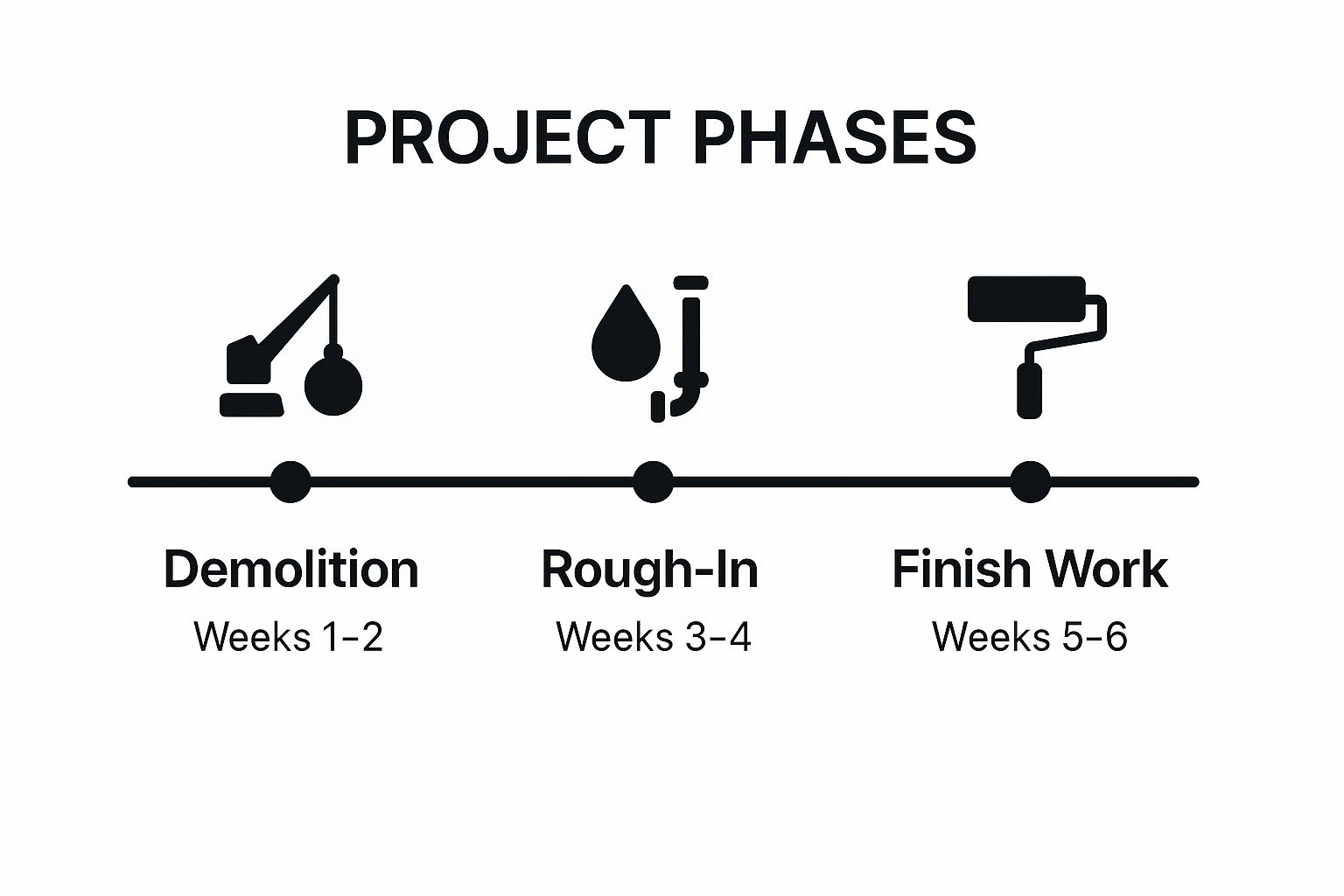
The visualization shows how each phase builds upon the last, underscoring the importance of completing each step on schedule to avoid a domino effect of delays.
What a Good Timeline Means for You
A comprehensive timeline is more than just a schedule; it’s a critical project management tool that sets expectations and provides a framework for communication. It helps you manage your life around the disruption.
- Clarity and Planning: Knowing the schedule for demolition, plumbing, electrical, and cabinet installation allows you to plan accordingly. For instance, in a kitchen remodel, knowing the "Rough-In" phase is weeks 3-4 helps you prepare for temporary utility shutoffs.
- Accountability: A written timeline with milestones creates a benchmark for progress. If the drywall isn't started by week five as planned, you have a specific, contract-backed point of reference for discussion.
- Dependency Management: It highlights critical decision points for you. If custom countertops need to be ordered by week six to arrive for an installation in week eight, the timeline makes this clear, preventing homeowner-caused delays.
How to Evaluate and Manage the Timeline
A timeline is only useful if it's realistic and actively managed. Don’t just accept the first draft; scrutinize it and make it a living document. For a granular look at what this involves, you can explore a detailed kitchen remodel timeline.
Actionable Verification Steps:
- Get it in Writing: Insist the detailed timeline, including key milestones and payment schedules, is an official part of the signed contract.
- Discuss Contingencies: Ask what factors could cause delays (weather, material backorders, inspections) and how much buffer time is built in. A deck build, for example, should always include a contingency for rain.
- Clarify Your Role: Identify which milestones depend on your decisions or material selections. Confirm the deadlines you must meet to keep the project on track.
- Establish Communication: Set up a regular check-in schedule (e.g., weekly) to review progress against the timeline and address any potential roadblocks before they become major issues.
4. Can you provide a detailed, itemized written estimate?
A total price on a handshake or a single-line quote is a major red flag. This question is crucial because a detailed, itemized estimate is the foundation of a transparent and well-managed project. It transforms a vague quote into a clear financial roadmap, allowing you to see exactly where every dollar is allocated and preventing costly misunderstandings down the line.

What Each Component Means for You
Understanding the breakdown of a professional estimate helps you compare bids accurately and control your budget effectively. It moves the conversation from a simple total cost to a detailed discussion of value.
- Labor: This should detail the cost of the workforce, often broken down by task or trade (e.g., plumbing, electrical, carpentry). It gives you insight into the complexity of the work.
- Materials: A good estimate specifies brands, models, and quantities. For instance, a kitchen remodel estimate should list "$8,000 for Fabuwood cabinets" and "$3,500 for 60 sq ft of MSI Calacatta Laza quartz countertops," not just "cabinets and counters."
- Allowances: These are budget placeholders for items you haven't selected yet, like tile or light fixtures. An estimate might include a "$2,500 tile allowance at $15/sq ft," giving you the flexibility to choose materials within that budget or upgrade if you wish.
- Overhead & Profit: This legitimate business cost covers the contractor’s operational expenses and profit margin. A transparent contractor will not hide this figure.
How to Verify a Contractor's Estimate
A detailed estimate is your primary tool for due diligence. Use it to ensure fairness, accuracy, and completeness before signing any contract.
Actionable Verification Steps:
- Compare Line Items: When you get multiple bids, compare them line by line, not just by the final number. This can reveal where one contractor may be overcharging; for example, one homeowner saved $3,000 after noticing an electrician’s sub-bid was significantly inflated in one estimate.
- Question Vague Entries: Ask for clarification on any ambiguous terms like "miscellaneous," "sundry items," or "contingency." Every cost should have a clear purpose.
- Clarify What's Excluded: Ask directly: "What is not included in this price?" This often uncovers hidden costs like final cleanup, debris hauling, or final inspections.
- Check Material Specs: Ensure all specified materials meet your quality expectations. A detailed estimate prevents a contractor from substituting lower-grade materials to increase their profit margin.
5. How do you handle changes, unexpected issues, and change orders?
Almost every renovation project encounters surprises. This question reveals a contractor's process for navigating the inevitable changes, whether they come from you or from unforeseen issues discovered on-site. A well-defined change order process is the hallmark of a professional contractor and is essential for maintaining control over your budget and timeline.
What Each Component Means for You
Understanding the change order process protects both parties from disputes and financial strain. It ensures all work is documented, priced fairly, and approved before execution, preventing misunderstandings and surprise costs.
- Unexpected Issues: These are problems hidden behind walls or under floors, such as rotted subfloors, outdated electrical wiring, or plumbing that isn't up to code. A good contractor will stop work, document the issue with photos, and present you with clear, costed solutions. For example, a kitchen remodel might uncover a rotted subfloor, leading to an $1,800 change order to ensure the new flooring has a stable foundation.
- Client-Requested Changes: This is when you decide to add or alter something mid-project, like adding recessed lighting after the drywall is up. A formal change order documents this new scope, its cost ($650, for instance), and any impact on the schedule, preventing future disputes over what was included.
- Change Orders: This is the official document that details the scope, cost, and timeline impact of any deviation from the original contract. It must be signed by both you and the contractor before the additional work begins. This legally amends your initial agreement.
How to Verify a Contractor's Process
A verbal agreement is not enough when it comes to project changes. A contractor’s process should be transparent and focused on clear, written communication to avoid costly errors. A detailed plan for these situations is a key part of any successful project, much like the steps outlined in this comprehensive kitchen renovation checklist.
Actionable Verification Steps:
- Request a Sample: Ask the contractor to show you a blank or redacted copy of their standard change order form so you can see what information it includes.
- Discuss the Process: Ask them to walk you through their step-by-step procedure when an unexpected issue arises. How do they communicate it? How quickly do they provide pricing?
- Clarify Markup: Inquire about their markup percentage on materials and labor for change order work. This is a standard practice, but the percentage should be clearly stated in your contract.
- Require Written Approvals: Confirm they will not proceed with any extra work, regardless of how minor, without your signed approval on a formal change order.
6. What warranty do you provide on labor and materials?
A warranty defines the contractor's long-term responsibility for their work after your project is complete. This is a critical question to ask a contractor before hiring because it reflects their confidence in their craftsmanship and provides you with a safety net against future issues. A robust warranty separates reputable professionals from those who may not stand behind their work.
What Each Component Means for You
Understanding the distinction between labor and material warranties is essential for knowing what protections you have. They are separate but equally important for safeguarding your investment.
- Labor Warranty: This covers the quality of the installation and workmanship. If a problem arises from how something was built or installed, this warranty applies. For example, a roofer's two-year labor warranty would cover fixing a leak caused by improper flashing installation.
- Material Warranty: This is provided by the product manufacturer and covers defects in the materials themselves. For instance, a quality deck builder might offer a five-year labor warranty but will also help you file a claim against the manufacturer's 25-year warranty if the composite boards prematurely warp.
- Exclusions and Limitations: Warranties are not all-encompassing. A kitchen remodeler’s one-year warranty might exclude cabinet hardware, which is often covered by a separate lifetime warranty from its manufacturer. A major risk is when a contractor goes out of business, potentially voiding their labor warranty entirely.
How to Verify a Contractor's Warranty
Never accept a verbal promise. A warranty is only enforceable if it is clearly documented and understood before any work begins. This diligence ensures you are protected long after the final payment is made.
Actionable Verification Steps:
- Request Terms in Writing: Insist that all warranty details, for both labor and materials, are explicitly stated in the signed contract. This should include duration, coverage specifics, and exclusions.
- Clarify the Claims Process: Ask about the procedure for filing a claim. What is their typical response time? Who is your point of contact?
- Confirm Material Registrations: Ensure that any high-value material warranties, like for roofing or windows, are properly registered in your name to activate the manufacturer's coverage.
- Schedule a Final Inspection: Before your labor warranty expires, consider scheduling a follow-up inspection to identify and address any potential issues while you are still covered.
7. Who will be working on my property and how will the site be managed?
This crucial question moves beyond the project scope and into the daily realities of living through a renovation. The answer reveals the contractor's organizational skills, respect for your home, and communication structure. Knowing who will be on-site, who is in charge, and how they operate is fundamental to a smooth and low-stress project experience.
What Site Management Means for You
Understanding the operational plan helps set clear expectations for daily life during construction. It addresses who is accountable for quality, safety, and communication, ensuring your home remains as livable and secure as possible.
- Personnel & Supervision: You need to know if the contractor you hired will be on-site daily or if a project manager or site supervisor will be your main point of contact. This determines who you call with immediate concerns. It also clarifies whether the work will be done by in-house employees or a team of specialized subcontractors.
- Site Logistics: This covers practical details that directly impact your comfort and security. It includes established work hours, policies on using your bathroom versus a portable toilet, and measures to protect existing floors, furniture, and landscaping from damage. For example, a contractor might specify daily floor protection and a 4 PM cleanup routine in the contract.
- Communication & Security: A clear plan defines how you will receive updates and who has access to your home. It establishes how subcontractors are managed and vetted, and what security measures are in place if workers need access when you are not home.
How to Clarify Site Operations
Don’t assume anything about the day-to-day process. A professional contractor will have clear, established procedures and should be able to answer these questions confidently.
Actionable Verification Steps:
- Ask for an Organizational Chart: Request a clear outline of who is responsible for what, from the lead contractor to the project manager and any key subcontractors.
- Request Subcontractor Info: Ask for a list of the primary subcontractors they plan to use and confirm they are also licensed and insured.
- Define "Clean": Get specifics on cleanup. Will they sweep daily? Run a HEPA filter to control dust? Will all debris be removed from the property at the end of each week?
- Establish Rules of the House: Discuss and agree on work hours (e.g., 8 AM to 5 PM, Monday-Friday), music volume, parking locations, and access protocols. Get these details included in your written contract.
8. What is the payment schedule and what protections do I have?
This is a pivotal question to ask a contractor before hiring, as it directly impacts your financial risk and leverage throughout the project. The payment structure defines when and how you pay for the work, and a well-defined schedule protects both you and the contractor. A contractor who demands excessive upfront payment or ties payments to arbitrary dates instead of completed work is a major red flag.
What Each Component Means for You
Understanding the mechanics of a project payment schedule is essential for safeguarding your investment and ensuring the job is completed to your satisfaction. A proper schedule aligns the contractor's cash flow needs with your need for quality assurance.
- Deposit: This initial payment allows the contractor to secure materials and schedule labor. It should be a reasonable percentage, typically 10-25%, and never more than 30%. A contractor demanding 50% upfront, for example, could abandon the project, leaving you with a significant financial loss.
- Progress Payments: These are payments made as the project reaches specific, verifiable milestones. For a kitchen remodel, this could be 25% after demolition and framing, 25% after rough inspections, and 25% after finish work is installed.
- Final Payment & Holdback: The final payment, often 10-20% of the total cost, is withheld until every item on the final punch list is complete and all inspections are passed. This gives the contractor a powerful incentive to finish the job properly and promptly. For instance, withholding a final 20% payment can provide the leverage needed to ensure a contractor completes punch list items within two weeks.
How to Verify and Protect Your Payments
Never agree to a vague payment plan. A detailed schedule written into the contract is your best defense against disputes and financial loss. A critical part of this is also understanding how you will fund these payments; some contractors help by letting you explore available financing options to manage project costs effectively.
Actionable Verification Steps:
- Tie Payments to Milestones: Insist that every payment, after the initial deposit, is tied to a clearly defined and completed stage of work, not a calendar date.
- Request Lien Waivers: Before making a progress payment, request a lien waiver from the general contractor and any major subcontractors. This protects you from a mechanic’s lien if the GC fails to pay their suppliers or crew.
- Document Everything: Take photos to document the completion of each milestone before releasing payment. Pay with a check or credit card to maintain a clear paper trail; avoid cash.
- Confirm Subcontractor Payments: If possible, verify that subcontractors have been paid before releasing the next round of funds to the general contractor to prevent future disputes.
Key Questions to Ask Contractors: Comparison of 8 Essentials
| Item | Implementation Complexity 🔄 | Resource Requirements ⚡ | Expected Outcomes 📊 | Ideal Use Cases 💡 | Key Advantages ⭐ |
|---|---|---|---|---|---|
| Are you licensed, bonded, and insured? | Moderate – requires verification of documents | Medium – time to verify licenses, bonds, insurance | Ensures legal compliance, financial protection | All contractor hires requiring legal and financial safeguards | Protects homeowner liability; ensures contractor legitimacy |
| Can you provide references from recent, similar projects? | Low – simple request and follow-up | Low – contacting references | Insight into work quality, reliability, communication | Projects where quality and reputation are critical | Firsthand client feedback; verifies claims |
| What is the detailed project timeline with milestones? | Moderate to high – needs detailed scheduling | Medium – coordination and timeline creation | Clear project schedule, better planning | Projects with tight deadlines or complex phases | Accountability; realistic expectations |
| Can you provide a detailed, itemized written estimate? | Moderate – requires thorough cost breakdown | Medium to high – time and detail for estimate | Transparent costs, easier comparisons | Projects with significant budgets or cost sensitivity | Cost transparency; reduces disputes |
| How do you handle changes, unexpected issues, and change orders? | High – requires defined procedures and documentation | Medium – ongoing communication and documentation | Prevents disputes, controls scope and costs | Projects with potential unknowns or high risk of changes | Clear process; protects both parties |
| What warranty do you provide on labor and materials? | Low to moderate – documentation and policy setup | Low to medium – documentation and tracking | Post-completion defect coverage | Projects where long-term quality assurance is desired | Confidence in work; protects homeowner investment |
| Who will be working on my property and how will the site be managed? | Moderate – requires clear communication and supervision | Medium – managing personnel and logistics | Smooth daily operations, site safety, security | Projects with multiple subcontractors or long duration | Accountability; reduces conflicts; site protection |
| What is the payment schedule and what protections do I have? | Moderate – requires milestone definition and contract terms | Low to medium – contract administration | Protection against financial risk; clear payments | All projects requiring staged payments and homeowner protection | Maintains leverage; prevents payment disputes |
From Questions to Confidence: Making Your Final Decision
Navigating the process of hiring a contractor can feel like a high-stakes interview where your home is the prize. You've now armed yourself with a comprehensive checklist of critical questions, moving far beyond a simple price comparison. This strategic approach transforms a potentially overwhelming task into a structured evaluation, allowing you to confidently vet professionals and protect your most significant investment. The goal isn't just to find someone who can do the job; it's to find a true partner who values transparency, clear communication, and professional accountability.
The answers you've collected are more than just data points. They are a direct reflection of a contractor's business practices and their commitment to client satisfaction. A professional who readily provides licensing and insurance details, offers a portfolio of relevant references, and presents a detailed, itemized bid is demonstrating a foundation of reliability. They are showing you, not just telling you, that they operate with integrity.
Synthesizing the Information for a Smart Decision
As you lay out the proposals side-by-side, look beyond the bottom-line number. The true value often lies in the details.
- Compare the Itemized Bids: Did one contractor provide a vague, one-page quote while another offered a multi-page document detailing labor, materials, and potential allowances? The latter indicates a more thorough planning process, reducing the likelihood of unexpected costs.
- Evaluate Communication Styles: How did each contractor respond to your list of questions? Were they patient and thorough, or did they seem dismissive or rushed? The initial communication often sets the tone for the entire project.
- Review the Timelines and Processes: A well-defined timeline with clear milestones, coupled with a formal process for handling change orders, is the hallmark of an experienced project manager. This structure is your best defense against project delays and budget overruns.
Ultimately, the best choice is the contractor whose answers consistently built a foundation of trust. It's the professional who didn't just give you a price but also provided a clear roadmap for success. By diligently asking these essential questions to ask a contractor before hiring, you've done the crucial upfront work to mitigate risks and align expectations. You are no longer just hiring a builder; you are investing in a smooth, predictable, and successful renovation experience that respects your home, your budget, and your vision. This diligence is the cornerstone of a successful project and the key to turning your dream space into a reality without the nightmare of a poorly managed renovation. You are now prepared to move forward not with hope, but with a well-earned sense of confidence.
Ready to partner with a team that welcomes detailed questions and provides transparent, comprehensive answers? For specialized projects involving high-end custom cabinetry, the vetting process is even more critical. At Sinclair Cabinetry inc, we pride ourselves on a process built on clarity, craftsmanship, and client collaboration, ensuring your vision is executed flawlessly from design to installation. Visit Sinclair Cabinetry inc to see how our commitment to professional excellence can elevate your next project.