
At the heart of any cabinet refresh is a fundamental choice: do you paint or do you stain? The difference really comes down to this: paint coats the surface, giving you a modern, uniform look with nearly endless color options, while stain soaks right into the wood, enhancing its natural grain and texture. Your decision hinges on whether you're after a clean, colorful vibe or a warmer, more organic feel.
Choosing Between Paint and Stain for Your Cabinets
Picking the perfect finish for your kitchen cabinets is a huge step in any renovation. Paint is fantastic for creating a clean, contemporary surface that can instantly brighten up a room. It’s also incredibly forgiving, easily hiding imperfections in older wood or covering materials like MDF. Stain, on the other hand, is all about celebrating the unique character of the wood itself, adding depth and warmth that feels right at home in traditional or rustic styles.
This image breaks down the key differences in cost, durability, and maintenance between these two popular finishes.
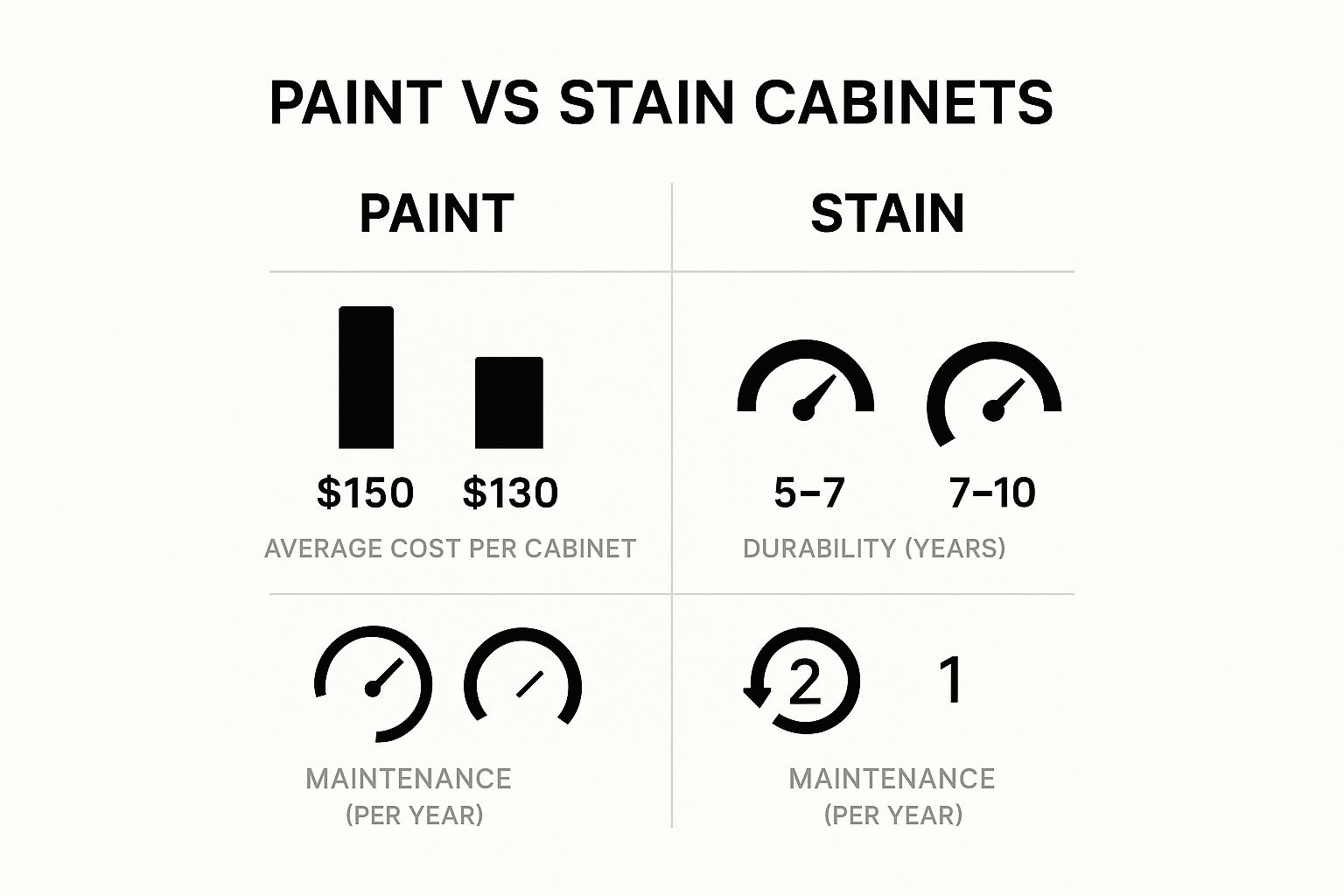
As you can see, while staining might be a bit less expensive upfront and is generally more durable, painting still offers a respectable lifespan with totally manageable upkeep.
Key Factors at a Glance
Choosing the right finish means you're balancing aesthetics with practical things like cost, the prep work involved, and long-term durability. This decision is a major reason the cabinet refinishing market, valued at USD 1.5 billion in 2024, is booming and expected to more than double by 2033. More and more homeowners are choosing to refinish rather than replace their cabinets, which can save them up to 50% on renovation costs.
The most critical factor? The condition and type of your wood. High-quality wood with a beautiful, prominent grain is the perfect candidate for stain. For surfaces that are less than perfect, paint is your best friend.
Whether you're working with brand-new custom pieces or breathing life back into existing ones, getting these core differences is key. If you are in the market for new cabinets, our guide to the best kitchen cabinet manufacturers is a great resource for finding top-tier quality.
Paint vs. Stain at a Glance
To make it even simpler, here’s a quick side-by-side look at how paint and stain stack up against each other across the most important attributes.
| Attribute | Paint | Stain |
|---|---|---|
| Appearance | Opaque, uniform, modern finish | Transparent, enhances natural wood grain |
| Color Options | Virtually unlimited | Limited to wood tones and some colors |
| Durability | Prone to chipping, easier to clean | Resists chipping, can scratch |
| Wood Suitability | Works on any material (wood, MDF) | Best for high-quality, attractive wood |
| Preparation | Less intensive; requires cleaning, sanding, primer | More intensive; requires stripping to bare wood |
Ultimately, there’s no single "best" choice—just the best choice for your specific kitchen, your style, and your cabinets.
Comparing Cabinet Looks: Paint vs. Stain
The finish you choose for your cabinets is hands-down the biggest factor in defining your kitchen's personality. When you're weighing paint vs. stain, you're not just picking a color; you're deciding on a texture, a mood, and a style that will anchor the entire room.
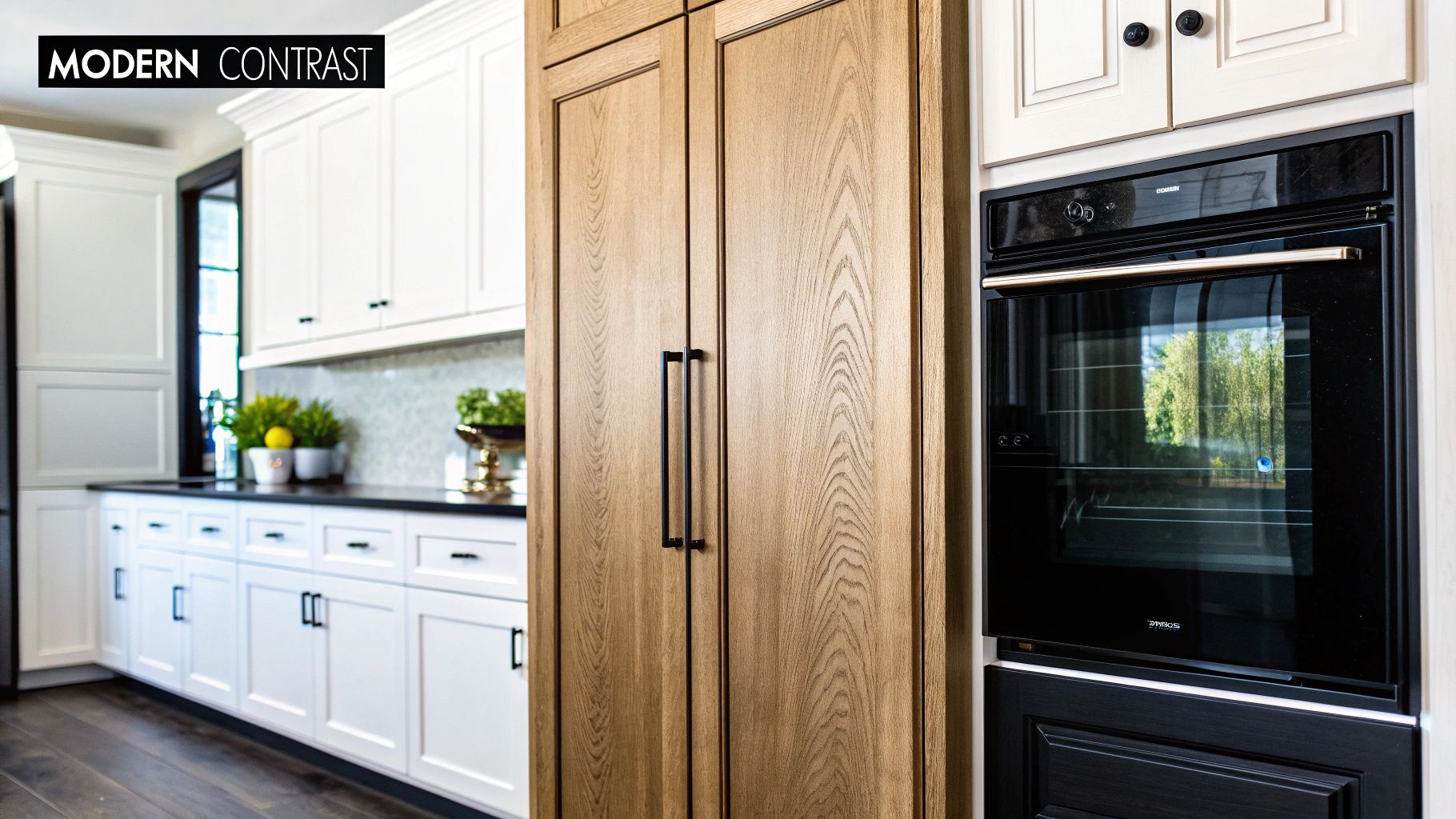
Painted cabinets give you a crisp, solid, and totally uniform surface that completely hides the material underneath. This quality makes paint the ultimate chameleon—it can adapt to just about any design aesthetic you can dream up.
The Clean Slate of Painted Cabinets
Think about a modern kitchen with those sleek, handleless doors. A flawless coat of semi-gloss white paint creates a seamless, almost monolithic look that just feels clean and expansive. The way it reflects light can make the whole room feel bigger and brighter.
Now, picture a cozy farmhouse kitchen. You could take the exact same cabinet style, coat it in a soft, matte sage green or a timeless navy blue, and instantly get a sense of warmth and character. Paint gives you the power to dial in the room's energy with real precision.
The finish, or sheen, plays a huge part in this:
- Satin or Eggshell: This gives you a soft, low-luster look that’s fantastic at hiding minor dings and scuffs but is still pretty easy to clean.
- Semi-Gloss: A great workhorse finish. It provides a more durable and wipeable surface with a noticeable shine, making it perfect for high-traffic kitchens.
- High-Gloss: This one delivers a dramatic, mirror-like finish. It's an amazing choice for ultra-modern or glamorous designs, but be warned—it will show off every single fingerprint and flaw.
Because paint completely covers the wood's grain, it's the perfect fix for cabinets made from less expensive materials like MDF or for older wood cabinets that have seen better days. It lets you create a brand-new surface from scratch.
The Organic Beauty of Stained Cabinets
Unlike paint, which just sits on top of the wood, stain soaks deep into the fibers. It doesn't hide the material—it celebrates it. Staining is all about bringing out the natural knots, grain patterns, and unique variations that make every piece of wood one-of-a-kind.
This is why stain is the go-to for styles that lean into warmth, texture, and authenticity. A light, honey-toned stain on oak cabinets feels right at home in a rustic or Craftsman-style kitchen, really making that prominent grain pop.
On the other hand, a deep, rich cherry or walnut stain on maple or birch cabinets lends an air of timeless sophistication that's perfect for a traditional home. The translucent quality of stain lets light play with the wood itself, creating a depth and richness that paint simply can't match.
We're seeing a real comeback for natural and authentic materials in home design, which has fueled a lot of new interest in wood finishes. In fact, the wood-stain market is projected to grow steadily as more people choose finishes that show off organic beauty. You can learn more about the growth of the staining industry here.
Visualizing the Transformation: A Real-World Scenario
Let's imagine the same set of shaker-style oak cabinets in an average-sized kitchen. How does the choice between paint and stain change the room's whole vibe?
-
Scenario 1: Painted White
The kitchen instantly feels bigger, brighter, and more contemporary. That uniform white finish becomes a clean backdrop, letting other elements—like a colorful backsplash, bold countertops, or dramatic light fixtures—be the stars of the show. The overall aesthetic is fresh, airy, and incredibly versatile. -
Scenario 2: Stained Dark Walnut
The same kitchen is now warm, intimate, and luxurious. The focus shifts directly to the cabinetry itself, with the dark stain highlighting the beautiful, swirling patterns in the oak. The atmosphere feels cozier and more grounded, creating a classic, elegant space that feels established and permanent.
Ultimately, your choice boils down to the story you want your kitchen to tell. Are you looking for a blank canvas to build your vision on, or do you want a celebration of natural artistry?
Durability and Long-Term Maintenance: What to Expect
A beautiful cabinet finish doesn't mean much if it can't handle the daily chaos of a busy kitchen. When you're weighing paint vs. stain, durability isn't just about which one lasts longer—it's about how each finish ages and what it's going to demand from you down the line.
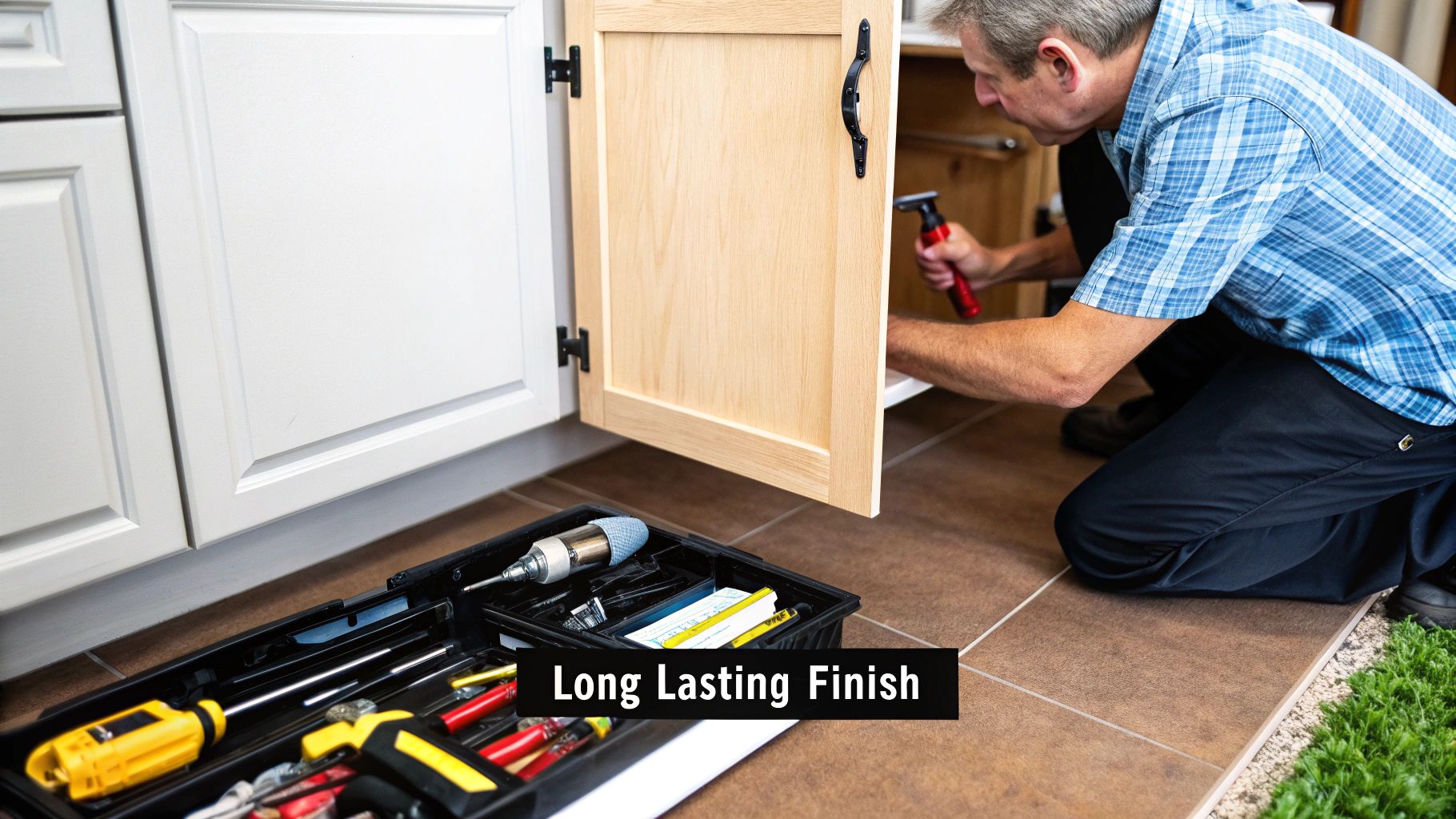
Paint creates a thick, hard shell over the wood. This film is fantastic for deflecting grease splatters and food spills, making cleanup a breeze with just a damp cloth. But that same rigidity is also its biggest weakness.
The Tradeoff With Painted Cabinets
Let's be blunt: painted cabinets are notorious for chipping. Because paint sits on top of the wood as a distinct layer, a sharp knock from a dropped pan or a bump from a dining chair can easily flake off a chip, revealing the primer or even the raw wood underneath.
You'll see this most often in high-traffic zones like the corners of doors, drawer edges, and around the trash pull-out. Wood also naturally expands and contracts with humidity changes, which can cause paint to form hairline cracks along the joints of doors and frames. While this is a normal part of the aging process, it can definitely interrupt that clean, seamless look.
Touching up these little imperfections brings its own set of headaches.
- Color Matching: Getting a perfect color match is tricky. The paint on your cabinets will have aged and faded slightly, making a new dab of paint stand out.
- Sheen Blending: The gloss level of your touch-up paint has to precisely match the original finish, otherwise you'll end up with noticeable patches.
- Texture Differences: A brushed-on touch-up rarely blends seamlessly with the original smooth, sprayed-on factory finish.
Despite this, a high-quality, professionally applied paint job that's been allowed to fully cure can be a tough surface that looks great for years—as long as you're careful. The key is understanding that maintenance will involve chasing after these occasional, but inevitable, surface dings.
"If they’re prepped well and painted properly and allowed to cure, you should only expect the odd chip over the first few years as things get hit on the edges too hard. Generally, if there isn’t a lot of sun on them, stained cabinets hold up longer, but that’s not to say that painted cabinets hold up poorly."
The Flexibility of Stained Cabinets
Stained cabinets bring a totally different kind of durability to the table. Since stain actually soaks into the wood fibers instead of sitting on top, it simply cannot chip or peel. The wood itself becomes the colored surface, which makes it incredibly resilient to the type of impact damage that plagues painted finishes.
Now, this doesn't mean stained cabinets are indestructible. The real durability comes from the protective topcoat, usually a polyurethane or varnish. This clear layer is what takes the abuse from scratches, moisture, and daily wear and tear.
Over time, this topcoat can wear thin, especially around handles and knobs where your hands make constant contact. The good news? Maintenance is far simpler and much more forgiving than with paint. Minor scratches on a stained surface often just blend into the natural wood grain, becoming almost invisible.
When you do have more significant wear, touching it up is refreshingly straightforward.
- Spot Sanding: A light sanding on the affected area is all you need to smooth it out.
- Stain Application: Dab a small amount of matching stain on with a cloth to blend the color.
- Topcoat Reapplication: Seal the spot with a new layer of the protective clear coat.
Because you're working with the wood's natural texture, these repairs melt away and become virtually invisible. For long-term care, you might want to give all your cabinets a light sanding and a fresh topcoat every 5 to 10 years to restore their original shine and protection. It's a much less intensive job than a full repaint.
Here’s a quick breakdown to help you decide which finish best suits your household's rhythm in the paint vs. stain cabinets debate.
| Durability Factor | Painted Cabinets | Stained Cabinets |
|---|---|---|
| Chip Resistance | Low. Prone to chipping from impacts, especially on edges. | High. Stain soaks into wood and cannot chip. |
| Scratch Resistance | Medium. Hard paint film can resist minor scratches. | Depends on topcoat. Scratches often blend into the grain. |
| Ease of Cleaning | High. Smooth, non-porous surface is easy to wipe clean. | High. Sealed topcoat is also simple to clean. |
| Touch-Up Simplicity | Low. Difficult to match color and sheen perfectly. | High. Scratches are easy to conceal with stain markers or pens. |
| Long-Term Aging | Shows wear through chips and hairline cracks at joints. | Shows wear as the topcoat thins or dulls in high-use areas. |
Ultimately, your tolerance for maintenance is the deciding factor. If you want that perfect, flawless look and don't mind staying on top of repairs, paint is a great choice. But if you have a busy, active home and want a finish that ages gracefully and hides minor battle scars, stain is often the more practical, long-lasting solution.
The Prep Work: Where the Real Work Begins
The final look of your cabinets is born from the work you do long before a brush ever touches the wood. When it comes to painting versus staining, the prep work isn't just a first step—it's everything. And the two paths couldn't be more different.
Painting is certainly work, but the prep is more forgiving. Since paint is a solid film that covers the surface, your goal is to create a clean, stable foundation for it to grab onto. You don't have to stress about the wood's underlying condition because the paint will hide minor flaws.
Prepping Cabinets for a Painted Finish
Getting a smooth, durable painted finish is all about methodical steps that guarantee the paint will stick and last. This isn't about revealing the wood's character; it's about creating a perfect canvas for a new color.
The typical process looks something like this:
- Deep Clean Everything: Kitchen cabinets are magnets for grease, oil, and years of grime. A serious cleaning with a degreaser like Trisodium Phosphate (TSP) is an absolute must.
- Scuff It Up: After cleaning, a light sanding with 120-180 grit sandpaper is key. You aren't trying to strip the old finish, just roughing up the surface enough for the primer to get a solid grip.
- Prime for Success: A high-quality bonding primer is the secret weapon for a paint job that won't chip or peel. It creates a uniform base, stops old stains from bleeding through, and helps your topcoat adhere like it should.
Flawless, durable results are built on meticulous preparation. Attempting to paint over a dirty or glossy surface without proper prep is the single biggest reason for paint failure, leading to chipping and peeling within months.
For a more detailed guide on this crucial phase, you can learn more about how to paint kitchen cabinets and make sure your project starts off right. This prep work, while it has a few stages, is definitely doable for most DIYers and is why paint is such a great choice for older cabinets or even ones made from MDF.
The Heavy Lift: Prepping for Stain
Staining, on the other hand, is a whole different beast. The prep work is far more intense because stain has to soak into the wood fibers. That means every last trace of the old finish—paint, varnish, you name it—has to be completely stripped away to get to the bare wood. There are no shortcuts.
This process is a ton of work and requires more specialized tools and chemicals. If even a tiny bit of the old finish is left behind, the new stain won't absorb evenly, leaving you with a blotchy, uneven mess that's nearly impossible to fix.
Here’s a look at what it takes to strip cabinets for staining:
- Chemical Stripping: It usually starts with applying a chemical paint or varnish stripper to dissolve the old coating. This is messy and requires good ventilation and safety gear.
- Scraping and More Scraping: Once the stripper does its job, the gooey old finish has to be scraped off every single surface, curve, and corner.
- Sanding Down to Bare Wood: After stripping comes the real workout. You have to sand the entire cabinet down to fresh, raw wood, usually starting with a coarse grit and working your way to a fine one. This is the only way to ensure the stain absorbs uniformly.
This level of prep is exactly why restaining is often a job best left to the pros. It's not just the elbow grease; it’s the skill required to get a perfectly uniform surface. If your cabinets have detailed woodwork or a deep grain, the job gets even tougher. The condition of the cabinets is critical, too—only high-quality solid wood can handle this kind of intensive refinishing.
Breaking Down The Costs Of Painting vs Staining
Let’s talk money. When you’re weighing painting versus staining, your budget is a huge piece of the puzzle. The final bill will depend on a few things: the size of your kitchen, the current condition of your cabinets, and whether you're rolling up your sleeves for a DIY project or calling in the pros. It's not just about the initial cash outlay, but the long-term value you get from each finish.
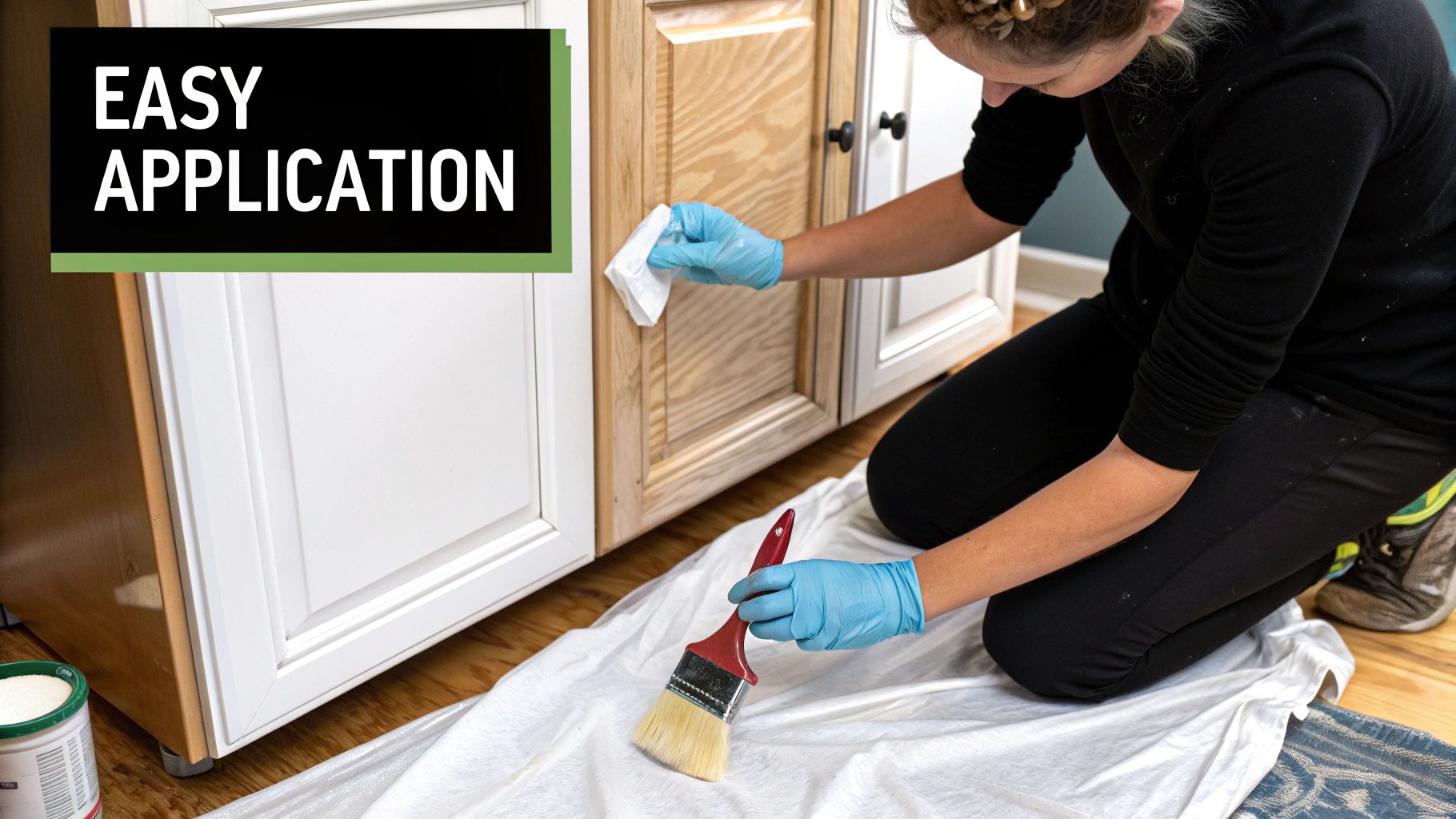
As a general rule, painting cabinets tends to have a slightly higher upfront cost, especially if you hire a professional. This really comes down to the materials and the extra steps involved. A top-notch paint job demands a good primer, several coats of quality paint, and a protective topcoat—each adding to the total. Stain, on the other hand, usually requires fewer products to get the job done.
Unpacking Material And Labor Expenses
If you're tackling this yourself, materials for painting an average-sized kitchen will likely run you somewhere between $200 and $600. That covers your high-quality paint, a bonding primer, sandpaper, rollers, and brushes. For staining, you’re often looking at a lower material cost, typically in the $150 to $500 range for the stain, sealant, and application tools.
The cost gap gets wider when you bring in a professional. A professionally painted finish is a meticulous process with a ton of prep work and careful application, which naturally drives up the labor hours and the price tag.
A professional paint job might cost more initially, but it can last up to a decade, offering excellent long-term value. Conversely, the lower material cost and easier DIY touch-ups for stain might be more budget-friendly over time for homeowners comfortable with minor upkeep.
Looking at the numbers, a professional job to stain cabinets usually lands between $1,500 and $5,000, which breaks down to about $4 to $15 per square foot. Painting costs are in a similar ballpark but can easily climb higher because of the extra materials and labor for priming and sealing. Thinking long-term, a painted finish can look great for 5 to 15 years, while a stained topcoat might need a refresh sooner.
Long-Term Value And Overall Investment
It’s crucial to think beyond that first invoice. A flawless, professionally painted finish can completely modernize a kitchen and even add to your home's resale value, making that higher initial cost a pretty smart investment.
But if your budget is a bit tighter or you just prefer a finish that wears its age well without a lot of drama, staining has some serious financial perks. It’s far more resistant to chipping, which means you’ll spend less time and money on touch-ups down the road.
This financial piece is a big part of any kitchen update, whether you're just refinishing or going for a full overhaul. If you're considering all-new cabinetry, getting a handle on the average cost of custom cabinets can give you a better sense of your total project budget.
To make things clearer, let's break down the potential costs side-by-side for professional and DIY projects.
Cost Comparison Paint vs Stain (Professional & DIY)
| Cost Factor | Painting | Staining |
|---|---|---|
| DIY Materials (Avg. Kitchen) | $200 – $600 | $150 – $500 |
| Professional Labor (Avg. Kitchen) | $2,000 – $6,000+ | $1,500 – $5,000 |
| Total Professional Cost | $2,200 – $6,600+ | $1,650 – $5,500 |
| Key Cost Driver | Labor-intensive prep and multiple coats (primer, paint, topcoat). | Intensive stripping process for restaining projects. |
Ultimately, the best choice for your wallet comes down to what you prioritize. Painting often gives you more visual bang for your buck, while staining delivers a durable, cost-effective finish that lets the natural wood shine.
So, How Do You Make the Final Call?
Alright, let's bring it all together. The whole paint-versus-stain debate isn't about finding a single "best" answer. It’s about looking at your kitchen, your lifestyle, and your goals to figure out which finish makes the most sense for you. This is where we move from a simple pro/con list to a smart, practical decision.
The biggest factor, hands down, is the condition and material of your existing cabinets. If you're lucky enough to have high-quality solid wood cabinets with a beautiful, rich grain, stain is almost always the way to go. It celebrates the natural beauty of the wood, bringing a warmth and depth to your kitchen that ages gracefully.
But what if your cabinets are MDF, have seen better days, or are made from a wood species that just isn't very attractive? That’s where paint becomes your best friend. Paint gives you a clean slate, creating a smooth, uniform surface that hides imperfections and lets you take total control of your kitchen's color scheme.
A Few Scenarios to Help You Decide
To really nail this down, let’s walk through a couple of real-world situations. Thinking about your own goals will make it much clearer which path is the right one for your time and money.
Scenario 1: You're Getting Ready to Sell
If you plan on putting your house on the market in the next few years, you need to think about broad appeal.
- Go with Paint: A fresh coat of paint in a go-to neutral—like a crisp white, a soft gray, or a warm greige—is a winning move for resale. It instantly makes a kitchen feel brighter, bigger, and more modern to the widest range of potential buyers.
- Why it Works: Paint covers up dated wood tones and creates a clean, updated look. It helps buyers see themselves in the space without getting hung up on a specific wood grain they might not love.
Scenario 2: You're Creating Your "Forever Home"
When you’re designing a kitchen you’ll be living in for the long haul, the choice becomes much more personal.
- Think About Stain: If you love the idea of an authentic, timeless kitchen, staining high-quality wood cabinets is a fantastic long-term investment. The finish is tough, easy to touch up, and shows off a level of craftsmanship that feels permanent and intentional.
- Think About Paint: On the other hand, if your style is more eclectic or you want the freedom to change things up down the road, paint is perfect. It gives you the power to match your cabinets to any design vision, whether that’s a moody, dramatic green or a bright, sunny yellow.
Just because your cabinets are solid wood doesn’t automatically mean they’re a great candidate for stain. A dated door style, like a prominent arch or cathedral curve, can still look old even with a beautiful new stain. In these cases, paint offers a more significant and modernizing transformation.
Don't Forget Your Lifestyle
Be honest with yourself about how you use your kitchen and how much upkeep you're willing to handle.
For a busy household with kids or pets, stained cabinets often have an edge. They’re incredibly forgiving because the wood grain helps hide minor dings and scratches, and touch-ups are a breeze. You won't have to worry about the finish chipping from an accidental bump, which is a common headache with painted cabinets.
But if you’re someone who loves a spotless, seamless look, paint might be more your speed. The smooth, non-porous surface is a dream to wipe clean. While you’ll probably have to do occasional touch-ups on chips, the pristine finish might be worth that little bit of extra effort.
Ultimately, choosing between paint and stain is all about balancing what you want with what you need. By taking a good look at your cabinets, your goals, and your daily life, you can confidently pick the finish that will not only give your kitchen a fresh look but also bring you joy for years to come.
Your Cabinet Finish Questions, Answered
Even after weighing the pros and cons of painted versus stained cabinets, you probably still have a few questions lingering. That's completely normal. Let's tackle some of the most common questions we get from homeowners to help you get those final details ironed out.
Can I Paint Over Stained Cabinets Without Sanding?
It’s tempting to look for shortcuts, but skipping the prep work here is a recipe for disaster. You absolutely should not paint over a stained finish without proper prep.
At the very least, you need to give the cabinets a deep clean with a degreaser to get rid of years of kitchen grime. After that, a light scuff-sanding is critical. This isn't about stripping the old finish, but about creating a rough texture for the new primer to grab onto. An adhesion-promoting bonding primer is non-negotiable after that. If you skip these steps, the new paint will have nothing to stick to and will inevitably peel and chip.
Which Is Better for My Home's Resale Value?
Both painted and stained cabinets can give your home’s value a nice bump, but the "better" option really depends on your home’s style and what buyers are looking for.
Painted cabinets, especially in classic neutrals like white, off-white, or a soft gray, have the widest appeal. They make a kitchen feel brighter, bigger, and more current, which makes them a pretty safe bet for most homes.
On the other hand, if your home has a distinct craftsman, rustic, or traditional vibe, beautifully stained wood cabinets can be a huge selling point. A quality stain highlights the wood's natural character and the home's craftsmanship, something buyers looking for that specific style will definitely appreciate. The trick is to choose a finish that feels authentic to your home.
A quick word of advice: The style of your cabinet door matters. A fresh coat of paint on an old-fashioned arched or cathedral-style door might not give you the modern update you’re hoping for. Sometimes, changing the door style itself makes the biggest impact on resale value.
Can I Stain Cabinets That Have Already Been Painted?
Technically, yes, it can be done. But honestly, it's a massive, labor-intensive project that we rarely recommend for a DIYer. To even attempt it, you have to strip every single trace of paint and primer off the wood, right down to the bare grain. This means hours of work with chemical strippers, careful scraping, and a whole lot of sanding.
If even a tiny bit of paint is left in the wood grain, the stain won't absorb properly, leaving you with a blotchy, uneven mess that’s almost impossible to fix. Given how much work is involved, it's usually far more practical—and cost-effective—to either repaint the cabinets or look into refacing them with new, ready-to-stain doors.
Ready to bring your kitchen vision to life with cabinetry that’s built to last? The team at Sinclair Cabinetry inc has been crafting beautiful, high-quality real wood cabinets for over 35 years. Explore our custom design options and let's start building the kitchen you've always wanted.