

Trying to pin down the exact cost of a kitchen renovation can feel a bit like asking, "How much does a car cost?" The real answer is… it depends. Are we talking about a reliable daily driver or a luxury sports car with all the bells and whistles?
Most homeowners find their projects landing somewhere between $14,590 and $41,540. But that's a huge range, right? Your final number is going to hinge on the scope of your project, the materials you fall in love with, and the labor required to bring it all together.
What Does a Kitchen Renovation Really Cost
Let’s be honest: there’s no single, magic number for a dream kitchen. A minor refresh—think a fresh coat of paint, new cabinet hardware, and an updated faucet—might only set you back a few thousand dollars.
On the other hand, if you're planning a major overhaul that involves tearing down walls, reconfiguring the layout, and installing all-new everything, you could easily see costs climb north of $65,000. The trick is to understand what drives these costs before you start swinging a sledgehammer.
The scope of your project is easily the biggest factor. Are you simply refacing your existing cabinets and swapping out appliances? That’s one budget. Are you gutting the space down to the studs and starting from scratch? That’s a completely different ballgame.
Your taste in materials also plays a massive role. Laminate countertops, for instance, are incredibly budget-friendly. A stunning slab of marble or high-end quartz, however, will command a much higher price. The same goes for cabinets—stock options from a big-box store are a world apart from handcrafted, custom-built cabinetry.
Kitchen Renovation Cost At a Glance
To give you a clearer picture, here’s a quick breakdown of what you can generally expect at different budget levels. Think of this as a starting point to see where your vision might fit.
| Renovation Tier | Typical Cost Range | Common Scope |
|---|---|---|
| Minor / Refresh | $5,000 – $15,000 | Painting walls and cabinets, new hardware, updating faucet and light fixtures, new backsplash. |
| Mid-Range / Pull & Replace | $15,000 – $40,000 | Replacing all appliances, installing new stock/semi-custom cabinets and countertops, new flooring. |
| Major / Custom Overhaul | $40,000 – $65,000+ | Full gut renovation, reconfiguring layout, custom cabinetry, high-end appliances and materials, structural changes. |
Remember, these are just ballpark figures. Your final cost will always come down to your specific choices and location.
Key Factors Influencing Your Total Spend
As you start planning, keep these core elements front and center. They are the main drivers that will determine where your project lands on the cost spectrum and will help you avoid sticker shock down the road.
- Project Scope: This is the big one. A cosmetic update (paint, hardware, new faucet) is leagues away from a full gut renovation that changes the kitchen's footprint.
- Material Quality: The difference between laminate and quartz, vinyl and hardwood, or stock and custom cabinets can create massive swings in your budget.
- Labor and Professional Fees: Costs here can vary quite a bit depending on your location and whether you hire a general contractor to manage everything or act as your own project manager.
- Geographic Location: It’s a simple fact that labor and material costs are significantly higher in major cities compared to more rural areas.
Digging into the national numbers, a detailed kitchen renovation cost breakdown shows the median figure hovering right around $26,976. On a smaller scale, this often works out to an investment of $75 to $250 per square foot, a number that shifts dramatically based on your kitchen's size and the finishes you choose. To see how these averages stack up across the country, you can learn more about kitchen remodel costs from HomeAdvisor.
Ultimately, getting a precise cost for your kitchen renovation comes down to careful planning and setting realistic expectations from the get-go. Once you have a handle on these primary cost drivers, you'll be in a much better position to build a budget that aligns with both your vision and your wallet.
For a deeper dive into how these numbers add up, you might be interested in our guide on the average cost of a kitchen remodel.
Breaking Down Your Renovation Budget
Once you have a ballpark figure in mind, the real work begins: figuring out where all that money actually goes. A detailed kitchen renovation cost breakdown is the best way to demystify the process, turning one big, scary number into a series of smaller, more manageable pieces. It’s like looking at the individual ingredients of a recipe instead of just the final dish—you get to see what really drives the cost and the outcome.
This approach puts you in the driver's seat. When you can see the budget allocation for every single component, you can make smart, strategic decisions about where to invest for the biggest impact and where you can pull back to save a few dollars without compromising your dream kitchen.
The image below gives you a clear visual hierarchy of these costs, showing exactly how different elements contribute to your total spend.
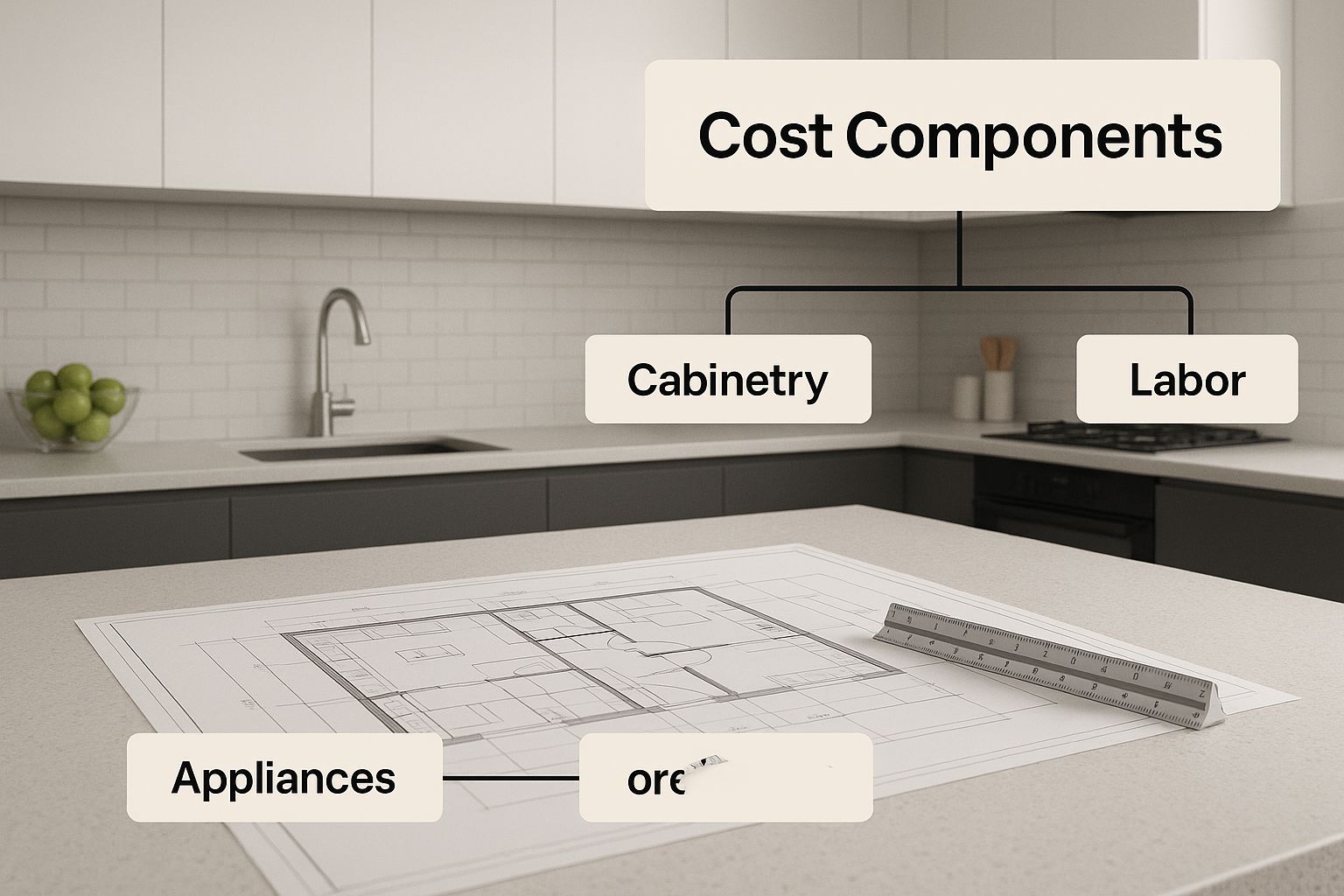
As you can see, a few key categories command the lion’s share of the budget. Your choices here will have the most significant financial impact on the entire project. Let's take a closer look with an itemized table.
Understanding how a typical budget is allocated can help you set realistic expectations for your own project. Here’s a sample breakdown based on a $30,000 kitchen remodel, showing the percentage of the total budget each category typically consumes.
Itemized Kitchen Renovation Budget Allocation
| Expense Category | Percentage of Total Budget | Example Cost (on a $30,000 budget) |
|---|---|---|
| Cabinetry & Hardware | 29% | $8,700 |
| Installation & Labor | 17% | $5,100 |
| Appliances & Ventilation | 14% | $4,200 |
| Countertops | 10% | $3,000 |
| Flooring | 7% | $2,100 |
| Lighting | 5% | $1,500 |
| Walls & Ceilings | 5% | $1,500 |
| Faucets & Plumbing | 4% | $1,200 |
| Design Fees | 4% | $1,200 |
| Doors & Windows | 4% | $1,200 |
| Other/Contingency | 1% | $300 |
This table illustrates that some items, like cabinets and labor, make up a huge chunk of the expenses. Smart planning in these areas is key to keeping your project on track.
The Heavy Hitters: Your Main Budget Drivers
In pretty much every kitchen renovation I've seen, three major categories consistently eat up the largest slice of the pie. If you want to effectively manage your total expenses, this is where you need to focus your attention first. These are the foundational elements that will define your kitchen's entire look, feel, and day-to-day functionality.
- Cabinets: This is the undisputed heavyweight champion of kitchen costs, often accounting for 29-35% of your entire budget.
- Labor & Installation: The skilled work to bring it all together is a huge factor, taking up another 15-20%.
- Appliances & Countertops: These two are the workhorses and visual centerpieces, and together they represent another significant cost center.
Making smart, informed choices in these areas is absolutely critical to keeping your project from spiraling out of control financially.
A Closer Look at Cabinetry Costs
It's no surprise that cabinetry is often the single most expensive line item. It's for a good reason, too—your cabinets define the kitchen’s entire layout, workflow, and style. Think of it like buying a suit: you can go off-the-rack, get something tailored, or have one made completely bespoke. Each comes with a different price tag.
- Stock Cabinets: These are your most affordable, "off-the-rack" option. They're pre-made in standard sizes with limited styles, but they're a fantastic choice for a tight budget.
- Semi-Custom Cabinets: This is the tailored suit. You start with stock sizes but get way more flexibility to modify dimensions, finishes, and add cool storage features. It's a great middle ground.
- Custom Cabinets: The bespoke experience. These are built from scratch to your exact specifications, offering unlimited design potential but also coming in at the highest price point.
Of course, the materials and construction play a huge role here, too. Solid wood is going to cost more than MDF (medium-density fiberboard), and adding fancy door styles or high-end finishes will bump up the final price.
Countertops and Appliances: The Finishing Touches
Right after cabinets, your countertops make the next biggest visual and financial splash. Your choice of material is everything here. Laminate is the most economical route, while beautiful materials like quartz, granite, and marble sit at the mid-to-high end of the spectrum. The cost isn't just about the slab itself; it's also driven by the skilled labor needed for fabrication and installation.
Appliances are the final piece of the puzzle. A basic appliance package can be quite affordable, but those costs can shoot up fast with professional-grade models or smart appliances packed with the latest features. Pro tip: bundling your appliances from a single brand can sometimes score you a nice package discount.
It's crucial to understand the weight of these decisions. When you combine them, cabinetry, countertops, and appliances can easily make up over half of the total renovation expenses, which really underscores their massive influence on your final budget.
By carefully weighing your options for these key components, you gain significant control over your project's bottom line. For a more personalized estimate based on your specific material and style choices, you can play around with our kitchen remodel cost calculator.
Cracking the Code on Labor Costs & Professional Fees
Alright, let's talk about the invisible engine that drives your entire kitchen renovation: the people. You can pick out the most beautiful materials and the shiniest appliances, but without skilled professionals, they’re just a pile of expensive stuff. This part of your kitchen renovation cost breakdown—the labor and fees—is what turns your vision into a solid, functional reality. It’s the critical difference between a dream kitchen and a DIY project that spirals into a nightmare.
Think of it this way: you’re the director of a movie. You have the script (your design), but you need a seasoned crew to handle the cameras, lighting, and sound to actually make the film. Your general contractor and team of tradespeople are that crew. They manage all the complex, behind-the-scenes work, from demolition to the final brushstroke of paint, making sure every single piece works together just right.
Who Are You Actually Hiring?
When you pay for professional labor, you're not just buying time or a set of hands; you're investing in experience. You’re paying for the plumber who knows exactly how to vent a drain line to code, the electrician who can spot faulty wiring before it becomes a hazard, and the installer who can scribe a countertop perfectly to a wavy wall. These pros have seen it all and can navigate the unexpected hiccups that inevitably pop up.
Your project team will likely include a few key players:
- General Contractor (GC): This is your project’s quarterback. The GC is the one coordinating every single trade, keeping the timeline on track, and serving as your main point of contact. They simplify what is otherwise an incredibly complex process.
- Plumbers & Electricians: These pros are non-negotiable. Their work is all about safety and function, and it’s heavily regulated by strict building codes. This is not the place to cut corners.
- Installers: You’ll have specialized crews for flooring, countertops, and cabinets. They have the specific skills to handle these expensive materials without making a costly mistake.
You can bet that a good chunk of your budget will go to the people doing the work. Labor typically eats up about 25% of the total project cost. So, for every $10,000 you spend, plan on around $2,500 going directly to the skilled professionals bringing it all together. You can get more granular data on these costs from resources like HomeAdvisor.
The Real Value of a Pro at the Helm
One of the biggest crossroads you'll face is whether to hire a general contractor or manage the project yourself. Going it alone can definitely save you some money on the management fee, but be warned: you’re essentially signing up for a demanding part-time job. It requires serious organization, a deep well of patience, and a good bit of industry know-how.
A great contractor does so much more than just schedule subcontractors. They have a roster of reliable, vetted tradespeople they’ve worked with for years. They often get trade discounts on materials that you can't access. And most importantly, they are professional problem-solvers. When the wrong tile shows up or an unexpected pipe is found in a wall, they handle it. They’re the ones pulling the permits, meeting with inspectors, and dealing with the day-to-day headaches so you don't have to.
When you start gathering quotes, insist on an itemized breakdown. This transparency is crucial. You should be able to see exactly what you’re paying for—from demolition and trash hauling to final installation and cleanup. Seeing it all laid out helps you understand the true value behind this essential—and significant—cost.
How Kitchen Size and Location Affect Your Budget

It’s easy to fall into the trap of thinking that if you double your kitchen’s square footage, you just double the cost. But in the real world of renovations, the math just isn't that simple. In fact, the financial jump is often much, much bigger. You can have two kitchens with nearly identical designs, but their final price tags can be worlds apart based on two simple things: how big the room is and what zip code it’s in.
Think of it this way: a bigger kitchen doesn't just need more cabinets and countertops. It’s what’s happening behind the walls that really drives up the cost. You’re not just paying for more materials you can see; you're investing in a far more complex infrastructure to make that larger space function. This hidden complexity is one of the biggest factors in any kitchen renovation cost breakdown.
The True Cost of a Larger Kitchen Footprint
When a kitchen expands, the hidden costs tend to grow exponentially. You're not just scaling up the visible parts; you're dealing with more intricate and labor-intensive work that most people don't see coming.
Here’s what you’re really paying for as the square footage goes up:
- More complex electrical work: This means more outlets, dedicated circuits for that new double oven or wine fridge, and a more sophisticated lighting plan to properly illuminate the larger space.
- Extended plumbing lines: Want a sink in your new island? Or maybe a pot filler over the stove? Each new fixture adds significant material and specialized labor costs.
- HVAC adjustments: A larger, more open kitchen needs to be properly heated and cooled. That could mean moving existing vents or adding new ones to keep the room comfortable.
- Additional flooring and subfloor prep: This can quickly become a major expense, especially if you’re choosing high-end tile or hardwood.
It’s crucial to understand just how dramatically size impacts the final bill. The average total cost for a medium-sized kitchen is around $71,159. But for larger kitchens, that number skyrockets to an average of $137,228. The cost doesn't just scale—it multiplies. You can find more great insights into how location and size influence remodel costs via House Beautiful.
How Your Location Impacts the Bottom Line
Beyond the physical dimensions of your kitchen, your geographic location plays a massive role in what you’ll spend. The very same project—down to the last cabinet knob—can cost thousands more in one city compared to another.
Why the big difference? It really comes down to the local cost of living, which directly impacts labor rates. A skilled contractor in a major city like San Francisco or Boston has higher overhead and can command a much higher wage than one in a small rural town.
Material costs also fluctuate based on what's available locally and how far things need to be shipped. It’s no surprise that states with a higher cost of living, like California and Massachusetts, often see the highest renovation prices. Meanwhile, homeowners in places like Ohio and Louisiana typically spend quite a bit less for similar projects.
Planning For Hidden Costs And Unexpected Issues
Here's a hard-earned piece of wisdom from the renovation world: no project, no matter how perfectly planned, goes off without a single surprise. The parts of your kitchen renovation cost breakdown that you can't see are almost always the ones that throw your budget for a loop.
That's why we talk about the "renovation iceberg." What you see above the surface are the exciting decisions—the cabinets, countertops, and shiny new appliances. But just beneath the waterline, hidden costs are waiting, and they can sink your budget fast if you're not ready for them.
What Lies Beneath The Surface
These budget-busters have a knack for showing up right after demolition starts, which is exactly when you're most committed. Once the old walls and floors are torn out, a whole new world of potential problems can come to light.
Some of the most common surprises we see include:
- Outdated Electrical Wiring: Finding old knob-and-tube wiring is a showstopper. Bringing an ancient electrical panel up to modern safety codes often requires a complete, and costly, overhaul.
- Hidden Plumbing Problems: There's nothing worse than discovering corroded pipes, leaky drains, or improper venting tucked away inside a wall. These issues have to be fixed before anything else can happen.
- Structural Deficiencies: This is the scary stuff. Rotted subfloors, termite damage, or a sagging beam that was never properly supported—these are non-negotiable repairs that demand immediate and often expensive attention.
- Hazardous Material Abatement: If your home is older, you might uncover asbestos in old vinyl flooring or lead paint on the walls. This requires specialized, professional removal, which is a significant unbudgeted expense.
In older homes, unexpected electrical work can be especially disruptive and expensive. Before you even start, it's a good idea to check out the complete price guide to rewiring an old house to get a realistic idea of what you might be facing.
The single smartest thing you can do for your budget is to plan for the unknown. Set aside a contingency fund of 15-20% of your total project cost. This isn't a sign of bad planning—it's the hallmark of an experienced, realistic homeowner.
The Power Of A Contingency Fund
Think of your contingency fund as an insurance policy for your renovation. If your contractor opens up a wall and finds a plumbing nightmare, you have the money ready to handle it. You won't have to pause the project or, even worse, sacrifice the dream countertops you've been saving for.
And if your renovation goes off without a hitch? Fantastic! That money can go right back into your savings account. Or, you could use it for that final upgrade you thought was just out of reach.
This approach turns a potential crisis into a manageable bump in the road. Being prepared with a solid plan, like the one in our detailed kitchen renovation checklist, helps you stay ahead of problems before they become full-blown emergencies.
Smart Ways to Control Your Renovation Budget
Okay, you've seen the breakdown of where the money goes. Now comes the fun part: managing that budget without sacrificing your dream kitchen. Trust me, a stunning result isn't about having a blank check. It’s all about making smart, strategic choices that give you the biggest bang for your buck.
Think of it like putting together a great outfit. You don't need designer everything. Sometimes, a killer pair of shoes or a single piece of statement jewelry is all it takes to elevate the entire look. In the kitchen, that might be a striking new backsplash or some seriously stylish cabinet hardware. These small details can completely transform the vibe of your space for a tiny fraction of the cost of a full cabinet replacement.
Focus on High-Impact Savings
You can also find some pretty hefty savings by getting creative with your timing and labor. If you can schedule your project during a contractor's slow season—usually late fall or winter—you might find they're a bit more flexible on pricing. Less demand often means more competitive quotes.
And don't be afraid to get your hands dirty! A weekend spent carefully handling your own demolition or painting the walls can easily save you hundreds, sometimes even thousands, in labor costs. Another pro tip: source your own materials. Shopping for your own tile or light fixtures lets you hunt for sales and sidestep the typical contractor markups.
Remember, a kitchen remodel isn't just an expense—it's a genuine investment. Even with the upfront cost, these projects consistently deliver a strong return, often between 70% and 80%. You're not just getting a beautiful kitchen; you're boosting your home's value. Discover more insights about kitchen remodel ROI on HomeAdvisor.
While your focus is on the kitchen, thinking about the bigger picture can unlock even more long-term savings. For example, you can explore details of a deep energy retrofit project for a private house to see how integrating larger efficiency goals can impact your overall budget. A little bit of smart planning ensures you get the kitchen you’ve been dreaming of without breaking the bank.
Common Questions About Kitchen Renovation Costs
When you start digging into the financial side of a kitchen remodel, a lot of practical questions pop up. Getting straight answers is the first step to building a realistic budget and steering your project with confidence. Let's tackle some of the most common questions we hear from homeowners.
How Do I Create an Accurate Kitchen Renovation Budget?
First things first, make two lists: your absolute must-haves and your nice-to-haves. This simple exercise helps you prioritize where the money should go. Then, do some homework on the big-ticket items—cabinets, countertops, and appliances—to get a feel for the low, mid, and high-end price points.
Once you have a rough idea, it's time to get at least three detailed, itemized quotes from contractors you trust. And here’s the most important tip: add a 15-20% contingency fund to whatever number you land on. Think of it as your project’s safety net for those inevitable "uh-oh" moments that demolition can reveal.
What Is the Most Expensive Part of a Kitchen Remodel?
Nine times out of ten, cabinetry is the single biggest line item on the invoice. It's not unusual for cabinets to eat up 30-40% of the entire project budget.
Why so much? The cost is driven by the materials you choose, the quality of construction, and how much customization you want. After cabinets, your next biggest expenses are typically high-end appliances and premium countertops, so your selections in those areas will definitely move the needle on the final cost.
Is It Cheaper to Reface or Replace Kitchen Cabinets?
Refacing is always the more budget-friendly route. By keeping your existing cabinet boxes and just swapping out the doors, drawer fronts, and hardware, you can slash your cabinetry costs by a whopping 30-50%.
This is a fantastic option if you're happy with your kitchen’s current layout and the cabinet boxes themselves are still structurally sound. You get a massive visual upgrade for a fraction of the cost and in much less time than a full tear-out.
At Sinclair Cabinetry inc, we specialize in crafting custom cabinetry that becomes the heart of your home. If you're ready to transform your kitchen with quality and precision, explore our custom cabinet solutions today.