

Walk into any professional kitchen, and you'll quickly spot the unsung heroes of the culinary world: commercial kitchen cabinets. These aren't your typical home cabinets. They're built for constant use, extreme durability, and have to meet strict health codes. They are a serious investment in making sure a kitchen runs smoothly.
Understanding Commercial Grade Kitchen Cabinetry
The cabinetry in a commercial kitchen is a completely different beast from what you’d find in a home. It's less like furniture and more like high-performance equipment. While home cabinets are often chosen for their looks, commercial kitchen cabinetry has to be tough enough to form the structural backbone of a fast-paced, demanding environment. It’s a purpose-built system designed to take a beating, day in and day out.
This means every single part is built for a specific, grueling job. These cabinets have to withstand daily scrubbing with harsh chemicals, constant heat and moisture from ovens and dishwashers, and the impact of heavy pots, pans, and carts. The difference is huge; a standard residential cabinet would fall apart in months under these conditions.
The Core Principles of Commercial Cabinet Design
To be this resilient, commercial cabinets are designed around a few core principles that set them apart. Understanding these pillars makes it clear why this kind of cabinetry is a necessity, not just a preference.
It all comes down to meeting key operational demands:
- Unyielding Durability: Cabinets have to hold heavy loads, handle frequent bumps, and endure the stress of a busy kitchen team without warping, sagging, or breaking.
- Sanitation and Compliance: Materials must be non-porous and easy to clean to meet tough health codes. The designs often feature seamless construction to get rid of any crevices where bacteria could hide and grow.
- Workflow Optimization: Placement is everything. Every cabinet should support a logical flow, cutting down on how much staff has to move and speeding up service times during the dinner rush.
- Equipment Integration: Commercial cabinetry is specifically made to house and support heavy-duty commercial appliances, making sure there's proper ventilation, stability, and access for repairs.
You see, commercial kitchen cabinetry isn't just for storage. It's a key part of an ergonomic system that directly affects a kitchen's safety, speed, and profitability. A smart cabinet layout can shave precious seconds off ticket times and make the whole team's job easier.
At the end of the day, these cabinets are not a one-size-fits-all solution. They are specialized tools, built to solve the unique challenges of high-volume kitchens in restaurants, hotels, and hospitals. Choosing the right system is one of the first and most important steps in building a kitchen that’s not just functional, but built to last for years of tough service.
Selecting Materials for Durability and Sanitation
Choosing the right material for your commercial kitchen cabinetry is a lot like picking tires for a race car. You need something that can handle intense heat, constant abuse, and relentless stress without failing. In a commercial kitchen, the "track" is a punishing environment of steam, grease, and heavy use. The material you choose will determine your cabinetry’s performance, its lifespan, and whether you pass your next health inspection.
This decision impacts everything from your daily cleaning routine to long-term replacement costs. It’s not just about a surface; it’s about the very core of your kitchen's resilience. Getting it right prevents premature wear and tear, keeps inspectors happy, and ensures your investment serves you for years, not just a few months.
To help you map out the best choice for your operation, this decision tree breaks down the key factors based on your kitchen's intensity.
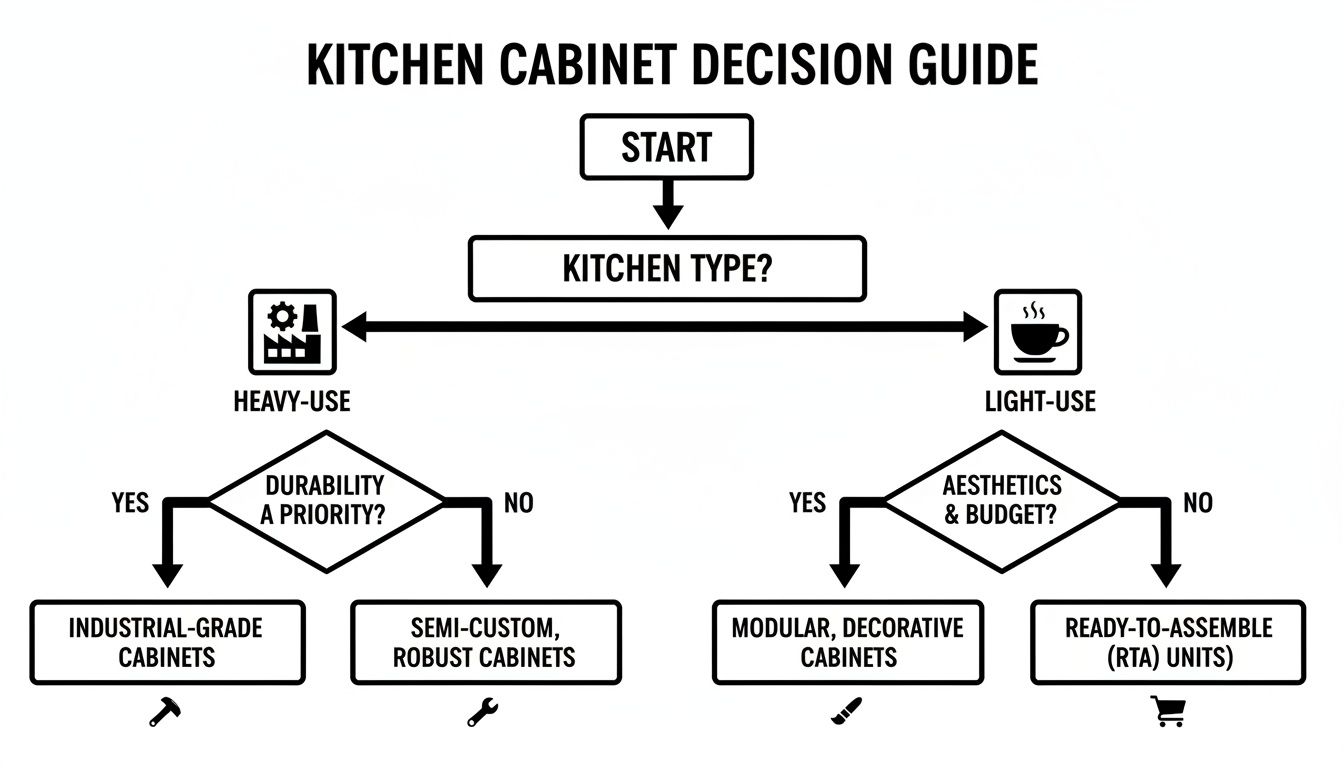
As the guide shows, while high-traffic kitchens absolutely demand the uncompromising strength of stainless steel, lighter-use settings can strike a beautiful balance between aesthetics and function with other materials.
To make the decision-making process a bit easier, here’s a quick side-by-side look at the most common materials you'll be considering.
Comparing Commercial Cabinetry Materials
| Material | Durability | Sanitation Level | Cost | Best For |
|---|---|---|---|---|
| Stainless Steel | Excellent | Excellent | High | High-volume kitchens, food prep areas, and dishwashing stations where sanitation is paramount. |
| Treated Hardwoods | Good | Good | Medium-High | Front-of-house areas, service counters, and dry storage in open-concept kitchens. |
| High-Pressure Laminate | Good | Good | Low-Medium | Dry storage, staff breakrooms, and front-of-house cabinetry where budget and style are key. |
Each material has its place, and the best choice really comes down to the specific demands of your space and budget. Let’s dig a little deeper into what makes each one tick.
Stainless Steel: The Unquestioned Champion
When you step into a serious commercial kitchen, stainless steel is everywhere. That’s no accident. It’s the undisputed champion of materials because it was practically born for environments where sanitation and durability are non-negotiable.
The magic is in its non-porous surface. Unlike wood, stainless steel has zero tiny cracks or pores where bacteria, moisture, or food particles can hide. This makes it incredibly easy to clean and sanitize—a critical feature for passing health inspections. It’s also naturally resistant to rust, corrosion, and heat, making it perfect for the splash zone around dish pits or the intense heat of the cooking line.
Simply put, stainless steel is the default choice for any surface that comes into direct contact with food or is subjected to the harshest cleaning protocols. It’s a material that performs under pressure, providing a sterile and robust foundation for any serious culinary operation.
Treated Hardwoods: Aesthetic Appeal Meets Commercial Strength
While stainless steel owns the "hot zones," there are plenty of spots in a commercial setting where looks matter just as much as function. This is where professionally treated hardwoods really shine. Think front-of-house service counters, beverage stations, or even dry storage areas in an open-concept kitchen. For a closer look at different options, check out our expert guide on the best materials for kitchen cabinets.
Now, we’re not talking about your standard residential-grade wood. To stand up to a commercial environment, these hardwoods are sealed with heavy-duty, food-safe finishes. This creates a tough barrier against moisture, stains, and daily wear and tear. It’s a crucial step that preserves the wood's natural warmth while giving you a durable, cleanable surface. With the right treatment, hardwood delivers a unique blend of high-end visual appeal and practical resilience.
High-Pressure Laminates and Polymers
For areas that need to be tough on a tighter budget, high-pressure laminates (HPL) and modern polymers offer a versatile and practical solution. HPL is made by fusing multiple layers of kraft paper with resin and bonding it to a stable core, like marine-grade plywood. The result is a surface that’s highly resistant to scratches, impacts, and—when properly sealed—moisture.
This material is a workhorse for:
- Dry Storage Cabinets: Perfect for holding heavy bags of flour and bulky cans.
- Staff Breakrooms: Provides a durable surface that’s a breeze to clean.
- Front-of-House Cabinetry: Offers a huge range of colors and patterns to match your brand’s aesthetic without the cost of solid wood.
The booming foodservice industry has created a huge demand for these kinds of durable solutions. Hotels and restaurants need ultra-tough cabinets with features like stainless steel reinforcements and seamless designs that can handle thousands of cycles every year. These commercial clients make up about 25-30% of the total market share, and that figure is growing as new restaurants open at rates topping 5% annually in major cities.
This demand highlights just how important it is to have materials that deliver both performance and value. The key is making sure the laminate is applied to a high-quality, moisture-resistant core. Using a cheap substrate like particleboard is a recipe for disaster in a commercial kitchen—it will fail, and fast.
Navigating Health Codes and Safety Regulations
Let's be clear: meeting health and safety standards isn't just about checking a box. It's the absolute foundation of running a legal, reputable food service business. The cabinets you pick are a huge piece of that puzzle. It’s better to think of them less like furniture and more like critical safety equipment that directly impacts your ability to pass inspections and keep your customers safe.
The rules of the road are set by local health departments and national bodies like the NSF (National Sanitation Foundation). These regulations all share one primary goal: to get rid of any and all places where bacteria, pests, and other contaminants can hide out and multiply. For commercial kitchen cabinetry, that means your materials and design must actively support a sterile environment.
Understanding NSF Standards and Requirements
When you spot an NSF certification on a piece of equipment, it’s not just a sticker. It’s proof that the item has been put through rigorous testing and meets strict public health standards. To a health inspector, it’s a green light, signaling that your cabinetry is built for the job.
These standards focus on specific physical traits that make cabinets a breeze to clean and tough to contaminate.
- Seamless Construction: Joints, welds, and corners have to be perfectly smooth and sealed. Any tiny crevice can become a trap for food bits and moisture, creating a perfect breeding ground for bacteria.
- Non-Porous Surfaces: The materials can't absorb anything. This is why stainless steel is the gold standard for prep areas—liquids and germs simply can't seep in.
- Coved Bases: Where cabinets meet the floor, you'll often see a requirement for a coved (curved) base. This simple curve eliminates that sharp 90-degree angle that’s famously difficult to clean, stopping grime from building up.
- Accessibility for Cleaning: Your cabinets must either be installed with enough room for staff to clean behind and underneath them, or they have to be completely sealed to the wall and floor. No exceptions.
Choosing NSF-certified commercial kitchen cabinetry is like getting a pre-approved pass for a major part of your health inspection. It shows you’re serious about safety and dramatically cuts the risk of violations that could lead to fines or, even worse, a shutdown.
Practical Steps for Ensuring Compliance
Wading through all these regulations can feel like a lot, but a smart approach makes it manageable. It all starts with choosing the right products and making sure they're installed correctly. After all, even the most compliant cabinet is useless in an inspector's eyes if it's installed improperly.
The intense focus on cleanability has pushed cabinet design forward. Post-2020, commercial renovations jumped by 18% in North America, with the rebounding hospitality industry leading the charge. This created a huge demand for cabinets with advanced features, like antimicrobial surfaces, which are now found in about 40% of new installations. It's a clear shift toward cabinetry that does more, offering a solid return on investment with maintenance costs often 30% lower than stock options while making the kitchen safer for everyone.
To get your setup compliant right from the get-go, focus on these steps:
- Verify Certifications: Always double-check that the cabinets you're looking at are NSF-certified or meet your local health code standards, especially for any zones where food is handled.
- Plan for Cleaning Access: When you're designing the layout, make sure there’s enough space around and under units for someone to get in there and clean properly. If you’re sealing them to the wall or floor, confirm it creates a totally watertight barrier.
- Use the Right Materials for Each Zone: Stainless steel is non-negotiable for prep and wash areas, but sealed hardwoods or high-pressure laminates might be perfectly fine for dry storage or service stations. If you want to dive deeper into which materials are easiest to maintain, you might find our guide on easy-to-clean kitchen cabinets helpful.
- Train Your Staff: The best cabinets in the world won't matter if they aren't cleaned correctly. Make sure your team knows the proper protocols for sanitizing every surface, every single day.
By putting regulatory compliance at the top of your list when choosing cabinets, you’re doing more than just dodging penalties. You’re building a kitchen that’s safer, more professional, and runs a whole lot smoother.
Designing a Layout for Maximum Kitchen Efficiency
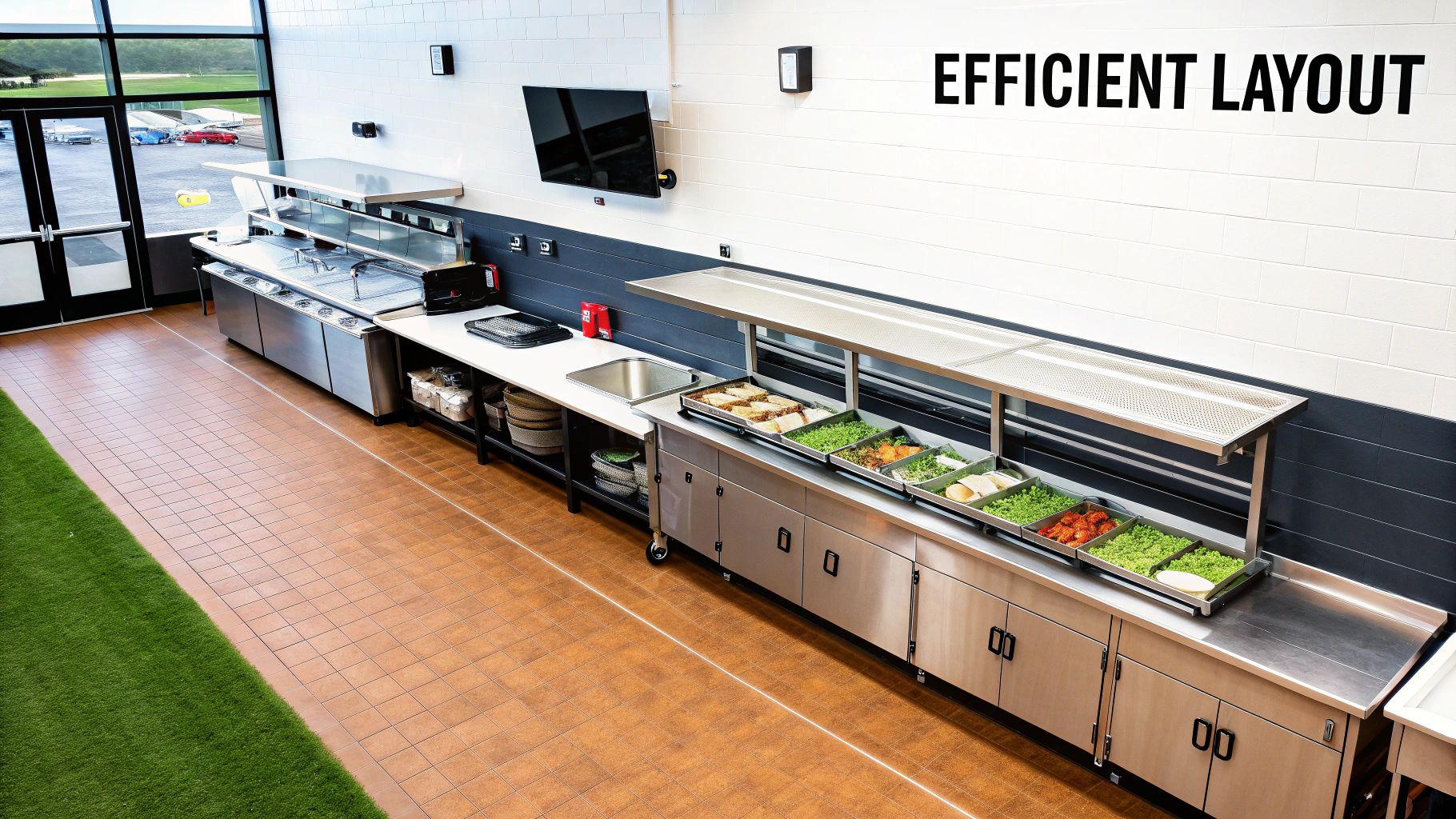
Great cabinetry is about so much more than just a place to store pans and plates; it’s the architectural backbone of a smart, fast-paced kitchen. The right placement of each unit can turn a potentially chaotic space into a high-performance engine, smoothing out bottlenecks and creating clear, efficient pathways. It’s all about designing a system where every movement is deliberate and every second counts.
This isn’t just about aesthetics—it's about the physics of a busy kitchen. By arranging your commercial kitchen cabinetry to support a logical flow, you can dramatically cut down on unnecessary steps, reduce the risk of accidents, and shave precious seconds off every single order. Think of it as choreography for your culinary team. The better the stage is set, the more graceful and effective their performance will be.
Adapting the Work Triangle for Commercial Kitchens
You’ve probably heard of the classic residential "kitchen work triangle" that connects the sink, refrigerator, and stove. Well, in a high-volume commercial kitchen, that simple triangle explodes into a web of specialized zones, each with its own mini-triangle of activity. The core principle, though, is exactly the same: eliminate wasted motion.
Instead of a single triangle, a commercial kitchen functions with multiple, interlocking work zones. To get it right, you have to understand how to properly design a restaurant kitchen, ensuring cabinetry and equipment are placed to support the natural rhythm of these zones. For a deeper look at this foundational idea, you can learn more about how the kitchen work triangle gets adapted for the pros.
A thoughtfully designed layout will have dedicated stations, each supported by the right kind of cabinetry.
- Receiving and Storage Zone: Positioned right near the delivery door, this area needs heavy-duty shelving and tough base cabinets for holding bulk goods.
- Prep Zone: This is where you’ll want cabinets with handy features like integrated waste chutes, specialized tool drawers, and durable countertops ready for endless chopping and mixing.
- Cooking Line: This zone calls for heat-resistant cabinetry and easy-to-grab storage for essential spices, oils, and cookware that need to be within arm's reach.
- Washing and Sanitation Zone: Here, moisture-resistant cabinets are a must—often stainless steel—to keep cleaning supplies organized and manage the constant flow of dishes.
By creating these distinct areas, you stop staff from tripping over each other, which is one of the biggest causes of slowdowns and collisions during a hectic dinner rush.
Leveraging Different Cabinet Types for Speed
The specific type of cabinet you choose and where you put it is just as crucial as the zones themselves. Every style has a purpose in making the kitchen run smoother. A smart layout mixes and matches cabinet types to ensure every tool and ingredient is exactly where your team needs it, right when they need it.
An efficient layout isn’t a luxury; it’s a core business strategy. Every step a chef doesn't have to take is time and energy that goes directly into the quality of the food and the speed of service.
Let's break down how different cabinet configurations can support specific tasks and boost your team's productivity.
Wall-Mounted Cabinets and Open Shelving
These are your best friends for storing frequently used items—think plates, spices, and glassware—right above prep stations or on the cooking line. Keeping this stuff at eye level means your staff can grab what they need without bending, turning, or walking away, letting them stay focused on the task at hand. Open shelving is even faster, offering instant visual access that cuts out the time spent opening and closing doors.
Base Cabinets as Workstation Anchors
Base cabinets are the foundation for your prep stations, cooking lines, and service counters. They have to be absolute workhorses, sturdy enough to support heavy equipment and countertops. The real magic, though, is outfitting them with specialized inserts.
- Drawer Banks: Perfect for organizing all the small utensils, from whisks and spatulas to plating tongs.
- Pull-Out Shelves: A lifesaver for getting to heavy pots, pans, and small appliances tucked away in deep cabinets.
- Custom Cutouts: Designed to perfectly house under-counter refrigerators or integrated trash and recycling bins, keeping them out of the way.
Mobile Cabinets for Ultimate Flexibility
In a modern kitchen, mobile base cabinets on heavy-duty casters are a total game-changer. These rolling units can be moved to create temporary prep stations during a rush, transport ingredients from storage to the line, or be reconfigured to make space for new equipment. This kind of adaptability lets a kitchen grow and change with its menu without needing a complete overhaul. When you design a layout that thoughtfully combines all these elements, your commercial kitchen cabinetry stops being just storage and becomes an active partner in your success.
The Strategic Value of Custom Cabinetry
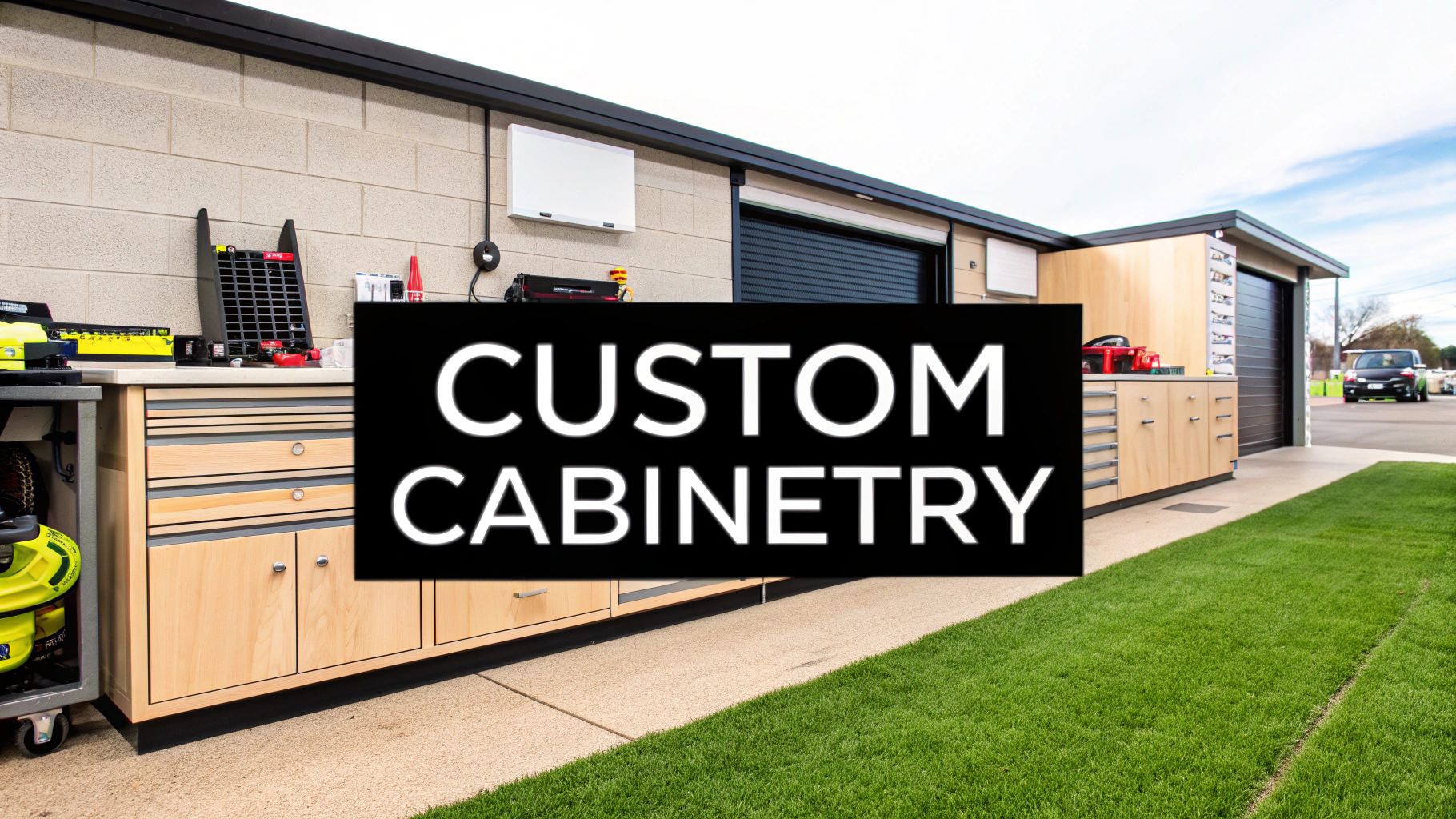
In the fast-paced world of a commercial kitchen, every square inch is prime real estate. Off-the-shelf cabinetry often forces you to work around its limitations, leading to awkward gaps, unused corners, and clumsy layouts. Custom commercial kitchen cabinetry flips that script entirely. It transforms your space from a series of compromises into a high-performance, purpose-built machine.
This isn't just about luxury—it's a strategic investment in how your kitchen runs. Think of it like an off-the-rack suit versus a tailored one. The first might fit okay, but the second is made for your exact measurements, improving comfort, movement, and confidence. In the same way, custom cabinetry is built to the precise dimensions and unique challenges of your kitchen.
Solving Unique Operational Challenges
No two commercial kitchens are the same. A busy bakery has completely different needs than a high-end steakhouse or a hospital cafeteria. This is where customization becomes a problem-solver, allowing you to design solutions that directly support your menu and service style.
A tailored approach tackles issues that stock solutions just can't touch:
- Ergonomic Optimization: Counters can be built to the perfect height for your chefs, cutting down on physical strain and boosting productivity over long shifts.
- Specialized Storage: Imagine custom-built drawers with dividers for specific pastry tools or deep, reinforced pull-outs designed to hold heavy stand mixers. No more searching.
- Awkward Spaces: Custom cabinetry can turn a challenging corner or an oddly angled wall into a fully functional storage or prep area, making every inch count.
For any custom project, understanding how to develop the initial concepts is key, and this often starts by mastering the product design sketch.
Customization is about creating a kitchen that thinks ahead for you. When a cabinet is designed to perfectly house a specific piece of equipment or organize a precise set of tools, it eliminates wasted steps and streamlines every action your team takes.
Seamless Equipment Integration and Brand Identity
Stock cabinets are rarely designed to handle the specific dimensions and ventilation needs of commercial-grade ovens, fryers, or refrigeration units. Custom solutions ensure a perfect, seamless fit. This doesn't just look more professional—it improves safety and equipment life by providing the proper airflow and support. It reinforces a sense of order and high standards.
Even better, your cabinetry can become an extension of your brand, especially in open-kitchen concepts. Materials, finishes, and hardware can be chosen to match your restaurant’s aesthetic, creating a cohesive and memorable customer experience. A kitchen that looks organized, efficient, and well-designed communicates quality before the first plate of food ever leaves the pass.
Budgeting for Your Commercial Cabinetry Project
Let’s talk money. When you’re outfitting a commercial kitchen, it’s easy to focus on the upfront price of your cabinetry. But thinking of it as a simple purchase is a mistake. This is a long-term investment in your kitchen’s core infrastructure, and the decisions you make now will ripple through your operational costs for years to come.
The final price tag isn't just one number; it’s a blend of several crucial factors. The most obvious is your material choice—gleaming stainless steel will always have a higher initial cost than a durable high-pressure laminate. But that’s just scratching the surface of what goes into a realistic budget.
Breaking Down the Core Cost Drivers
Getting a handle on where every dollar is going is the first step. A smart cabinetry plan accounts for everything from the cabinet boxes themselves to the skilled hands needed to install them perfectly.
Here are the main components that will shape your total investment:
- Material and Finish: This is the big one. Premium options like stainless steel and treated hardwoods sit at the top, while laminates are a more wallet-friendly choice, perfect for less demanding areas.
- Hardware Selection: You need hardware that can take a beating. Heavy-duty hinges, commercial-grade drawer slides, and robust pulls are non-negotiable for longevity, and they cost more than what you'd find in a residential kitchen.
- Customization Complexity: Off-the-shelf units are the most economical route. However, a custom solution built to fit an awkward corner or integrate a specific piece of equipment will naturally add to the cost. Think custom pull-outs, integrated waste systems, or counters set to a specific ergonomic height.
- Installation and Labor: In a commercial kitchen, professional installation isn't a luxury—it's a requirement for compliance and durability. This cost will shift based on how big and complex the job is.
The Total Cost of Ownership
Focusing only on the initial quote for your commercial kitchen cabinetry can set you up for a world of hurt later. A cheaper cabinet that you have to rip out and replace in five years is a lot more expensive than a durable one that soldiers on for fifteen. This is what we call the total cost of ownership.
Smart budgeting isn't about chasing the lowest price today. It's about securing the best value over the long haul by investing in cabinetry that won't nickel-and-dime you with repairs and replacements down the road.
Think about it this way: spending more upfront on marine-grade plywood cores for the cabinets in your high-moisture dishwashing area might feel like a splurge. But when you avoid the nightmare of water damage and delamination a few years in, you’ll see it was one of the smartest financial decisions you made.
Actionable Tips for a Realistic Budget
To build a budget that actually works, you have to balance what you need right now with your long-term goals. Start by prioritizing the high-traffic, high-abuse zones—your prep stations and cooking line are where you absolutely need the toughest materials.
Consider a blended strategy. You can go all-in with top-tier stainless steel in the critical wet and hot zones, then switch to more cost-effective laminates for dry storage or the staff breakroom. This approach puts your money where it matters most without blowing the budget. And always, always get detailed, itemized quotes from suppliers. This lets you see exactly where the costs are and helps you spot areas for smart, strategic adjustments.
Answering Your Questions About Commercial Kitchen Cabinetry
Choosing the right cabinetry for a commercial kitchen is a big decision. It’s a balancing act between durability, health code compliance, workflow, and of course, budget. To help you feel confident in your choices, we’ve put together some straight answers to the questions we hear most often.
Think of this as your final gut check. We're covering the key details that separate a kitchen built for efficiency and safety from one that just won't cut it.
Is Custom Commercial Cabinetry Really Worth the Extra Cost?
In a word, absolutely. While the upfront investment for custom commercial kitchen cabinetry is higher, the long-term payoff is huge. Custom solutions are built specifically for your kitchen and your workflow, which means you can say goodbye to wasted corners and awkward, unusable gaps. That precision makes for a much more efficient kitchen from day one.
Even more importantly, custom cabinets are built with the right materials and construction methods for the heavy-duty demands of your operation. This means they last far longer than something you'd pull off a shelf, which often needs to be replaced in just a few years. When you look at the cost over a decade, custom often turns out to be the smarter financial move.
How Long Should Commercial Cabinets Actually Last?
The lifespan of your cabinets really comes down to what they're made of and how well they're put together. Properly built, custom commercial cabinets made from materials like stainless steel or cores of marine-grade plywood should easily last 10-20 years. With the right care, they can often go even longer.
On the other hand, stock or mass-produced cabinets built with cheaper materials like particleboard might only make it 3-5 years in a busy kitchen. Before long, you'll start seeing the classic signs of failure: sagging doors, peeling laminate, and broken hardware.
Can I Just Use Residential Cabinets in My Kitchen?
You can, but you absolutely shouldn't. Residential cabinets are simply not designed to survive the harsh environment of a commercial kitchen. They don't have what it takes to handle:
- Constant Moisture and Heat: The steam from industrial dishwashers and heat coming off the line will make residential-grade materials warp and delaminate in no time.
- Heavy Use: They aren't built to hold the weight of bulk ingredients or withstand the constant opening and slamming that happens during a busy service.
- Health Code Compliance: This is the big one. Most residential cabinets can't meet the strict sanitation and cleanability standards health inspectors require. Using them is a major compliance risk that could get you shut down.
Investing in true commercial-grade cabinetry isn’t just a good idea; it’s a non-negotiable for building a safe, legal, and functional kitchen. It's about protecting your business, your team, and your customers.
What Materials Are the Easiest to Clean and Maintain?
For pure, no-fuss sanitation, nothing comes close to stainless steel. Its non-porous surface gives bacteria nowhere to hide, and it can take a beating from the strongest cleaning chemicals without issue. Solid surface countertops are another fantastic choice for prep areas for the same reason.
When it comes to the cabinet boxes and doors, high-pressure laminates (HPL) over a quality plywood core give you a surface that's both durable and a breeze to wipe down. The trick is to make sure you're choosing materials and finishes that were specifically made to resist grease, moisture, and constant scrubbing.
Ready to build a kitchen with cabinetry that works as hard as you do? The experts at Sinclair Cabinetry inc have over 35 years of experience crafting bespoke, high-performance solutions for any commercial environment. Contact us today to start designing a system built for lasting success.