

If you ask what the best cabinets types of material are, you’ll likely get a few different answers. For classic durability and a timeless look, nothing beats solid hardwoods for doors and frames. But for the cabinet box itself—the unsung hero of your kitchen—high-quality plywood is the professional's choice for its incredible stability and resistance to moisture. Then you have engineered woods like MDF, which are perfect for achieving that flawless painted finish without breaking the bank.
Making Sense of Your Cabinet Material Choices
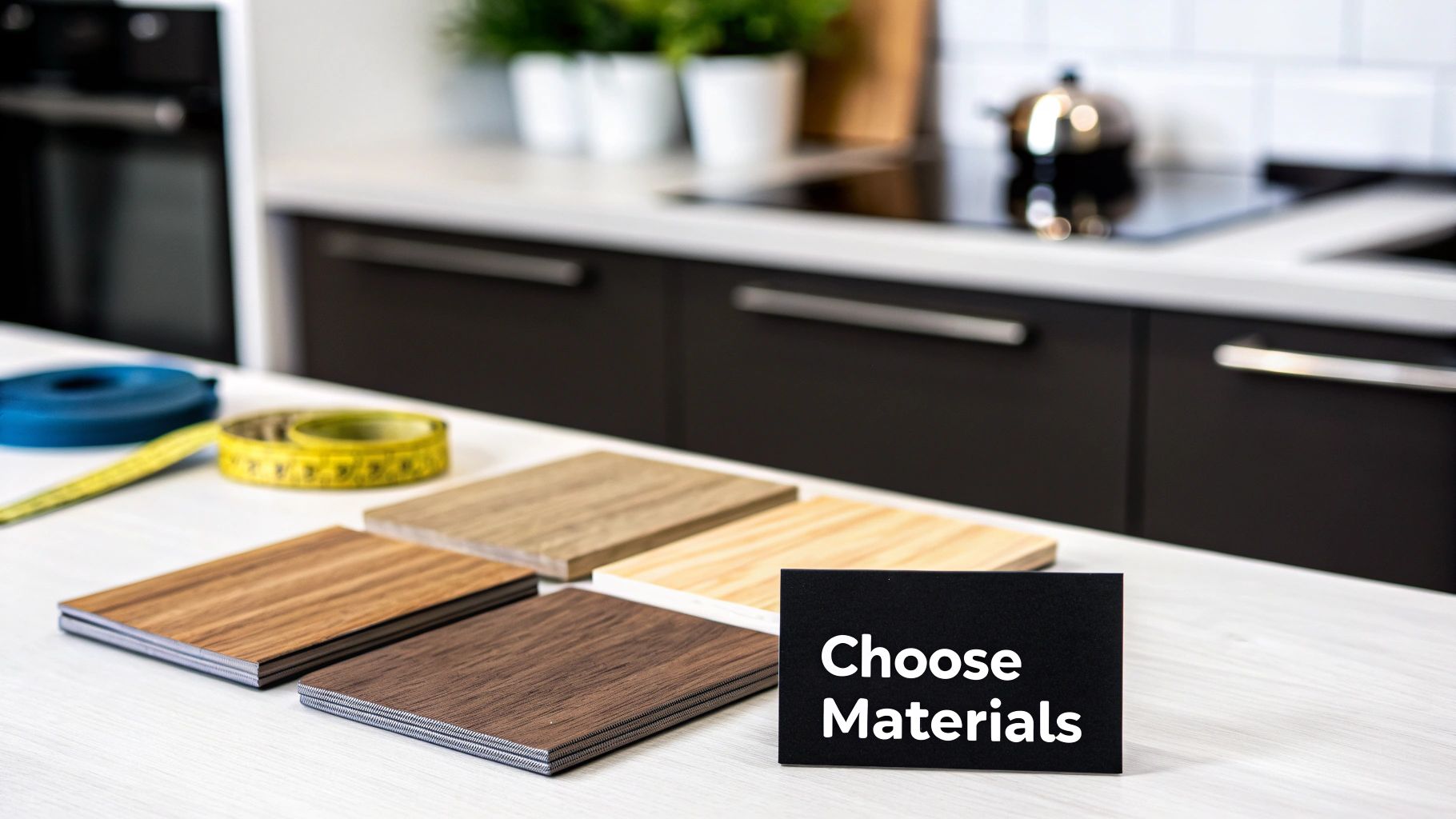
Picking the right material for your cabinets is probably the single biggest decision you'll make in a kitchen or bathroom remodel. It’s the choice that sets the stage for everything else. It defines the style, dictates how long your cabinets will last, and anchors the budget for the whole project. This isn't just about picking a color; it's an investment in how your home looks, feels, and functions for years to come.
Think of it this way: a high-quality cabinet is rarely made of just one material. It’s more like a strategic team where each player has a specific strength. Solid wood is the star player, perfect for the doors and face frames that take the brunt of daily use. Behind the scenes, sturdy and stable plywood forms the cabinet box, the invisible backbone holding it all together.
Getting to Know the Material Landscape
This guide is your roadmap to navigating the world of cabinets types of material, helping you cut through the noise and make a choice you feel great about. We’ll break down the pros and cons of every option, from the undeniable charm of solid wood to the perfectly smooth, paint-ready surface of MDF.
To kick things off, the quick-reference table below gives you a bird's-eye view of the most common choices. For a much deeper dive, be sure to explore our full guide on the best materials for kitchen cabinets to see what the experts recommend for truly luxurious results.
A well-chosen cabinet material doesn't just look good on day one; it performs reliably for decades. The goal is to find that perfect sweet spot where your design vision, daily life, and budget all meet.
Cabinet Material Quick Comparison
This table offers a high-level overview of common cabinet materials, comparing their cost, durability, and ideal uses to help you make a fast, informed assessment.
| Material Type | Typical Cost | Durability Rating | Best Application |
|---|---|---|---|
| Solid Wood | High | Excellent | Cabinet doors, face frames, and high-end projects |
| Plywood | Medium-High | Very Good | Cabinet boxes (carcasses) and shelving |
| MDF | Medium | Good | Painted cabinet doors and decorative panels |
| Laminates | Low-Medium | Good | Modern, flat-panel doors and budget remodels |
Each of these materials brings something unique to the table. Getting a handle on these fundamentals is the first step toward creating a space that’s not just beautiful but genuinely built to last. If you want to keep learning, timbercloud's blog on wood products is a great resource for articles and discussions on different wood types and their best uses.
The Timeless Value of Solid Wood Cabinets
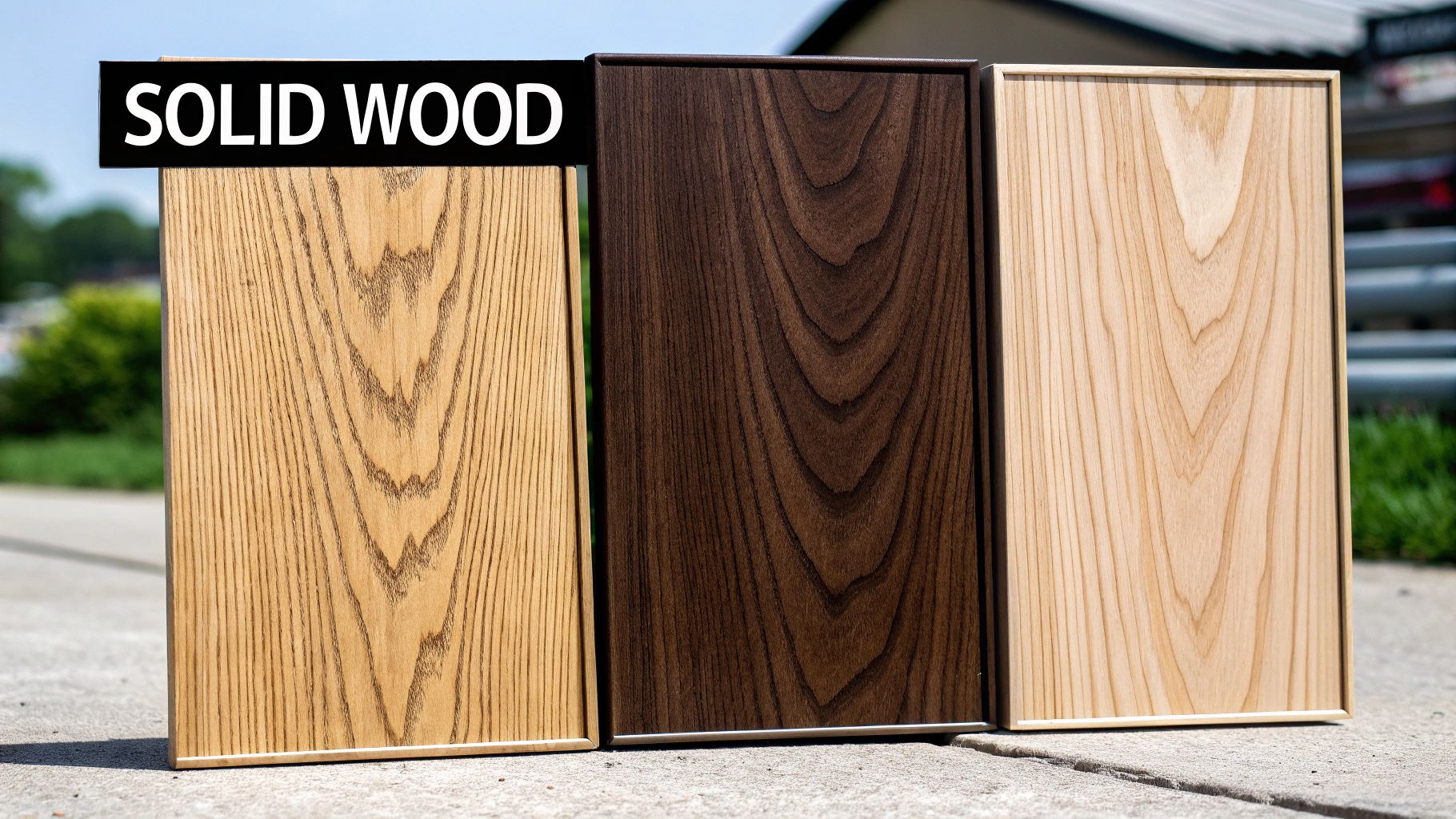
When you think of classic, high-quality cabinetry, chances are you’re picturing solid wood. It's the gold standard for a reason, offering a powerful mix of natural beauty, rock-solid strength, and value that lasts a lifetime.
Every piece of solid wood tells its own story through unique grain patterns, knots, and mineral streaks. This means no two cabinet doors will ever be identical. It’s this organic character that brings a genuine warmth to any space, whether you’re designing a rustic farmhouse kitchen or a more formal, traditional dining room.
Hardwoods vs. Softwoods: What’s the Real Difference?
Not all solid wood is created equal. The first thing to understand is the split between hardwoods and softwoods, which has more to do with the tree’s biology than how the wood actually feels.
-
Hardwoods: These come from deciduous trees—the kind that lose their leaves in the fall, like oak, maple, and cherry. They’re generally denser, tougher, and more resistant to dings and scratches, which is why they’re the top pick for hardworking kitchens.
-
Softwoods: These come from coniferous trees, or evergreens, like pine and fir. While they are still plenty strong, they tend to be less dense than hardwoods and can dent more easily. This makes them a better fit for decorative pieces or low-traffic areas.
When it comes to cabinetry that has to stand up to the chaos of daily life, hardwoods are the clear winners. They’ve got the muscle needed for doors, frames, and drawers that will be opened and closed thousands of times over the years.
Common Wood Species and Their Personalities
Picking a wood species is a lot like choosing the right fabric for a custom suit. Each one brings its own distinct character, texture, and feel to the finished piece. Think of it this way: oak is like your favorite pair of durable denim—strong, reliable, and full of character. Cherry, with its rich color that deepens over time, is more like luxurious velvet—elegant and sophisticated.
If you want to dive deeper into the specific qualities of different woods, this guide on wood furniture explained: choosing the right hardwood for longevity and style is a great resource.
The real magic of solid wood is that it can be repaired and refinished. While other materials might have to be completely tossed out when they get damaged, a solid wood cabinet can be sanded down and given a new lease on life, making it last for generations.
The Unmistakable Pros and Cons
Solid wood is a premium choice, and it's important to look at both sides of the coin to decide if it’s the right material for your home and budget.
The Benefits:
- Unmatched Durability and Strength: With proper care, hardwood cabinets can easily last 50 years or more.
- Timeless Aesthetic Appeal: The natural beauty of real wood grain adds character and value that simply can’t be faked.
- Longevity and Repairability: Scratches and dings can be sanded out, and the whole cabinet can be refinished for a brand-new look.
- Increased Home Value: High-quality wood cabinetry is a huge selling point for potential homebuyers.
The Drawbacks:
- Higher Initial Cost: There’s no getting around it—solid wood is one of the more expensive materials available.
- Sensitivity to Humidity: Wood is a natural material that expands and contracts with humidity changes. Without proper climate control, this can sometimes lead to warping or cracking.
- Maintenance Needs: The finish needs to be protected from moisture and harsh cleaners to keep it looking its best.
Even with so many modern alternatives flooding the market, people still overwhelmingly prefer natural materials. Market data from the last two decades shows that solid wood and wood-based materials remain the top choice for cabinets worldwide, making up about 65% of the global cabinet market. It’s a trend that proves real quality never goes out of style.
For an even more detailed breakdown, our guide covering the different types of wood for cabinets offers a closer look at each species' unique traits.
Understanding Engineered Wood Options
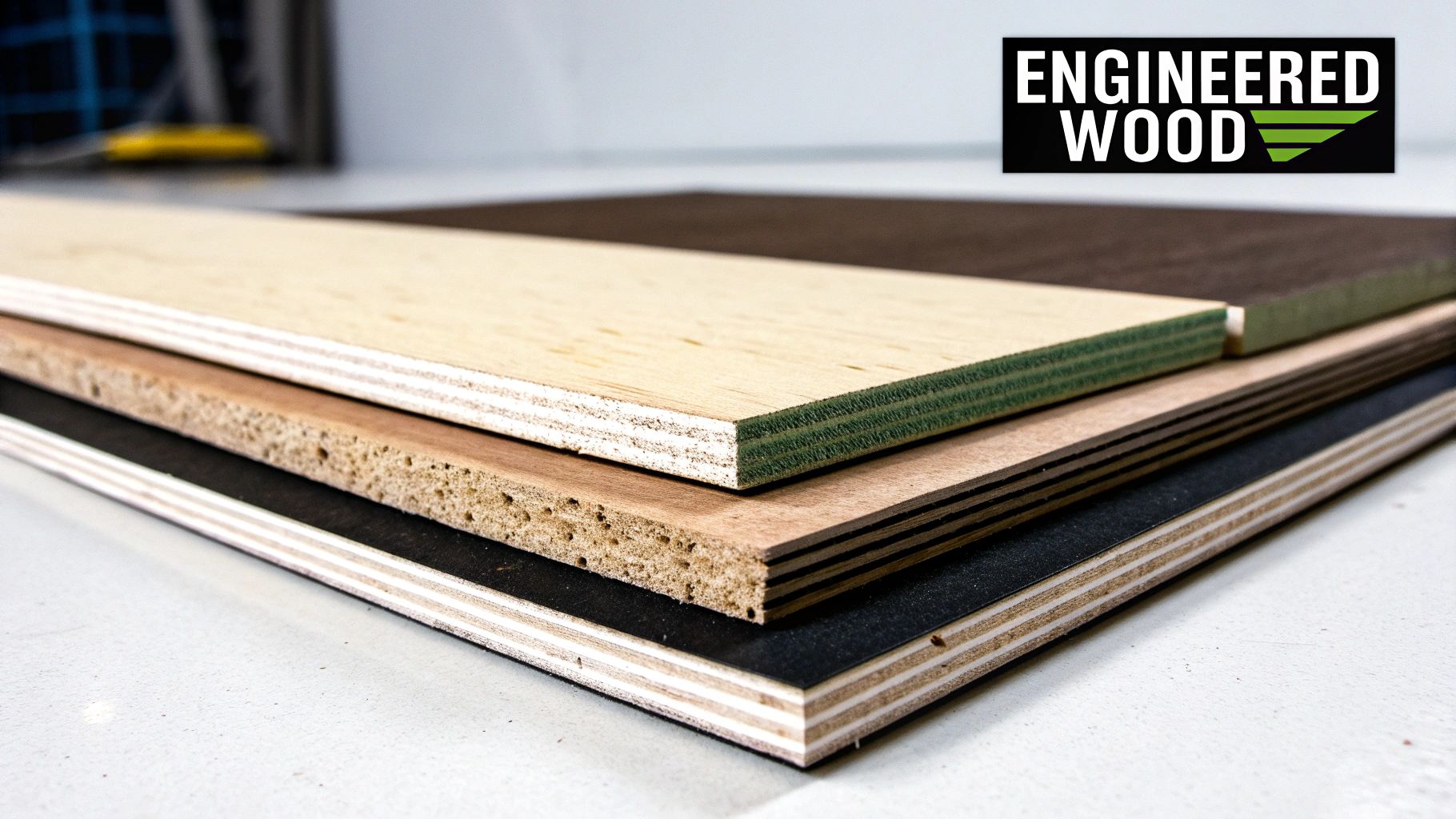
While solid wood often steals the spotlight, some of the most durable and reliable cabinets types of material are actually engineered woods. These aren't "fake wood" by any means. Think of them as innovative products designed specifically to overcome the natural downsides of solid wood, like its tendency to warp in humid environments.
A seasoned cabinet maker knows exactly when to reach for solid wood and when an engineered option is the smarter choice for stability, a smooth finish, or affordability. It's all about using the right tool for the job.
The term covers a few key players, but the three you’ll run into most are plywood, Medium-Density Fiberboard (MDF), and particleboard. Knowing how they differ is the key to understanding what makes a cabinet truly high-quality.
Plywood: The Strong and Stable Workhorse
When it comes to cabinet box construction, plywood is the undisputed champion. Imagine it as a perfectly made layer cake. Thin sheets of real wood, called veneers, are glued together with the grain of each layer running perpendicular to the one before it.
This cross-grained structure is plywood’s superpower. It creates incredible dimensional stability and strength, making it far less likely to expand, shrink, or warp with changes in temperature and humidity. It also holds screws like a vise grip—absolutely essential for mounting hinges and drawer slides that need to stay put.
This is why high-end cabinetry almost always uses furniture-grade plywood for the cabinet box (or "carcass"). It builds a rock-solid foundation that ensures your doors hang perfectly straight and your drawers glide smoothly for decades.
MDF: The Flawless Canvas for Paint
Medium-Density Fiberboard, or MDF, is another star player, but for a totally different reason. If plywood is a layer cake, think of MDF as finely milled wood flour mixed with resin and compressed under extreme heat and pressure into a solid, dense panel.
The result is a board with zero wood grain and an impeccably smooth, uniform surface. This makes MDF the absolute best material for painted cabinet doors. Because it’s one stable piece, it doesn't have the joints of a traditional solid wood door, which means no seams where paint can crack as the wood underneath naturally expands and contracts.
The secret to that perfect painted kitchen is often a hybrid approach: flawless MDF doors for a seamless, durable finish, paired with sturdy plywood boxes for structural integrity. You truly get the best of both worlds.
While MDF is very stable, its main weakness is moisture. If the painted surface gets a deep scratch or chip that exposes the core, it can soak up water like a sponge and swell. That's why it's not the best pick for cabinet boxes, especially around sinks.
Particleboard: The Budget-Conscious Contender
Particleboard is the most affordable of the bunch. It’s made by mixing larger wood particles—think sawdust and small wood chips—with a resin and pressing it all into sheets. It’s noticeably lighter and less dense than MDF.
Because of its composition, particleboard has some significant drawbacks. It has the weakest screw-holding power and is the most vulnerable to water damage. Once it gets wet, it can swell up and crumble, and it will never go back to its original shape.
For these reasons, you'll typically find particleboard in flat-pack furniture or the most basic stock cabinetry. While it might be fine for a bedroom closet organizer in a dry area, it just doesn't have the durability for a hardworking kitchen. For a deeper dive, our detailed comparison of plywood vs. particle board cabinets really breaks down the performance differences.
While wood has a long history, the market has clearly embraced these engineered alternatives. Consumer trends show materials like laminate and MDF are gaining on traditional wood, with engineered boards now used in well over a third of residential cabinet projects. This strategic use of different cabinets types of material is the hallmark of modern, intelligent cabinet design.
When you move past natural and engineered woods, you find a whole world of modern cabinet surfaces built for consistency, durability, and a clean, sleek look. These materials—specifically laminates and thermofoil—are often the secret behind today's most popular seamless, minimalist kitchen styles.
They're a practical and often budget-friendly path to a modern aesthetic. It’s important to understand, though, that these aren't solid materials. They are sophisticated finishes applied to a core substrate, usually MDF or particleboard. This construction opens up a universe of design possibilities that would be impossible or incredibly expensive to achieve with natural wood.
Laminates: The Durable Decorative Skin
Think of laminate as a super-resilient, multi-layered "skin" that's fused to a cabinet door under intense heat and pressure. This skin is basically a sandwich: a decorative paper layer that can be printed with any color, pattern, or even a surprisingly realistic wood grain, all topped with a tough, clear protective layer.
This process creates a surface that is exceptionally hard and stands up well to scratches, stains, and fading. Because the color and pattern are printed, you get perfect uniformity from one cabinet door to the next—a look that's highly sought-after in contemporary design.
The real magic of laminate is its blend of affordability and toughness. It delivers a consistent, easy-to-clean surface that can handle the chaos of a busy kitchen, making it a smart, pragmatic choice for many families.
The sheer versatility of laminate is what really makes it shine. It allows for bold colors, high-gloss sheens, and intricate patterns that create a striking, modern statement. It's the perfect choice when you want a very specific, consistent appearance without the natural variations you'd find in real wood.
Thermofoil: The Seamless Vinyl Wrap
Thermofoil offers another route to a smooth, modern finish, but it gets there in a totally different way. Picture taking a finely routed MDF door and shrink-wrapping it with a thin, flexible layer of vinyl. That’s essentially thermofoil.
This material, technically called Rigid Thermal Foil (RTF), is applied using a combination of heat and a vacuum press. This process lets the vinyl conform perfectly to any contours or details on the door's surface, creating a completely seamless finish on the face and edges. It's this method that gives thermofoil cabinets their signature smooth, easy-to-clean profile.
Because it's a non-porous surface, thermofoil is highly resistant to staining and is incredibly simple to wipe down. This has made it a go-to choice for crisp, bright white kitchens where cleanliness and a flawless appearance are top priorities.
A Clear-Eyed Look at Pros and Cons
Both of these modern surfaces bring distinct advantages—and a few potential drawbacks—to the table. Choosing between them usually comes down to balancing your budget, your style, and how you really live in your space.
Key Benefits of Laminate & Thermofoil:
- Affordability: Generally, they are much more cost-effective than solid wood or high-end painted finishes.
- Consistency: The color, pattern, and texture are perfectly uniform across every single cabinet component.
- Low Maintenance: Both surfaces are non-porous and a breeze to clean with just a little mild soap and water.
- Design Variety: You have an almost limitless range of colors, patterns, and sheens to choose from.
Potential Downsides to Consider:
- Repair Difficulty: Unlike wood, deep scratches or chips in laminate are nearly impossible to fix. In most cases, the entire door has to be replaced.
- Heat Sensitivity: Thermofoil can be particularly sensitive to heat. If it’s installed right next to a stove or dishwasher without proper heat shields, the vinyl layer can delaminate, peel, or even discolor over time.
- Water Damage Risk: If the surface layer gets punctured and water seeps into the MDF or particleboard core, it can cause irreversible swelling and damage.
At the end of the day, these modern cabinets types of material are fantastic for achieving a specific contemporary look on a practical budget. Their strength is in their consistency and ease of care, making them a smart fit for modern homes and lifestyles.
Thinking Outside the (Cabinet) Box: Alternative Materials
While wood and its engineered cousins cover most of the bases, sometimes a project calls for something completely different. When you're chasing a specific look or need high-performance features, materials like metal, glass, and reclaimed wood offer unique personalities that traditional options just can't match.
These aren't just substitutes for wood; they bring their own distinct advantages to the table. Choosing stainless steel or glass isn’t just a stylistic whim—it's a practical decision rooted in durability, hygiene, and a totally fresh approach to kitchen design.
Metal Cabinets: The Sleek and Strong Option
Ever wonder why professional kitchens are always gleaming with stainless steel? It’s because metal brings an industrial-chic, high-end feel that’s prized for both its sharp looks and incredible performance.
Metal cabinets, typically stainless steel or aluminum, come with a serious list of benefits:
- Basically Indestructible: They stand up to heat, rust, and corrosion without breaking a sweat, making them the undisputed champion for demanding spots like outdoor kitchens.
- A Germaphobe's Dream: Metal's non-porous surface gives bacteria nowhere to hide, making it incredibly easy to clean and sanitize.
- Completely Waterproof: Spills? Humidity? Not a problem. Metal is immune to water damage, so you can forget about warping or swelling.
This rock-solid durability is why metal cabinets are carving out a serious niche. Projections show the market for metal cabinets is set to grow at a 5.1% CAGR, especially as designers look for corrosion-resistant materials for minimalist interiors and even healthcare settings. If you want to dive deeper, you can explore recent cabinet market trends.
Glass Inserts: Adding a Touch of Light and Personality
Glass isn’t usually used for the whole cabinet, but as a design accent? It’s a powerhouse. Swapping a few solid cabinet doors for glass-front ones is a brilliant way to break up a wall of wood, create a sense of depth, and put your favorite dishes or glassware on display.
You’ve got a few great styles to choose from:
- Clear Glass: The classic choice. It gives you an open, airy look that can make a small kitchen feel much bigger and brighter.
- Frosted Glass: A touch more elegant, this style softly blurs the contents, giving you a hint of what’s inside without revealing any clutter.
- Textured or Seeded Glass: Perfect for adding a vintage or artisanal vibe. The unique patterns in the glass create fantastic visual interest.
Using glass strategically can completely change the atmosphere of a room. It transforms simple storage into a curated display, injecting your personal style while making the entire space feel more open and inviting.
Reclaimed Wood: A Story in Every Grain
For those who prioritize sustainability and character, reclaimed wood is a fantastic choice. This isn't just wood; it's lumber with a past. Sourced from old barns, warehouses, and other historic structures, it brings a rich history and one-of-a-kind rustic charm right into your home.
Each plank tells a story through its weathered patina, old nail holes, and unique grain patterns. Having already spent decades exposed to the elements, reclaimed wood is often denser and more stable than brand-new lumber. It’s an eco-friendly decision that cuts down on waste and delivers an authenticity that no factory-made material can ever hope to replicate.
How to Choose the Right Material for Your Home
Walking through the world of cabinet materials can feel like a maze. But honestly, picking the right one always boils down to asking a few straightforward questions about your own home and lifestyle.
Instead of getting bogged down in every little detail, you can slice through the confusion by focusing on what truly matters to you. Think of it as your own personal checklist. Answering these key questions helps you quickly rule out what won't work and zero in on the perfect fit, ensuring your new cabinets are a source of pride for years to come.
Your Personal Cabinet Selection Checklist
Let's get practical. Run through these questions to find the perfect direction for your project.
-
What's my real-world budget? This is always the starting line. Your budget will naturally guide your choices. Solid wood is a premium, long-term investment, while materials like laminates and thermofoil deliver a sharp, modern aesthetic at a more approachable price point.
-
What's my home's architectural style? Your cabinets should feel like they belong. The deep, rich grain of solid oak might be the perfect complement for a traditional home, but the clean, uniform sheen of a high-gloss laminate could be the star in a contemporary space.
-
Where are these cabinets going? Location is everything. A busy kitchen is a demanding environment that needs tough materials ready for heat, steam, and constant traffic. A powder room or laundry area, on the other hand, doesn't need nearly the same level of heavy-duty resilience.
-
How much maintenance am I willing to do? Be honest with yourself here. If you're all about easy clean-up, you'll love low-maintenance surfaces like thermofoil or laminates. But if you appreciate the timeless appeal of a material that can be repaired and refinished down the road, nothing beats solid wood.
This handy decision tree shows how different priorities can lead you to completely different, but equally fantastic, material choices.
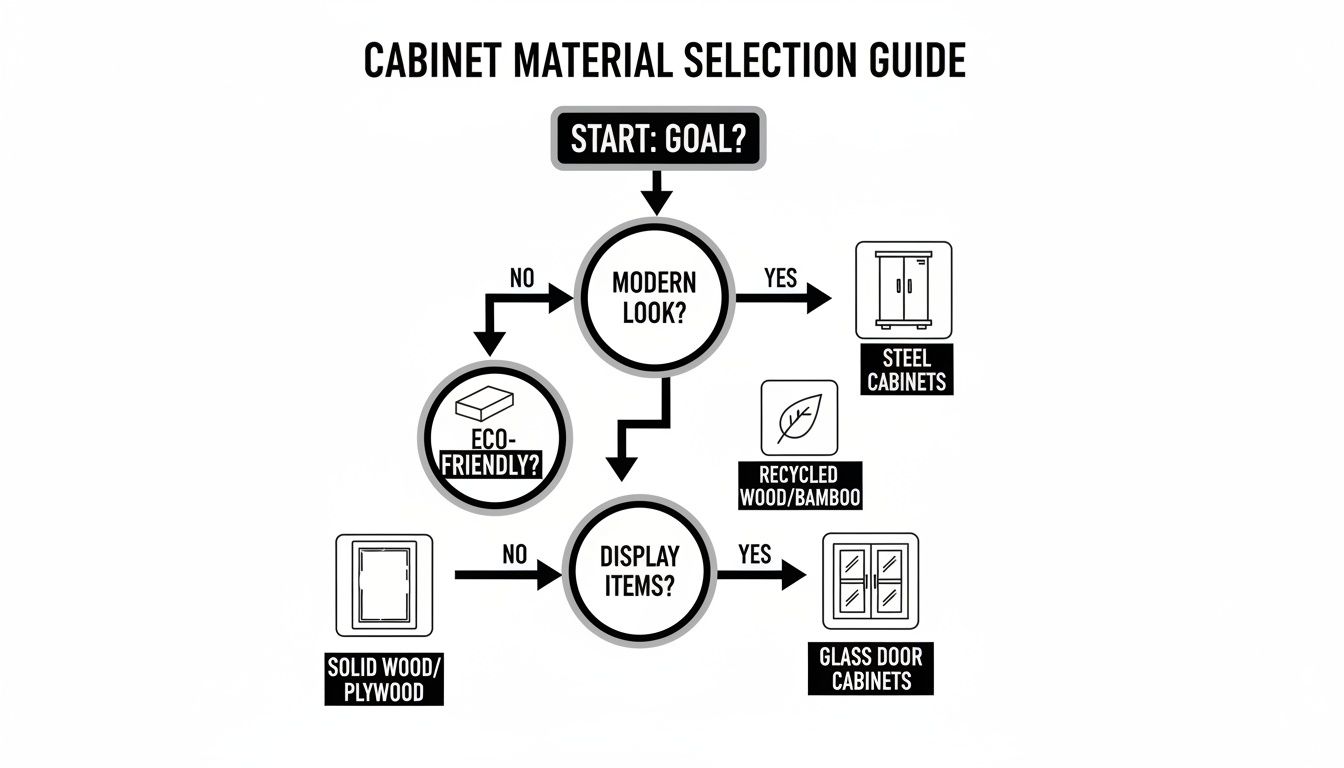
As the flowchart shows, if a modern look is your main goal, metal might be your top contender. If you're focused on sustainability, reclaimed wood is an incredible option.
The right cabinet material is where beauty, performance, and value all meet. When you balance what you want with what you actually need, you're making a smart, lasting investment in your home.
At the end of the day, the best cabinet material is the one that fits your life. By working through this simple checklist, you can go from feeling overwhelmed to feeling confident that you’ve picked a winner.
Still Have a Few Questions?
Even after laying out all the options, you might still be mulling over a few things. That’s perfectly normal. Choosing the right cabinet material types is a huge investment, and it’s smart to get every last doubt cleared up before you pull the trigger.
Let's tackle some of the most common questions we hear from homeowners. Getting clear, straightforward answers is the best way to feel confident you're making the right call.
What Is the Most Durable Material for Kitchen Cabinets?
When it comes to pure strength and the ability to last a lifetime, you just can't beat the classic tag team of solid hardwood and high-quality plywood.
For the parts of your cabinets that take the most daily abuse—the doors and face frames—solid hardwoods like maple, oak, and hickory are the undisputed champions. Their dense structure shrugs off dings and dents, and they have the incredible ability to be sanded and refinished, effectively erasing decades of wear and tear.
For the cabinet box itself, the unsung hero is furniture-grade plywood. Its cross-laminated construction gives it incredible structural integrity, fighting off the warping that humidity can cause. It also holds screws like a vise, which means your hardware isn't going anywhere.
Is MDF a Bad Material for Cabinets?
Not at all! In fact, MDF is an excellent material—when it’s used for the right job.
MDF’s biggest superpower is its perfectly smooth, uniform, and stable surface. This makes it the ideal canvas for a painted finish. Unlike solid wood, MDF doesn’t expand or contract with changes in humidity, which means you won't see those tiny hairline cracks that can sometimes appear at the joints of painted wood doors.
The flip side is its weakness to moisture. You wouldn't want to use it in an area that's prone to getting wet, like under a sink, because it can swell and bubble if the sealed surface gets compromised. The best cabinet makers often use a smart hybrid approach: stunning, flawless MDF doors paired with rock-solid plywood boxes.
The real key is understanding that different materials have different strengths. A great cabinet design uses each material for what it does best, creating a final product that's both gorgeous and built to last.
How Can I Tell if My Cabinets Are Solid Wood or Veneer?
Figuring out if you're looking at solid wood or a veneer is actually easier than you'd think. It all comes down to checking the grain pattern.
- Solid Wood: Take a close look at the edges of a door or drawer front. If it's a solid piece, the wood grain you see on the face will wrap right around and continue over the edge. The pattern will look organic, with natural variations.
- Veneer: On a veneered door, the grain on the face might look perfect—sometimes a little too perfect. Now, check that same edge. You'll likely see a very thin, straight line separating the face from the edge. That's the edge banding, a separate strip used to cover the core material (like plywood or MDF).
Ready to see how premium, real-wood materials can completely transform your space? The experts at Sinclair Cabinetry inc have over 35 years of experience crafting custom cabinetry that blends timeless beauty with unmatched durability. Explore our gallery and start designing the kitchen or bathroom you've always dreamed of today.