
Embarking on a kitchen renovation is about so much more than just picking out new countertops and cabinets. It’s really about reshaping the heart of your home, and that all starts with smart, detailed planning. The absolute key is to begin by defining your why—the real, honest-to-goodness reasons behind your remodel. This "why" will become your north star, guiding every single decision you make, from the budget all the way to the backsplash.
When you get this part right, kitchen renovation planning transforms from a daunting project into an exciting, totally manageable process.
Starting Your Kitchen Renovation Journey
Long before a single hammer swings, the most critical work you'll do is with a pen and paper. A truly successful remodel is built on a solid foundation of clear goals and realistic expectations.
It’s tempting to jump straight to Pinterest boards, but hold off for just a moment. First, take some time to assess what truly isn't working in your current kitchen. Is it the constant lack of counter space? The ancient appliances? Maybe it’s a workflow that makes you feel like you’re running a marathon just to make dinner, or simply a style that feels like it belongs to someone else.
Answering this question honestly is the best way to prevent regrettable decisions or overspending on flashy features you don't actually need. This initial phase is where you ground your vision in reality, setting the stage for a space that’s not only beautiful but deeply functional for your real-world lifestyle.
Defining Your Scope and Inspiration
Once you’ve nailed down your "why," then you can start gathering inspiration that actually solves your specific problems. Look for layouts that improve traffic flow or clever storage solutions that will finally tackle that clutter. This isn't just about aesthetics; it's about making your life easier.
Here are a few practical first steps:
- Identify Your Pain Points: Jot down a list of your top three frustrations with your current kitchen. For instance, "I have no prep area next to the stove," or "the kids' homework always ends up on the only usable counter space."
- Establish Your Must-Haves: What are the non-negotiables? This could be a huge island for family gatherings, ultra-durable countertops that can withstand kids and crafts, or a second sink.
- Set a Preliminary Budget: Having a rough idea of your spending limit early on is crucial. It keeps your dreams tethered to reality and will immediately help guide your material selections.
Understanding Real-World Costs
It's vital to anchor your expectations in what's happening in the market right now. Renovation costs are climbing, and being informed from day one helps you build a budget that won’t fall apart later.
To give you a clearer picture, let's look at some recent data. The figures below show the typical spending for both major and minor remodels in larger kitchens (over 250 sq ft).
Kitchen Renovation Budget Snapshot
| Renovation Type | Median Spend (Previous Year) | Median Spend (Current Year) | Top 10% Spend |
|---|---|---|---|
| Major Remodel | $66,000 | $72,000 | $180,000+ |
| Minor Remodel | $16,000 | $28,000 | $60,000+ |
As you can see, median spending on major renovations for these larger kitchens saw a notable 9% increase, climbing from $66,000 to $72,000. The trend was even more dramatic for minor remodels in the same size kitchens, where spending leaped by an eye-popping 75%. You can dig deeper into these numbers by exploring the latest kitchen trends report to get a better handle on these costs.
This data isn't meant to scare you, but to empower you. Knowing the real numbers helps you plan effectively.
Key Takeaway: The most successful kitchen renovations begin long before demolition. By clearly defining your goals, understanding your pain points, and grounding your budget in real-world data, you create a solid plan that minimizes stress and maximizes your return on investment. This foundational work ensures the final result is a kitchen you'll absolutely love for years to come.
Building a Realistic Renovation Budget

Let's talk numbers. A successful kitchen remodel isn't built on a single, scary figure—it’s built on a smart financial game plan. We need to move past guesswork and create a detailed budget that covers everything from the big-ticket appliances down to the drawer pulls. This is where a vague idea transforms into an actionable plan.
The first step is always to get a clear picture of where your money will actually go. Breaking the project down into its core components is the only way to do this. Once you understand the typical cost buckets, you can start allocating your funds with confidence.
Deconstructing Your Kitchen Costs
Think of your total budget as a pie. Each slice represents a different piece of the renovation puzzle. While every single project is unique, most remodels follow a pretty similar cost distribution.
Here’s a rough breakdown I’ve seen hold true for hundreds of kitchen projects:
- Cabinetry and Hardware (30-40%): This is almost always the biggest chunk of the budget. It covers all your cabinets, pulls, hinges, and any clever custom storage you’ve been dreaming of.
- Labor and Installation (20-35%): This is what you pay the pros—your general contractor, plumbers, electricians, and painters. Never underestimate this cost.
- Appliances (10-15%): Your fridge, oven, dishwasher, and microwave all fit in here.
- Countertops (10-15%): This slice covers the material itself, plus the critical fabrication and installation.
- Flooring (5-7%): The new flooring material and the labor to put it in.
- Fixtures and Other Elements (5-10%): Think sinks, faucets, lighting, and that beautiful backsplash tile.
When you look at your budget this way, making trade-offs becomes much easier. For instance, if you absolutely fall in love with a high-end quartz countertop, you’ll know immediately which other areas you might need to dial back to stay on track.
For a more granular look, try plugging your numbers into a good kitchen remodel cost calculator. It’s a great tool for seeing how different choices will affect your bottom line in real-time.
The Essential Contingency Fund
Here's a piece of advice I give every single client: no matter how perfectly you plan, there will be surprises. It's just the nature of renovation. This is precisely why a contingency fund isn't optional—it's your project's safety net. As soon as you open up those walls, you might find anything from old, faulty wiring to hidden water damage that has to be fixed.
Plan on setting aside 15-20% of your total project cost for this fund. This isn't "extra" money; it's an integral part of a realistic budget. Having this buffer means you can tackle unexpected issues without derailing the project or sacrificing your vision.
Think of it as project insurance. If you get lucky and don't need it, great! You’ve got a surplus for a few upgrades. But if you do need it, you'll be incredibly glad it’s there.
Strategic Spending: Where It Matters Most
A smart budget is all about knowing where to splurge and where to save. Not every dollar spent has the same impact. Some investments give you a much better return, both in your daily life and in the long-term value of your home.
Where to Invest:
- Quality Cabinetry: You touch your cabinets dozens of times a day. Well-made cabinets with solid hardware and features like soft-close drawers will make your kitchen a joy to use for decades.
- Functional Layout: Good flow is priceless. Spending a little extra on a designer or taking more time to perfect the layout will pay you back every single day.
- Durable Countertops: Your counters are the workhorses of the kitchen. Choosing a tough, low-maintenance material will save you a lot of headaches later on.
Where You Can Save:
- Stock or Semi-Custom Cabinets: You don't always need fully custom work. Today's high-quality stock and semi-custom lines can deliver a premium look for a fraction of the price.
- DIY Demolition or Painting: If you're comfortable with a little sweat equity, handling some of the less-skilled labor yourself can lead to significant savings.
- Mid-Range Appliances: The most expensive, feature-packed appliances aren't always necessary. Reliable, well-reviewed mid-range models often have everything you truly need.
Financing Your Renovation
Finally, you’ll need to figure out how you're going to pay for it all. Most people use a home equity loan, a HELOC, a personal loan, or cash savings. It’s also worth looking into government-backed options; for example, an FHA 203(k) loan for renovation financing can be a great choice because it bundles your home purchase and remodel costs into a single mortgage.
Do your homework on these options early on. A solid financial plan is the foundation for a kitchen that you'll love for years to come.
Designing a Functional and Stylish Kitchen

Alright, this is where the fun really begins. The design phase is the creative heart of your kitchen renovation planning—it's where your vision finally starts to take shape on paper. But a great design is so much more than just pretty finishes. It's about creating a space that feels intuitive and flows with the rhythm of your life, solving those little daily frustrations that drive you nuts.
Before you get lost in tile samples and paint swatches, take a brutally honest look at your current kitchen. What are the bottlenecks? What’s the one thing that drives you crazy every time you try to cook? Maybe it’s that tiny sliver of counter space next to the stove, or the way the refrigerator door blocks the main walkway every time it's open. Pinpointing these specific pain points is the first real step toward a kitchen that actually works for you.
From Work Triangle to Work Zones
For decades, kitchen design was all about the "work triangle," a classic concept that connects the fridge, stove, and sink. It’s still a solid starting point, but modern kitchens are so much more than that. We now think of them as a collection of specialized work zones.
Think about how you really use your kitchen. You don't just stand in one spot; you move between different task areas. Breaking it down into zones just makes sense:
- Prep Zone: This is your command center for chopping and mixing. You want plenty of counter space here, with easy access to the trash and sink.
- Cooking Zone: Centered around your cooktop and oven. All your pots, pans, oils, and spices should be within arm's reach.
- Cleaning Zone: This is the sink and dishwasher hub. Having your everyday glassware and plate storage nearby makes unloading the dishwasher a breeze.
- Storage Zone: Your pantry and refrigerator, the main spots for food. Keeping them close together simplifies grocery unloading.
Thinking in zones helps create a layout that can handle multiple people working at once without constantly bumping into each other.
Popular Layouts and The Great Island Debate
The shape of your room will naturally guide your layout options. L-shape, U-shape, and galley kitchens are the most common for a reason—they're efficient. An L-shape layout is fantastic for opening up the space, while a U-shape gives you an incredible amount of counter and storage real estate.
Now, let's talk about the island. Adding an island can be a total game-changer, offering a ton of prep space, casual seating, and a natural social hub. But—and this is a big but—it needs room to breathe. You absolutely need at least 36 to 42 inches of clear walkway on all sides. Anything less and you've created a cramped, frustrating obstacle course. Don't try to shoehorn an island into a kitchen that can't handle it.
Expert Tip: Grab some painter's tape and mark the exact footprint of your dream island on the floor. Live with that taped-off outline for a few days. See how it feels to walk around it. This simple trick has saved countless clients from making a very expensive layout mistake.
Defining Your Kitchen's Style
With a functional layout locked in, it’s time to focus on aesthetics. This is where you get to inject your personality into the kitchen. Are you drawn to the sleek, clean lines of modern design? The cozy, welcoming vibe of a modern farmhouse? Or maybe the rich textures and earthy feel of a rustic style?
The single best thing you can do here is create a mood board. Whether it's a physical corkboard or a digital one on Pinterest, this is your North Star. Don’t just pin random images you like; be intentional about gathering the core elements:
- Color Palette: Pick two or three main colors and one or two accent shades.
- Cabinetry Style and Finish: This is the biggest visual element in the room. For a deeper dive, check out our detailed guide on how to plan kitchen cabinets to explore all the options.
- Countertop Material: Balance the look you want with the maintenance you're willing to do.
- Hardware and Fixtures: This is the "jewelry" of the kitchen. The pulls, faucets, and lighting are what pull the whole look together.
A solid mood board keeps all your choices cohesive and becomes a powerful communication tool when you bring in professionals. It also helps you resist those impulse buys that don't quite fit the vision. Remember, a thoughtfully designed kitchen isn't just a joy to use—it's a major asset. It's no surprise that kitchens are the most renovated room before a sale, factoring into nearly 70% of pre-sale projects because of their massive impact on home value.
Choosing Your Kitchen Materials and Appliances
Alright, now for the fun part: picking out all the materials and appliances. This is where your kitchen really starts to take shape, but it's also where you need to balance your dream look with your budget and a healthy dose of practicality. These are the things you'll touch, use, and look at every single day, so think of these choices as long-term investments in your kitchen's workhorses.
It's easy to get swept up in aesthetics alone, but we need to go deeper. How much maintenance are you willing to do? How will that gorgeous butcher block hold up to your kids' spilled juice? Every decision, from countertops to cabinets, impacts the kitchen's feel and function.
The pie chart below gives you a great visual breakdown of where the money typically goes in a kitchen remodel. No surprise here—it shows you just how much of your budget is dedicated to the big-ticket items.
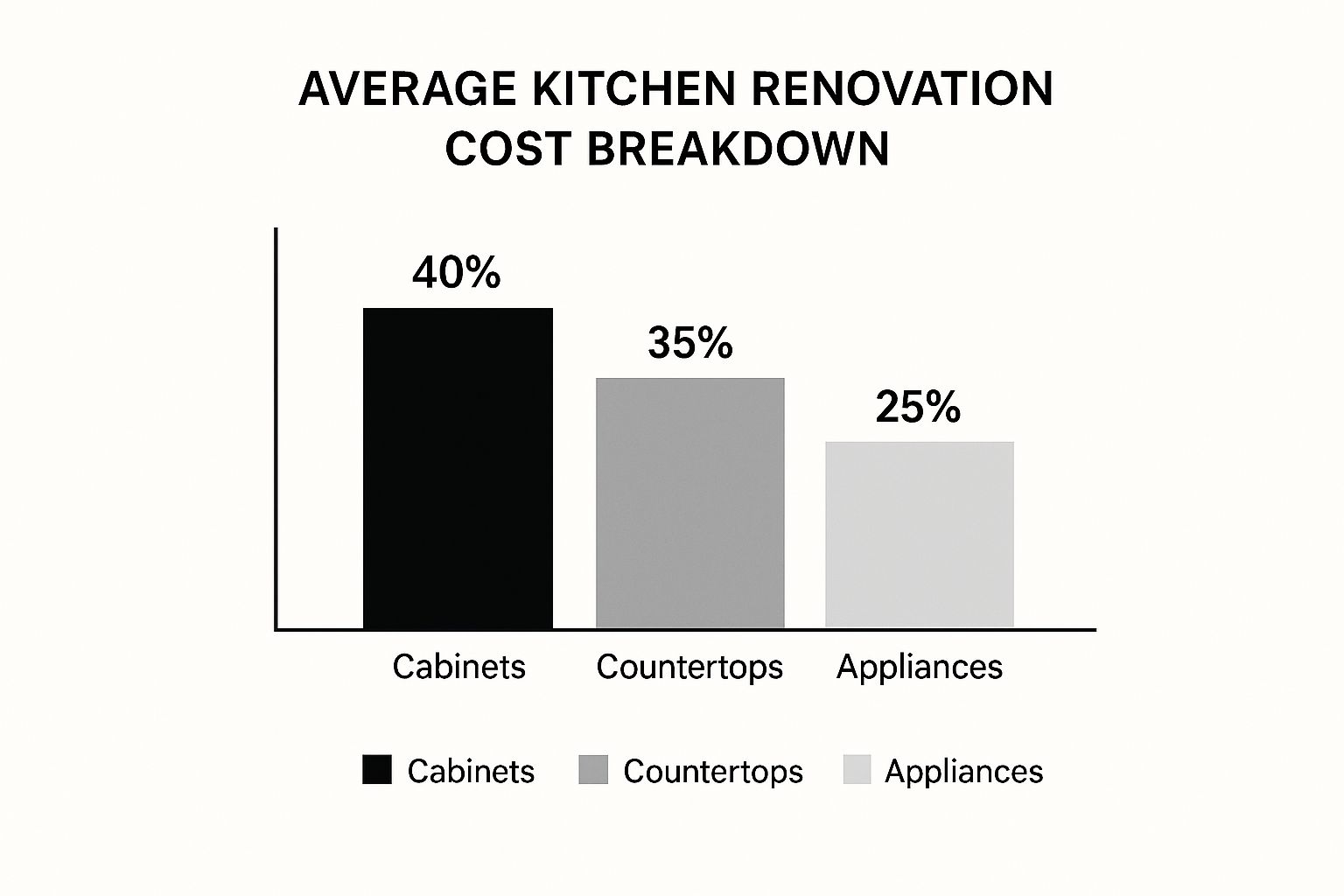
As you can see, cabinetry and countertops eat up the biggest slice of the pie. That’s why getting these foundational choices right is absolutely critical.
Picking Your Core Surfaces
Your countertops and floors are the bedrock of the kitchen, both visually and functionally. They have to look good, sure, but they also have to stand up to a ton of daily abuse. It’s all about finding that sweet spot between style and staying power.
To help you decide, I've put together a quick comparison of the most popular countertop materials I see homeowners considering.
Countertop Material Comparison Guide
| Material | Average Cost (Per Sq. Ft.) | Durability & Maintenance | Best For |
|---|---|---|---|
| Quartz | $50 – $150 | Nearly indestructible. Non-porous, so it resists stains and scratches. No sealing required. | Busy families and anyone wanting a super low-maintenance, consistent look. |
| Granite | $40 – $100 | Very durable and heat-resistant. Each slab is unique. Requires periodic sealing. | Homeowners who love natural stone and want a one-of-a-kind pattern. |
| Butcher Block | $40 – $100 | Adds warmth and is great for chopping. Needs regular oiling to prevent drying and water damage. | Adding a warm, organic touch or creating a dedicated food prep zone. |
| Laminate | $20 – $50 | The most budget-friendly option with tons of design choices. Can scratch or chip. | Budget-conscious renovations, rental properties, or secondary spaces like laundry rooms. |
When it comes to flooring, the big deciders are usually water resistance and comfort underfoot. Luxury vinyl plank (LVP) is a crowd-pleaser because it's 100% waterproof, tough as nails, and feels much softer than tile. While classic hardwood is beautiful, it’s a bit of a risk in a kitchen where spills are inevitable.
Making Smart Cabinetry Choices
Let's be honest: cabinets are the main event. They set the entire style of the room and, more importantly, hold all your stuff. Your material choice here has a massive impact on both cost and how well they hold up over time.
- Solid Wood: The gold standard for beauty and longevity. You can sand and refinish them down the road, but they're the priciest option and can warp in humid climates.
- MDF (Medium-Density Fiberboard): If you're planning on painted cabinets, MDF is your friend. It's an engineered product with a super smooth surface that resists the cracking that can happen with painted wood. Its weak spot? Water. It will swell if not perfectly sealed.
- Plywood: A fantastic all-arounder. Made from layers of wood veneer, it’s much more stable and water-resistant than MDF, making it the go-to choice for quality cabinet boxes.
A piece of advice I give every client: Splurge on the cabinet construction, not just the doors. Even if you go with a more affordable door style, make sure the cabinet boxes are sturdy plywood. And don't skimp on the hardware! Features like soft-close hinges and full-extension drawers completely change how your kitchen feels to use every day.
Investing in the Right Appliances
Your appliances are the engine of your kitchen, so focus on how you actually cook, not just on what looks shiniest. Are you a serious baker who dreams of a high-performance convection oven? Or do you entertain constantly and need a double oven and a wine fridge?
Take induction cooktops, for example. They're a perfect example of practical, modern tech. You get incredibly precise temperature control, they boil water faster than gas, and cleanup is a breeze. I've seen so many homeowners make the switch and swear they’ll never go back to scrubbing gas grates again.
Sure, smart fridges with internal cameras are cool, but will you really use those features? Sometimes, a top-rated, energy-efficient model without the tech frills is a much smarter buy. And a crucial final check: before you fall in love with a suite of new, powerful appliances, you need to know if your electrical panel can handle them. It's essential to calculate electrical load to avoid any nasty surprises on installation day. The goal is to find a blend of technology that makes your life easier and reliable performance you can trust for years.
Finding and Hiring the Right Professionals
Let's be honest: your dream kitchen is only as good as the people you hire to build it. This is the stage where your carefully crafted plans and Pinterest boards meet reality. Finding skilled, trustworthy pros is what turns a blueprint into a beautiful, functional space you'll love for years.
The trend toward hiring experts is growing for a reason. Pro-led projects in the kitchen and bath industry are projected to see significant growth, far outpacing the small increase expected for DIY jobs. You can dive deeper into these numbers by checking out the full research on the kitchen and bath market outlook.
It just makes sense. A full-scale kitchen remodel is a complex dance of plumbing, electrical, and even structural work. Getting it wrong isn't just an aesthetic problem; it can be a costly and dangerous one. The key is figuring out exactly who you need on your team.
Who Should You Hire?
Your choice of professional really comes down to your project's scope and how hands-on you want to be. There’s no single right answer, but understanding what each pro does will make the decision a lot clearer.
- General Contractor (GC): Think of a GC as the quarterback of your renovation. They manage the entire project, hiring and scheduling all the subcontractors—plumbers, electricians, painters, you name it. They keep the project on track and are responsible for the big-picture execution. If you're moving walls or changing the plumbing and electrical layout, a good GC is absolutely essential.
- Kitchen Designer: A designer is a specialist in the art and science of kitchen layouts. They are experts in ergonomics, space planning, and creating a cohesive look. A designer will give you detailed drawings that your contractor can build from, ensuring every single inch of your kitchen is optimized for both function and style.
- Design-Build Firm: This is your all-in-one solution. A design-build firm has the designers, project managers, and construction crews all working under one roof. This integrated approach can be a huge plus, streamlining communication and creating a seamless process from the first sketch to the final cabinet knob. It gives you a single point of contact and accountability.
If you have a rock-solid vision and are just swapping out cabinets and counters in the same footprint, a great general contractor might be all you need. But if you’re reconfiguring the layout or feeling swamped by the endless design choices, investing in a kitchen designer is money well spent.
Vetting Your Potential Team
Once you know the type of pro you need, the real work begins. Don't just go with the first person who gives you a quote. A little bit of homework now will save you a world of headaches down the road.
Crucial Takeaway: Hiring a professional is about more than their technical skill. It's a relationship. You need to find someone whose communication style works for you and who you feel comfortable having in your home for weeks, or even months.
Here’s a practical checklist to run through when you’re evaluating candidates:
- Check Licenses and Insurance: This is completely non-negotiable. Ask for proof of their general liability insurance and worker's compensation. You should also verify their contractor's license with your state’s licensing board. This step protects you from liability if an accident or property damage happens on your watch.
- Review Their Portfolio: Look at photos of their past projects. Do they have experience with kitchens that are similar in scope and style to what you want? Zoom in on the details—look at the alignment of cabinet doors, the precision of the tile work, and the overall fit and finish.
- Call Their References: Ask for at least three recent references, and then actually call them. Don't just ask if they were happy. Get specific. Ask questions like: How did the team handle unexpected problems? Was the project finished on time and on budget? How was their communication throughout the process?
Understanding the Contract
Before you sign on the dotted line, read the contract. Carefully. A vague contract is a major red flag. A good one protects both you and the contractor by spelling everything out clearly.
Your contract should always include:
- A Detailed Scope of Work: The contract needs to list every single task, from demolition to the final coat of paint. No assumptions.
- A Clear Payment Schedule: Payments should be tied to project milestones (like demolition complete, cabinets installed), not just arbitrary dates. Never pay for the entire project upfront.
- Specific Materials and Products: It should specify the exact brand, model number, and color for all major items like cabinets, countertops, appliances, and flooring.
- A Projected Timeline: This should include a firm start date and an estimated completion date.
Building the right team is one of the most critical parts of your kitchen remodel. Taking the time to find and vet true professionals will make the entire process smoother and ensure the final result is everything you dreamed of.
Answering Your Top Kitchen Renovation Questions
Even the most buttoned-up kitchen renovation plan can leave a few lingering questions. These are the practical, “what-if” scenarios that tend to pop up when you least expect them. I've pulled together the questions I hear most often from real projects to give you clear, straight answers and help you navigate the process with a lot more confidence.
Think of this as your personal project FAQ. It’s here to fill in the gaps before the first hammer swings.
How Long Will My Kitchen Renovation Actually Take?
This is the big one, and the honest answer is: it completely depends on the scope of your project.
A simple cosmetic refresh—think new paint, hardware, and maybe a fresh backsplash—could be wrapped up in as little as 1-3 weeks. A more standard remodel, where you're replacing cabinets and appliances but keeping the same layout, usually falls in the 4-8 week range.
But if you’re planning a full gut renovation? We’re talking about moving walls, re-routing plumbing, or significant electrical work. That kind of project can easily stretch to 3-5 months, and sometimes even longer.
The two biggest culprits for delays are almost always:
- Material Availability: A single backordered tile or a delayed appliance delivery can bring everything to a grinding halt for weeks.
- Contractor Scheduling: A good contractor is a busy one. Lining up their team and all the necessary subcontractors (plumbers, electricians, countertop installers) takes careful coordination.
My best advice? Proactive planning is your superpower. The single most effective way to prevent frustrating delays is to have all your materials ordered, delivered, and stored on-site before demolition even begins.
What Are The Most Common Hidden Costs?
The biggest budget surprises almost always live behind the drywall. It’s the stuff you just can’t see until demolition starts. Once the walls are open, it’s not unusual to find issues that need immediate attention.
Key Insight: That 15-20% contingency fund isn't just a friendly suggestion; it's a non-negotiable part of a healthy renovation budget. Seriously. It’s your project’s insurance policy against these common surprises:
- Outdated Electrical Wiring: Finding old knob-and-tube or aluminum wiring is a showstopper. It’s not up to modern safety codes and will have to be replaced.
- Hidden Water Damage: A slow, undiscovered leak from an old sink or dishwasher can lead to rotted subfloors and a nasty mold problem.
- Structural Issues: You might discover that the wall you were so excited to knock down is actually load-bearing, which means adding expensive structural support.
When you plan for these potential costs from day one, you can address any critical repairs properly without having to sacrifice parts of your dream kitchen to pay for them.
Do I Really Need A Kitchen Designer?
This is a great question, and it really comes down to your project's complexity and your own confidence in your design eye. A fantastic general contractor is a master of execution—they build what’s on the plan flawlessly. But their main job isn't optimizing a tricky layout or making sure all your finishes work together beautifully.
You might be fine with just a contractor if you're simply replacing items in their exact same spots and you have a crystal-clear vision for every material and finish.
However, hiring a kitchen designer is a very smart investment if you are:
- Changing the layout or moving walls around.
- Struggling to make the most of a small or awkward space.
- Feeling completely overwhelmed by the thousands of choices for materials, colors, and finishes.
A good designer is a space-planning expert. They can keep you from making very expensive design mistakes—the kind you’ll have to stare at every day for years to come.
How Can I Survive Living At Home During The Renovation?
Surviving the chaos is all about preparation. Before any work gets started, take the time to set up a temporary "field kitchen" in another room, like your dining room, basement, or even the garage.
Stock this temporary zone with the essentials: a microwave, a slow cooker or air fryer, a coffee maker, and a mini-fridge. Plan for simple meals, get friendly with your grill, and embrace paper plates to keep dishwashing to a minimum. You can get creative using a laundry sink or even a bathtub for washing the odd pan.
Clear and constant communication with your contractor is also key. Make sure you understand their daily schedule, what they’re doing for dust control, and when they plan to shut off utilities like water or power.
Once the hard work is done, you'll face the final boss: cleanup. To get a handle on the inevitable dust, a good post-construction cleaning checklist can show you what to expect. And for more help staying organized through the whole process, our own kitchen renovation checklist is an invaluable resource.
Just remember, it’s a short-term headache for a fantastic long-term reward.
Ready to transform your kitchen with expert craftsmanship? The team at Sinclair Cabinetry inc has over 35 years of experience creating stunning, high-quality real wood cabinets that bring your vision to life. Let's start planning your dream kitchen today. Learn more at https://sinclaircabinets.com.