

Ever notice how some kitchens just feel right? You can move around with ease, reaching for ingredients and tools without a second thought. That effortless flow isn’t an accident. It’s often the result of a classic design principle known as the kitchen design work triangle, the secret sauce behind the most functional kitchens in the world.
What Is The Kitchen Design Work Triangle?
At its core, the kitchen work triangle is a simple ergonomic concept that connects the three most-used areas in your kitchen: the sink, the refrigerator, and the stove. Picture these three points creating the corners of a triangle. The whole idea is to arrange them in a way that lets you move between them smoothly, without any awkward obstacles, cutting down on wasted steps and making cooking feel natural.
This isn't some new-age trend; it's a battle-tested idea born out of efficiency studies from the early 20th century. The goal back then was simple: make household work, especially cooking, less exhausting. By keeping the path between these key stations short and clear, the design transforms a kitchen from just a collection of appliances into a high-performance workspace.
Why This Concept Still Matters Today
Kitchens have definitely changed. They’re no longer just utilitarian cooking zones but the central hub of family life. Even so, the fundamental tasks haven't changed much. Think about it—you grab food from the fridge, rinse it at the sink, and then cook it on the stove. This sequence is the backbone of nearly every meal you make.
The work triangle makes sure this natural workflow is as efficient as possible. Its power lies in its simplicity. It’s a foundational guideline that helps homeowners and designers sidestep common layout blunders that lead to a cramped, frustrating kitchen.
A well-planned kitchen work triangle is the secret to a space that feels larger and works smarter. It’s about creating an environment where cooking is a pleasure, not a chore, by making every movement count.
By starting with this principle, you ensure your kitchen layout is built on a solid, practical foundation. For a deeper look into creating a truly functional space, our guide on improving kitchen efficiency with a smart layout offers even more tips.
Core Benefits of a Well-Executed Triangle
When you get the kitchen work triangle right, you’ll notice the difference in your daily routine almost immediately. The biggest wins include:
- Improved Workflow: It creates a logical, fluid path for cooking, slashing unnecessary steps and saving you precious time.
- Reduced Kitchen Traffic: A smart triangle design keeps the main work zone clear of foot traffic, so family members aren't constantly walking through your cooking space. No more collisions!
- Enhanced Safety: Shorter distances mean you’re not carrying hot pots or sharp knives across a busy room. This simple change drastically cuts down the risk of spills and accidents.
Of course, a great layout needs great infrastructure to support it. When you’re planning a kitchen that works this well, you also need to think about the plumbing that makes it all possible. Working with experts who provide comprehensive kitchen and bathroom services ensures your design is seamlessly integrated with the essential utilities. This guide will walk you through how to put these timeless rules to work in your own kitchen.
The Surprising History Of The Kitchen Work Triangle
The kitchen work triangle isn’t some trendy design rule that popped up overnight. It's a century-old concept rooted in making life in the kitchen simpler and more efficient. And its story doesn't start in a high-end design studio, but on the factory floor with a brilliant pioneer who saw the home kitchen for what it was: a production line in need of a serious overhaul.
Our journey begins back in the 1920s with Lillian Moller Gilbreth, an industrial psychologist, engineer, and mother to twelve children—so you know she understood efficiency! Gilbreth took the same time-motion studies used to streamline factory workflows and applied them to everyday household chores, carefully tracking every single step a person took to cook a meal.
Her mission was simple: eliminate wasted movement. Think of it like choreographing a dance where every step has a purpose. She observed the countless trips between the stove, sink, and icebox, identifying all the clumsy, time-consuming patterns that made cooking feel like a marathon.
From Factory Floor To Family Kitchen
Gilbreth’s research wasn’t just theoretical. She teamed up with the Brooklyn Borough Gas Company to build the 'Kitchen Practical,' a model kitchen showcased at a 1929 Women's Exposition. This design applied scientific management principles to dramatically slash the number of steps needed for cooking from hundreds down to just a few dozen.
This was a game-changer. Back then, kitchens were often a chaotic mess of appliances placed wherever they could fit. Gilbreth's layout, however, was deliberate, creating a smooth, circular path that kept the three main work areas—the sink, stove, and refrigerator—close together. The kitchen work triangle was born.
By applying industrial efficiency to domestic work, Gilbreth proved that a smart layout could completely transform the kitchen from a place of exhausting labor into a hub of streamlined productivity.
Standardizing The Perfect Workflow
While Gilbreth laid the foundation, the concept was fine-tuned and standardized in the 1940s at the University of Illinois School of Architecture. Researchers there formalized the triangular layout, creating the specific dimensional guidelines that would become the gold standard for designers and builders for decades.
This research helped make the kitchen work triangle a household name. It became the bedrock of modern kitchen design, a simple but powerful formula for creating a kitchen that just works. The principles were so clear and easy to follow that they ensured generations of new homes were built with efficiency at their core.
Why Its Legacy Endures
Even as kitchens have evolved with new technology and open-concept layouts, the fundamental logic of the work triangle holds up. Its lasting power is a testament to its simple genius. In fact, a recent survey by the National Kitchen & Bath Association found that 78% of professional designers still use the work triangle in at least 70% of their projects. Why? They report a significant 25-30% reduction in average cooking time per meal. You can explore more about the history and impact of this concept and how it continues to shape modern design.
The history of the work triangle shows it’s far more than a simple layout tip. It’s a time-tested scientific principle built around human behavior, proving that the best designs are the ones that make our lives easier. This is why, even in today’s most luxurious and customized kitchens, the triangle remains the key to unlocking true functionality.
Measuring Your Way To Perfect Kitchen Flow
Okay, so we’ve covered the "why" behind the kitchen work triangle. Now for the fun part: turning that theory into a real-world, functional layout. This all comes down to a few simple measurements that make the difference between a kitchen that works for you and one that works against you. The goal is to make your movements feel effortless and intuitive, not like you're running a marathon between the fridge and the stove.
First thing's first: grab a tape measure. You're going to measure the three “legs” of your triangle. These are the imaginary lines connecting the center front of your sink, stove, and refrigerator. Jot down the distance between each of these three points—these numbers are the blueprint for your kitchen's workflow.
The Numbers That Define Efficiency
Decades of ergonomic research have given us a tried-and-true recipe for the perfect kitchen flow. While every kitchen is unique, these guidelines are the secret sauce to a space that just feels right.
The big rule is that the total perimeter of the triangle—that’s all three legs added together—should fall somewhere between 13 and 26 feet. This is the sweet spot. It keeps everything close enough for convenience but gives you enough room to work without feeling boxed in. Go under 13 feet, and things get cramped. Go over 26 feet, and you’ll be getting your steps in just to make dinner.
Breaking Down Each Leg Of The Triangle
Beyond the total perimeter, the length of each individual leg matters, too. For the best results, each side should measure between 4 and 9 feet. This simple rule prevents any one workstation from becoming a lonely island.
Here's a quick breakdown of why it's so important:
- Less than 4 feet: When your appliances are practically touching, you sacrifice precious counter space. It also makes it nearly impossible for two people to work in the kitchen without bumping elbows.
- More than 9 feet: Any leg longer than this creates a long, awkward trek. Picture carrying a heavy pot of boiling water from the stove to the sink across a huge open space—it’s not just inefficient, it’s a safety risk.
This concept didn't just appear out of thin air. It evolved from early 20th-century factory efficiency studies into the gold standard for home kitchen design.
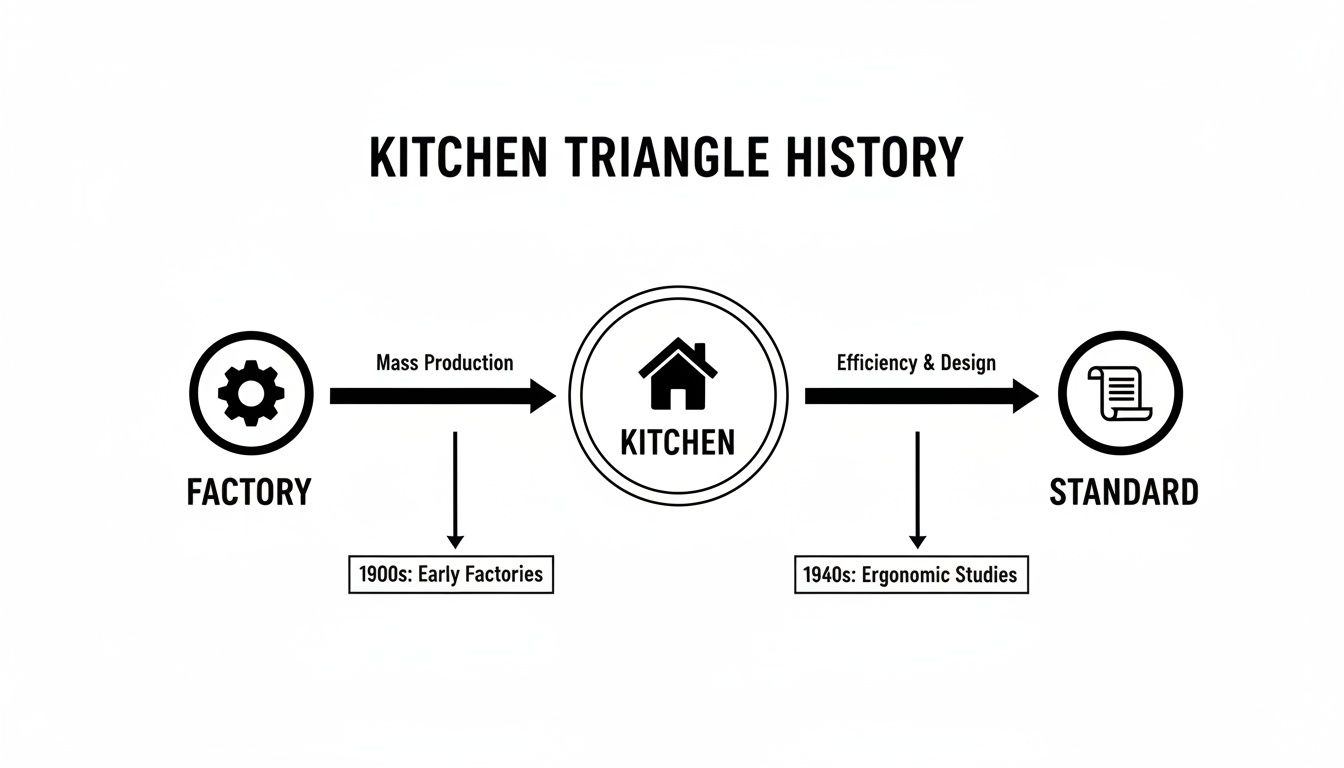
As you can see, the idea of optimizing workflow has been around for a while, eventually becoming the foundation for the comfortable, ergonomic kitchens we love today.
Essential Clearances And Landing Zones
But the triangle itself is only half the story. To get that perfect flow, you also have to think about the space around the triangle. I'm talking about work aisles and what we in the business call landing zones—the counter space right next to your key appliances.
A kitchen with perfect triangle measurements can still feel dysfunctional if you don't have adequate clearance for movement and dedicated space to place items next to your appliances.
We can thank the efficiency experts of the 1940s for dialing in these numbers. Work aisles should be at least 42 inches wide for a one-person kitchen or 48 inches for a household with multiple cooks. This simple clearance prevents traffic jams and ensures you can open cabinet doors and appliances without hitting anything. In fact, getting this right can cut down on wasted steps by as much as 50%.
Landing zones are those critical countertop spots next to your appliances. You need a place to set down groceries from the fridge or a hot pan from the stove without a hassle. The general rule is to aim for at least 15 inches of counter space on one side of the refrigerator and cooktop, and 24 inches on one side of the sink with 18 inches on the other.
To give you a quick cheat sheet, here are the key numbers to keep in mind.
Kitchen Work Triangle At-A-Glance Dimensions
This table breaks down the core measurements you'll need to plan an efficient and comfortable kitchen layout.
| Measurement | Minimum | Maximum | Ideal Range |
|---|---|---|---|
| Triangle Perimeter (Total) | 13 feet | 26 feet | 15-22 feet |
| Individual Leg Length | 4 feet | 9 feet | 5-8 feet |
| Work Aisle (1 Cook) | 42 inches | N/A | 42-48 inches |
| Work Aisle (2+ Cooks) | 48 inches | N/A | 48-54 inches |
| Sink Landing Space | 18" one side, 24" other | N/A | 18" & 24" |
| Range/Cooktop Landing | 12" one side, 15" other | N/A | 15" both sides |
| Refrigerator Landing | 15 inches | N/A | 15-18 inches |
Stick to these guidelines, and you'll be well on your way to a kitchen that is as functional as it is beautiful. For a deeper dive into all the critical numbers, check out our guide on essential kitchen design measurements.
Adapting The Triangle For Modern Kitchen Lifestyles
The classic kitchen work triangle was born in a totally different era. Think enclosed kitchens where one person did all the cooking. But today's kitchens are the heart of the home, bustling with multiple cooks, kids doing homework, and guests mingling. They’re open, multi-functional spaces that need a more flexible approach.
So, is the trusty triangle obsolete? Not at all. It’s just evolved. The core ideas of efficiency are as relevant as ever; they just need a modern twist. The key is to shift from thinking about a rigid triangle to a more dynamic concept: work zones.
From A Single Triangle To Multiple Work Zones
Instead of viewing your kitchen as one big workspace, think of it as a collection of specialized stations. The main kitchen design work triangle—linking the sink, stove, and refrigerator—is still the essential hub for the primary cook. But now, we can add other dedicated zones for specific tasks.
This zoned approach prevents traffic jams and keeps other activities from getting in the way of the main cooking flow. It makes for a more organized and intuitive kitchen, especially in those larger, open-concept layouts we love today.
Here are a few popular examples of specialized work zones:
- Baking Zone: A dedicated counter space with easy access to your mixer, bowls, and baking supplies stored right where you need them. Many bakers even opt for a lower countertop height here to make kneading dough easier.
- Coffee and Beverage Station: A spot for the coffee maker, mugs, and tea supplies that keeps the morning rush out of the main cooking area.
- Prep Zone: A secondary sink and plenty of counter space, often on an island, just for chopping vegetables and getting ingredients ready.
- Cleaning Zone: This area groups the main sink, dishwasher, and trash/recycling bins together to make cleanup after meals a breeze.
By creating these distinct zones, you keep the efficiency of the original work triangle for the main cook while making space for all the other ways we use our kitchens.
The Kitchen Island: A Bridge, Not A Barrier
In modern kitchen design, the island is often the star of the show. But a poorly placed island can be the single biggest mistake you can make, creating a frustrating obstacle that breaks the flow of the work triangle. The trick is to make the island an active part of your layout.
An island can actually improve your work triangle by housing one of its three key elements. For instance, putting your main sink or cooktop on the island can create a super-efficient, compact triangle that frees up perimeter counter space.
A well-designed kitchen island should be a central hub that connects your work zones, not a wall that divides them. It’s a tool for making the flow better, not blocking it.
While the kitchen work triangle hit its peak after WWII, its principles have been tweaked over the years. By the 1990s, the National Kitchen & Bath Association floated a "multiple rectangle" idea, but it never really caught on. Instead, the concept of zones—prep, cooking, cleaning—offered more flexibility without ditching the triangle.
Today, in 85% of kitchens surveyed by a recent NKBA Kitchen Trends Report, designers are blending the triangle with islands, which boosts prep space by 30%. What's more, 62% of luxury remodels prioritize it for resale appeal, adding 5-8% to home values, according to Realtor data. You can explore how kitchen design has evolved from a simple utility space into the centerpiece of the modern home and see these trends in action.
Applying The Triangle To Any Layout
The beauty of the work triangle is its incredible versatility. It isn't just for one type of kitchen; its principles can work in just about any common layout.
- L-Shaped Kitchens: This layout is a natural fit. You can place two points of the triangle along one wall and the third on the adjacent wall, which creates an open and efficient workspace.
- U-Shaped Kitchens: Often called the most efficient layout, the U-shape lets you put one key appliance on each of the three walls, forming a perfect, compact work triangle.
- Galley Kitchens: In this linear layout, the triangle is often flattened out. The sink and refrigerator might be on one wall with the stove directly opposite, creating a tight and effective workflow.
By focusing on the principles rather than a rigid shape, you can build an efficient kitchen no matter its size or configuration. To see how these concepts come to life, check out our guide on how the work triangle functions in various kitchen designs.
Common Work Triangle Mistakes And How To Avoid Them
Even with a solid grasp of the kitchen design work triangle, it’s surprisingly easy to get it wrong. A small miscalculation on paper can quickly become a daily frustration, turning your dream kitchen into a space that just feels… off. Knowing the common pitfalls is the first step toward creating a layout that truly works for you.
These mistakes usually happen when we prioritize looks over ergonomics or forget to think about how we actually live and cook in our space. The good news? They’re almost all preventable with a little bit of planning. Let's break down the most frequent blunders and how to steer clear of them.
Mistake 1: The Island Obstacle Course
Placing a big, beautiful island right in the middle of your work triangle is one of the most common design flaws we see. Instead of a helpful prep station, it becomes a barrier you’re constantly dodging. This single error can add dozens of extra steps to even simple tasks, like carrying veggies from the fridge to the sink.
How to Fix It: Don’t let your island block the flow—make it part of it. A great solution is to place your main sink or cooktop within the island itself. This move redefines the triangle’s path, creating a much more compact and efficient workflow. Just be sure to leave at least a 42-inch clearance around the island so you have plenty of room to move.
Mistake 2: The Cross-Kitchen Marathon
Another frequent issue is stretching the triangle’s legs too far apart. A vast, open kitchen might feel luxurious, but putting the fridge on one side of the room and the stove on the complete opposite end creates a marathon every time you cook. Any leg of the triangle longer than 9 feet is a red flag.
This layout isn't just tiring; it can be a safety hazard. Imagine carrying a heavy pot of boiling pasta across a long stretch of floor, especially with kids or pets underfoot. It’s an accident waiting to happen.
How to Fix It: Stick to the guidelines. Keep each leg of your triangle between 4 and 9 feet, and make sure the total perimeter is no more than 26 feet. If you have a large kitchen, design a tight primary work triangle and then create secondary work zones for other activities like baking or making coffee.
"A well-designed kitchen feels intuitive. If you find yourself constantly backtracking or navigating around obstacles, your work triangle is likely compromised. Efficiency should never be sacrificed for scale."
Mistake 3: Ignoring Household Traffic Flow
Your kitchen is rarely just a kitchen; it's often the main highway of your home. A critical mistake is letting a major traffic path—like the route from the garage to the living room—cut right through your work triangle. This creates a bottleneck of constant interruptions and potential collisions.
Think about trying to move a hot pan from the stove to the sink while family members are walking through your workspace. The core cooking area should feel like a protected zone, not Grand Central Station.
Here are a few ways to avoid this:
- Reroute Traffic: Try to design the layout so foot traffic flows around the edge of your work triangle, not through it.
- Use an Island as a Buffer: A strategically placed island or peninsula can act as a soft barrier, subtly guiding people away from the main cooking action.
- Cluster Your Appliances: In an open-concept space, grouping the core appliances in one corner can help separate the work zone from the main living area.
By thinking ahead and planning for these common issues, you can design a kitchen that supports your daily routine with seamless efficiency.
Designing A Kitchen That Works For You
At the end of the day, all these rules about the kitchen work triangle aren't just about measurements. They’re about creating a kitchen that feels completely intuitive—a space that supports the natural rhythm of your life. A truly great kitchen is more than just a pretty face; it’s a room where cooking is a joy instead of a chore, simply because every tool is right where you need it.
Bringing that kind of ergonomic design to life takes more than a tape measure. It demands expert planning and the kind of precision that only comes with quality craftsmanship, especially when you’re investing in a custom layout. This is where the textbook rules of design meet the reality of your home and your personal habits.
From Blueprint To Reality
Achieving that perfect balance of style and function is an art. It's all about translating your vision into a physical space that works flawlessly every single day. This means every cabinet, countertop, and appliance is placed with purpose to create an efficient workflow.
Here’s what bridging that gap actually looks like:
- Personalized Workflow: A professional designer takes the time to understand how you actually cook. Are you an avid baker who needs a dedicated station? Do multiple people cook at once? Your layout should reflect your lifestyle.
- Precision Craftsmanship: Custom cabinetry is built to the exact specs needed to optimize your space. Not an inch is wasted, and every landing zone is perfectly sized for its task.
- Seamless Integration: An expert knows how to make the work triangle operate in harmony with modern additions like islands or specialized zones, turning potential roadblocks into functional assets.
To help get your ideas flowing before you commit, you might want to explore some useful interior design apps. These tools can be a great starting point for visualizing how different layouts might feel in your own space.
The ultimate goal is a kitchen that anticipates your next move. It’s a space where the layout feels so natural that you don't even have to think about it—you can just enjoy the process of creating and connecting with family.
This level of thoughtful design is what transforms a good kitchen into a truly great one. It’s about building a space not just for your home, but for you.
At Sinclair Cabinetry, we specialize in turning these design principles into stunning, functional realities. With 35 years of expertise in crafting bespoke cabinetry, we know how to build a kitchen that perfectly implements the work triangle while catering to your unique needs. We believe your kitchen should be the most inviting and efficient room in your home. If you’re ready to design a space that’s as hardworking as it is beautiful, we’re here to help you get started.
Common Questions About The Kitchen Work Triangle
Even after you get the hang of the rules, putting the kitchen work triangle into practice in your own home can bring up some real-world questions. Here are the answers to the ones we hear most often, helping you adapt this classic design principle to your space.
Does The Kitchen Work Triangle Even Work For Small Kitchens?
Absolutely. You could even say it's more critical in smaller kitchens where every single inch has to pull its weight. The whole point is to maximize your efficiency, and that's exactly what you need to keep a compact layout from feeling cramped and chaotic.
In tiny layouts, like a galley or single-wall kitchen, the "triangle" might flatten out into more of a straight line. But the core idea is exactly the same: keep your sink, stove, and refrigerator close and in a logical order. This is where custom cabinetry really shines, letting you optimize every bit of storage and appliance placement.
What If My Kitchen Island Is Blocking The Work Triangle?
This is a classic design blunder, and it's one that can single-handedly kill the flow of an entire kitchen. An island should be a helpful hub for activity, not a roadblock you’re constantly dodging.
If your island forces you to walk around it to get from the sink to the fridge, you've created a major bottleneck. The best fix is to bring one of the key functions into the island itself.
By placing your main sink or a cooktop on the island, you completely redefine the triangle. You’ve just turned a barrier into a functional, beautiful centerpiece and restored an efficient workflow.
No matter what, always make sure you have at least 42 to 48 inches of clearance all the way around the island so people can move comfortably.
Is The Work Triangle Outdated For Open-Concept Kitchens?
Not at all—it's just evolved. While the days of the fully enclosed kitchen are mostly behind us, the ergonomic common sense of the work triangle is still the foundation for today's more flexible "work zones."
In an open-concept layout, you still want to maintain that core triangle for the main cook (sink, stove, fridge). Think of it as the command center. From there, you can add other specialized zones outside of that primary path to keep family and guests from getting underfoot. These might include:
- A beverage station with the coffee maker and a mini-fridge.
- A dedicated baking center where all your supplies are within reach.
- A separate prep sink and counter space for a second person to help out.
This approach gives you the best of both worlds: it keeps the triangle's famous efficiency while adapting to how we really live, cook, and entertain in our kitchens today.
At Sinclair Cabinetry inc, we believe a truly great kitchen starts with a design that just gets you. Our expertise is in taking powerful principles like the kitchen work triangle and translating them into beautiful, functional spaces with custom cabinetry built for your life. Ready to create a kitchen that works as beautifully as it looks? Start your design journey with us today.