
When you start thinking about redoing your kitchen cabinets, the first question is always about the cost. A typical kitchen cabinet remodel cost lands somewhere between $3,000 and $12,000, but that’s just a starting point. For high-end, custom projects, that number can climb significantly higher.
It’s a lot like buying a car. Are you looking for a reliable, no-frills model to get you from A to B? Or maybe a popular mid-range option with a few nice upgrades? Or are you dreaming of a fully loaded luxury vehicle built just for you? The materials, labor, and type of cabinet you choose will steer your total investment in the same way.
Answering Your Kitchen Cabinet Remodel Cost Question
Figuring out the financial side of your kitchen transformation is the most important first step. The total cost really boils down to three things: the type of cabinets you pick, what they’re made of, and the price of professional installation. These factors all play together, creating a huge price spectrum. It's crucial to know where your project might fit in.
Cabinets are almost always the biggest single expense in a kitchen renovation. It’s not uncommon for them to eat up 40% or more of the entire project budget. To put that in perspective, national data from sources like Homelight shows a minor kitchen remodel averages around $27,492, but the cabinets alone can run anywhere from $2,000 to a staggering $28,000 depending on what you choose.
A Quick Cost Snapshot
To give you a better feel for the numbers, let's look at the typical price ranges for a standard 10×10 kitchen. This is a common industry baseline that helps make apples-to-apples comparisons a little easier. Just remember, these are estimates. Your kitchen’s unique size, layout, and even your zip code will affect the final price. For a closer look at how everything adds up, check out our guide on the average cost of a kitchen remodel.
The most important thing to remember is that you are in the driver's seat. Once you understand the differences between cabinet tiers—stock, semi-custom, and custom—you can make smart choices that match your budget to your vision without any painful surprises.
Here's a simple table to give you a clearer picture of what to expect.
Average Kitchen Cabinet Remodel Costs at a Glance
This table breaks down the estimated costs for a standard 10×10 kitchen, giving you a baseline for what you might spend on materials and installation for each major cabinet category.
| Cabinet Type | Estimated Material Cost | Estimated Installation Cost | Total Estimated Project Cost |
|---|---|---|---|
| Stock Cabinets | $2,500 – $6,000 | $1,500 – $3,000 | $4,000 – $9,000 |
| Semi-Custom Cabinets | $4,500 – $12,000 | $2,000 – $4,000 | $6,500 – $16,000 |
| Custom Cabinets | $10,000 – $25,000+ | $2,500 – $5,000+ | $12,500 – $30,000+ |
Think of this as your starting point. Next, we’ll dive deeper into each of these cabinet types so you can feel confident in making the right decision for your home and your budget.
How Cabinet Tiers Influence Your Budget
When you start digging into cabinet options, you'll see pretty quickly that the kitchen cabinet remodel cost really comes down to the "tier" you choose. Think of it like buying a suit. You can grab one off the rack, get one tailored for a better fit, or have one made completely bespoke. Each comes with a different price tag and level of personalization.
Kitchen cabinets follow that same logic. Understanding the three main tiers—stock, semi-custom, and custom—is the secret to making your vision and your budget shake hands. Each one strikes a different balance between cost, quality, and the freedom to make it your own. Let's get into what makes each one tick.
Before we jump into the tiers, it helps to see the big picture of where your money goes. This image breaks down the typical split between materials and labor for a cabinet project.
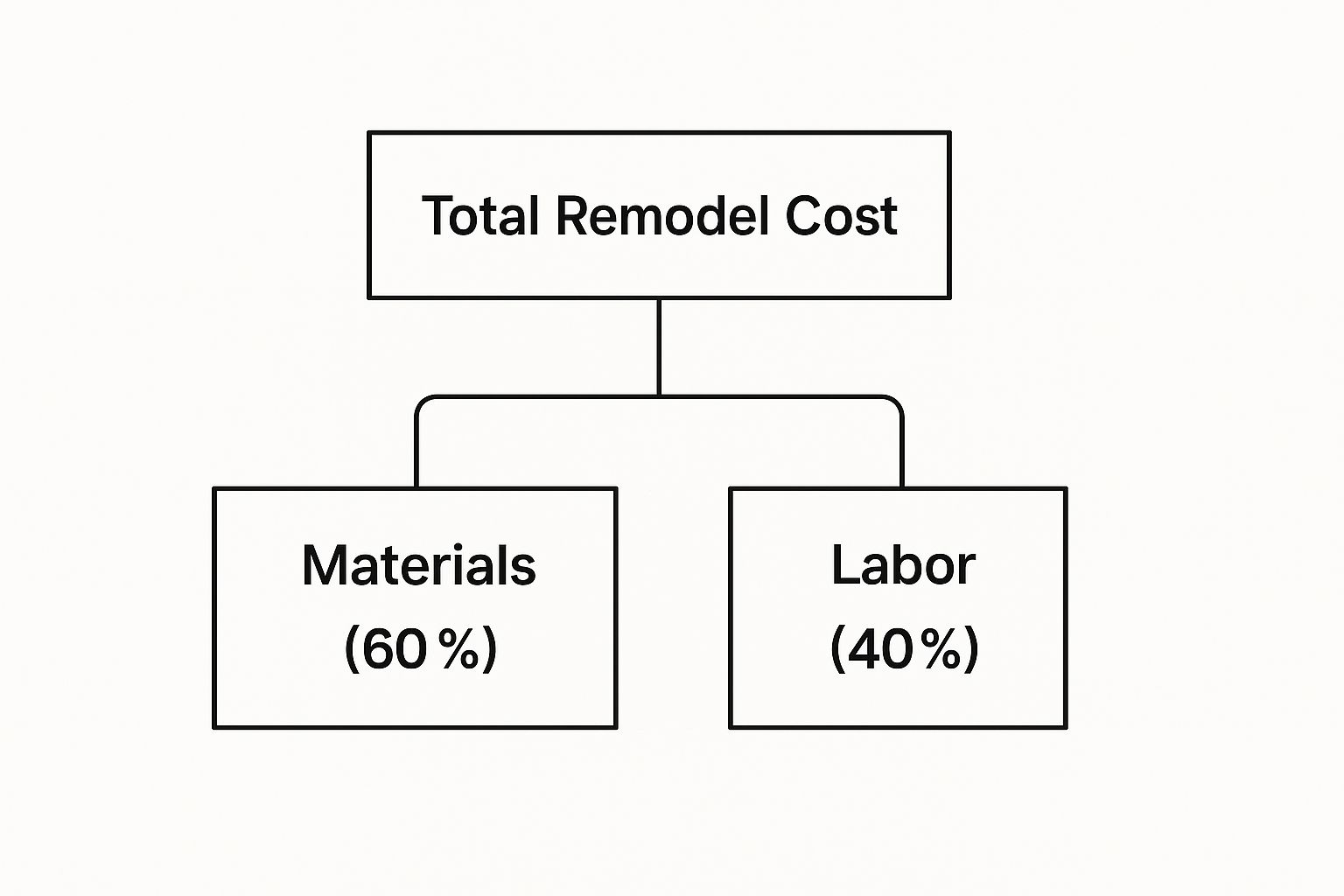
See how materials eat up the biggest slice of the pie? That’s exactly why your choice of cabinet tier is such a massive factor in the final cost.
Stock Cabinets: The Ready-to-Wear Option
Stock cabinets are your most wallet-friendly choice, just like buying a standard-sized shirt right off the shelf. They're mass-produced in the most common sizes and styles, which keeps the price down and means you can usually get them fast.
- Materials: You'll typically find particleboard or MDF boxes, often finished with laminate or thermofoil.
- Customization: It's pretty limited. You're choosing from a set menu of sizes, colors, and door styles.
- Cost: Plan on spending somewhere between $100 to $300 per linear foot.
Because they're pre-made and waiting in a warehouse, stock cabinets are a fantastic option if you're on a tight budget or a tight timeline. The trade-off, of course, is that you don't get much wiggle room on sizing or design.
Semi-Custom Cabinets: The Tailored Fit
This is where you find the happy medium between the one-size-fits-all world of stock and the complete freedom of custom. Think of semi-custom cabinets as that suit you buy off the rack but have tailored to fit you perfectly. You start with standard sizes, but you have the power to make modifications.
This tier really is the sweet spot for a lot of homeowners. It gives you a much more personalized look and a step up in quality without jumping to the premium price tag of a fully custom job.
You can often tweak dimensions, pick from a much wider catalog of finishes, and add cool organizational features.
- Materials: These often feature a mix of materials, like durable plywood boxes paired with solid wood doors.
- Customization: You get a good amount of flexibility here. You can change cabinet depths, widths, and heights, plus you get access to a way bigger library of stains, paints, and door styles.
- Cost: These typically land in the $200 to $650 per linear foot range.
Semi-custom is a brilliant way to go if you crave more design freedom and better construction but don't quite need the built-from-scratch control that comes with custom work.
Custom Cabinets: The Bespoke Experience
Welcome to the couture of the kitchen world. Custom cabinets are designed and built from the ground up to your exact specifications. Every single detail—from the precise dimensions and materials to the finish and hardware—is created just for your space. This is how you get a flawless fit, especially in kitchens with funky layouts or very specific design goals.
The desire for high-end, personalized kitchens is a huge force in the global market. In fact, the kitchen cabinet industry is massive, projected to grow from USD 79.36 billion in 2025 to nearly USD 100.76 billion by 2030. That tells you just how much people value quality and customization. You can dive deeper into these trends in the full industry report on MordorIntelligence.com.
Naturally, this level of craftsmanship and personalization comes with a premium price tag.
- Materials: You're almost always looking at high-end stuff here, like solid hardwoods and furniture-grade plywood.
- Customization: There are no limits. If you can dream it up, a skilled cabinet maker can bring it to life.
- Cost: Prices usually start at $500 per linear foot and can easily climb past $1,200.
While they are the biggest investment, custom cabinets deliver unmatched quality, durability, and the ability to create a kitchen that is truly one of a kind.
Comparing Stock, Semi-Custom, and Custom Cabinets
To make it easier to see the differences side-by-side, here's a quick breakdown of what you get with each tier. This table can help you pinpoint which option aligns best with your project goals and budget.
| Feature | Stock Cabinets | Semi-Custom Cabinets | Custom Cabinets |
|---|---|---|---|
| Cost Per Linear Foot | $100 – $300 | $200 – $650 | $500 – $1,200+ |
| Typical Materials | Particleboard, MDF, Thermofoil | Plywood Boxes, Solid Wood Doors | Solid Hardwoods, Furniture-Grade Plywood |
| Customization | Very limited; standard sizes only | Moderate; size modifications and more finish options | Unlimited; built to any specification |
| Lead Time | Short (days to a few weeks) | Medium (4-8 weeks) | Long (8-12+ weeks) |
| Best For | Budget remodels, quick turnarounds | Homeowners wanting a balance of style and value | Unique spaces, high-end designs, specific needs |
Ultimately, the right choice depends on your priorities. Are you looking for a quick and affordable update, or are you designing a forever kitchen where every detail matters? Answering that question will point you in the right direction.
Choosing Materials and Finishes That Fit Your Budget
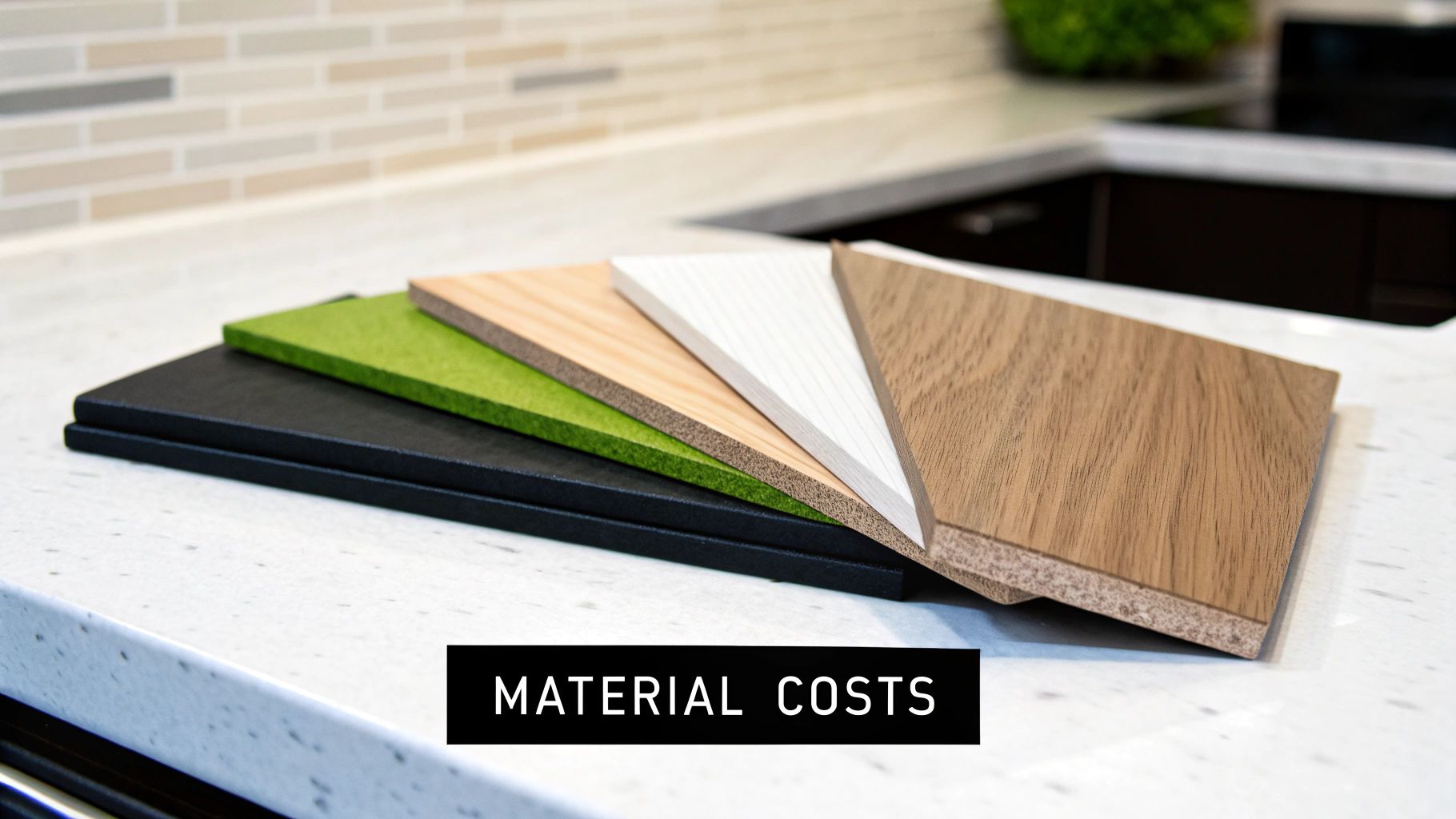
Once you’ve decided on a cabinet tier—stock, semi-custom, or custom—the next big conversation is about materials and finishes. This part of the process is a lot like picking the upholstery for a new sofa. A high-end leather will feel and cost completely different from a standard fabric, and both dramatically change the final look and price tag.
The same exact principle applies to your kitchen cabinet remodel cost. The guts of your cabinets and the coating on the outside are two of the biggest factors driving the price. From wallet-friendly engineered woods to gorgeous solid hardwoods, every option brings its own unique blend of durability, style, and cost. Getting a handle on these differences is the key to choosing something you’ll love without blowing your budget.
Budget-Friendly Cabinet Materials
If keeping costs down is your top priority, engineered woods are going to be your best friend. These materials are made by pressing and bonding wood fibers, particles, or thin veneers together with adhesive and heat. They provide a stable and affordable foundation for most stock and many semi-custom cabinets.
- Particleboard: This is the most economical choice out there. Made from compressed wood particles, it's lightweight and easy to work with. The tradeoff? It’s the least durable material and can be easily damaged by moisture.
- Medium-Density Fiberboard (MDF): A definite step up from particleboard, MDF is made from much finer wood fibers, which creates a denser, smoother panel. That super-smooth surface makes it a perfect canvas for paint, thermofoil, or laminate finishes.
While these materials are great for the initial bottom line, they just don't have the staying power or water resistance of their more expensive cousins. They work best in dry areas for homeowners whose main goal is a fresh new look for less.
Mid-Range and High-End Materials
As you move up the price ladder, you start getting into the world of plywood and solid wood. These materials are the heavy hitters, known for their incredible strength, durability, and timeless beauty. They’re the foundation of high-quality semi-custom and fully custom cabinetry.
Plywood is built from thin layers of wood veneer glued together in alternating directions, giving it fantastic structural integrity and much better moisture resistance than particleboard. It’s a workhorse material and a popular choice for building sturdy cabinet boxes.
Solid wood is the premium choice, typically used for cabinet doors, drawer fronts, and face frames. It has a classic appeal that never goes out of style and can be sanded and refinished years down the road. Common choices like oak, maple, and cherry each offer their own unique grain and character.
While solid wood is stunning and built to last, it's also more expensive and can naturally expand or contract with humidity changes. For a deeper dive into pricing, you can check out guides that break down the kitchen cabinet cost per linear foot, which can change quite a bit depending on the wood species you choose.
How Finishes Affect the Final Price
The finish isn't just about color—it's the protective shield on your cabinets. It has a huge impact on durability, how you’ll clean them, and, you guessed it, the cost.
- Laminate and Thermofoil: These are budget-friendly options applied over an MDF or particleboard core. Laminate is a tough plastic layer, while thermofoil is a vinyl film that’s heat-fused to the surface. Both create a smooth, seamless look that’s a breeze to wipe down.
- Paint: A painted finish gives you a world of color options and a clean, modern look. It’s usually applied to MDF or smooth-grained woods like maple. Just know that a high-quality, factory-applied paint job can cost more than staining and might be more likely to chip over time.
- Stain: Staining is all about bringing out the natural beauty and grain of solid wood. It’s a very durable finish and much easier to touch up than paint if you get a scratch. The price can vary based on how complex the staining process is and the type of wood.
At the end of the day, finding the right balance between your material and finish is how you stick to your budget. An MDF cabinet with a simple thermofoil finish will land on the lowest end of the price range. On the other hand, a solid cherry cabinet with a custom, multi-step stain is a premium investment that will be reflected in the final cost.
Breaking Down Labor Costs and Project Timelines
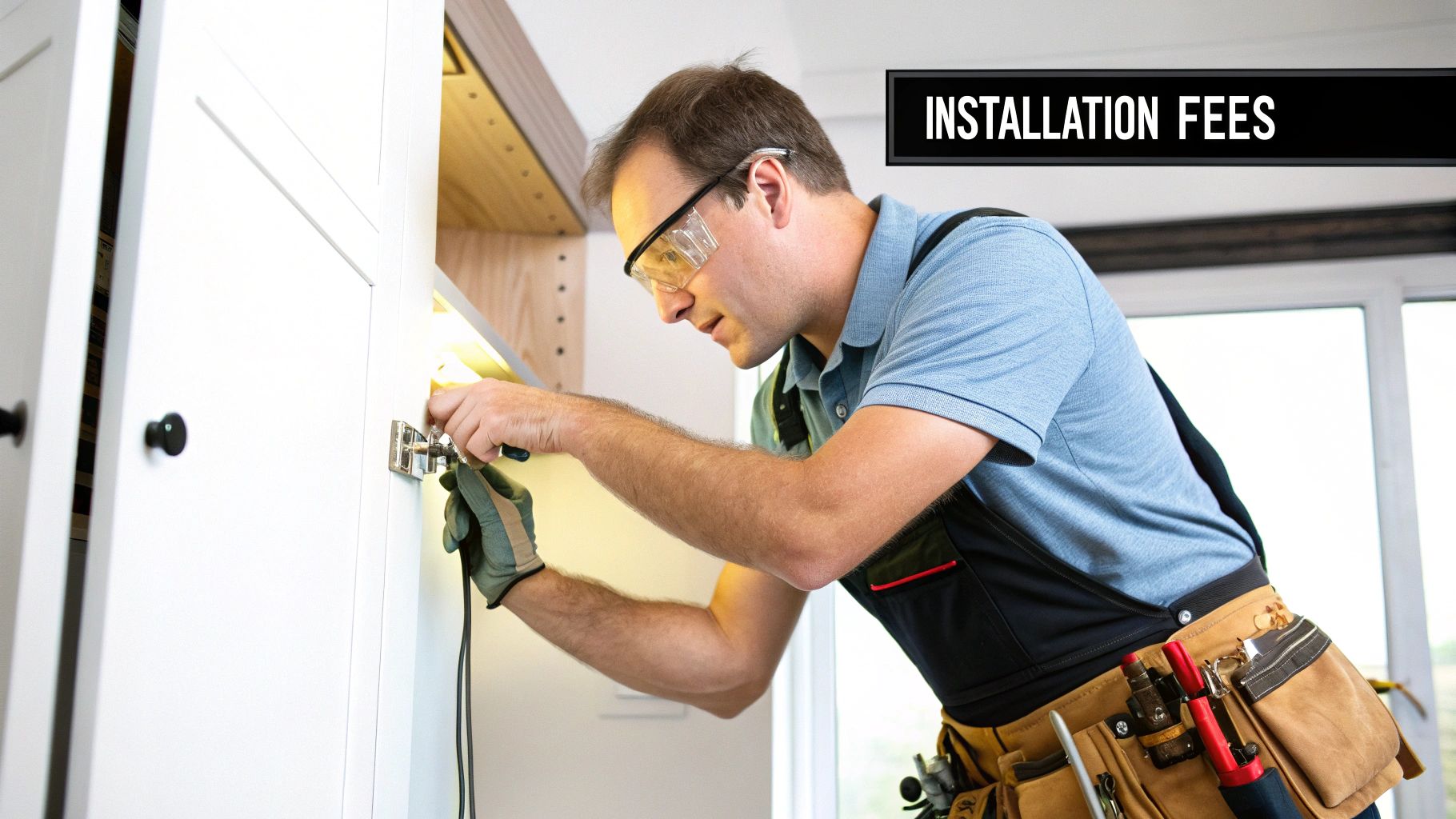
While the cabinets themselves are the star of the show, labor is the critical—and often surprising—expense that brings it all together. It’s easy to get laser-focused on the price of the materials, but don't forget that the skill and time needed for a perfect installation can easily eat up 40% or more of your total project budget.
Think of a seasoned cabinet installer like an expert craftsman. Their experience is what guarantees a flawless finish, helping navigate the inevitable hiccups like uneven walls or quirky layouts. Trying to DIY a complex installation can quickly turn into a nightmare of costly mistakes and endless frustration.
What Goes into Cabinet Installation Labor
When you hire a pro, you're paying for way more than just someone screwing boxes to the wall. That labor cost covers a detailed, multi-step process that ensures your new kitchen looks amazing and lasts for decades.
Here’s a quick look at what’s involved:
- Careful Demolition: A good crew will safely remove your old cabinets while doing their best to minimize damage to your walls, floors, and plumbing.
- Site Preparation: This is all about precision. They’ll measure and mark your layout, making sure every line is level and plumb before a single new cabinet goes in.
- Cabinet Installation: This is where the magic happens. Each cabinet box is meticulously hung, leveled, and secured to the wall and to each other, creating one solid, seamless unit.
- Finishing Touches: The final sprint includes installing doors and drawer fronts, adjusting all the hinges for perfect alignment, and attaching your new knobs and pulls.
Across the country, you can expect a professional cabinet installer to charge somewhere between $70 to $120 per hour. For a typical kitchen, that often adds up to a total labor bill of $2,000 to $4,000, though this can definitely go up depending on how complicated the job is.
Factors That Increase Labor Costs
Not all kitchens are built the same, and a few common issues can add time and skill requirements to the installation, which in turn bumps up your labor costs.
A kitchen with a complex layout—think lots of corners, a peninsula, or a big island—requires far more intricate cuts and fitting than a simple, straight-line galley kitchen. It’s also very common for older homes to have walls or floors that aren’t perfectly level. If that’s your house, your installer will need extra time to shim and adjust every single cabinet for a clean fit.
Custom and semi-custom cabinets almost always demand more on-site assembly and fine-tuning than off-the-shelf stock units. The more customized your cabinets are, the more you should budget for the skilled labor needed to get them installed just right.
And don’t forget about the other trades. Any electrical or plumbing work, like moving outlets for under-cabinet lighting or shifting pipes for a new sink, will add to the final labor bill and stretch out your timeline.
Understanding Project Timelines
Knowing what to expect timeline-wise helps you plan your life around the disruption and get your kitchen back up and running as soon as possible. With a professional team, the actual cabinet installation part of the remodel is surprisingly quick.
Here are some realistic timelines just for the cabinet installation itself:
- Stock Cabinet Installation: For a small or medium-sized kitchen using pre-assembled stock cabinets, the work can often be done in 1-2 days.
- Semi-Custom Installation: With more components and potential on-site tweaks, a semi-custom job usually takes about 2-4 days.
- Full Custom Installation: Because every piece is built to spec and requires careful fitting, a true custom job can last 3-5 days or even longer.
Keep in mind, these estimates are only for the cabinet work. You’ll need to tack on extra days for demolition, countertop templating and installation, putting in a backsplash, and the final plumbing and electrical hookups. All in all, a complete kitchen cabinet project, from tear-out to the final polish, often takes one to two weeks.
Smart Ways to Trim Your Cabinet Remodel Cost
Getting the kitchen you’ve always wanted doesn’t mean you have to empty your bank account. While ripping everything out and starting from scratch delivers a major transformation, there are several clever strategies that can seriously cut down your kitchen cabinet remodel cost. It’s all about making smart choices that work for your budget without skimping on style.
Think of it this way: you could buy a brand-new car, or you could give your current ride a facelift with new upholstery and a better sound system. For a fraction of the cost, your car feels totally new. The same idea applies in the kitchen, where a few smart moves can give you that high-end look for less.
Look Beyond a Full Replacement
Before you bring out the sledgehammer, take a hard look at your existing cabinet boxes. If the layout still works and the frames are solid, you’ve got some fantastic, budget-friendly options that can completely reinvent your kitchen.
- Cabinet Refacing: This is a great middle-of-the-road solution. You keep the cabinet boxes but get all-new doors and drawer fronts. A pro then covers the visible parts of the frames with a new veneer to match. This move alone can save you 30-50% compared to a total replacement.
- Cabinet Refinishing or Repainting: This is your most affordable option. It involves stripping the old finish, sanding everything down, and applying a fresh coat of paint or stain. It’s definitely a labor of love, but the material costs are low, making it a perfect project for a handy DIYer.
These alternatives are becoming more popular as the home renovation market booms. The global kitchen cabinet industry hit around USD 160 billion in 2023 and is expected to soar to USD 245 billion by 2032. With so many people upgrading their homes, finding ways to save is more important than ever. You can dig into these market trends on dataintelo.com.
Shop Smarter for New Cabinets
If brand-new cabinets are the only way to go, you can still find plenty of room to save. A little strategic shopping can stretch your budget further than you might think.
Check out Ready-to-Assemble (RTA) cabinets. They’re shipped flat-packed, so you or your contractor will assemble them on-site. Just by doing that, you can shave thousands off labor and shipping costs. Many RTA brands today offer impressive quality, often featuring plywood boxes and solid wood doors that rival more expensive semi-custom lines.
A mix-and-match strategy can also work wonders for your wallet. Splurge on premium, show-stopping cabinets for a focal point like your island, but use more affordable stock cabinets for the rest of the kitchen. This trick gives you a custom feel while keeping the total material cost down.
Finally, don’t forget to time your purchase. Keep an eye out for seasonal sales at big-box stores and local suppliers, especially around major holidays. Planning your project around these events can often snag you discounts of 10-20% or more—a huge savings on a big-ticket item like cabinets.
The DIY Installation Dilemma
One of the biggest places to save money is on installation. Labor can eat up a massive chunk of your budget, so doing it yourself can dramatically lower your final bill. But be warned: this is a job that requires precision, patience, and the right equipment.
Before you commit to a DIY installation, be honest about your skill set. A single poorly installed cabinet can throw off the look of the entire kitchen and might not be as secure as it should be.
Here’s a quick gut-check to help you decide:
- Do you have the right tools? You’ll need a quality level, a drill, a stud finder, clamps, and saws at a minimum.
- Are your walls and floors straight? Uneven surfaces can turn a straightforward job into a nightmare.
- Do you have the time? A pro can get this done in a few days. A DIY project could easily stretch across several weekends.
If you’re confident in your skills, go for it! It's a fantastic way to save. But if you have any doubts, this is one area where hiring a professional is a smart investment to protect the value and look of your new kitchen.
Budgeting for Hidden Costs in Your Remodel
A carefully planned budget is your single best tool against the unwelcome surprises that can pop up during a kitchen remodel. While your cabinets and the labor to install them will make up the bulk of the kitchen cabinet remodel cost, a truly successful project is one that plans for all the little "hidden" expenses that are so easy to forget in the early stages.
These are the details that can quickly pile up, turning a perfectly good budget on its head.
Think of it like buying a new car. The sticker price is the main thing, but you still have to account for taxes, title, and registration fees. For kitchens, things like new hardware or under-cabinet lighting are just as essential for a finished, functional space. By planning for them from the start, you build a financial cushion that prevents a lot of stress down the road.
Common Overlooked Expenses
It’s easy to get so focused on the big-ticket items that you forget about the supporting cast of materials and services. These smaller pieces are crucial for both the look and the daily use of your kitchen, so it’s smart to build them into your financial plan from day one.
For a really deep dive, our complete kitchen renovation cost breakdown guide covers every potential expense you might run into.
Here’s a practical checklist of common costs to think about beyond the cabinets themselves:
- New Hardware: Knobs and pulls are the jewelry for your cabinets. They can run from just a few dollars to $20 or more per piece, which adds up fast when you have 20 or 30 of them.
- Under-Cabinet Lighting: This is a must-have for good task lighting. It often requires hiring an electrician and can easily add several hundred dollars to the total project cost.
- Backsplash and Countertops: New cabinets often mean you'll need a new backsplash or countertops. If your new layout is different, you’ll definitely need to patch, replace, or install new surfaces to match.
- Plumbing and Electrical Work: Moving a sink just a few feet or adding outlets for new appliances requires licensed pros, and their time comes with its own set of fees.
One last thing people forget: debris removal. Tearing out a kitchen creates a lot of junk. Make sure to ask your contractor if hauling it all away is included in their quote, or if that’s an extra charge.
Professional Fees and Contingency Funds
Beyond the materials, you also need to account for professional fees and, most importantly, the completely unexpected. Once you pull out the old cabinets, you might find anything from hidden mold to ancient wiring or even subfloor damage. Those issues have to be fixed before you can move forward.
This is exactly why a contingency fund isn't just a nice idea—it's essential.
A good rule of thumb is to set aside an extra 10-15% of your total estimated budget. This buffer isn't for splurging on fancier countertops; it’s a safety net for dealing with those unforeseen problems without derailing the entire project. When you plan for the unexpected, you can move forward with confidence, knowing you’re prepared for whatever might be hiding behind those old cabinets.
Frequently Asked Questions
It’s completely normal to have a lot of questions when you’re diving into a cabinet remodel. Let's tackle some of the most common ones to help you move forward with your project confidently.
How Long Does a Typical Cabinet Installation Take?
For a standard kitchen, you can expect the actual cabinet installation to take between 2 to 5 days. The final timeline really hinges on the size of your kitchen and how intricate the cabinet design is.
Tearing out the old cabinets is usually the fast part—that can often be done in just a few hours. If you’re going with pre-assembled stock cabinets, the installation can be pretty quick.
On the other hand, custom or semi-custom projects need more time for precise fitting, leveling, and on-site adjustments. Keep in mind, this estimate is just for the cabinets; things like countertop installation or plumbing will add a few more days to the overall schedule.
Is It Cheaper to Reface or Replace Kitchen Cabinets?
Nine times out of ten, refacing your cabinets will be the more budget-friendly route. On average, refacing can slash your kitchen cabinet remodel cost by 30-50% compared to a full replacement with new semi-custom or custom cabinets.
Refacing is a fantastic option if you're happy with your current kitchen layout and your cabinet boxes are still in good, solid shape. The process involves swapping out the doors and drawer fronts and then applying a new veneer to all the visible exterior surfaces.
But if your cabinet boxes are starting to show their age or you’re planning a major layout change, a full replacement is a much smarter long-term investment.
What Is the Most Budget-Friendly Material for Cabinets?
When it comes to saving money, the most economical materials you'll find are particleboard and Medium-Density Fiberboard (MDF). These engineered woods are almost always finished with a layer of thermofoil or laminate to give them a clean, uniform look.
Stock cabinets are built almost exclusively from these materials to keep their prices down. While they are very affordable, it's good to know they aren't as durable and are more prone to moisture damage than plywood or solid wood.
For homeowners on a tight budget, they offer a great way to get a fresh look without the hefty price tag of solid wood, even if they don't have the same staying power.
Ready to transform your kitchen with cabinetry that blends timeless craftsmanship and modern design? Sinclair Cabinetry inc has over 35 years of experience creating stunning, real wood cabinets built to last. Explore our custom solutions and get a quote for your dream kitchen today at https://sinclaircabinets.com.