
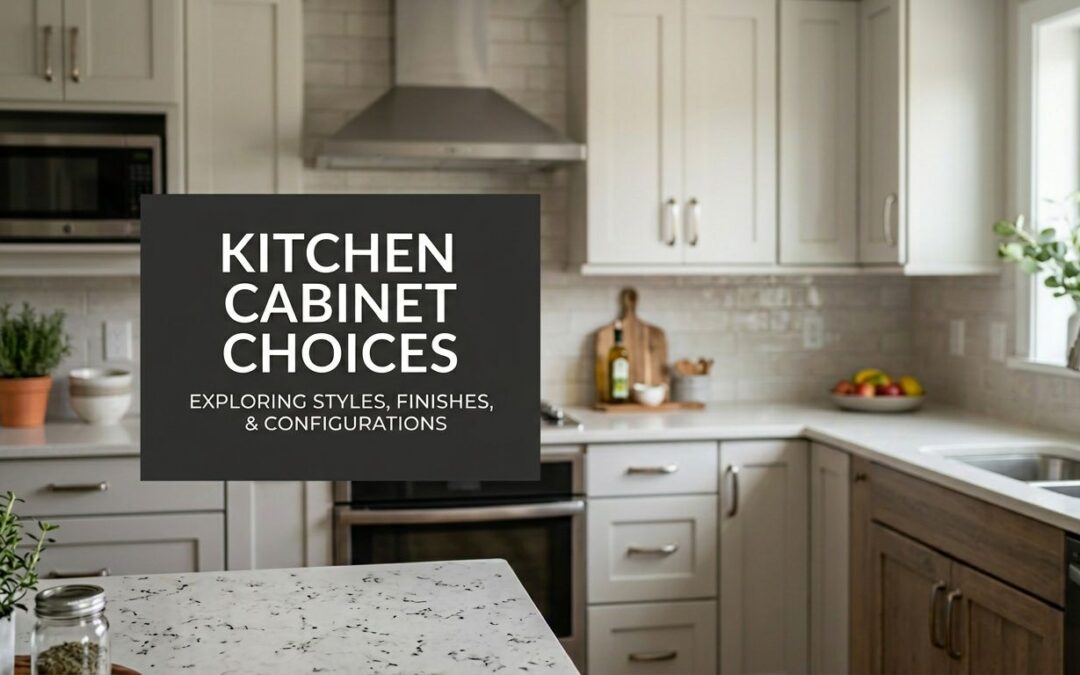
You’re probably standing in your kitchen right now doing the same math most homeowners do. You want it to look better. You want more storage. You want drawers that don’t stick, doors that stay aligned, and finishes that still look good years from now. Then the choices start piling up. Wood or MDF. Painted or stained. Stock, semi-custom, or full custom. Soft-close everything, or only where it matters.
That confusion is normal. Cabinets are the biggest visual surface in most kitchens, but they’re also one of the hardest working parts of the room. They affect traffic flow, storage, cleanup, maintenance, and how the kitchen feels every day.
Homeowners are putting more thought into that decision for a reason. The global kitchen cabinets market is projected to grow from USD 115.64 billion in 2026 to USD 218.23 billion by 2034 at a projected 8.26% CAGR, driven by renovation demand and the push for more customizable designs, according to Fortune Business Insights kitchen cabinet market data. That doesn’t just tell you the market is large. It tells you buyers are treating cabinetry as a long-term investment instead of a short-term purchase.
Your Guide to Making the Right Cabinet Choices
A common starting point is color. That’s understandable, but it’s backward.
The first kitchen cabinet choices should be about how the cabinets are built, what they’re built from, and how they’ll hold up in your home’s conditions. Style matters. Finish matters. But if the cabinet box swells, the hardware corrodes, or the drawers rack out of square, the look won’t save it.
A kitchen should work hard without asking for constant attention. That means choosing cabinets that match the way you cook, the way you clean, and the climate you live in. In Florida, that last part matters more than many homeowners realize. Humidity exposes weak construction fast. A cabinet that looks fine in a showroom can become a service call once moisture, daily use, and heavy loads start working on it.
I’ve spent decades building cabinets for real homes, not display walls. The difference shows up in the details homeowners don’t always see at first:
- Box construction: The cabinet shell carries the load every day.
- Door stability: Warping and movement usually start with material choice.
- Hardware quality: Hinges and slides take abuse long before the finish does.
- Installation accuracy: Even a good cabinet performs poorly if it’s set badly.
Practical rule: Buy your cabinets for year ten, not day one.
Good kitchen cabinet choices balance appearance with structure. The goal isn’t to chase every trend. It’s to build a kitchen that still feels solid, useful, and attractive long after the excitement of the remodel wears off.
The Four Pillars of Cabinet Design
A cabinet isn’t one decision. It’s four decisions working together. Get one wrong and the others have to compensate. Get all four right and the kitchen feels settled, intentional, and easy to live with.

Materials
Material choice affects durability more than any paint color ever will.
Real wood and plywood-based construction give you better long-term repairability, better screw holding, and a more furniture-like result. If a cabinet needs adjustment, refinishing, or a door replacement later, real wood gives a shop more workable options. It also ages with more character.
MDF has one clear advantage. It gives painted doors a very smooth face because it doesn’t have grain telegraphing through the finish the way some woods can. Used in the right place, it can be practical. Used everywhere, especially in moisture-prone parts of a kitchen, it becomes a compromise.
Particleboard is where most problems start in lower-cost cabinetry. It’s cheaper. It machines easily. But it doesn’t forgive leaks, steam, or repeated stress well.
A simple way to consider:
| Material | What it does well | Where it falls short |
|---|---|---|
| Real wood | Strong, repairable, attractive grain, long-term value | Moves naturally with humidity if not built properly |
| MDF | Smooth for paint, stable in some door applications | Heavy, vulnerable to moisture damage if exposed |
| Particleboard | Lower upfront cost | Weak screw holding, poor moisture tolerance, shorter service life |
Door styles
Door style determines the visual language of the kitchen.
Shaker remains the safest long-term choice because it works in traditional, transitional, coastal, and many modern homes. It isn’t fussy, and it doesn’t date itself quickly. That staying power is one reason it continues to dominate cabinet style conversations.
Slab doors fit cleaner, more modern spaces. They work well when you want fewer visual breaks and a flatter profile. The trade-off is that every line becomes more noticeable. Slight misalignment, inconsistent reveals, and poor installation show up faster on slab than on a framed profile.
Raised panel doors bring more depth and formality. In the right house, they look appropriate. In a smaller or darker kitchen, they can make the room feel heavier.
The right door style should fit the house first and the trend second.
Finishes
Finish does two jobs. It sets the look, and it protects the cabinet.
A painted finish gives you the broadest color control and works well when you want a crisp, precise kitchen. It also shows chips and impact marks more readily than stain, especially on busy island corners and around trash pull-outs.
A stained finish highlights the wood itself. That usually makes wear less obvious over time because the grain and tone variation already add visual texture. If you want a kitchen that hides everyday life a little better, stain is often the smarter choice.
A glaze or specialty finish can add depth, but it needs discipline. Too much treatment can make a new kitchen feel prematurely dated.
Hardware
Hardware is not decoration alone. It’s the moving part of the investment.
Knobs and pulls should match the scale of the doors and drawers. More important, the hidden hardware needs to be chosen for use, not just the brochure. Full-extension drawer slides, reliable hinges, and soft-close mechanisms matter because they’re touched constantly.
When clients ask what people most regret skipping, it’s rarely a fancier door profile. It’s usually better drawer function.
A practical checklist for this pillar:
- Visible hardware: Choose pulls that are comfortable with wet or greasy hands.
- Drawer slides: Full extension makes deep storage usable.
- Hinges: Soft-close reduces wear from repeated slamming.
- Corner accessories: Only choose complex mechanisms if you will use them.
Decoding Cabinet Construction Quality
Most cabinet problems don’t begin with the finish. They begin in the box.
A cabinet can look sharp on delivery day and still be built for a short life. Construction quality is the difference between drawers that stay square and drawers that start rubbing, doors that stay aligned and doors that drift, shelves that hold weight and shelves that sag.

What to inspect first
The fastest quality check is panel thickness.
Premium cabinets use 18mm plywood panels, roughly 3/4 inch, for sides, tops, bottoms, and shelves. That level of construction can support 35 to 75 kg per drawer when paired with the right slides, while lower-end products often use 12 to 15mm panels, which can lead to a 20 to 30% reduced lifespan in high-use environments, according to this cabinet construction breakdown.
That difference matters because kitchens don’t fail all at once. They fail a little at a time. Shelf sag. Joint movement. Hinge screws loosening. Drawer bottoms bowing under cookware.
For homeowners who want a deeper look at what separates durable cabinetry from mass-produced boxes, this overview of cabinet construction methods is worth reviewing before you buy.
Joinery tells the truth
Joinery is where the cabinet maker either earns your trust or hides shortcuts.
Dovetail drawers are a strong sign you’re looking at serious work. They mechanically lock the drawer sides together, which is why they resist pull-apart stress better than simple butt joints held with staples or glue.
Other quality markers matter just as much:
- Full back panels: Better wall attachment and less racking.
- Reinforced corners: More resistance under countertop weight.
- Properly banded edges: Better protection at exposed areas.
- Accurate boring and hinge placement: Better long-term door alignment.
If a cabinet maker can’t tell you what the box is made of, how thick it is, and how the drawers are joined, you’re buying blind.
What doesn’t hold up
Stapled particleboard boxes can survive light use. They don’t age gracefully in a busy kitchen.
The weak points are predictable. Fasteners loosen. Moisture gets into vulnerable edges. Heavy drawers loaded with dishes or cookware stress the box over and over again. Homeowners often think the hardware failed first, but the cabinet structure usually set that failure in motion.
Good construction costs more up front because there’s more material, more machining accuracy, and more labor in it. That’s also why it costs less to live with.
Maximizing Storage and Kitchen Layout
A beautiful cabinet layout can still be frustrating if the storage plan is wrong.
The best kitchens don’t just add more cabinetry. They put the right storage in the right place. Pots belong near the cooking zone. Trash should sit where prep happens. Everyday dishes should come out without opening two doors and bending into a dark box.

Use the layout to reduce effort
I’d take a smaller kitchen with smart storage over a larger kitchen with dead space any day.
Deep base cabinets often waste space because items disappear in the back. In most remodels, wide drawers work better for cookware, mixing bowls, storage containers, and even pantry goods. They bring contents to you instead of forcing you to crouch and dig.
The most useful storage upgrades are usually the least flashy:
- Full-extension drawers: Better visibility and easier access
- Vertical tray dividers: Good for sheet pans, cutting boards, and platters
- Pull-out trash and recycling: Keeps workflow cleaner
- Tall pantry pull-outs or fitted pantry cabinets: Better organization than scattered uppers
- Drawer organizers: Helps daily-use items stay controlled instead of drifting
For homeowners planning around awkward corners, narrow fillers, or limited wall space, this guide on how to maximize cabinet space shows the kind of layout thinking that prevents wasted storage.
Be careful with corner hardware in humid climates
Corner cabinets deserve more skepticism than most design galleries give them.
Lazy Susans, blind corner pull-outs, and rotating trays can be useful. But in humid regions, they also add more moving parts to the most awkward cabinet in the room. That matters in Florida. In humid U.S. regions like Florida, 68% of remodels report hardware failures within 5 years due to moisture, and using marine-grade plywood and sealed joints can reduce those failure rates by up to 40%, according to this humid-climate corner cabinet report.
That doesn’t mean you should avoid every corner accessory. It means you should choose them carefully.
A few trade-offs I discuss with clients:
| Option | Strength | Risk in humidity |
|---|---|---|
| Lazy Susan | Easy access to corner contents | More moving parts, more wear points |
| Blind corner pull-out | Better use of deep corners | Mechanism quality matters a lot |
| Diagonal corner cabinet | Simpler construction | Can reduce clean visual lines |
| Dead corner with better nearby storage | Fewer failure points | Gives up some theoretical storage |
Here’s a useful visual reference on layout and built-in function:
The best storage is often simpler
Not every problem needs a gadget.
In a humid kitchen, fewer moving parts often means fewer future repairs. A well-sized drawer stack, a smart pantry, and durable slides usually outperform a complicated corner contraption that looked clever on paper. If you cook every day, simplicity tends to win.
Understanding Cabinet Costs and Budgeting
Cabinet pricing only makes sense when you tie it to what you’re getting.
A low quote can mean fewer choices, thinner materials, weaker hardware, less detailed finishing, or less precise installation support. A higher quote may reflect better construction, custom sizing, better species selection, and labor that takes the fit seriously. Price matters. Value matters more.

The three cabinet tiers
Stock cabinets typically range from $2,000 to $10,000. Semi-custom cabinets typically range from $10,000 to $25,000. Full custom cabinets can exceed $25,000, and semi-custom holds 37.85% market share, balancing flexibility and budget, according to this cabinet cost and preference dataset.
That’s the pricing frame. The main question is what each tier asks you to compromise on.
What each budget level really buys
Stock works when the layout is straightforward and the homeowner is comfortable choosing from fixed sizes, limited finishes, and a narrower accessory menu. If the room is fairly standard and the budget is tight, stock can be a practical starting point. The downside is filler strips, awkward gaps, and less control over proportions.
Semi-custom is where many kitchens land because it softens those compromises. You get more finish options, some dimensional flexibility, and a wider range of accessories without moving all the way into a fully bespoke project. For many homeowners, that’s the balance point.
Full custom is justified when the room isn’t standard, the design goals are specific, or long-term material and construction priorities are paramount. Custom work makes sense when ceiling heights, appliance integration, storage habits, or architectural details require exact control.
A quick decision guide:
- Choose stock if your priority is lowest upfront cost and your room is simple.
- Choose semi-custom if you want flexibility without fully bespoke pricing.
- Choose full custom if fit, material quality, and design specificity matter most.
Budget for performance, not just appearance
Clients often overspend on visible upgrades and underspend on the parts they touch every day.
If the budget is limited, I’d protect these first:
- Cabinet box quality
- Drawer slide quality
- Hinge quality
- Functional storage design
- Finish and decorative upgrades
A cabinet that fits perfectly and works smoothly will feel more expensive than one with a fancier door and weaker construction.
If you want to compare options before meeting with a cabinet maker, a kitchen cabinet cost calculator can help frame the conversation around scope, not guesswork.
Sustainable Choices and Long-Term Maintenance
A sustainable cabinet isn’t just one made from natural material. It’s one that doesn’t need to be replaced early.
That’s why durability and sustainability are tied together. A well-built real wood cabinet that stays in service for decades is a better long-term choice than a disposable box that swells, chips apart, or gets ripped out long before the kitchen itself needs a redesign.

Why longevity is part of sustainability
Real wood cabinets can be repaired, adjusted, refinished, and in many cases updated rather than discarded. That matters. If a painted door gets damaged, a quality shop has a fighting chance of fixing it. If a stained wood front gets worn, it can often be renewed. Lower-grade materials usually don’t offer that same second life.
That doesn’t mean every wood cabinet is automatically responsible and every composite product is automatically wasteful. Construction quality still decides the outcome. But if your goal is to buy once and live with it for a long time, durable wood construction is hard to beat.
For homeowners who want exact sizing, real-wood species options, and custom paint or stain matching, Sinclair Cabinetry inc builds cabinetry to order rather than relying on fixed box sizes, which is one practical route for projects where long-term fit and material choice matter.
Maintenance that actually matters
Cabinet care doesn’t need to be complicated. It does need to be consistent.
The habits that protect cabinets longest are basic:
- Wipe spills early: Water around sink bases, toe kicks, and panel seams causes the most silent damage.
- Use a mild cleaner: Harsh chemicals can dull or soften finishes over time.
- Keep steam moving: Use ventilation when boiling or cooking heavily.
- Check hinges and slides: Small adjustments early prevent rubbing and misalignment later.
- Avoid hanging on doors: Even strong hinges aren’t built for body weight and repeated mechanical force.
Wood cabinets don’t ask for much. They ask for dryness, reasonable cleaning, and hardware that gets adjusted before it turns into damage.
What maintenance won’t fix
No maintenance routine can rescue poor construction forever.
If a cabinet is made from weak core material, badly edged, or assembled with shortcuts, the homeowner ends up doing more upkeep for less result. Good maintenance extends quality. It doesn’t create it. That’s why kitchen cabinet choices made at purchase matter more than any cleaning product you buy afterward.
How to Choose Your Custom Cabinet Maker
Choosing the cabinet maker is often more important than choosing the door style.
Two shops can show you similar photos and quote very different work behind the face frame. One will talk clearly about materials, joinery, finish process, installation, and service after the job. The other will stay vague and hope you compare only appearances.
Questions worth asking
A good cabinet maker should answer these without hesitation:
- What is the cabinet box made from: Ask for the exact material, not a broad phrase like “engineered wood.”
- How are drawers constructed: You want to hear specific joinery methods.
- What hardware brands or specifications do you use: Vague answers usually mean commodity hardware.
- How do you handle humidity exposure: In Florida, this is not a side question.
- Do you build to exact dimensions or work from fixed increments: This affects fit around appliances, walls, and ceilings.
- Who installs the cabinets: Build quality can be undone by careless installation.
- How are adjustments or warranty issues handled after install: Every kitchen settles a little. Good service plans for that.
You’re not interrogating the shop. You’re finding out whether they live in the details.
What a solid process looks like
The process should feel organized, not rushed.
A dependable cabinet project usually includes a sequence like this:
- Initial consultation about needs, style, storage habits, and budget
- Site measurements taken carefully and confirmed
- Design development with layout revisions and material selections
- Final approval before fabrication begins
- Shop production with clear communication on progress
- Installation by people who understand cabinet alignment and field fitting
- Final punch list for adjustment, touch-up, and client signoff
If a shop skips too quickly from rough idea to deposit request, slow the conversation down.
Signs of a maker who values the work
Some of the strongest indicators aren’t flashy.
Look for a cabinet maker who talks about reveal lines, drawer function, finish durability, moisture risk, and service access. Look for someone who asks how you use the kitchen instead of only asking what color you want. Look for a team that can explain trade-offs plainly.
A custom cabinet maker should also be comfortable telling you when a popular idea isn’t wise for your room. That honesty matters. The right answer isn’t always the one that looks best on a mood board.
Good cabinetry starts with listening. Better cabinetry follows with exact drawings, sound materials, and installation that respects the house.
Hiring with confidence
If you’re comparing custom shops, don’t focus on who promises the most. Focus on who explains the most.
Ask to see drawer construction. Ask how finish samples are approved. Ask how fillers, appliance panels, end panels, and crown details are resolved. Ask what happens if a wall is out of plumb or a floor is off level. Those are real-job questions. The right shop will have real-job answers.
If you’re beginning that search locally, reviewing experienced custom cabinet companies near me can help you build a better shortlist and compare makers on process, not just price.
If you want cabinets built with long-term durability in mind, especially for Florida conditions, Sinclair Cabinetry inc is a practical place to start. We build real wood cabinetry for kitchens, bathrooms, closets, and full-home projects, and we help homeowners make cabinet decisions based on how the finished room will be used, not just how it will photograph on install day.