
So, you're asking the big question: "how much does a small kitchen remodel cost?" The honest answer is that it's a wide spectrum, but you can generally expect most projects to fall somewhere between $15,000 and $50,000. The final number on your invoice will really come down to your material choices, the cost of labor in your area, and just how ambitious your plans are.
Your Small Kitchen Remodel Cost Explained
Diving into a kitchen renovation can feel like you're trying to navigate a maze of price tags and competing estimates. It's incredibly easy to get lost wondering what a realistic budget even looks like.
The truth is, there’s no single magic number that fits every project. Think of it less like a fixed price and more like a starting point that you get to customize with every decision you make. The final cost is a puzzle made of a few key pieces: where you live, the quality of materials you fall in love with, and the overall scope of the work.
Understanding the National Averages
To get your bearings, it’s helpful to see what other homeowners are spending. Looking at data from home improvement sources paints a pretty clear picture of the typical financial commitment. While the numbers jump around a bit, they all hover in a similar range, confirming that even a mid-range remodel is a significant investment.
For instance, industry reports show a huge cost spectrum. You could see figures as low as $10,500 for simple cosmetic updates, but that can quickly climb to over $80,000 for a high-end, down-to-the-studs gut renovation.
This big swing in price comes down to local labor costs, the grade of materials you choose, and how complex the job is. A key thing to remember is that certain fixed costs, like permits and professional labor, don't really shrink just because your kitchen is smaller. This tends to keep the cost-per-square-foot relatively high. You can find more in-depth data on what influences kitchen remodel expenses at HomeLight.com.
Key Takeaway: While a small kitchen remodel is generally more affordable than renovating a large space, your choices in finishes and fixtures will be the biggest driver of the final cost.
To help make sense of all these numbers, let's look at what some of the leading industry sources are reporting.
Average Small Kitchen Remodel Cost Estimates
This table gives you a side-by-side look at the cost ranges published by several major home improvement resources. It helps put the national averages into perspective.
| Source | Average Cost Range | Notes |
|---|---|---|
| Angi | $14,593 – $41,533 | Reflects a broad spectrum from basic updates to more involved renovations. |
| HomeGuide | $15,000 – $50,000 | Encompasses minor cosmetic changes up to mid-range remodels with new appliances. |
| Remodeling Magazine | $27,492 – $79,982 | Differentiates between minor cosmetic projects and major structural renovations. |
| Fixr | $10,500 – $30,000 | Focuses on the more budget-friendly end of small kitchen remodels. |
As you can see, the "average" can mean a lot of different things!
This article will act as your guide, breaking down each cost component so you can build a budget that aligns perfectly with your vision and your wallet.
Where Your Remodel Money Really Goes
Ever get sticker shock looking at kitchen remodel quotes? It can feel like the final number is pulled out of thin air, but there’s a method to the madness. Breaking down where the money actually goes is the first step to building a budget you can stick to.
Think of it like building a custom car. The chassis and engine are your foundational costs—labor, permits, the basics. But the final price tag really gets shaped by the options you choose: the leather seats, the high-end sound system, the custom paint job. In a kitchen, those "options" are your materials, appliances, and cabinetry.
This infographic gives you a great visual on how different kitchen layouts alone can impact the total project cost.
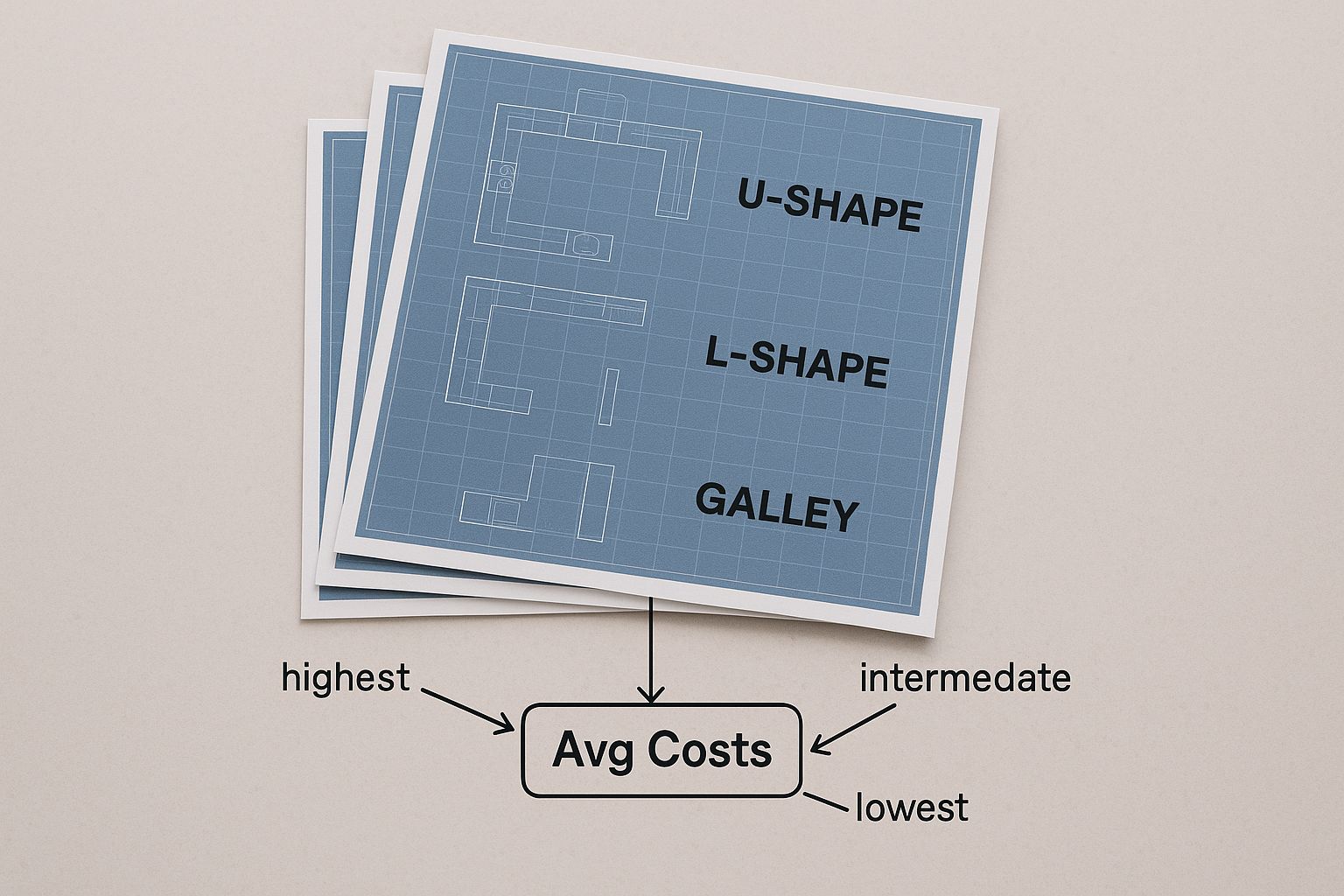
As you can see, even with the same square footage, the complexity of the layout plays a huge role in the bottom line.
The Big Five Cost Drivers
To really get a handle on your budget, you need to understand the five main areas where your money will be spent. These are the categories with the biggest potential for both splurging and saving.
1. Cabinetry: The Budget King
There's no way around it: cabinetry is almost always the single biggest line item in a kitchen remodel. It's not unusual for cabinets to eat up 25% to 35% of the entire budget. The price swing here is massive, from affordable off-the-shelf stock cabinets to fully custom, handcrafted units. Your decision to refinish, reface, or do a full rip-and-replace will have the largest impact on your total spend. For a deeper dive, our guide on the average cost of a kitchen remodel has even more detail.
2. Labor: The Unseen Expense
Labor is the second-largest piece of the pie, typically accounting for 15% to 25% of the total cost. This isn't just one person; it's a team of skilled pros—carpenters, plumbers, electricians, and painters. The more you shuffle your kitchen's layout, especially moving plumbing for a sink or gas lines for a range, the more those labor hours stack up. If you want to keep costs in check, sticking to your kitchen's original footprint is one of the most effective moves you can make.
3. Appliances: The Functional Core
Your appliances are the workhorses of the kitchen, and they generally make up about 10% to 15% of your budget. You can find solid, reliable appliance packages for a few thousand dollars. Or, you can go all-in on professional-grade, smart-enabled models that cost tens of thousands. This is a great area to hunt for deals during holiday sales, or by looking at floor models and scratch-and-dent outlets.
4. Countertops: The Visual Centerpiece
As a major focal point, countertops usually represent 8% to 12% of the remodel cost. Your material choice here will cause a huge swing in price. Laminate is the most budget-friendly route. Mid-range options like quartz and granite give you a great balance of looks and durability. At the top of the scale, you'll find materials like marble, quartzite, or custom butcher block.
A typical small kitchen remodel costs between $10,500 and $20,000, with the average landing around $15,250. With cabinets often claiming nearly a third of that, they become the most critical area for smart budget management.
5. Geographic Location: The Wild Card
Finally, where you live is a surprisingly significant factor. Labor rates and even material costs can vary dramatically from one city to the next. A remodel in a major metro area like San Francisco or New York will almost always cost more than the exact same project in a small town in the Midwest, simply due to the higher cost of living and greater demand for skilled labor.
Cosmetic Refresh Versus a Full Gut Renovation
Before you can even think about a budget, you need to get brutally honest about what you’re trying to accomplish. This is the single most important decision you'll make. Not all remodels are created equal, and the words "refresh" and "renovation" represent two vastly different paths—and price tags.
Let's break it down with an analogy. A cosmetic refresh is like giving your kitchen a great new outfit. You're swapping out accessories, maybe adding a fresh coat of paint, and changing its look on the surface. A full gut renovation, on the other hand, is like performing major surgery. You’re going deep, altering the very bones of the space.
The Budget-Friendly Cosmetic Refresh
A cosmetic refresh is all about making big visual changes without tearing down walls. It's the perfect route if your kitchen is structurally sound and functional but just feels a little dated. The name of the game here is maximum impact for minimum cost and disruption.
So, what does this look like in practice?
- Painting or Refinishing Cabinets: A fresh coat of paint can drag a kitchen out of the 1980s for a tiny fraction of the cost of new cabinets.
- Swapping Hardware: Never underestimate the power of new drawer pulls and knobs. It's an inexpensive detail that instantly modernizes the feel.
- Updating the Backsplash: A new tile backsplash is a relatively small project that injects a huge amount of personality and style.
- New Light Fixtures: Getting rid of that dated fluorescent box or track lighting can completely change the mood of the room.
- Painting the Walls: It sounds simple, but the right paint color can make a small kitchen feel brighter, bigger, and cleaner.
By focusing on these surface-level changes and maybe even tackling some of the work yourself, you can often keep the total cost under $10,000. With some savvy shopping, you might even get it done closer to $7,000.
The All-In Full Gut Renovation
Now we're talking about a completely different beast. A full gut renovation means tearing everything out—cabinets, floors, appliances, sometimes even the drywall—right down to the studs. This is what you do when you need to change the entire layout, fix underlying problems, or upgrade ancient plumbing and electrical systems.
This is where the answer to "how much does a small kitchen remodel cost" can really climb. You're not just paying for new finishes; you're paying for a fundamental transformation of the space.
A major remodel involving structural changes, moving plumbing or electrical systems, and incorporating luxury finishes can easily start at $50,000 even in a small kitchen. This scope fundamentally changes the financial investment required.
Think about it this way: moving your sink from one wall to another sounds easy enough. But that one decision means you need a plumber to reroute water and drain lines, and you probably need an electrician to move outlets. Right there, you’ve added thousands in labor costs that simply don't exist in a cosmetic refresh.
How Scope Impacts Your Bottom Line
On average, you can expect remodeling costs to hover around $150 to $160 per square foot in many areas. For a typical small kitchen of 70 square feet, that puts a starting baseline around $10,500 to $11,200.
But that's just a starting point. As you can see, a simple cosmetic project might land squarely in the $7,000 to $20,000 range. The moment you start gutting the space, that number can jump from $40,000 to well over $50,000, all depending on your material choices and how much you change the layout. For a closer look at these numbers, you can explore more details on how project scope affects remodel pricing on virginiakitchenandbath.com.
Deciding whether you need a simple facelift or a full-scale overhaul is the first and most critical step. Be honest with yourself about your goals, and you’ll be on the right track to building a budget that actually works.
Choosing Your Materials Wisely
Here’s where you have the most direct control over the final cost of your small kitchen remodel. Your material selections are the ultimate budget drivers, acting like levers you can pull to either trim expenses or go all-in on luxury.
Think of it like packing for a trip with a fixed-size suitcase—your budget. You have to decide which items are absolute must-haves and where you can get by with a lighter, more affordable alternative. Every single choice, from the countertops down to the cabinet pulls, involves a trade-off between price, durability, and style.
Making smart, informed decisions here is what separates a kitchen you love from a project that spirals out of control. It’s all about knowing where a splurge will pay off in the long run and where a savvy, budget-friendly choice makes more sense.
The Great Countertop Debate
Countertops are a huge focal point in any kitchen, so it's no surprise they're a major budget item. A big slice of your remodel budget will likely land right here. To get a handle on all the options, check out this comprehensive countertop materials comparison to see how different materials stack up.
- Budget-Friendly: Laminate countertops have come a long, long way. They offer an incredible range of colors and patterns at a price point that's tough to beat, often coming in under $40 per square foot.
- Mid-Range: This is where you'll find the workhorses of the kitchen world: quartz and granite. Both give you fantastic durability and a high-end look, typically running between $60 and $100 per square foot. Quartz is a fan favorite for being non-porous and low-maintenance, while granite brings one-of-a-kind natural beauty to the table.
- High-End: If you're looking to make a true luxury statement, materials like marble, quartzite, or even custom concrete can easily top $150 per square foot. They are absolutely stunning but often demand more maintenance to keep them looking pristine.
Cabinets: Stock, Custom, and Everything in Between
Cabinets are almost always the biggest single expense in a kitchen remodel. The choice you make here will have the most significant impact on your total cost.
Stock Cabinets: This is your most affordable route. You buy them right off the shelf from big-box stores. They come in standard sizes with a limited menu of styles and colors, but they are perfect for a straightforward, budget-first project.
Semi-Custom Cabinets: A fantastic middle ground. Semi-custom cabinets give you far more choices in style, finish, and sizing than stock options. This flexibility lets you get a more personalized look without the full price tag of custom work.
Custom Cabinets: Built from scratch to your exact specifications, custom cabinets offer limitless possibilities. You control the design, materials, and features completely. They provide the absolute best fit and the highest quality, but they also carry the highest price to reflect that detailed craftsmanship.
A great way to get a high-end look on a smaller budget is to mix and match. Many design-savvy homeowners use affordable IKEA cabinet boxes but pair them with semi-custom or custom door fronts. It's a clever hack that can save you thousands.
Material Cost Comparison for a Small Kitchen
To help you see how these decisions play out on the bottom line, let’s break down the estimated costs for the key components in a small kitchen. This table really shows how quickly the total can shift based on your material choices.
| Component | Budget-Friendly Option (Cost) | Mid-Range Option (Cost) | High-End Option (Cost) |
|---|---|---|---|
| Cabinets | Stock Cabinets ($2,500 – $5,000) | Semi-Custom ($5,000 – $12,000) | Custom ($12,000+) |
| Countertops | Laminate ($1,000 – $2,000) | Quartz/Granite ($2,500 – $5,000) | Marble/Quartzite ($5,000+) |
| Appliances | Basic Package ($2,000 – $4,000) | Energy-Efficient ($4,000 – $8,000) | Pro-Grade/Smart ($8,000+) |
| Flooring | Vinyl/Laminate ($500 – $1,500) | Engineered Hardwood ($1,500 – $3,000) | Tile/Hardwood ($3,000+) |
| Backsplash | Ceramic Tile ($400 – $800) | Glass/Subway Tile ($800 – $1,500) | Stone Slab/Mosaic ($1,500+) |
By being strategic with your materials, you can put your money where it matters most to you. Maybe you decide to splurge on those durable quartz countertops you'll be using every day but save by choosing a stylish—and highly affordable—vinyl plank floor. This kind of balance is the key to managing how much a small kitchen remodel will ultimately cost.
Proven Ways to Reduce Your Remodel Costs
Knowing what drives up the cost of a small kitchen remodel is half the battle. The other half—and the key to a project that doesn't break the bank—is knowing exactly where you can cut back without sacrificing the look and feel you're after. With a bit of smart planning, you can bring that final number way down.
Think of it less like taking a sledgehammer to your budget and more like carefully chiseling a sculpture. You’re strategically removing costs in the right places to reveal the gorgeous, functional kitchen you've been dreaming of. This takes a mix of forward-thinking, clever sourcing, and a willingness to get your hands a little dirty.
Keep Your Kitchen’s Footprint
The single biggest move you can make to control your budget is to keep the existing layout. This one decision stops a domino effect of skyrocketing costs before it even starts. Sure, moving a non-load-bearing wall is one thing, but the real budget-killers are relocating plumbing for a sink and dishwasher or moving electrical lines for your oven and outlets.
By working with your current footprint, you avoid the need for extensive—and expensive—work from specialized plumbers and electricians. This choice alone can literally save you thousands of dollars, making it the most powerful cost-saving strategy in your playbook.
Be Smart About Cabinetry
Since cabinets are the biggest line item in most kitchen remodels, they also represent the best opportunity to find major savings. Tearing everything out and starting from scratch isn't your only move.
- Refinish or Repaint: If your cabinet boxes are structurally sound, a professional-quality paint job can make them look brand new. It’s a cosmetic update with a massive visual payoff for a fraction of the cost of new units.
- Reface Your Cabinets: This is a fantastic middle ground. You keep your existing cabinet boxes but replace all the doors and drawer fronts. It gives you the look of brand-new cabinetry without the cost and mess of a full demolition.
If new cabinets are a must, you can still get creative. A popular trick is to use affordable cabinet boxes from a place like IKEA and then pair them with semi-custom doors from another company. You get a high-end, custom look on a much friendlier budget.
Become a Savvy Shopper
How you shop for materials and appliances can make or break your budget. Don't just walk into the first big-box store you see and pay sticker price for everything.
Pro Tip: Timing is everything. Try to schedule your remodel during the contractor off-season, which is usually late fall or winter. They're often less swamped and might offer more competitive bids to keep their crews busy.
Keep an eye out for deals everywhere:
- Scratch-and-Dent Appliances: Appliance outlets often sell floor models or units with tiny, barely-noticeable dings (that will probably be hidden once installed anyway) for a steep discount.
- Material Remnants: Call local countertop fabricators and ask about remnants. These are smaller leftover pieces from bigger jobs, which are perfect for a small kitchen and come at a much lower price.
- Holiday Sales: Major holidays like Black Friday, Labor Day, and Memorial Day are the best times to find incredible deals on appliance packages.
Embrace Strategic DIY
You absolutely want to leave the plumbing and electrical work to licensed professionals. But there are plenty of other tasks a handy homeowner can tackle to shave a good chunk off the labor bill.
- Demolition: Tearing out old cabinets, countertops, and flooring is mostly muscle work. It's labor-intensive, but as long as you learn how to do it safely (like turning off the water!), you can save a lot.
- Painting: A pro painter does flawless work, but if you have a steady hand and some patience, painting the walls and trim yourself can easily save you hundreds of dollars.
- Assembly: If you go with ready-to-assemble (RTA) cabinets, putting them together yourself before your installer arrives means they spend less time on the clock at your house.
By mixing and matching these strategies, you can take real control over your spending. To get a clearer picture tailored to your project, an online tool can be a huge help. You can explore different scenarios and get a personalized estimate with our kitchen remodel cost calculator, which lets you plug in your own material choices and project size.
Creating a Bulletproof Budget and Hiring a Pro
Alright, you've got the vision, you’ve picked out some materials—now it’s time for the real talk. Let's turn those exciting ideas into a solid financial plan. This is the moment where you lay the groundwork for a smooth remodel, one that doesn’t end in sleepless nights and financial headaches. A well-built budget is your single most important tool.
And the first thing you need to add to that budget? The one thing almost everyone forgets? A contingency fund.
Think of it as your project's financial shock absorber. No matter how much you plan, kitchens love to throw curveballs. You might open a wall and find some surprise plumbing from a previous owner's questionable DIY project, or a specific tile you love might suddenly go on backorder. It happens.
The secret to a stress-free renovation is setting aside an extra 15% to 20% of your total project cost. This buffer is what lets you handle those "uh-oh" moments without blowing up your entire budget or having to sacrifice that beautiful countertop you had your heart set on.
Finding the Right Contractor
With your numbers locked in, it's time to find the pro who will bring it all to life. Don't just go with the first person you find. The contractor you hire will have the biggest single impact on how well your remodel goes, so this is where you want to be picky. Your goal is to get at least three detailed, written quotes to compare.
To make sure you're comparing apples to apples, give every single contractor the exact same plans and list of materials. When you get their bids back, here’s what a professional quote should have:
- A Detailed Breakdown: It shouldn't just be one big number. A real pro will itemize the costs for labor, materials, permits, and everything in between.
- A Clear Timeline: The quote needs to include a realistic start date and a projected finish date.
- Proof of Insurance and Licensing: This is non-negotiable. Never, ever hire a contractor who can’t show you proof of liability insurance and the proper local licenses.
If you want to dive deeper into this part of the process, our guide on how to plan a kitchen remodel has even more great tips on creating a project timeline and what to expect when working with professionals.
Vetting Your Candidates
Remember, the cheapest bid is rarely the best bid. Before you sign on the dotted line, do your homework. Ask each contractor you're seriously considering for at least three recent references—and actually call them! Ask their former clients how the experience was, if the project stayed on budget, and if they’d hire them again.
As you put together your final numbers, using a comprehensive renovation checklist can be a lifesaver to make sure you haven't forgotten any potential costs. Be on the lookout for red flags like a contractor demanding a huge cash payment upfront, a bid that seems way too good to be true, or a complete lack of a professional contract. Taking these final steps to secure the right team and a solid budget is what paves the way for a beautiful kitchen remodel that you'll love from start to finish.
Got Questions About Small Kitchen Remodel Costs? We've Got Answers.
As you get closer to finalizing your plans, it's completely normal to have a few questions swirling around. Getting straight answers is the best way to move forward confidently, knowing exactly what to expect from your investment.
Does a Small Kitchen Remodel Actually Increase Home Value?
Yes, it absolutely does. In fact, a minor kitchen remodel is consistently one of the smartest home improvements you can make when it comes to return on investment (ROI). Most homeowners recoup between 60% and 80% of what they spend when it's time to sell. A fresh, modern kitchen is a massive selling point that gets buyers excited and can help your home fly off the market.
How Long Does a Small Kitchen Remodel Take?
This really comes down to the scope of your project. If you're doing a simple cosmetic refresh—think new paint and hardware—you might be looking at just 1-3 weeks.
But if you’re diving into a bigger renovation with new cabinets, countertops, and flooring, it’s best to plan for 4-8 weeks. Sometimes even longer, once you factor in things like contractor availability and material delivery lead times.
Key Insight: Your cabinets are almost always the biggest line item in a remodel, often eating up about a third of the total budget. Labor is a close second, especially if you’re moving the kitchen’s layout around.
What Is the Most Expensive Part of a Kitchen Remodel?
Without a doubt, cabinets are the biggest ticket item. They can easily account for over 30% of your entire budget.
Coming in at a close second is labor. This is especially true if you’re moving plumbing or electrical lines, which requires hiring licensed (and pricier) pros to get the job done right.
Can I Really Remodel a Small Kitchen for Under $10,000?
You sure can, but it takes some savvy planning and a smart, targeted approach. A budget like this is perfect for high-impact cosmetic updates, not a full-scale gut job. To pull it off, you’ll need to focus on:
- Painting or refinishing your existing cabinets instead of replacing them.
- Choosing budget-friendly laminate countertops.
- Installing an affordable backsplash yourself (hello, weekend DIY project!).
- Keeping your current layout and appliances exactly where they are.
This strategy is all about creating a stunning visual transformation without the high price tag of a complete overhaul.
At Sinclair Cabinetry inc, we believe a beautiful kitchen starts with exceptional cabinetry. Whether you're planning a full renovation or a simple refresh, our custom solutions can bring your vision to life. Explore our gallery and see the quality craftsmanship that sets us apart.