

When you walk into a kitchen, your eyes are almost always drawn to the cabinets first. They’re the foundation of the room's entire look and feel. But what really separates a decent set of cabinets from a truly exceptional one? It’s more than just the color or door style.
Think of it like the difference between a mass-produced t-shirt and a tailored suit. They both do the job, but one is built with an entirely different level of material quality and craftsmanship. One is designed to look good for a season; the other is made to last a lifetime.
High-quality kitchen cabinets are a serious investment, not just in your home's value, but in your daily life. It’s about the quiet, satisfying glide of a drawer closing, the solid, reassuring weight of a door, and knowing they can handle the chaos of a busy family kitchen without chipping, warping, or falling apart. Getting it right from the start saves you the headache and cost of replacing them just a few years down the road.
What Truly Makes Kitchen Cabinets Great
The real story of cabinet quality isn't just about what you see on the surface. It’s hidden in the bones of the cabinet—the materials and the construction methods. A cheap cabinet might look sharp in a showroom, but it’s often hiding flimsy particleboard boxes held together with little more than staples and wishful thinking.
In stark contrast, premium cabinets are built from the ground up with structural integrity in mind. Here’s what you should be looking for:
- Cabinet Box Construction: The undisputed gold standard here is all-plywood construction. Plywood is made from multiple thin layers of wood veneer glued together, creating a material that's incredibly strong, holds up against moisture, and won't sag over time like particleboard or MDF.
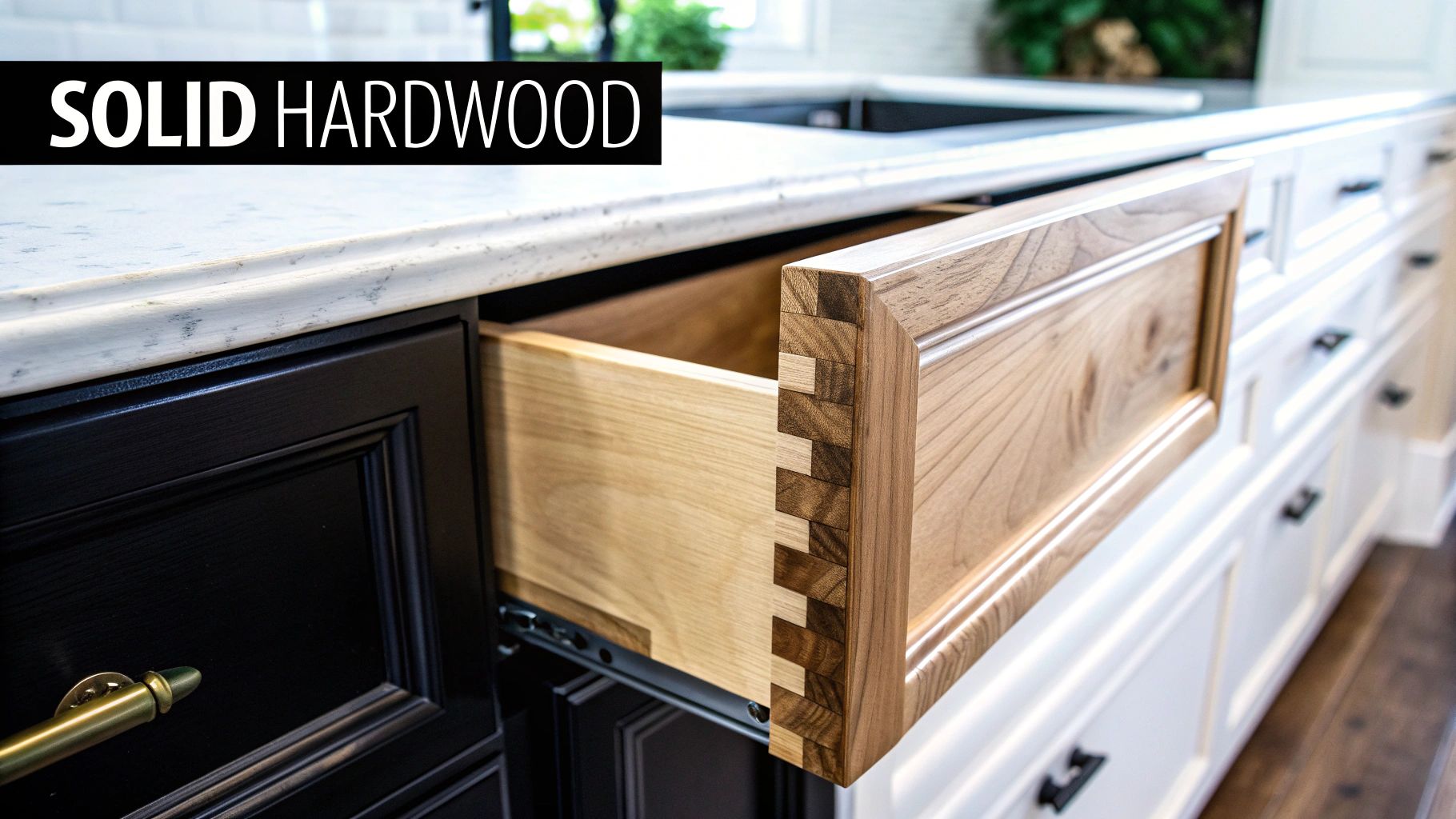
- Drawer Box Joinery: Take a peek inside the drawers. You want to see dovetail joinery. These interlocking joints are one of the strongest and oldest techniques in woodworking for a reason—they ensure your drawers can handle heavy pots and pans for years without breaking down.
- Face Frames and Doors: The best cabinets use solid hardwood for the parts you touch and see every day: the face frames, doors, and drawer fronts. Woods like maple, cherry, and oak don't just look beautiful with their authentic grain; they provide unmatched durability.
This focus on durability and quality isn't just a niche preference anymore. The global kitchen cabinets market was valued at USD 100.79 billion and is expected to climb to USD 183.53 billion by 2032. This shows a huge shift in what homeowners want—they're moving away from temporary fixes and investing in quality that lasts. You can dive deeper into these kitchen cabinet market trends to see how consumer priorities are evolving.
Quick Comparison: High-Quality vs. Standard Cabinets
To make it even clearer, let's break down the key differences between high-end cabinets and their standard or low-quality counterparts. This table gives you a cheat sheet for spotting genuine quality, from the core materials to the hardware that makes daily use a pleasure.
| Feature | High-Quality Cabinets | Standard/Low-Quality Cabinets |
|---|---|---|
| Box Material | All-Plywood Construction (APC) | Particleboard or Medium-Density Fiberboard (MDF) |
| Drawer Joinery | Dovetail Joints | Staples, Glue, or Butt Joints |
| Hardware | Soft-Close Hinges, Full-Extension Glides | Standard Hinges, Partial-Extension Glides |
| Finish | Multi-Step, Factory-Applied Finish | Thin Laminate, Thermofoil, or a Single Coat of Paint |
| Customization | Extensive Size, Style, and Finish Options | Limited Standard Sizes and Finishes |
| Warranty | Lifetime or Long-Term (25+ years) | Limited (1-5 years) |
Ultimately, the differences are stark. While high-quality cabinets require a larger upfront investment, their longevity, performance, and timeless appeal make them a far better value in the long run.
Understanding Cabinet Materials and Construction
When you’re investing in high-quality kitchen cabinets, you aren't just paying for a pretty face. You're putting your money into the hidden framework that determines whether they last for five years or fifty.
Think of it like a car's chassis. A weak frame compromises the entire vehicle's performance and safety, no matter how shiny the paint job is. The exact same principle applies to your cabinets. The core materials and construction methods are what matter most for long-term durability, defining how well your kitchen will stand up to the rigors of daily life.
The Foundation: The Cabinet Box
The cabinet box is the unsung hero of your kitchen. It's the core structure that holds up your heavy countertops, stacks of dishes, and all your pantry items. In lower-end cabinetry, this box is almost always made from particleboard, which is a composite of wood particles and sawdust bonded together with adhesive.
While it's a cheap way to build a cabinet, particleboard is a sponge when it comes to moisture—imagine a slow leak under the sink. It also tends to sag or "creep" over time under its own weight, which is why you see misaligned doors and sticking drawers in older, cheaper kitchens.
The Gold Standard: All-Plywood Construction
For truly high-quality kitchen cabinets, the benchmark for the box material is furniture-grade plywood. This isn’t the stuff you see at a construction site. It's made from multiple thin layers of wood veneer glued together with the grain direction alternating, creating a foundation that is incredibly strong, stable, and resistant to moisture.
Choosing all-plywood construction is probably the single most important decision you can make for the structural integrity of your kitchen. It’s the difference between a cabinet that bows under pressure and one that stays rigid for decades.
The Heart of Functionality: Drawer Box Construction
Drawer boxes take a beating. Day in and day out, they are opened and closed thousands of times, often loaded down with heavy pots, pans, and silverware. This is where shoddy construction becomes painfully obvious.
Budget cabinets typically have drawers held together with little more than staples, glue, and maybe a few dowels. This is a massive weak point, and these drawers are often the first thing to fail in a cheap kitchen. The sides pull apart, and eventually, the bottom falls right out.
If you want to go deeper on this topic, check out our guide on the best kitchen cabinet materials to compare your options.
Dovetail Joinery: The Mark of True Craftsmanship
In high-quality kitchen cabinets, you’ll find a time-honored technique called dovetail joinery. This method involves cutting a series of interlocking "pins" and "tails" into the wood that join the drawer sides at a 90-degree angle. It's a classic sign of quality furniture making.
- Exceptional Strength: The interlocking design creates a powerful mechanical bond that is nearly impossible to pull apart. It distributes stress across the entire joint, making it vastly superior to simple staples or glue.
- Lasting Durability: Dovetail joints are built to last for generations. They resist the constant racking and twisting forces that drawers experience from daily use.
- A Sign of Quality: Spotting dovetail joints is an immediate visual cue that the cabinet maker has prioritized strength and craftsmanship over cutting costs.
Next time you’re looking at cabinets, pull out a drawer and look closely at the corners. The presence of dovetail joints is a clear signal you’re looking at a well-built, premium product. It's a small detail that speaks volumes about the cabinet's ability to serve your family for years to come.
Choosing Your Cabinet Doors and Drawer Fronts
If the cabinet box is the skeleton, then the doors and drawer fronts are the face of your kitchen. They're the first thing anyone sees, and they set the entire tone for your home's design. But their job goes way beyond just looking good. The way a door is built is a dead giveaway of its quality and a huge factor in how it will hold up to years of daily use.
A well-made door feels solid in your hand and swings shut with a satisfying, smooth motion. A cheap one, on the other hand, will start showing its weaknesses pretty quickly. The choice you make here isn't just about style—it's about the long-term strength and performance of your entire kitchen. This is a critical piece of the puzzle when you're learning how to choose kitchen cabinets that will truly last.
Common Door Styles and Their Construction
The style of your cabinet door is more than a design decision; it's a direct reflection of how it was constructed. You'll find three main styles out there, and each one has tells that signal its quality.
- Shaker Style: Famous for its clean, five-piece design—a flat center panel inside a four-piece wood frame—the Shaker style is a timeless chameleon. In high-quality kitchen cabinets, that frame is made from solid hardwood, giving it the muscle to prevent twisting or warping over the years.
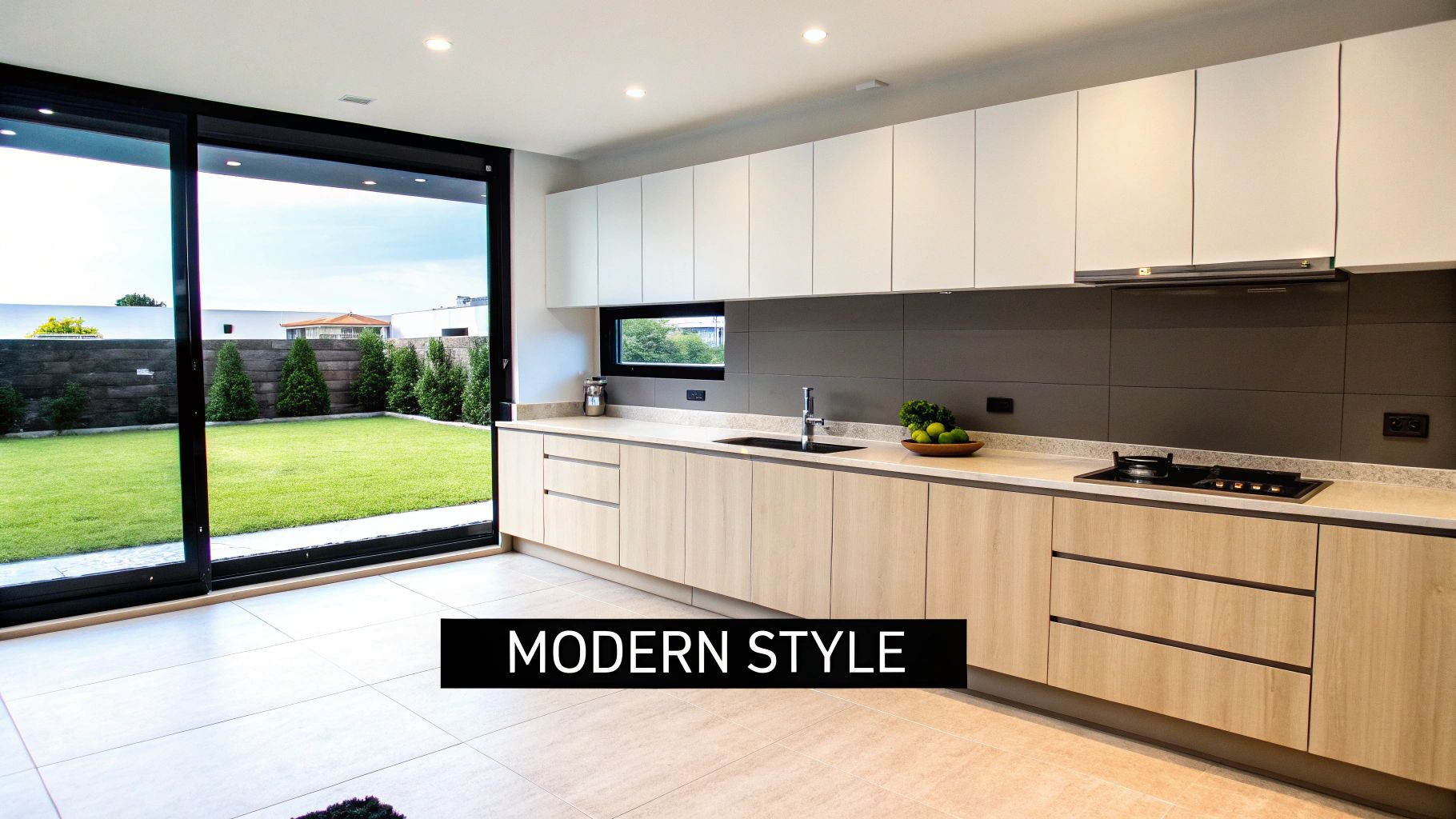
- Slab (or Flat-Panel) Style: If you're going for a minimalist, modern vibe, slab doors are your ticket. They're completely flat, and the best ones are crafted from solid wood or top-tier plywood with a genuine wood veneer. This gives you a gorgeous, consistent grain. Cheaper versions will use MDF or particleboard, which are far more likely to get damaged and just don't have the same lifespan.
- Raised-Panel Style: This is the classic, traditional look. The center panel is raised to be level with the frame, which creates elegant shadows and a formal feel. Because they're more complex to build, quality craftsmanship is everything. A poorly made raised-panel door will stick out like a sore thumb.
Solid Wood vs. Engineered Alternatives
The material of your door front is every bit as important as its style. The big debate usually comes down to solid wood versus engineered options, like Medium-Density Fiberboard (MDF) with a painted finish.
A premium cabinet door is an engineered product, designed for beauty and resilience. The difference lies in the quality of the engineering—whether it uses robust solid wood frames and stable center panels or relies on cheaper materials that compromise long-term stability.
For a stained finish that lets the wood's character shine through, solid wood doors are the undisputed champion. Nothing can replicate the natural beauty and grain variations of real wood. But wood has a natural tendency to expand and contract with humidity. To get around this, high-end cabinet makers often use a hybrid approach for painted doors: a solid wood frame with a stable, engineered center panel (like MDF or veneered plywood). This gives you the strength of a solid wood frame but stops the paint from cracking at the joints—a classic problem with all-solid-wood painted doors.
This kind of smart construction is a hallmark of truly high-end cabinetry. It shows a deep understanding of how materials actually behave in a busy, real-world kitchen. It’s what ensures your cabinet doors don't just look amazing on day one but continue to perform flawlessly for years, handling all the bumps, spills, and constant use a family can throw at them.
Why Hardware and Finishes Are So Important
If the cabinet boxes are the skeleton and the doors are the face, then you can think of the hardware and finishes as the parts that bring it all to life. These are the elements you touch and interact with every single day. They’re what separates a merely functional kitchen from one that feels truly premium and a joy to use.
It’s easy to get caught up in door styles and colors, but these unsung heroes are what you’ll notice most over time.
Think about the jarring bang of a cheap cabinet door slamming shut. Or a drawer that grinds to a halt three-quarters of the way out, forcing you to blindly fish around in the back. That’s the reality of low-grade hardware. Now, contrast that with the smooth, silent, and satisfying glide of premium hardware in action. It’s a night-and-day difference.
The Power of Premium Hardware
High-quality hardware is all about a better user experience and serious durability. It’s not just for looks; it’s about creating a kitchen that works seamlessly with you, not against you. Two features, in particular, have become non-negotiable for any high-end cabinet installation.
1. Soft-Close Hinges: These are an absolute game-changer for the sound and longevity of your cabinets. Instead of slamming, a door with a soft-close hinge catches itself in the last few inches and gently pulls itself shut. No noise, no impact. This simple mechanism dramatically reduces stress on the door, the hinges, and the cabinet frame itself, preventing wear and tear for years.
2. Full-Extension Drawer Glides: Standard drawer glides are notorious for stopping short, leaving that back quarter of the drawer a frustrating, inaccessible dead zone. Full-extension glides, on the other hand, allow the entire drawer to slide completely clear of the cabinet box. You get effortless access to every last inch. When you pair them with a soft-close feature, you get a fluid motion that can support heavy pots and pans without a single wobble or snag.
The true mark of quality hardware is that you shouldn't even notice it. It should just work—smoothly, silently, and reliably—every single time you open a door or drawer. Today, tomorrow, and for decades to come.
Why a Multi-Step Finish Is Not Just Paint
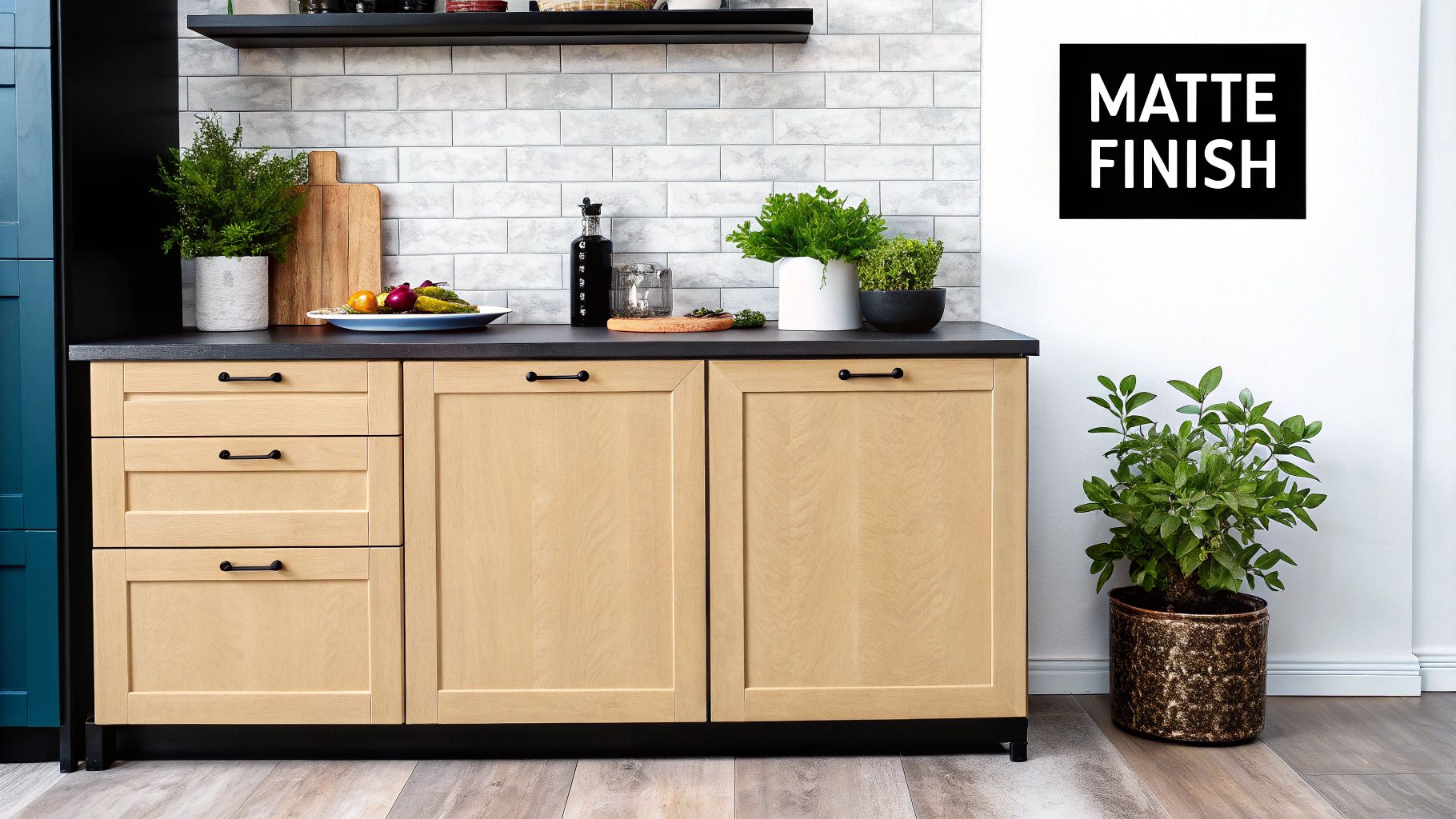
A cabinet’s finish is its shield. It’s the first line of defense against the daily onslaught of moisture, heat, grease, and cleaning products in a busy kitchen. A cheap, flimsy finish—like a thin layer of thermofoil wrap or a single coat of paint slapped on in your driveway—simply won’t hold up.
Think about the deep, almost liquid-looking paint job on a luxury car. That’s not one coat of paint. It’s a meticulous, multi-layer system engineered for both stunning looks and extreme durability. A high-quality cabinet finish follows the exact same principle. This isn't a weekend DIY job; it's a controlled, industrial process with several critical stages:
- Sanding: The raw wood is sanded to a perfectly smooth and uniform surface, creating an ideal canvas for stains and sealers.
- Staining or Priming: A base color is applied, penetrating deep into the wood grain for a rich, consistent look.
- Sealing: A protective sealant locks in the color and creates a crucial moisture-resistant barrier.
- Top-Coating: This is where the magic happens. Multiple layers of a catalyzed conversion varnish—an incredibly tough, chemical-resistant top coat—are applied. This creates a hard, non-porous shield that protects the wood from everything life throws at it.
This painstaking process results in a finish that isn't just beautiful, but tough as nails, resisting chips, fading, and water damage for years. It’s this demand for lasting quality that’s driving the global kitchen cabinet market, which was valued at around USD 160 billion and is projected to hit nearly USD 245 billion by 2032. Homeowners are clearly voting with their wallets for products built to last. You can dive deeper into the data on global kitchen cabinet market growth to see how consumer preferences are shifting toward durability.
Choosing Between Custom, Semi-Custom, and Stock Cabinets
When you start shopping for high-quality kitchen cabinets, you'll quickly discover there are three main tiers: stock, semi-custom, and custom. Think of it like buying a suit. Stock is your off-the-rack option, semi-custom is like getting a standard suit tailored to fit you better, and custom is a completely bespoke creation, made from scratch just for you.
Understanding the real-world differences between them is the key to matching your cabinets to your kitchen's layout, your design vision, and, of course, your budget. Each approach offers a different balance of cost, flexibility, and quality.
Stock Cabinets: The Readymade Solution
Stock cabinets are the most affordable and fastest way to get new cabinetry. They're mass-produced in standard sizes—usually in 3-inch increments like 12", 15", or 18" wide—and come in a limited menu of styles and finishes.
This makes them a solid choice for simple, straightforward kitchen layouts or for projects with a tight budget and a short timeline. The big drawback, however, is their lack of flexibility. If your kitchen has odd angles or non-standard dimensions, you'll almost always end up with awkward gaps that need to be hidden with bulky filler strips, which can interrupt the seamless, built-in look you're going for.
Semi-Custom Cabinets: The Flexible Middle Ground
Semi-custom cabinets strike a fantastic balance between affordability and personalization. They start with a base of standard sizes and styles, but then open the door to a whole range of modifications.
This might mean you can alter the width, depth, or height of a cabinet to better fit your space. You'll also get access to a much wider variety of door styles and a bigger palette of paint and stain finishes. For homeowners whose kitchens have a pesky support column or a strangely angled wall, semi-custom gives you the tools to get a much more fitted, high-end look without jumping all the way to the cost of full custom work.
Choosing the right cabinet type is like solving a puzzle. The goal is to find the option that best fits the unique shape and demands of your space, rather than forcing a one-size-fits-all solution into a room it was never designed for.
Custom Cabinets: The Bespoke Experience
Full custom cabinets are the absolute peak of the craft, giving you total freedom over the design, materials, and dimensions. With custom, there are no "standard" sizes or styles. Every single cabinet is built from the ground up to your exact specifications, designed to fit every last nook and cranny of your kitchen perfectly.
This is the ultimate way to achieve a truly integrated and seamless look, especially in older homes with quirky dimensions or for anyone with a very specific design vision in mind. The level of craftsmanship and the quality of materials are typically the best you can find. For those who want unparalleled design freedom, exploring the world of custom cabinets can open up possibilities you never even knew existed.
This decision tree can help you see where your project falls and whether a DIY or professional installation makes the most sense for your budget and skill set.
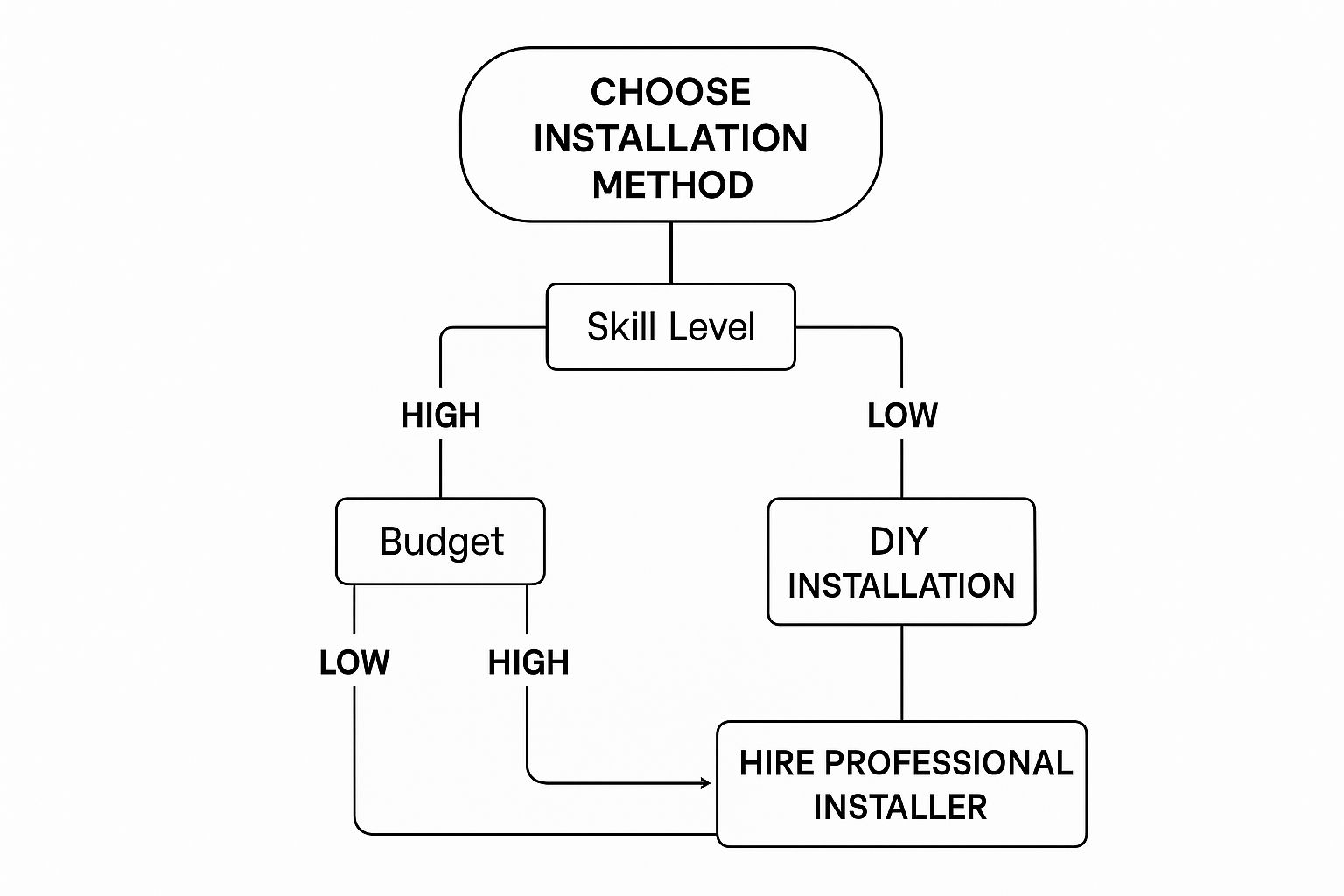
As the infographic shows, projects with a higher budget and those requiring a high level of skill almost always benefit from a professional installer to ensure a flawless finish for your investment.
To help you see the differences at a glance, here’s a straightforward comparison of the three tiers.
Cabinetry Tiers Comparison: Stock vs. Semi-Custom vs. Custom
| Attribute | Stock Cabinets | Semi-Custom Cabinets | Custom Cabinets |
|---|---|---|---|
| Customization | Very limited; standard sizes and finishes only. | Moderate; size, finish, and style modifications available. | Unlimited; built from scratch to any specification. |
| Lead Time | Shortest (days to a few weeks). | Moderate (typically 4-8 weeks). | Longest (can be 8-16+ weeks). |
| Cost | Most affordable option. | Mid-range price point. | Highest initial investment. |
| Best For | Standard layouts, tight budgets, and quick turnarounds. | Unique layouts and a desire for personalization without the full custom price tag. | Irregular spaces, historic homes, and achieving a specific, uncompromising design vision. |
Ultimately, the best choice really depends on what you value most—speed and cost, a balance of options, or complete creative control.
Making a Smart Investment in Your Kitchen
When it's time for new kitchen cabinets, it’s easy to get caught up in the style and color. But choosing your cabinets is much more than a design decision—it's a major investment in your home's future and your own daily happiness.
Think of it this way: high-quality kitchen cabinets aren't just an expense; they're an asset. Cheaper cabinets might seem like a win today, but they can lead to a world of frustration down the road with repairs, replacements, and even a hit to your home's value. In contrast, well-built cabinets are the backbone of a great kitchen, designed to look fantastic and handle real-life use for decades.
This isn't just a niche opinion; it’s a shift happening across the entire industry. The North American kitchen cabinet market, currently valued around USD 79.36 billion, is expected to soar past USD 100 billion by 2030. This growth is all thanks to homeowners like you who are catching on to the real value of quality materials and thoughtful construction.
Your Final Decision Checklist
To make sure you're getting cabinets that will last, you have to know what to look for and what to ask. Take this checklist with you to the showroom or on your call with a designer. It’ll help you see past the sales pitch and zero in on what truly matters.
- Box Construction: Start with the core. Ask, "Are the cabinet boxes made from all-plywood, or is it particleboard?" Plywood is the clear winner for strength and holding up against moisture.
- Drawer Joinery: Pull a drawer all the way out and look at the corners. You want to see dovetail joinery. Insist on it. It’s the gold standard for strength and a sign of true craftsmanship.
- Hardware: Open and close doors and drawers. Feel the action. Ask, "Are these soft-close hinges and full-extension, soft-close drawer glides?" This is a non-negotiable for a premium kitchen.
- Finish Durability: The finish is the cabinet's first line of defense. Ask about their process. "Is this a multi-step, catalyzed conversion varnish finish?" That's the stuff that creates a tough, factory-grade shield against daily wear and tear.
- Warranty: Don't be shy about this one. Ask, "What kind of warranty does this come with?" A lifetime limited warranty tells you everything you need to know about the manufacturer's confidence in their product.
Remember, the goal is to get the absolute best value, not just the lowest price. A higher upfront cost for superior materials and craftsmanship is an investment that protects you from the frustration and expense of premature replacement.
Of course, your cabinets are just one piece of the puzzle. Planning a truly functional kitchen means thinking about everything, including choosing kitchen appliances for your remodel to create a cohesive space. By focusing on these core signs of quality, you can build a kitchen that you'll be proud of for years and years.
A Few Lingering Questions About Kitchen Cabinets
Even after digging into all the details, it’s completely normal to have a few questions still floating around. An investment in high-quality kitchen cabinets is a big deal, and it’s smart to get all the information you can before you pull the trigger.
We’ve put together some straightforward answers to the questions we hear most often from homeowners. Think of this as the final piece of the puzzle, giving you the confidence to move forward and create the kitchen you’ve always dreamed of.
What Kind of Warranty Should I Look For?
A manufacturer's warranty is much more than a piece of paper—it's a direct reflection of their confidence in the product they build. For any high-quality kitchen cabinet, you should settle for nothing less than a Lifetime Limited Warranty. This is the industry standard for excellence, typically covering any defects in materials or craftsmanship for as long as you own your home.
This kind of warranty tells you the company invested in durable materials and solid construction methods designed to last for decades. A short-term warranty of only 1-5 years is a major red flag. It practically screams that the manufacturer expects their product to fail. Always read the fine print, of course, but a strong warranty is one of the clearest signs of a quality cabinet.
Is It Better to Reface or Replace My Cabinets?
This is a classic crossroads for homeowners looking to update their kitchen. Refacing means you keep your existing cabinet boxes but get new doors, drawer fronts, and hardware. Sometimes, a new veneer is applied to the visible parts of the cabinet frames to match. It can be a decent option if your cabinet boxes are structurally solid and you’re perfectly happy with your current kitchen layout.
But here’s the catch: refacing is often just a cosmetic fix. If your cabinet boxes are made from flimsy particleboard that’s already starting to sag, or if there’s any sign of water damage, you’re essentially just putting a pretty new face on a failing foundation.
Replacing your cabinets, on the other hand, lets you upgrade the entire structure to all-plywood construction. It also gives you the freedom to improve the layout and ensures every single component—from the box itself to the drawer glides—is brand new and built to last. For a true long-term investment, replacement is almost always the better choice.
Cabinet refacing might give you a temporary cosmetic upgrade, but replacing them addresses the foundational quality, ensuring your investment pays off in both functionality and durability for years to come.
How Much Do High Quality Cabinets Impact Resale Value?
Putting your money into a major kitchen remodel with high-quality cabinets consistently delivers one of the best returns on investment of any home improvement project. A thoughtfully designed kitchen with beautiful, durable cabinetry is a huge selling point for potential buyers. It tells them the home has been cared for and saves them the massive expense and headache of a future renovation.
While a cheap, builder-grade kitchen might not be a deal-breaker for everyone, a premium kitchen can genuinely make your home stand out, often leading to a quicker sale and a higher offer. Buyers can see and feel quality. The solid heft of the doors, the smooth, quiet glide of the drawers, and the flawless finish are all tangible details that create a powerful impression of the home’s overall value.
Ready to transform your home with cabinetry that blends timeless craftsmanship with lasting quality? The experts at Sinclair Cabinetry inc have over 35 years of experience creating bespoke kitchen, bathroom, and closet solutions. Explore our custom cabinet options and start your design journey today!