

Custom laundry room cabinets are more than just storage; they’re a complete system designed to fit your space and your life perfectly. They take a room that’s often chaotic and purely functional and turn it into an efficient, beautiful part of your home. Think of it as solving all those little annoyances, like countertop clutter and awkward workflows, for good. It's an investment that adds real value while making your daily chores a whole lot easier.
Why Custom Cabinets Are a Game Changer for Your Laundry Room
Let’s be honest, the laundry room is often the most overlooked space in a home. It quickly becomes a dumping ground for cleaning supplies, stray socks, and bulky items, creating a disorganized and stressful environment. While off-the-shelf stock cabinets offer a quick fix, they rarely solve the unique challenges of your specific layout or storage needs.
This is where custom laundry room cabinets make all the difference.
When you opt for a bespoke solution, every inch of your space is put to work. You're not just buying boxes to hang on a wall; you're creating a thoughtfully designed system that truly works for you and your family.
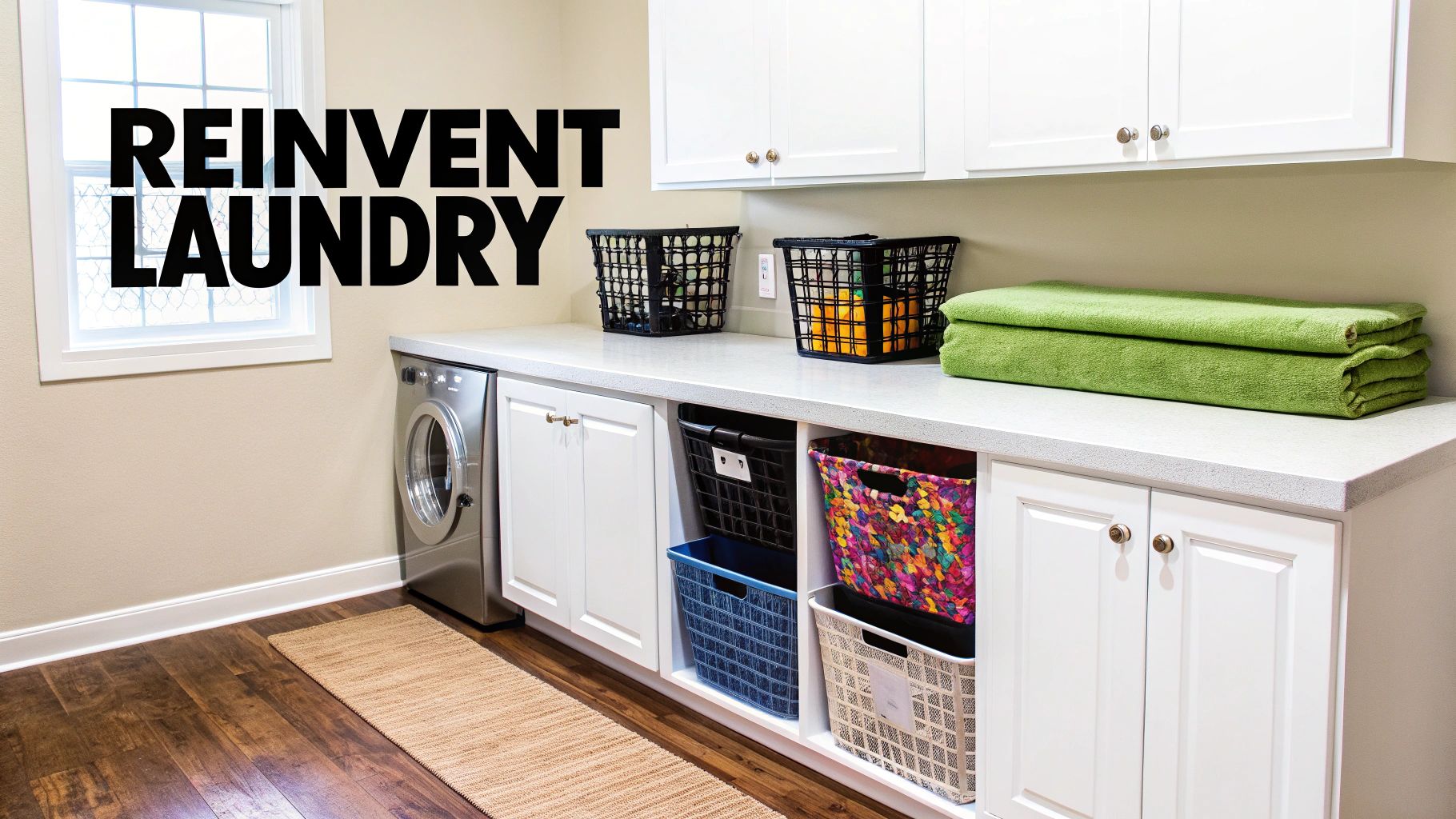
Beyond Basic Storage
Imagine a laundry room where everything has its own designated place. Customization allows you to build in features that standard options just can't offer. These purpose-built additions solve real-world problems and make chores feel less like, well, a chore.
Some of the most popular custom features we see homeowners request include:
- Integrated Hampers: Pull-out hampers are fantastic for keeping dirty clothes sorted and completely out of sight, maintaining a clean, streamlined look.
- Tall Pantry-Style Cabinets: This is the perfect spot for storing awkward items like an ironing board, mop, or vacuum vertically, freeing up precious floor space.
- Pull-Out Drying Racks: These clever racks give you plenty of space for air-drying delicates and can be tucked away neatly when you're done.
- Custom Shelving for Supplies: We can design specific compartments for detergents, softeners, and stain removers to ensure everything is right where you need it, when you need it.
This level of detailed planning is exactly why so many homeowners are now investing in their utility spaces. In fact, the broader laundry cabinet market is projected to reach USD 1184.4 million by 2031, a huge jump from USD 644.4 million in 2023. This growth highlights a clear trend toward creating highly functional, organized homes.
The real value of custom cabinetry lies in its ability to transform a chaotic chore zone into a streamlined, functional space that genuinely simplifies your life. It's an investment in both your home's value and your daily peace of mind.
To help you see the difference at a glance, here’s a quick comparison of custom versus stock options.
Custom vs Stock Cabinets Quick Comparison
| Feature | Custom Cabinets | Stock Cabinets |
|---|---|---|
| Fit & Sizing | Built to the exact dimensions of your room, maximizing every inch. | Comes in standard, fixed sizes, often leaving awkward gaps. |
| Material Quality | You choose from high-quality materials like solid wood or premium plywood. | Typically made from lower-cost materials like MDF or particleboard. |
| Design & Style | Unlimited options for style, color, finish, and hardware to match your home. | Limited selection of pre-determined styles and finishes. |
| Functionality | Can include built-in features like hampers, drying racks, and specialized storage. | Basic shelving and storage with no specialized features. |
| Durability | Built to last with superior craftsmanship and joinery techniques. | Shorter lifespan; more susceptible to wear, tear, and moisture damage. |
| Cost | Higher initial investment due to personalized labor and premium materials. | Lower upfront cost, making it a budget-friendly option for a quick fix. |
Ultimately, while stock cabinets can be a good temporary solution, custom cabinets offer a permanent upgrade in both function and form.
By choosing a custom approach, you control everything—the materials, the finishes, and the layout. This ensures the final product not only meets your functional needs but also perfectly complements your home’s overall aesthetic. To see the full range of possibilities, you can explore how custom-built cabinetry can be applied throughout your home.
This guide will walk you through turning your laundry room vision into a beautiful, hardworking reality.
Planning Your Ideal Laundry Room Layout
A truly functional laundry room starts with a smart plan, not just pretty cabinets. Before you even begin daydreaming about door styles or paint colors, the most important step is mapping out a layout that works with your life, not against it. This blueprinting phase is what ensures your investment in custom laundry room cabinets pays off in daily convenience and efficiency.
Think of this stage as a detailed audit of your space and your routine. It's about understanding every limitation and every opportunity your room offers before a single piece of wood gets cut.
Measure and Map Your Existing Space
First things first, let's get the fundamentals down with some precise measurements. Don't just grab the length and width of the room. You need to document every single thing that could throw a wrench in your cabinet design.
- Wall Dimensions: Get the height, width, and length of every wall. No guessing!
- Utility Locations: Mark the exact spot and size of your plumbing hookups (hot and cold water, plus the drainpipe), all electrical outlets (especially the 240v dryer outlet), and where the dryer vent exits. These points are usually set in stone, and your layout has to be built around them.
- Obstructions: Note where windows and doors are, and—critically—which way the doors swing. Don't forget light switches, thermostats, or any other fixed elements on the walls.
This detailed map is your foundation. I've seen entire cabinet plans get derailed simply because someone forgot to account for a door's swing. A little extra diligence here saves a lot of headaches (and money) later.
Envision Your Daily Laundry Workflow
With your technical map in hand, it's time to think about how you actually do laundry. A great laundry room layout should follow a logical path, cutting down on extra steps and creating a workspace that just makes sense. Walk yourself through a load of laundry from start to finish.
- Sorting: Where do the dirty clothes pile up? A popular solution is a built-in hamper system with multiple pull-out bins, perfect for pre-sorting whites, darks, and delicates right from the get-go.
- Washing & Drying: Your appliances are the main event. Do you prefer them side-by-side? This setup gives you a fantastic long countertop for folding. Or would a stacked washer and dryer work better, freeing up floor space for a tall storage cabinet or maybe a utility sink?
- Folding & Hanging: A clear, dedicated countertop is non-negotiable for folding. You'll want a surface at least 24-30 inches deep to give you enough room to work. A hanging rod installed between upper cabinets is another great touch for items that need to air dry or get put on hangers immediately.
Your layout should be a direct reflection of your routine. If you spend far more time folding than you do ironing, prioritize a big, comfortable countertop over specialized storage for an ironing board. The goal is to smooth out the friction points in your daily chores.
It's no surprise that thoughtfully designed spaces like these are in high demand. People are realizing that an organized home seriously improves their quality of life. In fact, the market for Household Laundry Care Cabinets is on track to hit around $240.89 million by 2025, with an expected annual growth rate of 8.82% through 2033. This isn't just a fad; it's a shift toward multifunctional, space-savvy solutions for modern homes.
Create a Needs-Based Inventory Checklist
Finally, make a list of everything you need to store. And I mean everything—not just the detergent. Thinking through every last item is what ensures your custom cabinets will have a designated home for it all, keeping your space beautifully clutter-free.
Here are a few categories to get you started:
- Cleaning Supplies: Detergent pods, liquid softener, stain removers, dryer sheets, cleaning sprays.
- Tall Items: Ironing board, mop, broom, or that stick vacuum that's always in the way.
- Bulky Items: Laundry baskets, extra bedding, bulk paper towels, even pet supplies.
- Miscellaneous: A sewing kit, lint rollers, clothes pins, a small step stool to reach the high shelves.
This inventory will directly shape your cabinet design. For instance, realizing you need a spot for a tall vacuum might lead you to include a pantry-style cabinet right next to your stacked washer and dryer. Identifying a need for better sorting will point you toward cabinets with integrated hampers. For a much deeper dive into creating a truly functional space, this guide on How To Design Your Laundry Room A Friendly Guide To A Functional Stylish Space is a fantastic resource.
By working through these stages—measuring the room, mapping your workflow, and inventorying your stuff—you create the ultimate blueprint. This detailed plan is the key to designing custom laundry room cabinets that aren't just stunning but are perfectly tailored to your home and your life.
Choosing Cabinet Materials That Endure
A laundry room is a tough place for cabinetry. It’s not like a kitchen or a bathroom; it’s a constant battleground of high humidity, wild temperature swings, and the occasional splash of bleach or detergent. This means choosing the right materials for your custom laundry room cabinets isn’t just about looks—it’s a critical investment in making sure they last.
The materials you pick for the cabinet boxes and doors will ultimately decide how well they stand up to warping, swelling, and all the bumps and scrapes of daily life. Let's break down the most common options to see how they perform in such a demanding space.
The Core of Your Cabinets Material Matters
The hidden structure of your cabinets, what we in the business call the "carcass" or "box," is the foundation holding everything together. You don't see it much, but its makeup is absolutely vital for durability, especially with all the moisture coming off a washer and dryer.
- Furniture-Grade Plywood: This is, hands down, the gold standard for laundry rooms. It’s made from thin layers of wood veneer glued together, with the grain of each layer running perpendicular to the next. This cross-grain construction gives it incredible strength and, more importantly, makes it far more resistant to moisture and warping than other engineered woods.
- Medium-Density Fiberboard (MDF): MDF is an engineered product made from wood fibers, wax, and resin, all pressed into super-dense sheets. Its biggest selling point is its perfectly smooth surface, which creates a flawless base for paint. But here’s the catch: standard MDF acts like a sponge around water, swelling up and falling apart fast. If you’re considering MDF, you absolutely must use a moisture-resistant (MR) grade and make sure it’s professionally sealed on every single edge and surface. No exceptions.
- Solid Wood: While beautiful and undeniably strong, solid wood can be a risky choice for a humid laundry room. It has a natural tendency to expand and contract with shifts in temperature and moisture, which can lead to warped doors and cracked joints over time. It’s better saved for decorative touches or for laundry rooms that have top-notch ventilation systems.
When it comes to the cabinet boxes, furniture-grade plywood gives you the best mix of strength, screw-holding power, and moisture resistance. It's the most reliable choice you can make for a high-humidity environment.
The infographic below really drives home how crucial good planning is before you even think about materials.
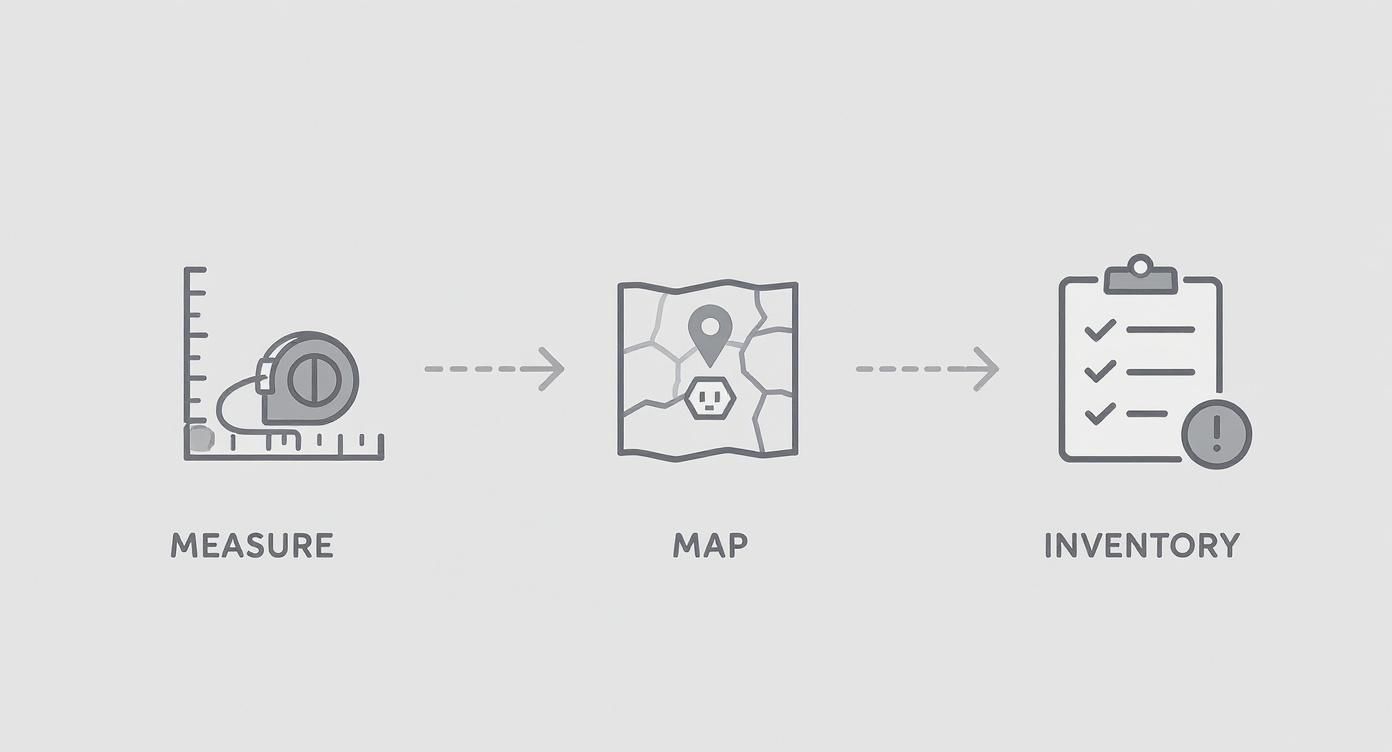
As you can see, a successful project starts with precise measurements, mapping out your plumbing and electrical, and taking stock of your storage needs. Getting this right from the beginning will guide you toward the right materials for the job.
Finishes That Form a Protective Shield
Think of the finish on your cabinet doors and frames as their first line of defense. It’s what protects them from moisture, scuffs, and stains. A cheap or poorly applied finish will fail quickly, letting moisture seep into the core material and cause damage you can't undo.
Thermofoil is a vinyl laminate that gets heat-fused onto an MDF core. This process creates a seamless, tough surface that’s super easy to clean and holds up well against moisture. It's a practical, budget-friendly option, but just know that it can be a real headache to repair if it gets chipped or starts to peel.
A professional-grade paint job offers endless color options and creates an excellent protective barrier—if it’s done right. The secret is in the prep work. Priming and sealing the surface is non-negotiable, especially with MDF. High-quality, cabinet-grade paint is much tougher than the stuff you put on your walls and is specifically formulated to handle the abuse a utility space takes.
Laundry Cabinet Material Durability Guide
To make the decision a bit easier, here’s a quick-glance table comparing how common materials hold up in the unique environment of a laundry room.
| Material | Moisture Resistance | Durability | Cost Level | Best For |
|---|---|---|---|---|
| Furniture-Grade Plywood | High | Very High | Mid-High | Cabinet boxes and shelving in any laundry room. |
| Moisture-Resistant MDF | Moderate-High | Moderate | Mid | Painted cabinet doors, when properly sealed on all sides. |
| Standard MDF | Very Low | Low | Low | Not recommended for laundry rooms due to moisture susceptibility. |
| Solid Wood | Low-Moderate | High | High | Decorative elements in well-ventilated spaces. |
| Thermofoil (on MDF) | Very High | Moderate | Mid | Budget-friendly, easy-clean doors needing high moisture defense. |
| Stainless Steel | Excellent | Excellent | Very High | High-end, industrial-style spaces or for countertops and sinks. |
This guide should help you weigh the pros and cons of each option based on your budget and how much wear and tear you expect your cabinets to face. Plywood remains the safest bet for the core structure, while finishes like thermofoil and professional paint offer robust protection for the visible parts.
Don't Overlook the Hardware
Last but not least, let's talk hardware. Your hinges, drawer slides, and handles are the moving parts that take a beating every day. In a laundry room, they’re also constantly exposed to moisture, which makes them prime targets for rust and corrosion.
Always, always choose stainless steel or hardware with a high-quality, corrosion-resistant finish. It's a small detail that makes a huge difference. Functional upgrades like soft-close hinges and full-extension drawer slides are worth every penny. They prevent doors from slamming, which reduces stress on the cabinet frames, and they let you reach things way in the back of your drawers without a struggle. Investing in durable hardware is the final step to ensuring your custom cabinets work smoothly for years.
Designing for Smart Storage and Style
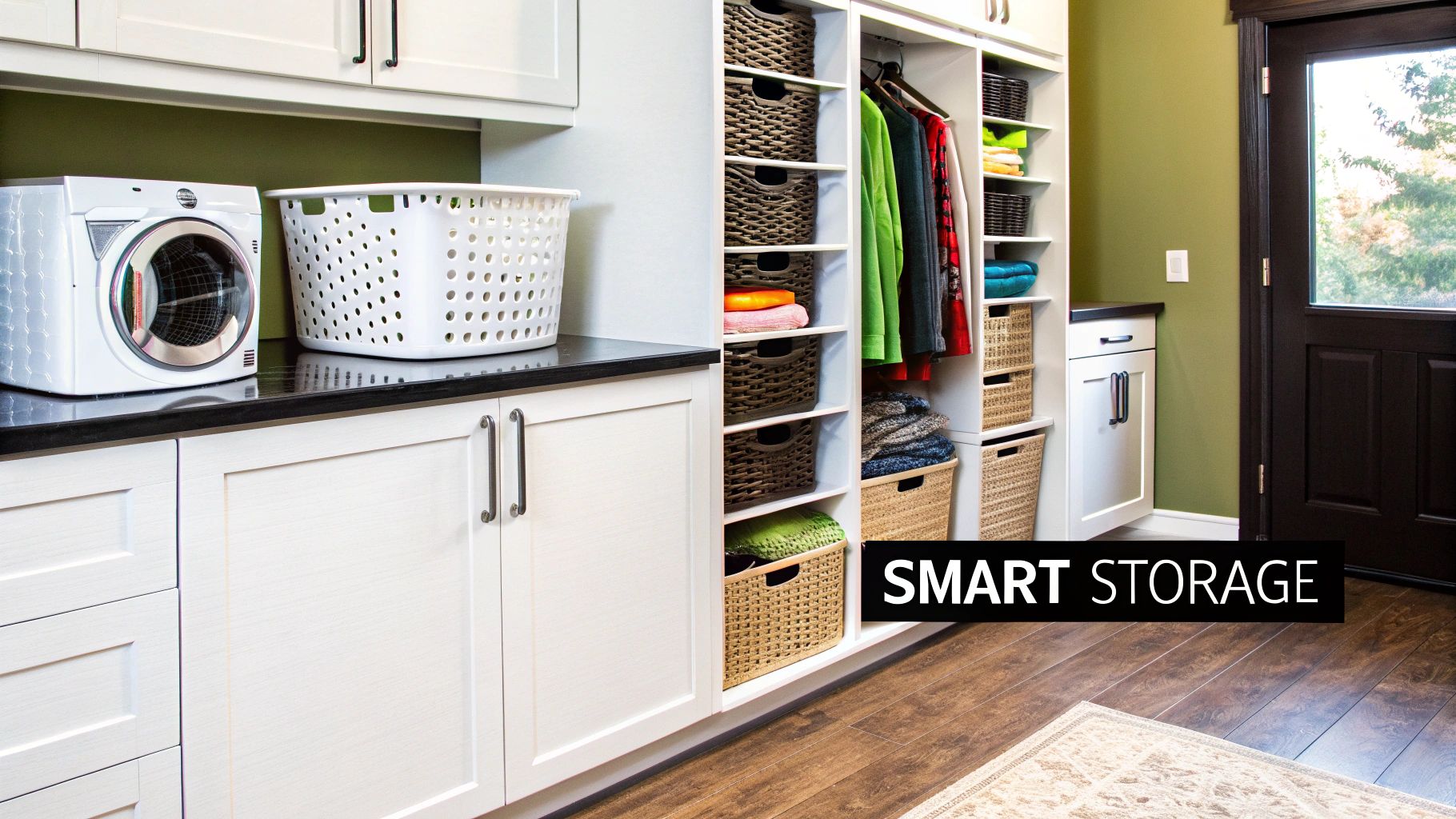
With a solid layout and durable materials picked out, we get to the fun part. This is where we elevate your laundry room from a purely functional zone into a smart, hardworking space that feels completely yours. It’s all about integrating clever features into your custom laundry room cabinets that solve real-world annoyances while showing off your personal style.
The idea is to move beyond just putting boxes on a wall. We're creating a cohesive system where every single element has a clear purpose, making the room as beautiful as it is practical.
Smart Storage Features That Make a Difference
This is where true customization really shines. By building specific storage solutions right into the cabinetry, you can finally get rid of the clutter and make laundry day feel less like a chore. These aren't just trendy add-ons; they're features that I’ve seen make a huge impact for my clients.
Here are a few game-changing ideas to consider:
- Pull-Out Drying Racks: Forget those clumsy, collapsible racks that are always in the way. We can design racks that slide out from a cabinet or fold down from a wall, giving you a sturdy spot for delicates that vanishes when you don't need it.
- Vertical Dividers: A tall, slender cabinet with vertical dividers is the perfect home for those awkward items. It creates dedicated slots for an ironing board, mops, or even rolls of gift wrap, so they're not constantly tipping over in a closet.
- Hidden Charging Stations: We can dedicate a drawer or a small cabinet to serve as an out-of-sight charging hub for your cordless vacuum, handheld steamer, and other household gadgets.
- Tilt-Out Hampers: This is one of the best tricks for keeping the room looking tidy. Integrated tilt-out hampers keep dirty clothes sorted and completely concealed within the cabinetry.
When planning custom laundry room cabinets, the goal is always to find creative ways to use every last inch. You can find more great ideas in this article on top storage solutions for small homes.
The smartest designs anticipate your needs before you even realize you have them. A well-placed pull-out shelf for a laundry basket or a dedicated drawer for lint rollers can make a surprising difference in your daily routine.
The demand for these kinds of efficient, built-in solutions is definitely on the rise. In fact, the market for commercial laundry cabinets—for places like hotels and hospitals—is projected to grow at a CAGR of about 5-7% from 2025 to 2033. It just goes to show how valuable smart, space-saving design really is.
Choosing Countertops and Sinks
Your countertop is the main stage for sorting clothes, treating stains, and folding. It has to be tough enough to handle moisture, chemicals, and the occasional scrape from a laundry basket.
- Quartz: This engineered stone is a top contender for a reason. It’s non-porous, so it won’t absorb spills or harbor germs, and it's incredibly resistant to scratches and stains.
- Laminate: A fantastic budget-friendly option. Modern laminate comes in a huge variety of colors and patterns, including some very convincing stone and wood looks. It holds up well but can be damaged by heat or sharp objects.
- Butcher Block: If you want a warmer, more natural vibe, a butcher block countertop is a beautiful choice. It just needs to be sealed properly to protect it from water, but it adds a cozy, farmhouse feel to the room.
Integrating a utility sink is another move you won't regret. A deep, wide basin is invaluable for hand-washing sweaters, pre-soaking stained clothes, or even cleaning up after messy projects, keeping all of that contained and away from your kitchen sink.
Defining Your Laundry Room Style
Finally, let's pull it all together with a style that fits your home. Your custom laundry room cabinets should feel like a natural extension of your home's overall aesthetic, not a forgotten corner.
The style really comes down to three key choices:
- Door Style: Shaker-style doors are a timeless classic that works with almost any decor, from modern farmhouse to transitional. For a more contemporary feel, a simple flat-panel door creates clean, sleek lines.
- Color Palette: White and light gray are always popular because they make small spaces feel bigger and brighter. But don't be afraid to go bold! A deep navy blue or a calming sage green can turn your laundry room into a showstopper.
- Hardware: The knobs and pulls are the jewelry of your cabinets. Brushed brass or gold hardware can add a touch of warmth and luxury, while matte black gives off a modern, industrial vibe. Choose a finish that complements your faucet and light fixtures to tie the whole look together.
By focusing on these elements, you can create a laundry room that’s not only super organized and efficient but also a genuinely pleasant place to spend time. For more tips from our experts, check out our guide on how to maximize cabinet space in any room of your house.
Navigating the Installation: DIY vs. Pro
https://www.youtube.com/embed/btR9CWYB1TM
Your design is finalized, and your stunning custom laundry room cabinets are ready to go. Now for the moment of truth: the installation. This final step is every bit as critical as your design choices. A sloppy installation can make even the highest-quality cabinets look cheap and function poorly. You’re at a crossroads with two paths—doing it yourself or calling in a professional.
This decision isn't just about the budget. It’s about a realistic gut-check of your skills, your free time, and the tools you have ready to go. Let's dig into both options so you can make a smart choice that gets your new cabinets installed securely, safely, and looking picture-perfect.
The DIY Installation Route
Taking on the installation yourself can be incredibly satisfying. There’s a special kind of pride that comes from seeing a project through with your own two hands. But let’s be clear: installing cabinets, especially in a laundry room where walls and floors are rarely perfect, is a precision job that requires more than basic handyman skills.
Before you jump in, take an honest look at your capabilities. This isn't the same as putting together a flat-pack bookcase from a big-box store. You’ll need to be genuinely comfortable with tasks like:
- Finding Studs and Marking Level Lines: This is the absolute, non-negotiable foundation of the entire job. Cabinets must be anchored securely to wall studs, and your reference lines have to be perfectly level. Get this wrong, and the whole project will be crooked.
- Lifting and Positioning Heavy Cabinets: Wall cabinets are heavy and awkward. You will 100% need a second person to help you lift and hold them steady while you secure them. Don't even think about trying this solo.
- Scribing and Cutting Filler Strips: Walls are almost never perfectly straight. Scribing is a classic woodworking technique where you transfer the wall’s unique contours onto a filler strip for a custom cut. This is how you get that seamless, built-in look with no ugly gaps.
- Shimming for a Plumb and Level Fit: Your cabinets have to be perfectly plumb (that’s vertically straight) and level (horizontally straight). This almost always means using small wedges called shims to compensate for dips in the floor or bows in the wall before you screw everything together.
A successful DIY install comes down to two things: patience and precision. If you rush the process or skimp on steps like proper shimming, you’ll end up with misaligned doors, uneven countertops, and a finished look that just feels a little… off.
If you’re still ready to tackle the challenge, having the right gear is the next critical piece of the puzzle.
Essential Tools for DIY Cabinet Installation
| Tool Category | Specific Items | Why You Need It |
|---|---|---|
| Measuring & Layout | Tape Measure, 4-Foot Level, Stud Finder, Chalk Line | For creating perfectly straight and level guidelines and locating secure mounting points. |
| Cutting & Fitting | Circular Saw or Jigsaw, Coping Saw | For cutting filler strips and scribing them to fit uneven walls perfectly. |
| Drilling & Fastening | Cordless Drill, Cabinet Screws, Wood Screws, Shims | To pre-drill pilot holes, fasten cabinets to each other, and secure them firmly to the wall studs. |
| Support & Safety | Step Ladder, Clamps, Safety Glasses, A Helper | To safely lift and hold cabinets in place while you work and to protect yourself from debris. |
If that list makes you a bit nervous, that’s your cue to seriously consider the alternative.
Hiring a Professional Installer
While it adds to the overall cost, hiring a pro brings invaluable peace of mind and guarantees a quality result. These experts install cabinets day in and day out. They have the experience to spot potential problems before they happen, the specialized tools for every situation, and the efficiency to get the job done right—and fast.
For a deep dive into the process from an expert’s point of view, our comprehensive cabinet installation guide breaks down every crucial step.
A professional also takes on full responsibility for the project. If a cabinet gets scratched during the install or something isn't aligned perfectly, it's on them to make it right. That accountability alone is often worth the investment.
When looking for an installer, find a licensed and insured contractor who specializes in cabinet installation. Always ask for references and check out a portfolio of their previous work. Try to get at least two to three quotes, and make sure each one is itemized so you know exactly what’s included.
Before you sign on the dotted line, ask these key questions:
- What’s the estimated timeline for the installation?
- Do you handle the removal and disposal of my old cabinets?
- How will you protect my floors, appliances, and the rest of my home?
- What kind of warranty or guarantee do you offer on your work?
At the end of the day, the choice between DIY and hiring a pro is a personal one. It's a balance of your budget, skills, and how much risk you're willing to take on. Be honest with yourself about your abilities, and you'll ensure your beautiful new laundry room cabinets get the flawless finish they deserve.
Answering Your Top Questions About Custom Laundry Cabinets
As you get closer to pulling the trigger on your dream laundry room, you're bound to have a few questions pop up. Planning a project with custom laundry room cabinets is a big deal, and it's smart to get all the facts before you commit. We've pulled together some of the most common questions we hear from homeowners to give you clear, no-nonsense answers.
Think of this as your quick-reference guide for hashing out those final details. These insights will help make sure your project goes off without a hitch, from the first measurement to the last knob.
How Much Do Custom Laundry Room Cabinets Cost?
This is always the first question, and the honest-to-goodness answer is: it really depends. The final price tag for custom laundry cabinets is a mix of your room's size, the materials you pick, and how fancy you get with the features.
For a smaller, more straightforward project using budget-friendly materials like thermofoil or painted MDF, you might be looking at a starting range of $2,000 to $4,000. On the other hand, if you're outfitting a larger space with premium materials like furniture-grade plywood, a quartz countertop, and all the bells and whistles—like pull-out hampers and built-in drying racks—the investment can easily climb to $8,000 to $15,000, or sometimes more.
The main price drivers are:
- Material Choice: Furniture-grade plywood will always cost more upfront than standard MDF.
- Design Complexity: Intricate door styles, integrated lighting, and custom pull-outs add to both labor and material costs.
- Local Labor Rates: Where you live plays a role, as installation costs can vary quite a bit.
Our best advice? Get at least three detailed quotes from reputable cabinet makers. This lets you compare not just the bottom line, but the quality of materials, hardware, and finishes included in each proposal.
What Is the Most Durable Cabinet Material?
In a space like a laundry room where humidity is a given, durability is everything. When it comes to cabinet boxes, you can't beat high-quality, furniture-grade plywood for reliability. Its cross-layered construction makes it incredibly resistant to the warping and moisture damage that are constant threats in a laundry room.
Unlike particleboard, plywood grips screws and fasteners for the long haul, so you know your cabinets will stay solid and stable. It does come with a higher price tag than MDF, but for a room that sees this much moisture, its superior performance is an investment in longevity.
Now, for cabinet doors where you want a perfectly smooth painted finish, moisture-resistant Medium-Density Fiberboard (MDR) is a fantastic, stable choice. When it's professionally sealed and painted on every single side, it gives you a flawless surface that won't expand and contract with temperature swings like solid wood can.
How Can I Maximize Storage in a Small Laundry Room?
A tight footprint is a common headache, but this is exactly where custom cabinets shine. The secret is to think vertically and make every single inch count.
One of the most effective moves you can make is building your cabinets all the way to the ceiling. Those upper cabinets are the perfect spot for stashing seasonal items or bulk supplies you don't need every day. Just like that, you can nearly double your storage without taking up an inch of extra floor space.
Stacking your washer and dryer is another game-changer. It frees up the floor space of one whole appliance, creating the ideal nook for a tall, skinny pantry-style cabinet. This is the perfect home for an ironing board, broom, or stick vacuum. And don't overlook those tiny gaps—a narrow pull-out organizer slipped between the washer and dryer can hold all your detergents and softeners.
Should My Laundry Cabinets Match My Kitchen?
There's no hard-and-fast rule here; it really boils down to your personal style and your home's layout. A lot of people choose to match their kitchen cabinets, and it's a safe bet for creating a cohesive flow, especially if your laundry room is right next to the kitchen or visible from it. That consistency helps your whole home feel more connected and thoughtfully designed.
But the laundry room is also a fantastic opportunity to have a little fun. You can treat it as a space to introduce a complementary style or a pop of color you might be too nervous to try in your main living areas. For instance, you could use the same Shaker-style doors from your kitchen but paint them a bold navy blue or a soft sage green. It's a great way to keep the designs related while still giving the laundry room its own unique personality.
Ready to transform your laundry room into a beautifully organized and functional space? The team at Sinclair Cabinetry inc has over 35 years of experience crafting high-quality, real wood cabinets that are built to last. Let us help you design the perfect custom solution for your home.