

Picking the best kitchen cabinet brands isn't about finding a single "best" for everyone. It's about matching the right quality, style, and price point to your home. Industry leaders like KraftMaid, MasterBrand Cabinets, and American Woodmark have built their reputations on delivering durable, stylish cabinets, but they're just the start. The brands that truly stand out do so with exceptional materials, flawless finishes, and warranties that show they stand behind their work.
This guide will walk you through the top contenders, from budget-friendly RTA systems to heirloom-quality custom creations.
Navigating the Top Kitchen Cabinet Brands
Investing in new kitchen cabinets is a big deal. It’s one of the most significant decisions you'll make in a home renovation, setting the tone for your kitchen's style and day-to-day functionality for years. The sheer number of options can feel paralyzing, but getting a handle on the landscape is the first step to choosing with confidence.
It's no surprise that the demand for quality cabinets is on the rise. Homeowners everywhere are looking for stylish, durable solutions to optimize their kitchen storage. To get a better feel for how different styles might look in your own space, it's worth playing around with some of the best kitchen design software available. Visualizing the end result can make all the difference.
The kitchen cabinet market is a massive industry, valued at around USD 100.79 billion in 2024 and it’s only expected to keep growing. This boom is fueled by homeowners like you who want more from their kitchens—better function and a look they love. We’ll break down the factors that really define a quality cabinet so you can make an investment that pays off.
Key Cabinet Brand Categories
To cut through the noise, it helps to group cabinet brands into a few main categories. Thinking about them in terms of price, customization level, and common use cases will help you narrow down your search from the very beginning. Before we dive deep into specific brands, here’s a quick overview of the main tiers you'll encounter.
If you want to get a more detailed look at the selection process itself, our guide on how to choose kitchen cabinets is a great place to start.
Now, let's break down the major brand categories to give you a clear starting point.
Top Kitchen Cabinet Brand Categories at a Glance
This table gives a high-level view of the cabinet market. Think of it as your map—it will help you figure out which direction to head in before we get into the nitty-gritty details of each brand.
| Brand Category | Typical Price Range | Best For | Key Feature |
|---|---|---|---|
| Stock/RTA | $ – $$ | DIY projects & tight budgets | Affordability and quick availability |
| Semi-Custom | $$ – $$$ | Homeowners wanting balance | A wide mix of styles & finishes |
| Custom | $$$$ | Unique layouts & luxury builds | Unmatched personalization & quality |
Understanding whether you're looking for something off-the-shelf, a personalized middle-ground, or a fully bespoke solution is the first and most important step. With this framework in mind, you're ready to explore the specific brands that excel in each category.
What Defines a High-Quality Kitchen Cabinet
To really compare the best kitchen cabinet brands, you have to know what separates a truly premium product from a budget alternative. It’s about more than just the color or door style you see on the surface. The real measure of quality is in the construction details—the hidden elements that dictate how your cabinets will hold up and how long they'll last. A cabinet can look fantastic in a showroom but start showing its weaknesses fast under the daily grind of a busy kitchen if it's not built with integrity.
The absolute foundation of any cabinet is its box construction. This is the unseen framework that has to support heavy countertops, stacks of dishes, and small appliances for decades. The main materials you'll find for cabinet boxes are plywood, particleboard, and Medium-Density Fiberboard (MDF). Each one brings something different to the table in terms of durability and moisture resistance.
Making the right call on materials is one of the most important decisions you'll make. It directly affects how long your kitchen will last and how well it will stand up to everyday life.
The Core Materials: Plywood vs. Particleboard
In the world of cabinets, plywood is widely seen as the superior choice for the box. It’s made from multiple thin layers of wood veneer, or "plies," which are glued together with the grain direction alternating. This cross-grain pattern gives it incredible strength and stability, making it far less likely to sag under heavy weight. On top of that, plywood holds screws and other fasteners much more securely and stands up better to moisture—a huge plus in a kitchen.
Particleboard, sometimes called furniture board, is engineered from wood particles, chips, and sawdust all bonded together with resin. While it is a more budget-friendly option and gives you a smooth surface for veneers, it just isn't as durable as plywood. It's especially vulnerable to water damage, which can make it swell and fall apart, and it doesn't grip screws as tightly over the long haul.
Key Takeaway: Even though high-density particleboard has gotten better over the years, plywood construction is still the gold standard for high-quality, long-lasting cabinet boxes. This is especially true for sink bases or any area that might get wet.
This infographic does a great job of showing the durability differences between the most common cabinet box materials.
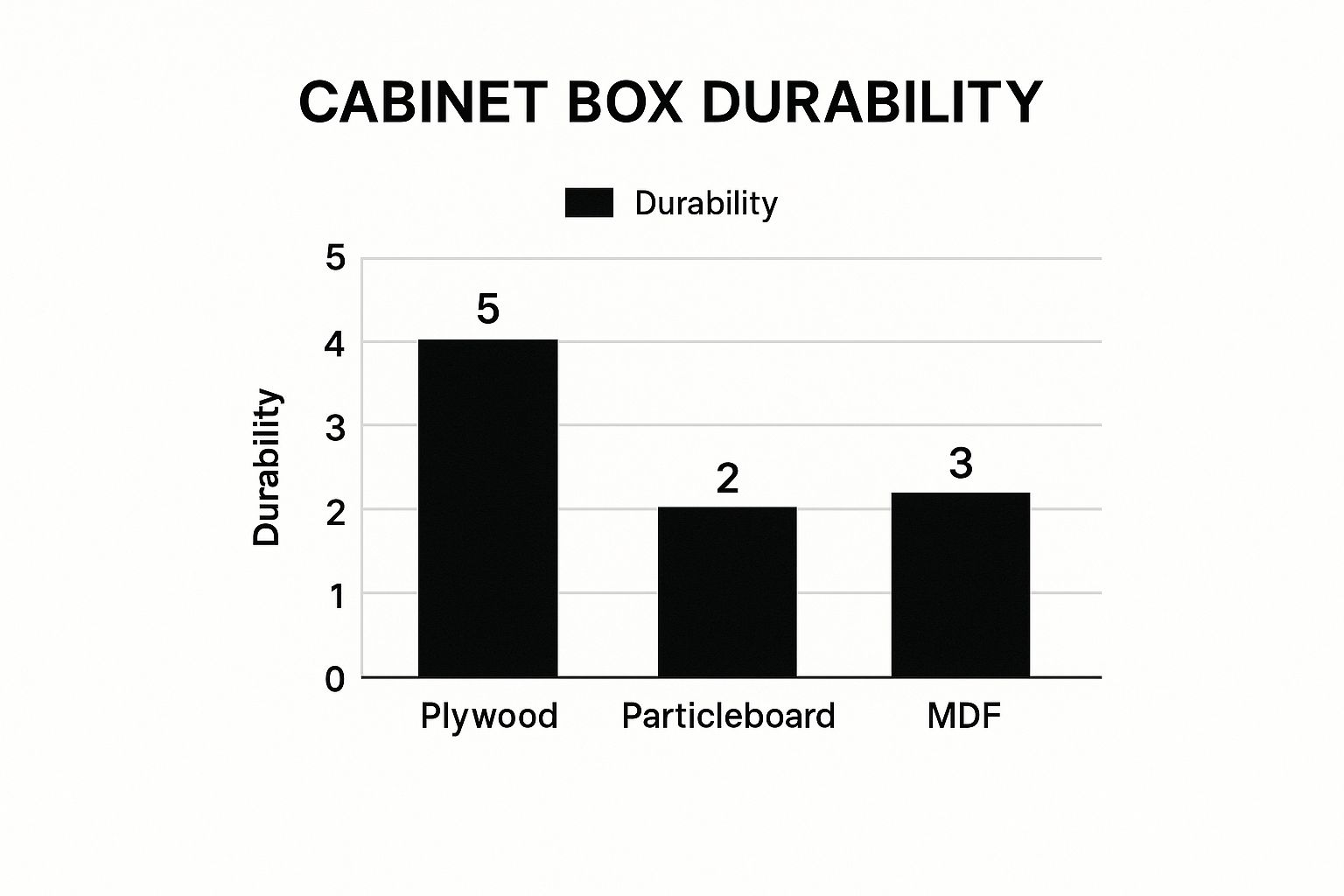
As you can see, the chart gives plywood a superior rating, backing up its reputation as the most resilient choice for cabinet construction.
Joinery and Hardware: The Details That Matter
How a cabinet is physically put together is just as crucial as the materials it's made from. The best brands use solid joinery methods that forge strong, permanent connections. You should look for techniques like dovetail or dowel joints, which actually interlock the pieces of wood for a tight fit that won't separate over time. In stark contrast, lower-end cabinets are often just held together with staples and glue, which can easily loosen and fail after a few years of opening and closing.
The hardware quality also makes a huge difference in how your kitchen feels and functions day-to-day. Premium cabinets almost always come with better hardware, including things like:
- Soft-Close Hinges: These are a game-changer. They stop doors from slamming shut, which reduces wear and tear on the frame and just makes for a quieter, more pleasant kitchen.
- Full-Extension Drawer Glides: These allow your drawers to slide all the way out, so you can easily see and reach everything inside—no more digging around in the back.
- Undermount Glides: Instead of being mounted on the sides, these glides are attached to the bottom of the drawer. They're invisible when the drawer is open and can handle a lot more weight.
These little components might seem minor, but they completely change your experience. Investing in a brand that doesn't skimp on quality hardware ensures your kitchen isn't just beautiful, but a genuine pleasure to use every single day.
Comparing The Best Kitchen Cabinet Brands
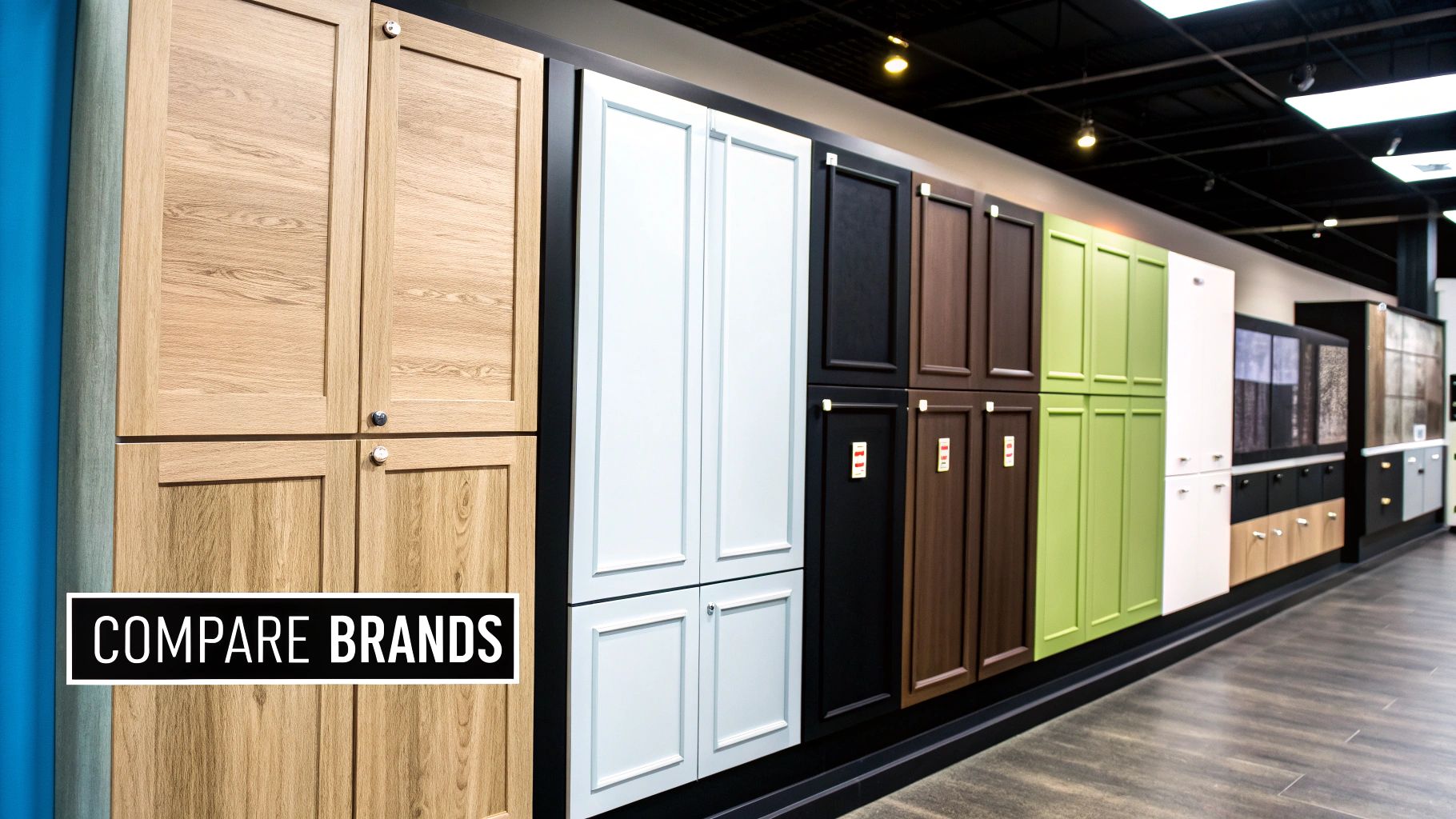
Alright, this is where the rubber meets the road. Choosing a cabinet brand is the moment you take all your research on materials and construction and apply it to a real-world decision. You're not just buying boxes; you're matching a company’s philosophy and product line to your home, your budget, and your vision.
Let's be clear: this isn't about finding one "winner." It's a look at how different brands serve completely different people, from a DIYer on a strict budget to a homeowner looking for a bespoke, heirloom-quality kitchen. We'll get into their construction, how much you can tweak the design, and what you're really getting for your money.
IKEA: The Smart Choice For Budget-Savvy DIYers
There's a good reason IKEA is a global giant in the ready-to-assemble (RTA) cabinet world. Their SEKTION system is a masterclass in affordable, user-friendly design, making it a favorite for first-time homeowners, landlords, and anyone tackling a remodel without a massive budget.
At their core, IKEA cabinets use high-density particleboard. While it's not going to have the same heft as plywood, modern furniture board holds up perfectly well for most homes, as long as it's assembled correctly and kept out of standing water. But the real magic of IKEA is the ecosystem.
Key Differentiator: IKEA's genius is its all-in-one system. The cabinets, drawer organizers, lighting, and even appliances are all designed to work together perfectly. It removes a ton of guesswork from the planning phase.
Their online design tool lets you map out your entire kitchen, and you can often walk out of the store with your cabinets the same day. That’s a massive advantage compared to the 6-12 week lead times you’ll see with semi-custom brands.
The trade-off, of course, is flexibility. You're working with fixed sizes, so you might end up with some awkward gaps that need filler strips. And while the quality is fantastic for the price, the particleboard construction just won't be as forgiving to moisture or heavy abuse over a 15-year lifespan.
KraftMaid: The All-Arounder For Family Kitchens
Moving up a tier from RTA, we have KraftMaid, which really represents the sweet spot in the semi-custom market. This is one of the best kitchen cabinet brands for homeowners who want more durability and style options than stock cabinets can offer, but aren't looking to pay the premium for full custom.
KraftMaid's standard cabinets are built with particleboard boxes, but they offer an all-plywood construction (APC) upgrade. Honestly, this is an upgrade I highly recommend, especially for the sink base and any other cabinets in high-use or potentially damp areas. It seriously boosts their longevity.
The brand's biggest strength is the balance it strikes. You get access to dozens of door styles, a huge palette of paints and stains, and practical modifications like increasing or decreasing cabinet depth. This gives you enough wiggle room to create a personalized design that truly fits your space.
Situational Recommendation: KraftMaid is a fantastic workhorse for a busy family kitchen. The finishes are built to handle daily life, and having features like soft-close hinges and full-extension glides come standard makes the kitchen so much more functional. Their lifetime limited warranty also adds some valuable peace of mind.
While the options feel endless, you are still working within a catalog. But for the vast majority of kitchen remodels, KraftMaid hits that perfect middle ground of quality, customization, and value.
Starmark Cabinetry: The Bridge To Premium Customization
Starmark carves out an interesting niche that I like to call "semi-custom plus." They deliver a level of modification and material quality that starts to blur the line with full-custom shops, all while keeping the production efficiencies of a larger manufacturer. This makes them a great solution for homeowners with tricky layouts or a taste for high-end finishes.
A key feature of Starmark is their standard all-plywood box construction on most lines. That immediately sets a higher baseline for quality compared to brands where plywood is an extra charge. You can really see their commitment to craftsmanship in the hand-applied finishes and sturdy joinery.
But where Starmark really pulls away from the pack is in their willingness to handle custom requests.
- Custom Sizing: They can adjust cabinet width, height, and depth down to 1/16th of an inch.
- Finish Matching: Have a specific paint color in mind? They offer custom paint and stain matching to create a truly bespoke look.
- Design Flexibility: They can build out more complex pieces, like a custom hutch or an appliance garage that perfectly matches the rest of your cabinets.
This level of flexibility is a lifesaver in older homes with quirky dimensions or for anyone with a very specific design vision. You get that custom-fit feeling without having to commission a fully bespoke project. Naturally, this quality and customization command a higher price than standard semi-custom brands.
To get a better sense of what makes these higher-end brands tick, our expert guide on luxurious cabinet materials is a great resource.
The Custom Cabinetry Experience: Ultimate Personalization
When nothing less than perfection will do, a true custom cabinet maker is the only way to go. Brands like Dura Supreme or local artisan shops—like our own here at Sinclair Cabinets—are playing a different game entirely. Every project begins with a completely blank slate.
Forget about standard sizes or catalogs. Every single cabinet is built to order, for your specific kitchen. This means you can design around any architectural challenge, integrate appliances seamlessly, and create storage solutions that are perfectly tailored to how you live. The material choices are also practically limitless, from classic woods like maple and cherry to exotic veneers and unique specialty finishes.
The build quality is what you’d expect from fine furniture, often featuring inset doors, handcrafted joinery, and meticulous, multi-step finishing processes. This isn't just about building cabinets; it’s about crafting a central feature of your home.
Why Choose Custom? Custom is the right call when your design vision is non-negotiable. It's for kitchens with unique layouts, for homeowners who demand the absolute best in materials and craftsmanship, and for projects where the cabinetry itself is a defining architectural element.
The main things to weigh are cost and time. A full custom kitchen is a major investment, often two to three times more than a semi-custom project. Lead times are also longer, which reflects the detailed design and hands-on build process.
Feature-by-Feature Brand Comparison
To lay it all out visually, this table breaks down the key attributes of the brands we’ve covered. Think of it as a cheat sheet to quickly see how they compare based on what matters most to you.
| Brand | Cabinet Construction | Customization Level | Average Cost (per linear foot) | Warranty Details |
|---|---|---|---|---|
| IKEA | Particleboard with thermofoil or laminate finishes | Low (Modular system with standard sizes) | $100 – $300 | 25-Year Limited |
| KraftMaid | Standard Particleboard (Plywood upgrade available) | Medium (Extensive styles, finishes, and some size mods) | $250 – $650 | Limited Lifetime |
| Starmark | Standard All-Plywood Construction | High (Custom sizing to 1/16", custom color matching) | $450 – $900 | Limited Lifetime |
| Custom Maker | Customer-Specified (Plywood, solid wood, exotic veneers) | Complete (Fully bespoke design and dimensions) | $1,000+ | Varies by Maker (Often 10+ years) |
This side-by-side look makes the trade-offs crystal clear. Your perfect brand really just depends on where your project priorities fall on the spectrum of cost, materials, and creative freedom.
Evaluating Custom and Sustainable Cabinet Options
Beyond the big names in stock and semi-custom cabinetry, there’s a major shift happening in kitchen design. Homeowners are moving toward solutions that are not just beautiful, but deeply personal and environmentally responsible. People want cabinets that fit their unique spaces perfectly and align with their values.
This demand for kitchens with character and a conscience is reshaping the industry. As of mid-2024, custom kitchen cabinets now command a 25% share of the U.S. market. Even more telling, 45% of buyers say they actively prioritize eco-friendly materials. While overall cabinet sales saw a small dip, the custom segment jumped by 7.2%—a clear sign that bespoke, sustainable design is what people are looking for.
The Rise Of Custom Cabinetry
Custom cabinetry gives you a level of design freedom that off-the-shelf options just can't touch. It’s the perfect answer for kitchens with tricky layouts, soaring ceilings, or very specific storage needs. With a custom maker, every single piece is built to order, letting you use every last inch of your space.
This approach also throws the doors wide open to a world of materials and finishes. You aren't stuck with a catalog. Instead, you can choose from an endless range of woods, veneers, and specialty finishes to create a kitchen that is truly yours. This is where you can get into the details, like perfectly grain-matched drawer fronts or a custom paint color that ties the whole room together.
Key Insight: Going custom is more than an aesthetic choice; it’s a functional upgrade. You can design highly specialized storage—think built-in knife blocks, hidden appliance garages, or drawers sized perfectly for your pots and pans. The result is a kitchen that’s not just beautiful, but brilliantly organized.
Navigating Sustainable and Eco-Friendly Choices
As more of us become environmentally conscious, the demand for sustainable cabinetry has exploded. A genuinely "green" cabinet isn't just about using recycled materials. It's about looking at the entire lifecycle, from how the wood is sourced and manufactured to the impact on your home's air quality.
To make sure you're making a truly eco-friendly choice, you need to look for specific certifications and material specs. These independent verifications are your proof that a brand is meeting strict environmental and health standards.
When you're comparing options, keep an eye out for these three things:
- Forest Stewardship Council (FSC) Certification: This is your guarantee that the wood comes from responsibly managed forests that are good for the environment, the community, and the economy.
- CARB Compliance: The California Air Resources Board (CARB) has incredibly strict limits on formaldehyde emissions from materials like particleboard and MDF. CARB Phase 2 compliance is the gold standard for healthy indoor air.
- Low-VOC Finishes: Look for cabinets finished with low-Volatile Organic Compound (VOC) paints and stains. These finishes release far fewer harmful chemicals into your home, which is better for everyone.
Making a sustainable choice doesn't have to be overwhelming. Our in-depth guide can walk you through how to choose eco-friendly kitchen cabinets that are both beautiful and healthy for your family. By focusing on these key certifications, you’re investing in cabinetry that’s not only built to last but also contributes to a healthier home and a healthier planet.
How to Choose the Right Cabinet Brand for You
Alright, you've done the homework. You know the difference between particleboard and plywood, and you can spot the difference between stock, semi-custom, and fully custom cabinets. But now comes the real question: Which brand is the right fit for your life?
Choosing the right brand isn’t about picking the most expensive option. It's about finding the one that perfectly balances quality, function, and the style you've been dreaming of for your project. Let's walk through a few common scenarios to help you zero in on the brand that feels like it was made for you.
The Best Brand for a Tight Budget
If your number one goal is a fresh, modern kitchen that doesn't break the bank, your best bet is a brand specializing in ready-to-assemble (RTA) or stock cabinetry. These brands are champs at delivering incredible value and getting cabinets into your hands quickly, making them a go-to for DIYers, first-time homeowners, or anyone flipping a rental property.
In this space, IKEA is the undeniable leader. Their SEKTION system is brilliantly engineered for affordability and easy assembly. No, you’re not getting heirloom-quality solid wood, but the high-density particleboard is more than tough enough for everyday use. The real magic is in the vast ecosystem of organizers and integrated lighting that lets you create a seriously functional kitchen on a shoestring budget.
The trade-off, of course, is customization. You’re working with fixed sizes, so you'll likely need some filler strips to close up gaps in an older home with quirky dimensions. But when time and money are the biggest priorities, it's a compromise that's almost always worth it.
The Top Choice for Growing Families
The family kitchen is command central. It has to endure everything from spilled juice and runaway toys to late-night homework sessions at the island. For this kind of high-traffic hub, you need durability, smart storage, and a finish that can take a beating. This is exactly where semi-custom brands like KraftMaid or Wellborn come into their own.
These brands are the sweet spot, offering a huge leap in quality from stock cabinets without the price tag of a fully custom job. You get access to a massive selection of door styles, super-durable finishes, and key upgrades like all-plywood construction and standard soft-close hardware.
The game-changer for families is the ability to tweak things. With a semi-custom brand, you can change cabinet depths for more counter space or add brilliant storage solutions like pull-out pantries and built-in recycling centers. That’s the kind of personalization that makes daily life run a lot smoother.
This flexibility means you can design a kitchen that not only looks incredible but works for your family's unique rhythm. You're investing in longevity and peace of mind, and it's all backed up by solid lifetime warranties.
The Premier Option for a Luxury Custom Build
When your kitchen isn't just a room but a central architectural statement, nothing short of a true custom cabinet maker will do. This is the path for homeowners with unique layouts, a passion for one-of-a-kind finishes, or those who simply refuse to compromise on craftsmanship.
Brands like Dura Supreme or a local artisan workshop, such as Sinclair Cabinets, don't work from a catalog. They start with a blank slate. Every single cabinet is designed and built from the ground up to your exact specifications. This means you get a flawless fit, perfect appliance integration, and an unlimited choice of materials, from rare wood veneers to custom-matched paint colors.
This is personalization at its peak, where every joint, finish, and detail is meticulously considered. Just be prepared for the investment it requires—this bespoke quality comes with longer lead times and a significantly higher price point.
Your Final Decision Checklist
Before you put pen to paper, run through this list with your designer or the showroom representative. Their answers will give you the confidence that you've found the right partner.
- Construction: Can you confirm the cabinet box is all-plywood construction, especially for the critical sink base?
- Hardware: Are soft-close hinges and full-extension, undermount drawer glides included as a standard feature?
- Finish: What’s the finishing process like? How many steps are involved to protect against moisture, stains, and daily wear?
- Customization: What are the real limits on modifying cabinet sizes, depths, or finishes? Where do we draw the line?
- Warranty: What, specifically, does the warranty cover, and for how long? Is it transferable if I sell my home?
- Lead Time: What’s the realistic timeline from the moment I sign off on the design to delivery and installation?
Getting clear answers to these questions ensures there are no surprises down the road. It guarantees the brand you choose truly aligns with your vision for quality, function, and service.
Your Kitchen Cabinet Questions, Answered
Jumping into the world of kitchen cabinets can feel a little overwhelming. There are so many terms, options, and price points to consider. Getting straightforward answers is the first step toward making a choice you'll be happy with for years. Let's tackle some of the most common questions we hear from homeowners.
Think of this as your cheat sheet. The right information helps you look beyond the pretty showroom finishes and focus on the bones of your cabinets—the quality and function that truly matter.
What Is The Difference Between Framed And Frameless Cabinets?
This is one of the first big decisions you'll run into, and it shapes both the look and the practicality of your kitchen.
Framed cabinets are what most of us picture when we think of traditional American kitchens. They have a solid wood face frame built onto the front of the cabinet box. This frame adds a ton of rigidity and creates that classic, layered look. Doors and drawers are then mounted onto the frame, which means you'll see the frame peeking out around them.
On the other hand, frameless cabinets (you'll often hear them called European-style) do away with the face frame completely. The doors and drawers mount directly to the sides of the cabinet box. The result is a clean, modern aesthetic with very tight, consistent gaps. A practical bonus? You get a little more usable interior space since there's no frame lip getting in the way. Your choice really boils down to style preference and how you want to maximize your storage.
How Much Should I Budget For New Kitchen Cabinets?
Cabinets are easily the biggest single expense in a kitchen remodel, often eating up 40-50% of the total budget. The final number can swing wildly depending on the brand, materials, and how much you want to personalize things.
Here’s a rough breakdown for a standard 10×10 kitchen to give you a starting point:
- Stock Cabinets: Plan on spending between $2,000 and $5,000. These are your most affordable, off-the-shelf options.
- Semi-Custom Cabinets: This is the sweet spot for many, typically running from $4,000 to $12,000. You get a great mix of personalization without the full custom price tag.
- Fully Custom Cabinets: For a kitchen built just for you, high-end, bespoke cabinetry usually starts around $10,000 and can easily climb past $20,000, all depending on the design and materials.
Remember to always account for the cost of materials, any special modifications, and professional installation when you're setting your budget.
Pro Tip: Always insist on detailed, itemized quotes from a few different suppliers. This is the only way to compare apples to apples and see what's actually included in the price, from the hinges and hardware to delivery fees.
Are Plywood Cabinets Always Better Than Particleboard?
For the most part, yes, they are. Plywood is the industry gold standard for cabinet construction for a reason—it’s incredibly strong and durable. It’s made by gluing thin layers of wood veneer together in alternating directions. This cross-grain structure gives it fantastic screw-holding power and makes it much more resistant to moisture damage, which is obviously a huge plus in a kitchen.
But let's be fair—not all particleboard is junk. Modern, high-density furniture board used by reputable brands can be a perfectly stable and cost-effective choice for the cabinet boxes themselves. It offers a smooth, flawless surface that's perfect for laminates and veneers.
Even so, when it comes to areas that will see water, like your sink base, or high-stress parts like drawer boxes, plywood is still the undisputed champ. It’s the best way to guarantee your cabinets will hold up and maintain their structural integrity for the long haul.
Ready to create a kitchen with cabinetry that's built to last a lifetime? At Sinclair Cabinetry inc, we combine over 35 years of craftsmanship with the finest materials to build custom cabinets tailored to your vision. Discover the Sinclair difference and start designing your dream kitchen today.