
Let's be honest: the first question on everyone's mind when planning a bathroom remodeling naples fl project is, "How much is this going to cost?" In our market, the numbers can feel a bit intimidating. A straightforward, mid-range update might start around $16,700, while a full-blown upscale renovation can easily soar past $56,000.
These aren't just random figures. The Naples market is unique, and everything from our skilled labor costs to the high-end materials homeowners expect plays a role in the final price tag. Getting a handle on what drives these costs is the key to creating a realistic budget you can stick to.
Decoding the Cost of a Naples Bathroom Remodel

When you remodel a bathroom in Naples, you're not just swapping out a sink. You're navigating a market where luxury standards and our beautiful coastal environment meet. The final cost isn't just about the size of your room; it's shaped by every single choice you make, from the complexity of your tile pattern to whether you choose locally sourced quartz or imported Italian marble.
The biggest factor, by far, is the scope of your project. Are we talking about a simple cosmetic facelift—new paint, modern fixtures, maybe a new vanity? Or are you planning to tear everything down to the studs and move plumbing and electrical lines? That second option is a whole different ballgame, involving more intensive labor, complex permitting, and a much higher price tag.
Factors That Shape Your Remodel Budget
Knowing where your money goes is the best way to build a budget that makes sense. Here are the main things that will move the needle on your final cost:
- Scope of Work: A surface-level refresh is your most budget-friendly option. A complete gut job that changes the bathroom's layout is the biggest investment you can make.
- Material Quality: There's a world of difference between standard builder-grade porcelain tile and a slab of Calacatta marble. This same principle applies to everything from your vanity and faucets to the light fixtures.
- Labor Complexity: Laying a simple subway tile is one thing. Creating an intricate, custom mosaic is another. The more time and specialized skill your project demands from craftsmen, the higher the labor costs will be.
- Level of Customization: You can find a stock vanity at a big-box store for a few hundred dollars. But a custom-built, solid wood vanity designed and crafted just for your space will be a major line item.
One of the most common mistakes we see is underestimating labor. In a high-skill market like Naples, labor can easily eat up 40-50% of your total budget. Always insist on itemized quotes that clearly separate material costs from labor.
Understanding Local Market Realities
Naples has its own economic realities that directly impact renovation costs. Labor is in high demand, and the standards for quality are exceptionally high. For a realistic comparison, we often look at data from nearby Fort Myers, which shows that a mid-range remodel—where you update fixtures, flooring, and cabinets without moving walls—starts at $16,700.
If your vision is more luxurious, with spa-like features such as a steam shower, premium natural stone, and extensive custom work, your budget can quickly climb north of $50,000. To get a better feel for your own project, it helps to use a tool built for our market. You can get a much more accurate starting point by plugging your details into our bathroom remodel cost estimator.
To give you a clearer idea of what to expect, we've broken down the typical budget tiers for a Naples bathroom remodel.
Naples Bathroom Remodel Budget Tiers
This table offers a snapshot of what you can generally expect at different investment levels in our local market.
| Remodel Tier | Average Cost Range | Common Features |
|---|---|---|
| Mid-Range Remodel | $16,000 – $30,000 | New vanity, quartz countertops, porcelain tile, updated fixtures, new paint, standard lighting. The existing layout is typically kept. |
| Upscale Remodel | $30,000 – $70,000+ | Full gut renovation, custom cabinetry, natural stone (marble/quartzite), freestanding tub, frameless glass shower, designer fixtures, smart home features. |
This breakdown helps illustrate how different features and finishes directly correspond to the overall budget.
At the end of the day, a successful bathroom remodeling in Naples FL depends on a detailed, realistic budget created from the very beginning. By understanding these cost drivers, you can make smart decisions that align your dream bathroom with your financial plan, ensuring a beautiful outcome without any last-minute financial surprises.
Choosing Materials That Thrive in Coastal Florida
A beautiful design for your bathroom remodel is only half the battle. Here in Naples, the real test is how well your choices stand up to our relentless coastal humidity. That moisture in the air is a constant, and it will challenge your materials year after year.
This is why selecting materials built for longevity in our environment is probably the single most important decision you'll make for your renovation. We're not just talking about avoiding a bit of mold or mildew. It's about preventing the silent, creeping damage humidity causes—peeling paint, swollen cabinet doors, and warped flooring. A smart material strategy is what ensures your investment looks just as stunning in five years as it does on day one.
Building a Moisture-Resistant Foundation
Your bathroom's ability to fight off moisture starts with the surfaces that see the most action: your floors and walls. While natural stone like marble is undeniably gorgeous, its porous nature means it can stain and absorb moisture if you're not meticulous about sealing and maintaining it. This is where modern alternatives really shine.
- Porcelain Tile: This is the undisputed champion for Naples bathrooms, hands down. Porcelain is fired at incredibly high temperatures, which makes it far denser and less porous than standard ceramic tile. It absorbs less than 0.5% of water, making it virtually waterproof and a fortress against stains and bacteria.
- Luxury Vinyl Plank (LVP): If you love the warm look of wood but dread what our humidity would do to it, LVP is your answer. It's 100% waterproof, tough as nails, and feels great underfoot. The latest LVP designs offer shockingly realistic wood and stone visuals that can fool even a trained eye.
A common mistake I see is homeowners choosing materials based on aesthetics alone, completely forgetting the unique environmental pressures we face in Southwest Florida. Prioritizing performance against humidity will save you a world of headaches and costly repairs down the road.
Selecting Cabinetry That Won’t Swell or Warp
Bathroom cabinetry is especially vulnerable to the daily assault of steam and humidity. Traditional solid wood doors will expand and contract with the moisture, eventually leading to cracked paint and warped frames. The key is to pick materials and finishes that are engineered to create an impenetrable barrier.
Believe it or not, high-quality Medium-Density Fiberboard (MDF) or plywood with a durable thermofoil or factory-painted finish often outperforms solid wood in a steamy bathroom. These finishes create a seamless, non-porous surface that moisture simply can't get through. For a deeper look into cabinetry that can handle our climate, you can explore the best material for bathroom cabinets in our detailed guide.
The Unsung Hero: Your Ventilation System
Even with the best waterproof materials in the world, you have to get that moist air out of the room. A cheap, undersized bathroom fan is a recipe for disaster. Investing in a high-quality ventilation fan isn't a luxury; it's a non-negotiable part of any Naples bathroom remodel.
You'll want to look for a fan with a high CFM (Cubic Feet per Minute) rating that’s appropriate for your bathroom's size. The general rule of thumb is at least 1 CFM per square foot of floor space. For bathrooms over 100 square feet, we recommend adding more CFM capacity for each major fixture.
| Bathroom Feature | Recommended Additional CFM |
|---|---|
| Standard Toilet | Add 50 CFM |
| Jetted Tub | Add 100 CFM |
| Standalone Shower | Add 50 CFM |
| Steam Shower | Add 100 CFM and a vapor-proof fan |
Modern fans are also incredibly quiet and can come with brilliant features like humidity sensors that automatically kick on when moisture levels rise. This "set it and forget it" functionality ensures your bathroom stays protected even when you forget to flip the switch.
Choosing the right materials is really about creating a symbiotic relationship between your design and its environment. When you select products specifically suited for coastal Florida, your bathroom won't just survive—it will thrive for years to come.
Mapping Your Remodel and Navigating Naples Permits
Before a single tile is pulled up or a new faucet gets installed, the real work of your Naples bathroom remodel happens on paper. This is the planning stage, where your Pinterest boards and ideas finally get turned into a solid, workable blueprint. A detailed plan is your best defense against budget overruns, surprise delays, and a finished product that doesn't quite hit the mark.
The first thing to figure out is the true scope of your project. Are you just looking for a quick cosmetic facelift, or are you planning a down-to-the-studs transformation? This one decision will shape everything else, from the final price tag to whether or not you'll be dealing with the county permit office.
Defining Your Project Scope
Not all remodels are the same, and getting clear on what you want will help you have productive conversations with contractors and get quotes that actually make sense.
- Cosmetic Refresh: This is the simplest and most budget-friendly path. We're talking about surface-level changes like a fresh coat of paint, a new vanity, updated light fixtures, or a new faucet. The core plumbing and electrical systems are left alone.
- Pull-and-Replace Remodel: This is a step up. Old fixtures get pulled out, and new ones go back in the same spots. You might be replacing the entire shower, toilet, and vanity, but you aren't changing the bathroom's layout or footprint.
- Full Gut Renovation: Here's where things get serious. This is the most complex approach, involving tearing everything out down to the studs. A full gut gives you the freedom to completely reconfigure the layout—move a toilet, expand the shower, or add that second sink you've always wanted. This means major plumbing and electrical work is a given.
Getting a handle on your project's scope is the first real step, helping you see the road ahead. This infographic gives a quick look at the typical flow for choosing materials in a coastal Florida bathroom, where our climate is a major factor.
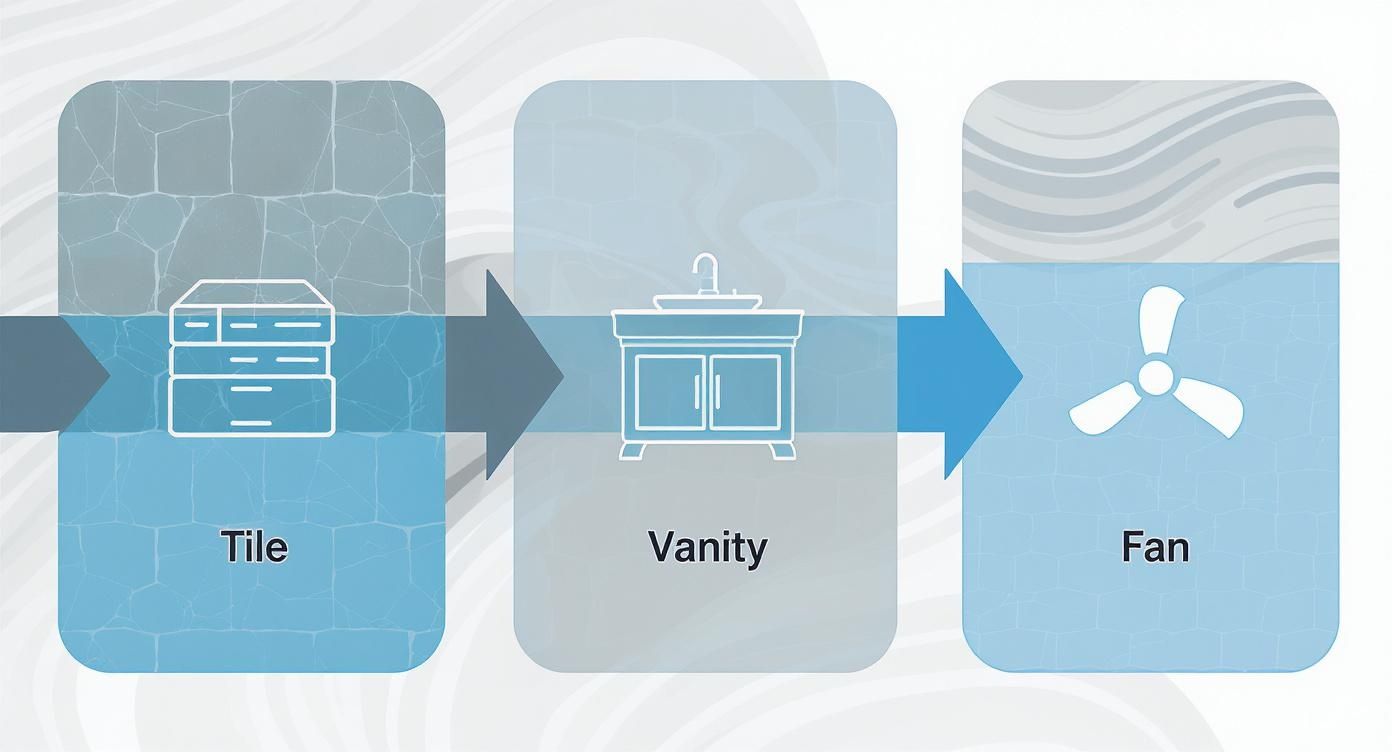
As you can see, key components like tile, vanities, and especially ventilation fans have to be selected specifically to handle the humidity and coastal conditions we live with here in Naples.
Demystifying Collier County Permits
That word "permit" can make homeowners nervous, but it's really just a system to make sure your project is safe and up to local building codes. Here in Collier County, the rule of thumb is pretty simple: if you're touching the plumbing, electrical, or structural parts of your home, you're going to need a permit.
You generally do not need a permit for easy cosmetic updates like painting or swapping a faucet with a similar model in the exact same location. However, you absolutely will need a permit for most common remodeling tasks, including:
- Moving a toilet or a sink
- Converting a bathtub into a shower
- Adding or relocating electrical outlets and light fixtures
- Altering any walls (even the non-load-bearing ones)
Florida has some of the toughest building codes in the country, especially when it comes to hurricane resistance and humidity control. This is especially true in coastal cities like Naples. These strict requirements impact labor and material choices, which in turn affects the cost. A minor update might take a few weeks, but you can expect a comprehensive, high-end remodel to take anywhere from 6 to 10 weeks. You can get a better sense of how local rules affect costs by reading up on Florida bathroom remodel expenses.
Key Takeaway: It’s always safest to assume you’ll need a permit for any work that goes beyond simple surface changes. A licensed, insured contractor will handle the entire permitting process for you, from submitting the plans to scheduling all the required inspections.
Working with a professional not only keeps your project compliant but also protects your home's value and your family's safety. Trying to skip the permit process can lead to huge fines, major headaches when you try to sell your home, and the very real risk of shoddy, unsafe work. Planning for permits from the get-go is one of the smartest things you can do.
How to Find and Hire the Right Naples Contractor
Let’s be honest: your choice of contractor is the single most important decision you’ll make for your entire bathroom remodel. The right pro brings your vision to life, navigates the maze of local permits, and keeps the project running like a well-oiled machine. But the wrong one? That’s a fast track to a costly, stressful nightmare.
Finding the perfect partner for a bathroom remodeling Naples FL project isn't about jumping on the lowest bid. It's about finding a qualified, insured, and communicative professional who truly gets our local market and building codes. This is where your homework really begins.
Creating Your Shortlist of Candidates
Start by asking around. Talk to neighbors in your Naples community, friends who’ve recently renovated, or even local interior designers you trust. Word-of-mouth is still gold in this business. Online platforms like Houzz and the National Kitchen & Bath Association (NKBA) are also fantastic resources for finding reputable pros with portfolios you can browse right from your couch.
Once you’ve got a list of three to five solid contenders, it’s time to do some digging. Your goal is to verify their credentials before you even pick up the phone. This isn’t optional—it’s the step that protects you from uninsured or unlicensed operators who could leave you high and dry.
Verifying Licenses and Insurance
Here in Florida, contractor licensing is a very big deal. The first thing you need to do is check that each candidate holds a valid, active license with the Florida Department of Business and Professional Regulation (DBPR). A quick search confirms they meet state standards and are legally allowed to do the work. It’s also wise to research any specialized licenses needed, like understanding electrical contractor license requirements, especially if you're planning major electrical changes.
Next, you need to see proof of two critical types of insurance:
- General Liability Insurance: This is what protects your home from any damage caused by the contractor or their crew during the remodel.
- Worker's Compensation Insurance: This covers injuries that workers might have on your property, protecting you from being held personally liable.
Never, ever hire a contractor who can't immediately show you a certificate for both. If a worker gets hurt in your home and the contractor isn’t covered, you could find yourself on the hook for their medical bills. It's a risk you can't afford to take.
The Interview and Estimate Process
With a list of verified pros, it's time to schedule some in-person meetings. This is your opportunity to get a feel for their communication style, professionalism, and expertise. Pay close attention to the questions they ask you. A great contractor is just as interested in your goals and how you live as you are in their qualifications.
During the interview, get right to the point with questions that reveal how they operate:
- How do you handle surprises, like finding hidden water damage behind a wall?
- What’s your communication plan? Will I get daily updates, weekly check-ins?
- Can you share references from recent bathroom remodels here in the Naples area?
- How will you protect the rest of my home from dust and debris during construction?
After the meetings, you should receive detailed, itemized estimates. Be very cautious of a one-page quote with just a single number at the bottom. A true professional provides a breakdown of costs for materials, labor, permits, and allowances. This transparency lets you accurately compare apples to apples and is the hallmark of a contractor you can trust.
For a complete rundown of what to look for, our comprehensive contractor hiring checklist gives you a step-by-step guide to make sure you cover all your bases before signing anything. Hiring with confidence means knowing you’ve found a true partner for your project.
What to Expect When Construction Begins
Once the plans are signed off and your contractor is on board, the quiet planning phase officially ends. Now, the real action begins. This is the stage where your vision starts taking physical shape, but it also means your daily routine is about to get a temporary shake-up. Knowing what’s coming can make all the difference, helping you stay excited instead of stressed.
The first day is usually the most dramatic—it’s demo day. Your crew will be careful to protect the rest of your home, but a bit of organized chaos is simply part of the deal. This is the classic "it has to get worse before it gets better" moment, and it’s the essential first step toward your new space.
Preparing Your Home for Remodeling
Before the team arrives with their tools, you can take a few simple steps to make the whole process smoother for everyone. A little prep work on your end goes a long way in minimizing the disruption to the rest of your household.
- Clear the Path: Make sure there’s a direct, unobstructed route from the front door to the bathroom. Move any furniture, area rugs, or wall art that could get in the way or risk being damaged.
- Set Up a Temporary Bathroom: If the bathroom being torn up is your only full bath, you’ll need a backup plan. Designate another bathroom for your family to use and stock it with all the essentials ahead of time.
- Protect Your Belongings: Your contractor will seal off the area with plastic sheeting, but fine construction dust has a sneaky way of traveling. It's smart to cover furniture and electronics in nearby rooms with old sheets or drop cloths just to be safe.
One of the best pieces of advice I can give any homeowner is to establish a clear communication plan with your project manager right from the start. Decide how you'll stay in touch—whether it’s a daily text, a quick phone call at the end of the day, or a weekly email—to keep up with progress and any unexpected discoveries.
The Construction Sequence Unveiled
After the dust from demolition settles, the work becomes much more methodical. Your crew will begin the "rough-in" phase, which is all about putting the new bones of your bathroom into place. This is when they'll run new plumbing lines for that freestanding tub you’ve been dreaming of or install the electrical wiring for your new vanity sconces.
This stage is absolutely critical because it’s when inspectors from Collier County will likely visit. They need to approve the plumbing and electrical work before any walls are closed up. Once the rough-ins get the green light, the crew can move on to installing insulation, hanging drywall, and starting the finishing work that finally brings your design to life. This is the fun part, when tile starts going down, the vanity is set in place, and the room starts to feel like a bathroom again.
Of course, the cost and return on investment are often on homeowners' minds during this phase. Here in Naples, even smaller projects are a significant investment. Across Florida, small bathroom remodels typically cost between $11,000 and $21,000. On the bright side, mid-range renovations can yield a 60% to 70% return on investment at resale—a key factor for any market-savvy homeowner.
Navigating the Final Touches
The final week of your bathroom remodeling Naples FL project is all about the details. This is when the plumbers come back to install the faucets and toilet, electricians connect the light fixtures, and painters apply the final coats. It’s an exciting time, but it also requires a bit of patience, as these last steps demand precision.
As everything comes together, be prepared for a major cleanup. You might want to consider professional post-construction cleaning services to tackle the fine dust and debris, ensuring your new space is sparkling and ready to enjoy.
Finally, your contractor will walk you through the finished bathroom for a final inspection. This is often called creating a "punch list," where you’ll point out any small items that need a final tweak or adjustment before the job is officially considered complete.
Your Top Naples Bathroom Remodeling Questions Answered
Even the most detailed plan brings up questions, and that's a normal part of any home renovation. When it comes to remodeling a bathroom here in Naples, homeowners often have very specific concerns—from realistic timelines to the nitty-gritty of Collier County rules. Getting clear, straightforward answers is the key to moving forward with confidence.
We’ve pulled together the most common questions we hear from our Naples clients to give you the direct insights you need. Think of this as your local FAQ, built to tackle the practical side of remodeling in our unique coastal community.
How Long Does a Bathroom Remodel Actually Take in Naples, FL?
This is usually the first thing on everyone's mind: "How long will my bathroom be out of commission?" The honest answer is it really depends on how deep you're going with the renovation. There’s no single, one-size-fits-all schedule.
A simple cosmetic refresh—we’re talking new paint, swapping out a faucet, and maybe a new light fixture—can often be wrapped up in just one to two weeks. It’s quick because you’re not touching the core plumbing or electrical systems.
For a more standard, mid-range remodel where you're replacing the tile, vanity, and toilet but keeping the layout the same, you should plan for about three to five weeks. This gives enough time for proper demolition, installation, and all the finishing touches.
But if you're planning a full gut renovation that involves moving plumbing, reconfiguring walls, or changing the electrical layout, the timeline gets longer. For these bigger projects, six to ten weeks is a much more realistic expectation.
Local Insight: Always build in a little buffer for things unique to our area. Lead times for custom-ordered tile or cabinetry and the Collier County permitting and inspection process can easily add unexpected days or even weeks to a schedule. An experienced local contractor will factor these potential delays into their initial timeline from the get-go.
What Kind of ROI Can I Expect From a Bathroom Remodel in Naples?
In a high-value real estate market like Naples, a bathroom remodel isn't just a lifestyle upgrade; it’s a smart investment in your home's worth. The financial return is a huge factor for many homeowners, and the good news is that these projects perform very well here.
Nationally, homeowners can typically expect to get back 60% to 70% of what they spend on a mid-range bathroom remodel when they sell. That figure holds strong right here in the Naples market, where updated, modern bathrooms are a major selling point.
Beyond the direct percentage, an updated bathroom seriously improves your home’s marketability. In a competitive area, a dated bathroom can be a deal-breaker for buyers. A fresh, modern space helps your home sell faster and often for a better price. While a super high-end, luxury remodel might have a slightly lower ROI on paper, it's often essential for meeting the expectations of buyers in Naples' more upscale neighborhoods.
Do I Really Need a Permit for My Bathroom Remodel in Collier County?
Navigating local regulations can feel a little overwhelming, but the rules in Collier County are pretty clear. Whether or not you need a permit all comes down to the scope of your work.
You generally do not need a permit for purely cosmetic changes. This includes things like:
- Painting the walls
- Replacing a faucet in its existing location
- Swapping out a light fixture with a similar one
However, the moment you start altering the bathroom's core systems, a permit becomes mandatory. You will need a permit from Collier County if your project involves:
- Moving any plumbing lines (like relocating a toilet, sink, or shower)
- Altering the electrical wiring (adding a new outlet or moving a switch)
- Changing any structural elements, including moving or removing a wall
Florida's building codes are some of the strictest in the country, designed to ensure safety and durability, especially with our coastal weather. It's always safest to assume you need a permit for anything beyond surface-level updates. Your licensed contractor is responsible for handling the entire permitting process, ensuring all the work is properly inspected and approved.
Ready to turn your vision into a stunning reality? The experts at Sinclair Cabinetry inc have been crafting custom cabinetry and leading bathroom renovations in Southwest Florida for over 35 years. Schedule your design consultation today!