

If you’ve ever admired a piece of antique furniture that has stood strong for a century, you’ve likely seen the mortise and tenon joint in action. So, what is mortise and tenon joinery? It's a time-honored woodworking technique where a precisely cut tongue on one piece of wood (the tenon) fits snugly into a matching slot (the mortise) on another. Think of it as a perfectly crafted wooden lock and key—an interlocking bond that craftsmen have trusted for thousands of years.
The Gold Standard of Cabinet Construction
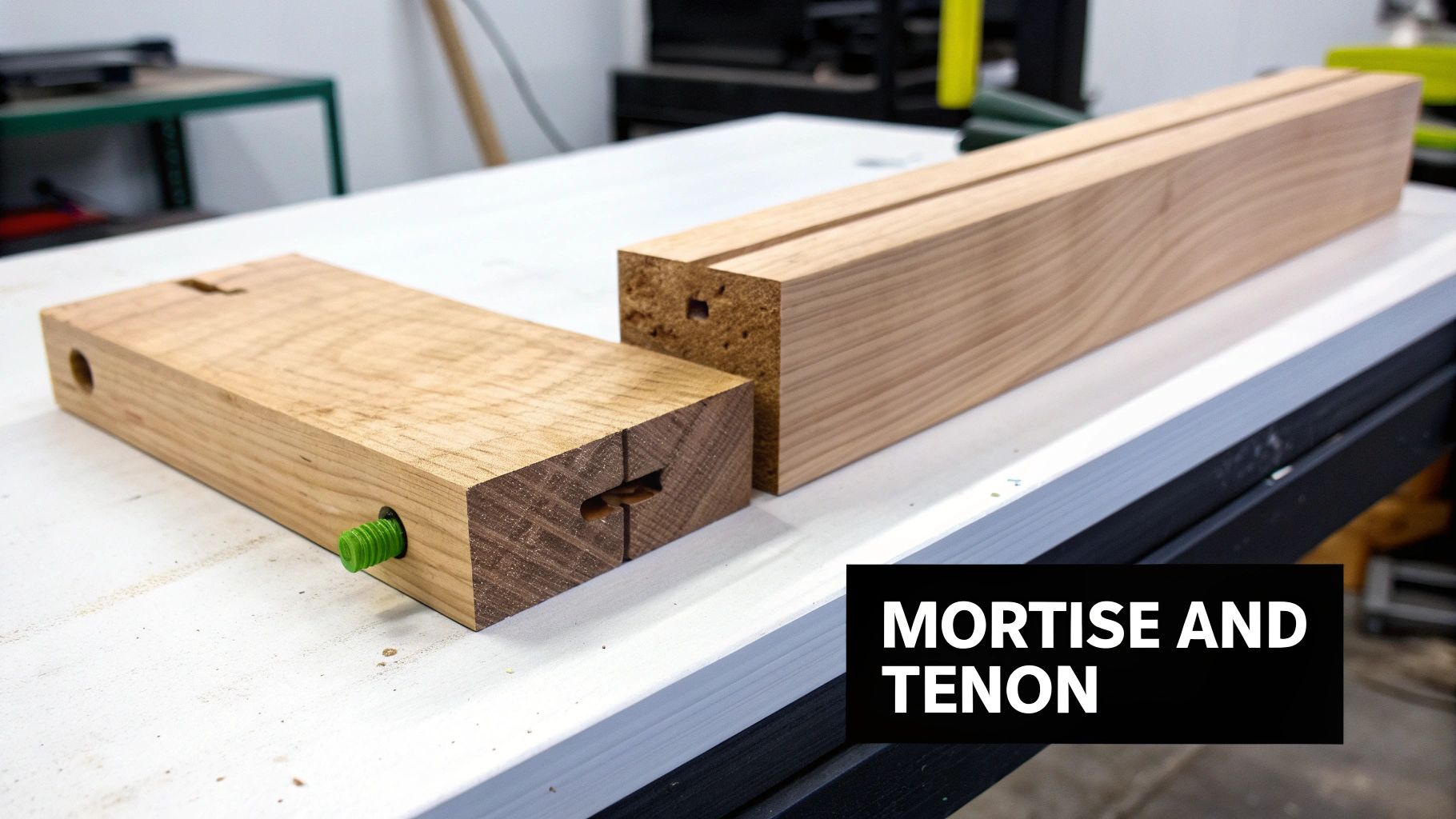
The mortise and tenon is so much more than just a way to connect two pieces of wood. It represents a core principle of craftsmanship that’s built to last.
Its incredible strength comes from a clever mechanical design that physically locks the components together. This also creates a massive surface area for glue to bond, resulting in a joint that powerfully resists the pulling, twisting, and racking forces that cabinets and furniture face every single day.
Unlike modern fasteners like screws or dowels that can wiggle loose over time, this joint becomes a single, unified part of the wood's structure. This inherent stability is exactly why it’s been the go-to method for everything from ancient ships to timber-frame homes and, of course, heirloom-quality furniture. The joint isn't just strong; it's a piece of thoughtful engineering. You’ll find similar principles of structural strength are essential in larger projects, too, like building rock-solid support for decks.
The Anatomy of the Joint
At Sinclair Cabinetry, we find that when you understand the basics, you can truly appreciate the quality you're investing in. The joint is made of two simple, yet brilliant, parts.
This table gives you a quick look at the two core components and how they work together.
| Component | Function | Analogy |
|---|---|---|
| The Mortise | The "female" part—a carefully cut slot or rectangular hole ready to receive its counterpart. | The Lock |
| The Tenon | The "male" part—a projecting tongue shaped to fit precisely into the mortise. | The Key |
When these two pieces come together, they create a bond that distributes stress across the entire joint, preventing weak points from ever forming.
The beauty of the mortise and tenon lies in its elegant simplicity. It leverages the natural strength of wood to create a connection that is often stronger than the wood itself, ensuring that what is built today is meant to last for generations.
This commitment to lasting quality is precisely why we build our cabinets this way. You can explore more about how these details come together in our guide to cabinet construction details. By choosing this time-tested method, we ensure that every cabinet frame and door from Sinclair Cabinetry is not just a beautiful addition to your home, but a durable investment built to withstand the test of time.
A 7,000-Year Legacy of Human Ingenuity
The mortise and tenon joint is more than just a way to connect two pieces of wood. It's a piece of living history, a testament to human ingenuity that has stood the test of time, connecting generations of craftspeople. This technique wasn’t dreamed up in a modern workshop or even during the Renaissance. Its roots run incredibly deep, tracing back thousands of years to the very dawn of organized construction.
This remarkable journey begins not with furniture or temples, but with something far more fundamental to civilization: access to clean water. The earliest known examples of this sophisticated joint were found in ancient wells in Central Europe, proving the mortise and tenon is one of humanity's most enduring woodworking techniques, with evidence dating back roughly 7,000 years. Researchers uncovered ancient water wells in Germany, dating between 5,600 and 4,900 BC, that used these joints to hold their timber walls together. To learn more about this ancient engineering, you can explore the history of this foundational joint.
This incredible discovery shows that Neolithic builders already had the skill and foresight to create strong, interlocking structures that could withstand the immense pressure of earth and water. It wasn't just a primitive connection; it was a refined solution born from pure necessity.
From Ancient Ships to Soaring Cathedrals
As civilizations grew, so did the applications for this powerful joint. Millennia later, Egyptian shipbuilders on the Nile relied on mortise and tenon joints to construct their vessels. These joints allowed them to create strong yet flexible hulls capable of navigating one of the world's mightiest rivers. The interlocking timbers could handle the constant stress of the water, proving the joint’s value in dynamic, high-stakes environments.
The technique continued to evolve and spread, becoming a cornerstone of monumental architecture across the globe. Just look at the immense timber-framed structures that have survived for centuries—you'll find the mortise and tenon at their very core.
- Medieval European Cathedrals: The massive timber roof trusses that soar above stone arches were held together by expertly cut mortise and tenon joints, distributing tremendous weight without a single metal fastener.
- Traditional Japanese Temples: Revered for their ability to withstand earthquakes, these structures use complex and beautiful mortise and tenon joinery, allowing the wooden frames to flex and absorb seismic energy.
- Colonial American Barns: The iconic post-and-beam frames of barns across the American landscape were assembled using this time-tested method, creating open, durable structures that have served families for generations.
This widespread, independent use across vastly different cultures and eras highlights a universal truth in woodworking: the mortise and tenon just works. It wasn't simply a tradition passed down; it was a principle rediscovered and perfected by artisans who truly understood the nature of wood.
A Legacy of Lasting Quality
The history of the mortise and tenon isn't just an academic footnote; it’s the ultimate proof of its performance. The same fundamental principles that kept ancient wells from collapsing and Egyptian ships afloat are what make it the superior choice for high-quality cabinetry today.
When a joint has been tested for 7,000 years and remains the gold standard for strength and longevity, it ceases to be an old-fashioned technique and becomes a perfected one. It is a symbol of enduring quality and a commitment to building things that last.
This legacy is exactly why we at Sinclair Cabinetry choose this method. It connects our work to a long line of master craftspeople who valued strength, precision, and permanence above all else. By understanding what is mortise and tenon in its historical context, you can appreciate that it's not just a joint—it's a promise of durability built into the very bones of your cabinetry.
How Different Mortise and Tenon Joints Are Used
The mortise and tenon isn't just a single, one-size-fits-all joint. It’s more like a versatile family of connections, with each variation thoughtfully engineered for a specific job. Understanding these different types pulls back the curtain on the depth of craftsmanship that goes into high-quality woodwork, where every joint is chosen for that perfect balance of strength and visual appeal.
This infographic traces the historical milestones of this foundational joint, from ancient infrastructure to iconic architecture.
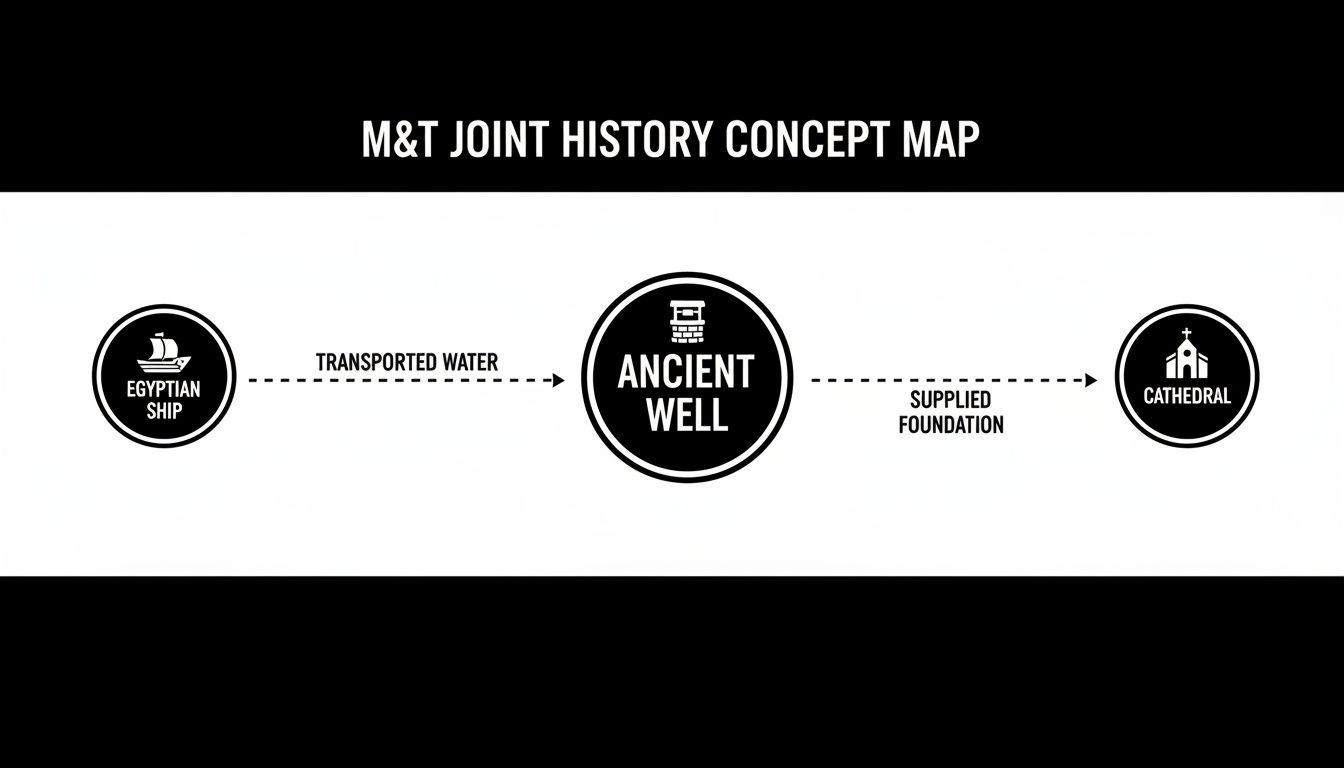
As you can see, the core principles of strength and interlocking design have been trusted across cultures and millennia for the most critical structural work.
The Clean Look of the Blind Tenon
The most common variation you’ll find in fine cabinetry is the blind mortise and tenon. In this version, the tenon stops partway inside the mortise, so it's completely hidden once the joint is assembled. This creates a clean, uninterrupted surface—ideal for the sophisticated and seamless look we want in custom kitchen and bathroom cabinets.
Its main advantage is pure aesthetics. You get all the structural integrity without any visible sign of how the pieces are joined. This makes it the go-to choice for cabinet face frames and doors, where the focus should be on the beauty of the wood, not the joinery. To see how we apply this, you can learn more about our approach to cabinet face frame construction.
The blind tenon is the unsung hero of custom cabinetry. It does its work silently, providing immense strength from within while allowing the flawless exterior of the cabinet to shine. It is the very definition of hidden quality.
The Expressive Style of the Through Tenon
In complete contrast, the through mortise and tenon is designed to be seen. Here, the tenon passes completely through the mortise and comes out the other side. This exposed end-grain becomes a deliberate decorative element, showcasing the precision and skill of the woodworker.
This joint is often used where both maximum strength and a bold, honest aesthetic are desired. You’ll frequently see it in:
- Timber Framing: Where the ends of massive beams are visibly locked into posts.
- Sturdy Furniture: On the legs of heavy-duty workbenches or rustic dining tables.
- Arts and Crafts Style: As a hallmark design feature that emphasizes honest construction.
The visible tenon not only adds visual interest but also provides an extra layer of mechanical strength, making it perfect for pieces that will endure significant stress.
Specialized Joints for Unique Needs
Beyond these two fundamental types, craftsmen have developed specialized variations to tackle unique challenges. These creative solutions really show how adaptable the core mortise and tenon concept is.
One fascinating example is the tusk tenon. This is a through tenon that extends far enough to have a hole cut through it. A wooden wedge, or "tusk," is then driven through this hole, locking the joint together under tension. The best part? It can be easily disassembled just by tapping out the wedge, making it perfect for large furniture that might need to be moved.
Another is the haunched tenon, which includes an extra notch (the haunch) that fits into a matching recess at the end of the mortise. This small addition dramatically increases the joint's resistance to twisting forces, making it an excellent choice for the rails and stiles of a cabinet door, where preventing warping over time is critical. Each type tells a story of problem-solving, perfectly tailored to a specific structural or aesthetic demand.
Why Mortise and Tenon Is Superior to Modern Alternatives
In a world full of flat-pack furniture and lightning-fast assembly, it’s fair to wonder how a 7,000-year-old woodworking joint holds up. After all, we have pocket screws, dowels, and biscuits—all designed for speed and convenience.
But here’s the thing: those modern methods work on a completely different principle. They prioritize ease of assembly, not necessarily strength that lasts a lifetime. Understanding this difference is what separates good cabinetry from great cabinetry, and it’s why this ancient technique is still the undisputed champion for building things to endure.
The Downfall of Quick-Fix Joinery
Modern fasteners often create a weak link right where you need strength the most. They’re a shortcut, not a long-term solution.
Take pocket screws, for example. They are incredibly fast and easy to use, making them a favorite for DIY projects and mass production. But their strength is entirely dependent on a metal screw grabbing a small chunk of wood at an angle. The constant push and pull of daily use—opening a cabinet door or leaning against a frame—will eventually cause that screw to loosen. That’s where the wobble begins.
Dowels and biscuits are a bit different. They’re fantastic for lining things up perfectly during glue-up, but they don't offer much mechanical strength on their own. The real holding power comes from the glue around them. If that glue fails or the wood gets stressed, the joint loses its integrity.
Modern fasteners often create a point of potential failure, relying on the grip of a screw or the shear strength of a small dowel. A mortise and tenon joint, by contrast, transforms two separate pieces of wood into a single, unified structural component.
The Unmatched Strength of a Mechanical Lock
This is where the mortise and tenon joint really shines. It doesn't just hold two pieces of wood next to each other; it physically locks them together. Think of it like a key fitting perfectly into a lock. The tenon slides snugly into the mortise, creating a massive surface area for glue—way more than any dowel or biscuit.
But the real magic is the powerful mechanical connection that resists force from every direction.
- Racking Forces: That deep, interlocking fit prevents the side-to-side wiggle that makes furniture and cabinet frames feel flimsy over time.
- Tensile Strength: The broad shoulders of the tenon keep it from being pulled out of the mortise, which is a common failure point for screw-based joints.
- Wood Movement: A well-made joint is smart—it allows for the wood's natural expansion and contraction with humidity changes, staying tight where metal fasteners would loosen or even split the wood.
This incredible structural design is why it’s the go-to choice for anything that has to withstand constant stress. Think about your kitchen cabinet doors, opened and closed thousands of times a year. A mortise and tenon joint in the frame ensures it will never sag, warp, or pull apart.
For a deeper dive into how different joints affect the final product, check out our guide on cabinet construction methods.
Longevity Is in the Details
Of course, the strongest joint in the world is only as good as the wood it’s made from. As the experts explain when it comes to choosing the right hardwood for longevity and style, you have to pair superior construction with durable materials to get heirloom quality.
The mortise and tenon joint represents a commitment to that very idea. Yes, it takes more time and skill to create. But the result is cabinetry built not just for today, but for generations. It’s an investment in permanence and a testament to true craftsmanship that quicker, weaker alternatives simply can't match.
The Sinclair Cabinetry Commitment to Lasting Quality
Our decision to build with mortise and tenon joinery isn’t just a technical choice—it’s the very core of our commitment to you. We believe true quality isn't about how your cabinets look on day one, but how they feel and function after decades of family dinners, holiday gatherings, and daily life.
This timeless technique is our promise that your investment will stand strong against the tests of time, constant use, and even Florida's challenging, humid climate. Cabinet doors and frames built this way simply won't sag, shift, or fail. The interlocking mechanical bond creates a level of structural integrity that screws and glue alone can't replicate, especially when wood naturally expands and contracts.
The real magic of a well-made mortise and tenon joint is how it accommodates that subtle wood movement without ever losing its grip. This resilience is the secret to building cabinetry that feels just as solid in 20 years as it does the day we install it.
Blending Tradition with Technology
With over 35 years in the craft, we’ve honed a hybrid approach that marries the time-tested wisdom of traditional woodworking with the flawless accuracy of modern technology. This unique blend allows us to create mortise and tenon joints with a level of precision that ensures a perfect, airtight fit every single time.
Our process combines the best of both worlds:
- Precision Machining: We use state-of-the-art equipment to cut each mortise and tenon to exact tolerances. This isn't just about speed; it's about guaranteeing a perfect geometric lock that creates an incredibly strong foundation.
- Artisanal Assembly: The final fitting, gluing, and clamping of each joint is still done by the skilled hands of our artisans. Their experience is what ensures every connection is seamless, secure, and set for maximum longevity.
This methodical system eliminates the tiny imperfections that can cause a joint to weaken over the years. It’s a deliberate process designed to build not just cabinets, but complete confidence. By refusing to take shortcuts, we build lasting trust with homeowners, developers, and designers who demand nothing less than perfection.
A Foundation for Lifelong Value
So, why do we invest so much in a single joint? Because we know the frame is the skeleton of your cabinetry. If the frame weakens, the whole structure is compromised. The strength of the mortise and tenon joint ensures that doors hang perfectly, drawers glide smoothly, and the entire cabinet system stays square and true for a lifetime.
When you ask, "what is mortise and tenon?" in the context of our work, the answer is simple. It's our way of making sure your custom cabinetry is more than just a beautiful feature. It’s a functional, durable, and valuable asset that will serve your family for generations.
This is the Sinclair Cabinetry difference—a commitment to lasting quality, built into the very bones of everything we create.
Answering Your Questions About Mortise and Tenon Joinery
Even after understanding the mechanics, homeowners always have a few practical questions about how this joint really impacts their project. It’s one thing to know what it is, but another to know why it’s the right choice for your home. Let's clear up some of the most common questions we hear.
Is This Joinery Really Worth the Extra Investment for My Cabinets?
Absolutely. It’s an upfront investment in the structural soul of your cabinetry, and the long-term payoff is huge.
Think about the common headaches with lesser-quality cabinets: doors that start to sag, frames that pull apart at the corners, and a general feeling of looseness after a few years of daily use. Mortise-and-tenon joinery prevents all of that. It ensures your cabinets will open smoothly and hold their shape for decades, saving you a fortune on future repairs or replacements. It’s an investment in doing it right the first time.
Will I Actually See These Joints on My Finished Cabinets?
For the clean, high-end look most clients want, the answer is no. We almost always use what's called a blind mortise and tenon. The tenon slides deep into the mortise but doesn't go all the way through, so the entire joint is completely hidden from sight once assembled.
This gives you a flawless, uninterrupted surface that keeps the focus on the beauty of the wood and the cabinet design. While you might occasionally see an exposed "through" tenon on rustic or Craftsman-style furniture as a design feature, our modern and transitional kitchens rely on concealed joinery for a seamless, elegant finish.
How Does This Joint Hold Up in Humid Places Like Florida?
It's not just good in humidity; it’s the best choice, which is precisely why it’s our standard. Wood is a natural material that breathes—it expands and contracts with humidity changes. A well-crafted mortise and tenon joint is designed to work with this movement, not against it.
Unlike screws that can loosen or metal fasteners that might rust, this all-wood connection offers a massive surface area for glue and a mechanical lock that remains stable. It flexes with the wood's natural cycles without ever losing its grip.
This resilience is what makes it the superior choice for coastal homes. Where other joints would eventually wiggle loose and fail, the mortise and tenon stays strong for the long haul.
Are Your Joints Cut by Hand or by Machine?
We've found the perfect sweet spot: a hybrid approach that gives us the best of both worlds—unbeatable precision from technology and irreplaceable skill from our artisans.
Our process breaks down into two key stages:
- Precision Machining: First, we use our advanced machinery to cut the mortises and tenons. This guarantees a perfect, airtight fit with tolerances that are geometrically flawless—something essential for creating the strongest possible mechanical bond.
- Artisanal Assembly: Then, our skilled cabinetmakers take over. They handle the critical steps of fitting, gluing, and assembling each joint by hand. Their expertise ensures every connection is not just structurally perfect but also completely seamless.
This blend of modern accuracy and old-world craftsmanship is how we guarantee that every cabinet we build is not just strong, but a true symbol of lasting quality.
At Sinclair Cabinetry inc, we believe that understanding what mortise and tenon construction really means is the first step toward appreciating true, lasting quality. If you're ready to invest in custom cabinetry that is built to endure for generations, we invite you to start your project with us. Explore our custom cabinet solutions and discover the difference that uncompromising craftsmanship can make in your home.