

Ever notice that awkward, hard-to-reach corner in an L-shaped or U-shaped kitchen? That’s the space a blind corner cabinet is designed to conquer. Instead of leaving a void where your cabinetry meets at a 90-degree angle, this specialized unit extends deep into the corner, reclaiming what would otherwise be lost space. Think of it as a secret pantry, tucked just out of sight.
Solving The Awkward Kitchen Corner Problem
We’ve all seen it: the dreaded corner. It’s a space full of potential yet notoriously difficult to actually use. For years, this "dead corner" was a black hole where pots, pans, and forgotten wedding gifts would go to disappear, never to be seen again. This common design headache is precisely why the blind corner cabinet was invented.
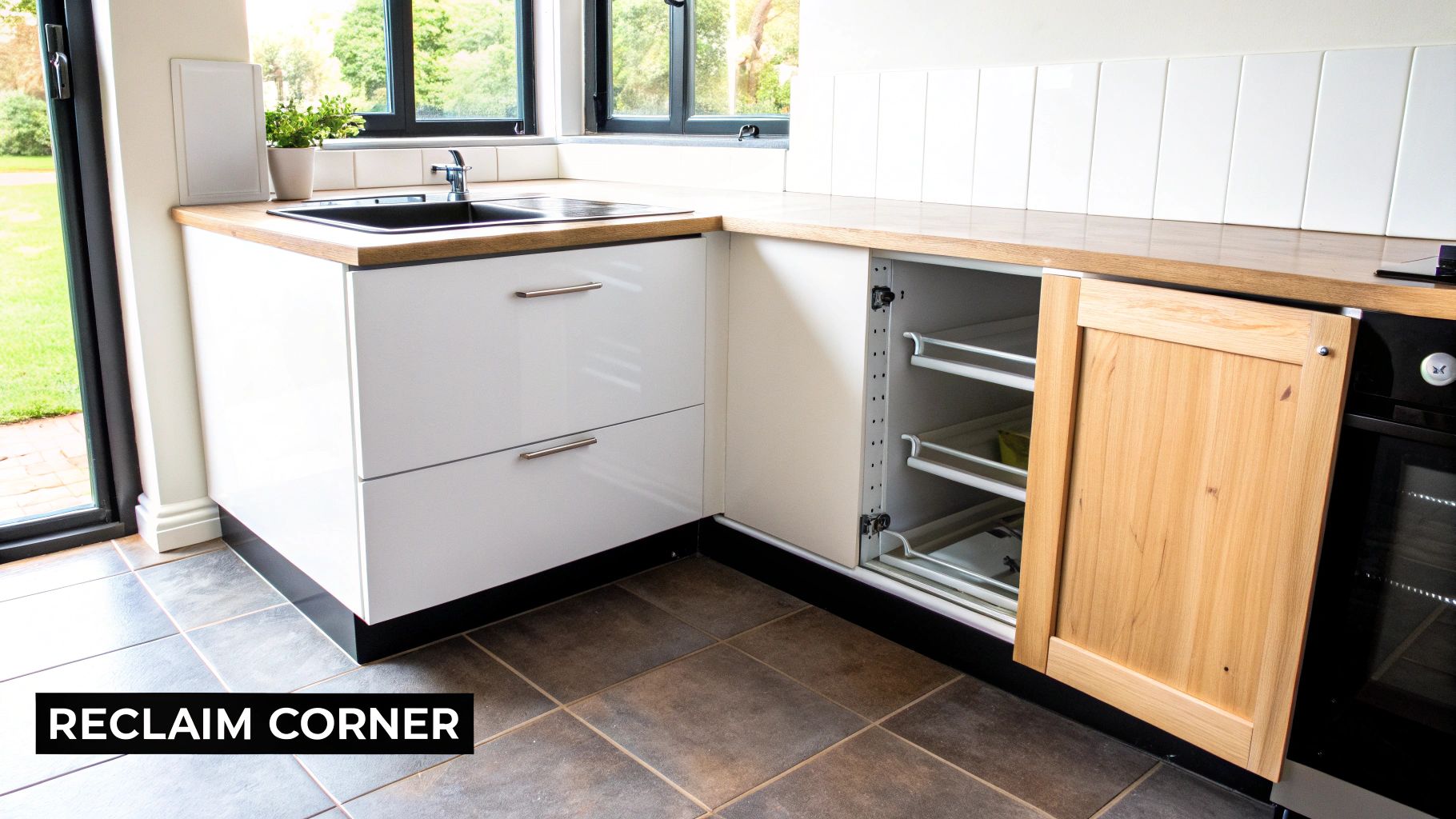
This cabinet is engineered to fit perfectly into that intersection. While one part of the cabinet is visible with a standard door, the other "blind" section stretches back behind the neighboring row of cabinets. Of course, without the right internal hardware, reaching into that deep space is still a challenge.
From Dead Space to Dynamic Storage
The real magic of a modern blind corner cabinet isn't just that it fills a gap—it's that it transforms that inaccessible void into a highly functional storage powerhouse. Homeowners are catching on, and the demand for clever corner solutions has never been higher.
A blind corner cabinet is a specialized storage solution in kitchen designs where two cabinet faces meet at a 90-degree angle, creating a 'blind' area that's notoriously hard to access without innovative features like pull-outs or lazy Susans.
This growing interest has fueled a booming market for brilliant mechanisms built to tame the corner. In fact, the global blind corner cabinet pull-out market recently hit USD 1.27 billion, showing a massive shift in how we approach kitchen design.
Instead of just accepting wasted space, today’s kitchen designs use advanced organizers that bring the cabinet’s contents directly to you. These systems turn a frustrating corner into one of the most efficient storage zones in your entire kitchen. For anyone looking to make the most of every square inch, figuring out how to maximize cabinet space is the first step toward a kitchen that truly works for you. This guide will walk you through the best ways to unlock that hidden potential.
Getting the Dimensions Right on a Blind Corner Cabinet
To really get what a blind corner cabinet is all about, you have to look past the door and see how it fits into the bigger picture of your kitchen layout. These aren't just standalone boxes; they're engineered to connect two perpendicular runs of standard cabinets, creating that seamless, L-shaped or U-shaped flow we all want. Getting the dimensions right is the key to making it all look effortless.
For starters, blind corner cabinets play by the same rules as most of your other base cabinets. They almost always have a standard depth of 24 inches to sit perfectly flush with your countertops. Their height is also a standard 34.5 inches, which lets them line up perfectly with their neighbors and leaves room for a toe-kick underneath.
Breaking Down The Cabinet's Anatomy
It helps to think of a blind corner cabinet in three parts. First, you have the visible section with the door—it looks just like any other cabinet from the front. Then, you have the cabinet right next to it, running at a 90-degree angle. And finally, you have the “blind” section, which is the hidden cavern of storage space that extends behind that adjacent cabinet.
Once you picture it that way, you can see why getting your stuff out of that dark, deep space can be a real headache without some clever hardware. That one little door is your only window into a much bigger storage area.
The biggest challenge in any kitchen corner is just being able to reach what you’ve stored there. Blind corner cabinets are a smart solution, built to standard 24-inch depths and 34.5-inch heights to match your other cabinets perfectly. Their widths vary, usually from 33 to 42 inches, to work in all kinds of layouts. For a deeper dive, check out these insights on cabinet dimensions from castacabinetry.com.
That range of widths is what gives you flexibility. You can squeeze a blind corner solution into a tight condo kitchen just as easily as you can design one for a sprawling suburban home. The width you end up choosing will determine the size of your door opening, which in turn affects what kind of pull-out organizer you can install inside.
Don't Forget The Filler Space—It's Critical
Now, let's talk about one of the most overlooked but absolutely essential parts of a blind corner cabinet installation: the filler space. It’s just a small strip of wood, usually between three and six inches wide, that goes between the corner cabinet and whatever is next to it. It might not look like much, but trust me, its job is crucial.
Skip the filler, and you’re going to run into some serious, and seriously annoying, problems. Here’s why it’s a non-negotiable part of the plan:
- Handle Clearance: The filler creates just enough space so that when you open the cabinet door, its handle won’t smash into the knobs or pulls on the drawers of the adjacent cabinet. It’s a knuckle-saver.
- Appliance Access: It also gives you the clearance you need so the cabinet door doesn't bang into the handle of your dishwasher or oven every time you open it.
- Full Functionality: For those fancy pull-out and swing-out organizers, the filler is what guarantees the mechanism can extend all the way out without getting blocked by hardware on the neighboring cabinet face.
Forgetting to account for a filler is a classic rookie mistake that can turn a beautiful, expensive corner system into a frustrating, unusable mess. Getting your measurements right—and including this space from the start—is absolutely critical for a flawless and functional kitchen.
Exploring Smart Corner Storage Solutions
Simply sticking a cabinet in a corner isn’t enough. The real magic of a blind corner cabinet comes from the clever systems inside that bring everything hiding in the back into the light. These mechanisms are what turn that deep, dark cavern from a place where Tupperware goes to die into one of your kitchen's most valuable assets. Lucky for us, there are some brilliant options out there, each with its own way of solving the corner conundrum.
These solutions have come a long way from a simple fixed shelf. Blind corner cabinets have gone from being awkward, L-shaped dead zones to high-functioning storage powerhouses, especially as the kitchen cabinet market is expected to hit $236.01 billion by 2029 with a 7.4% annual growth rate. To get a feel for how these pieces fit together, take a look at this concept map. It shows the relationship between the door, the essential filler piece, and that hidden "blind" section.
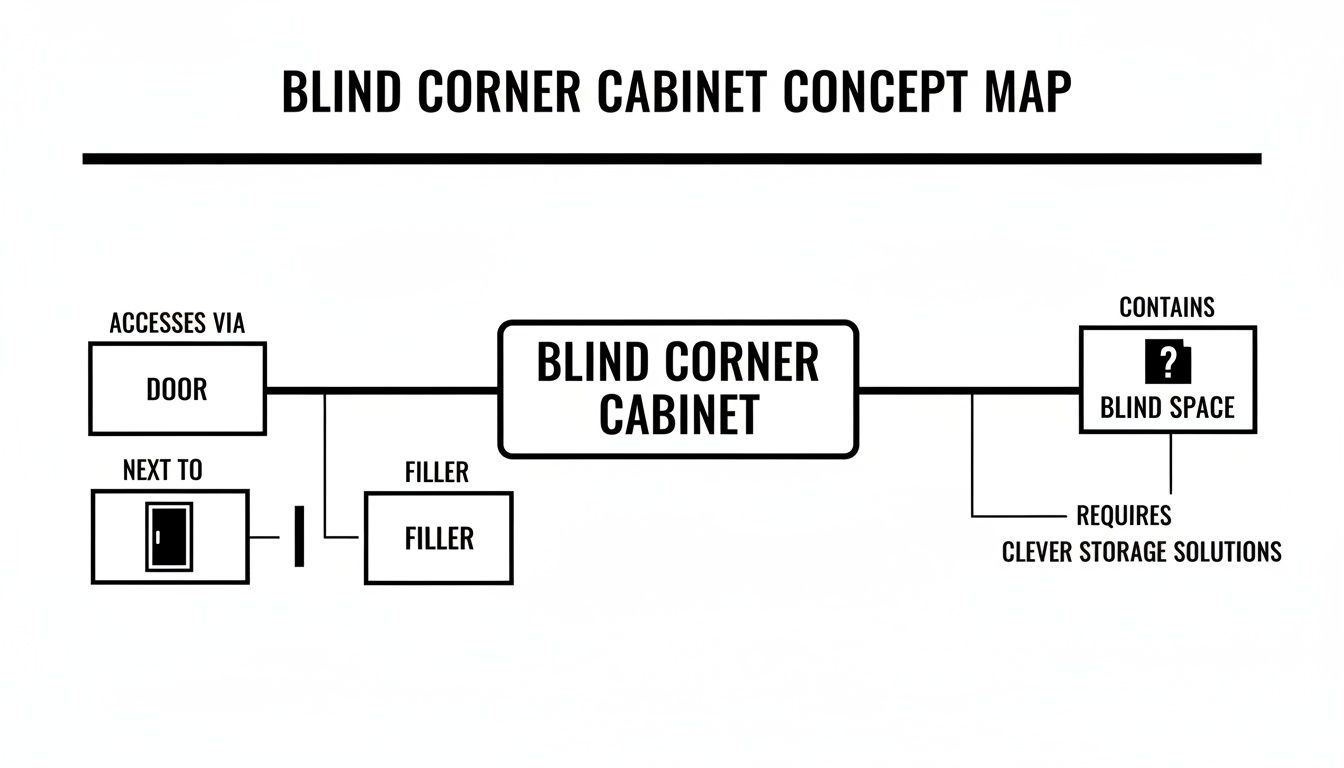
This visual really breaks down the cabinet’s anatomy. You can see how the filler acts as that all-important buffer, giving the internal mechanism enough room to swing out without crashing into the door or adjacent cabinet handles.
Classic and Modern Organizer Types
The oldest trick in the book is the Lazy Susan. These rotating shelves, often shaped like a kidney to fit the unique space, spin around to bring items from the back right to the front. They get the job done, but they don't always make the most of every single square inch of the cabinet's rectangular shape.
For a more modern take, today’s hardware brings accessibility to a whole new level. These systems are engineered to physically pull the entire contents of the cabinet out into your kitchen, right where you can see them.
- Swing-Out Systems: Think of these like a little train on a track. You open the cabinet door, and the first set of shelves (often attached to the door) swings out toward you. As it moves, it pulls a second set of shelves from the deep corner forward into the now-empty space.
- Pull-Out or "LeMans" Systems: Named after the famous racetrack for their smooth, curving motion, these organizers feature cloud- or peanut-shaped shelves that glide independently out of the cabinet. You can pull each shelf out one at a time, giving you incredible access and a clear view of everything on it.
- "Magic Corner" Units: This is the most complex system, combining both swinging and sliding motions in one fluid movement. When you open the door, it pulls the front baskets out and to the side, which then triggers the rear baskets to slide forward into the main opening. It’s probably the most efficient way to bring 100% of the cabinet's contents within easy reach.
To help you visualize these options, here's a quick rundown of the most popular mechanisms.
Comparing Popular Blind Corner Cabinet Organizers
| Solution Type | How It Works | Best For Storing | Accessibility Level |
|---|---|---|---|
| Lazy Susan | Shelves rotate on a central pole, bringing items from back to front. | Spices, cans, small appliances, and pantry staples. | Good – Items are easy to see but can sometimes fall off. |
| Swing-Out System | Front shelves attached to the door swing out, pulling rear shelves forward. | Boxes of pasta, mixing bowls, and everyday cookware. | Very Good – Brings most items out of the cabinet. |
| Pull-Out (LeMans) | Shelves glide independently out of the cabinet in a smooth, curved path. | Heavy pots, pans, stand mixers, and bulky appliances. | Excellent – Full access to each shelf's contents. |
| Magic Corner | A combination system where front baskets swing out, pulling rear baskets into view. | A mix of small and large items; great for maximizing total capacity. | Excellent – Brings nearly all contents out into the open. |
Each of these is engineered to solve the same fundamental problem: making the unreachable, reachable. The best choice really depends on what you plan to store. Heavy pots and pans might need the sturdy, smooth action of a LeMans unit, while smaller pantry items could be perfectly happy on a swing-out system.
Making the Right Choice for Your Kitchen
When you're deciding on an organizer, think about your daily routine. Are you constantly reaching for a heavy stand mixer, or is this corner for lighter, less-used items? Your own mobility and comfort are also huge factors. Some systems bring absolutely everything out to you, while others offer a more modest improvement over a basic shelf.
Ultimately, these systems are what make the modern blind corner cabinet so incredible, turning a historically frustrating space into one of the kitchen's hardest-working storage spots. To see how these systems stack up and figure out which one is the perfect fit for your project, check out our detailed guide on cabinet corner solutions.
How To Choose The Right Corner Solution
Picking the right solution for your blind corner cabinet isn’t a one-size-fits-all decision. It's really about matching the hardware to your lifestyle, your budget, and the very specific demands of your kitchen.
After all, the perfect system for a gourmet chef storing heavy Dutch ovens will look very different from one for a family just trying to keep bulky cereal boxes out of sight.
To find your ideal fit, start by asking yourself a few key questions. What are you actually planning to store in this corner? And how important is it for you to access 100% of the cabinet's contents with minimal effort? Answering these honestly will immediately help you narrow down the options.
Assess Your Storage Needs And Habits
First, think about the items you'll be keeping in there. Heavy appliances like a stand mixer or cast-iron pots demand a seriously sturdy mechanism with a high weight capacity. This makes a LeMans-style pull-out an excellent choice, as its solid shelves and smooth gliding action can handle the load with ease.
On the other hand, if you’re storing lighter items like mixing bowls, Tupperware, or pantry staples, a simpler swing-out system might be perfectly fine—and more budget-friendly. For small, frequently used items like spices or cans, the classic rotating shelf still holds its own. Our guide on what is a Lazy Susan cabinet offers a lot more insight into this timeless option.
Your own physical comfort and accessibility needs are also crucial. If bending down and reaching deep into a cabinet is a challenge, investing in a "Magic Corner" or a full pull-out system that brings everything out to you is a smart move. These systems are specifically designed to minimize physical strain and make your kitchen workflow much, much smoother.
Consider Your Kitchen Layout And Budget
Your kitchen’s layout also plays a huge role in this decision. In a compact L-shaped kitchen, a solution with a smaller swing radius might be necessary to avoid blocking a walkway or another appliance. For larger, U-shaped kitchens, you have a lot more freedom to choose a system with a larger footprint that maximizes every available inch.
The goal is to find the perfect intersection of functionality, aesthetics, and cost. A well-chosen corner solution should not only solve a storage problem but also enhance your daily kitchen experience and blend seamlessly with your cabinet design.
Finally, you have to consider your budget. Basic stationary shelves are the most affordable but are also the least accessible. As you move up the ladder to Lazy Susans, swing-outs, and the more advanced pull-out systems, the cost increases along with the complexity of the hardware.
To make sure you're selecting the best fit for your home, it helps to review the fundamentals of what to look for when buying cabinets. At the end of the day, you need to weigh the long-term value of improved accessibility against the upfront investment to find a solution that offers the best return for your daily life.
Installation And Customization Considerations
Getting a blind corner cabinet into your kitchen is a bit more involved than just sliding a box into an empty space. For it to work flawlessly, you need a solid plan and an eye for the little details that can make or break the whole corner's functionality. A proper installation is what guarantees your fancy new storage solution will glide smoothly for years, not just weeks.
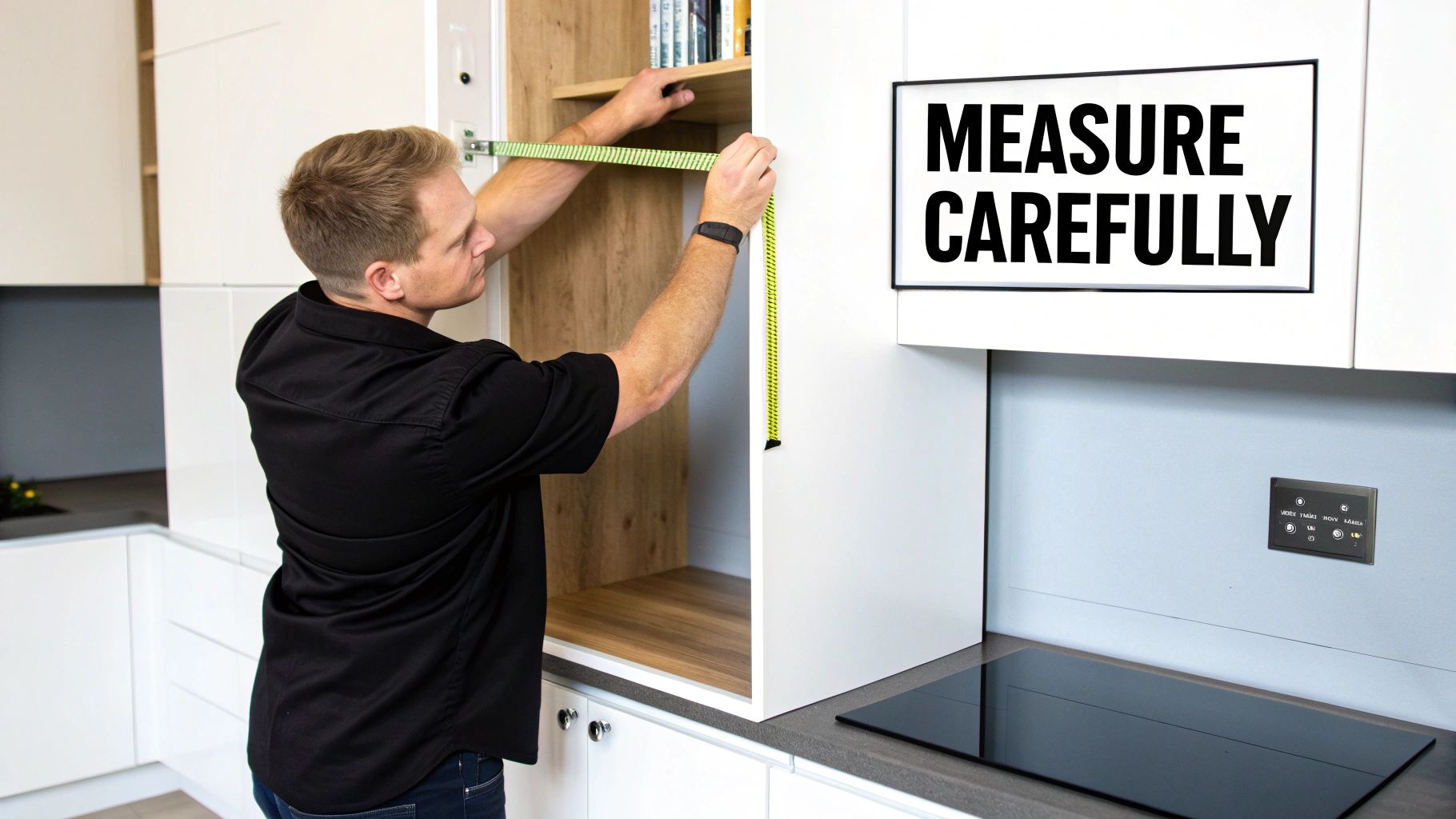
The absolute most important step? Measuring for clearance. Picture this: you install a beautiful swing-out organizer, but the moment you pull it out, it smacks right into your oven handle. It’s a frustratingly common mistake, but one you can easily sidestep by carefully accounting for every adjacent knob, pull, and appliance door.
This is exactly why we often recommend a professional installation, especially for the more intricate systems like a "Magic Corner." An expert installer will make sure every mechanism is perfectly aligned and calibrated, giving you that smooth, wobble-free operation that you’ll appreciate every single day.
Tailoring The Cabinet To Your Kitchen
Customization is where a blind corner unit stops feeling like an add-on and starts feeling like an intentional part of your kitchen's design. The whole point is to achieve a seamless look, not a clunky afterthought. That means matching the door style, finish, and hardware to your existing cabinets is non-negotiable for a cohesive, put-together aesthetic.
But it’s not just about looks. Customization also gets into the nitty-gritty of material selection. You have the freedom to choose high-quality, sustainable materials that reflect your personal values and the overall vibe of your home. It’s also a good idea to think about how everything else fits together—even choices like hardwood flooring in kitchens can influence the final look and feel, creating a truly unified space from the ground up.
The real value of a blind corner cabinet lies in its perfect integration. A successful installation feels like it was always meant to be there, enhancing both the kitchen’s workflow and its visual harmony.
Upgrading Your Existing Corner Space
Already stuck with a dead corner? The good news is you don’t always have to rip everything out and start from scratch. During a kitchen remodel, retrofitting is an incredibly popular and smart option. That existing, underused blind corner can often be brought back to life with a modern organizer.
The process usually involves measuring your current cabinet’s interior dimensions and the door opening to find a compatible system. It’s a fantastic way to inject modern functionality into an older kitchen layout without the cost and hassle of a full cabinet replacement.
Breaking Down the Cost and Value
When you’re mapping out your kitchen budget, it’s easy to just look at the price tag on a blind corner cabinet. But the real story is in the long-term value it brings to your daily life. The total cost is a tale of two parts: the base cabinet itself and, more importantly, the clever hardware you choose to bring it to life.
A basic cabinet with a simple, fixed shelf is always going to be your most wallet-friendly option. No surprises there. The true investment, however, is in the internal mechanism that transforms it from a dark cave into a functional storage powerhouse. A standard Lazy Susan is a modest and effective upgrade, but the price starts to climb as you explore more sophisticated systems like multi-tiered swing-outs, the elegantly gliding LeMans pull-outs, or the intricate "Magic Corner" hardware. These high-end solutions can run from a few hundred to over a thousand dollars, depending on the brand and complexity.
Calculating Your Return on Investment
It’s tempting to balk at the upfront cost of a premium corner system, but it’s better to think of it as an investment—not just in your home’s resale value, but in your own sanity. The return on investment (ROI) here isn't just a number on a spreadsheet; it's about making your kitchen work for you, day in and day out.
Think about it: you're reclaiming a huge chunk of space that was otherwise a frustrating dead zone. A quality organizer turns that forgotten corner into a hard-working storage hub. This single upgrade delivers some serious daily wins:
- Maximized Storage: You suddenly have a massive, easy-to-access spot for bulky pots, heavy pans, or all those small appliances that clutter your countertops.
- A Tidier Kitchen: When everything has a proper home, your counters stay clear. It’s that simple.
- A Better Workflow: No more getting on your hands and knees to dig for a lost lid in a dark abyss. Cooking becomes smoother and far more enjoyable.
Investing in a quality corner solution is less about the one-time expense and more about the daily convenience it delivers. It's a functional upgrade that pays you back every single time you effortlessly pull out exactly what you need from the deepest part of your corner.
Ultimately, a thoughtfully designed blind corner solution doesn't just improve your kitchen's usability; it gives it a high-end feel that potential buyers will definitely notice. It's a strategic move that pays dividends in both your daily satisfaction and your home’s long-term appeal.
Common Questions Answered
Even after getting the basics down, you probably still have a few questions rolling around. It’s completely normal. Let's tackle some of the most common ones we hear from homeowners, so you can move forward with your kitchen remodel feeling confident.
Are Blind Corner Cabinets Better Than Diagonal Ones?
This is a classic kitchen design debate, but the truth is, neither one is universally "better." It all comes down to your kitchen's layout and the look you’re going for.
A blind corner cabinet is the champion of clean, continuous lines. It keeps your cabinetry run looking sleek and uninterrupted, which is perfect for modern or transitional kitchens. You rely on smart hardware to bring the contents of that hidden space out to you.
On the other hand, a diagonal corner cabinet literally cuts the corner, creating an angled front that usually houses a big Lazy Susan. While this gives you a large, easy-to-see storage area, it also creates an angled countertop that can feel a bit bulky, especially in smaller kitchens. The choice really boils down to what you value more: a seamless, modern aesthetic or a single, cavernous storage space.
Can I Add a Pull-Out System to My Existing Cabinet?
Yes, you absolutely can! In fact, retrofitting an older blind corner cabinet with a modern pull-out organizer is one of the most popular and impactful upgrades you can make in a kitchen.
The success of this little project hinges entirely on two things: your cabinet's internal dimensions and the size of the door opening. You'll need to measure carefully to make sure the new hardware has enough room to not just fit, but operate smoothly without catching. For the more complex swing-out or "Magic Corner" systems, getting a professional to take a look is a smart move. They can guarantee a perfect fit and a sturdy, wobble-free installation that will last for years.
Think about it this way: the amount of truly usable space in a blind corner cabinet depends entirely on what’s inside. A simple fixed shelf might only give you easy access to 25-30% of the cabinet's contents. But with advanced swing-out or pull-out systems, that number jumps to 85-95%, bringing nearly everything out into the open.
That’s a huge difference. A smart hardware upgrade doesn't just add a feature; it completely transforms the functionality of your existing space.
Ready to turn your kitchen's awkward corners into some of its most functional, beautiful features? The experts at Sinclair Cabinets specialize in creating custom solutions that maximize every inch of your space with unparalleled craftsmanship. Explore our gallery and schedule your design consultation today.