
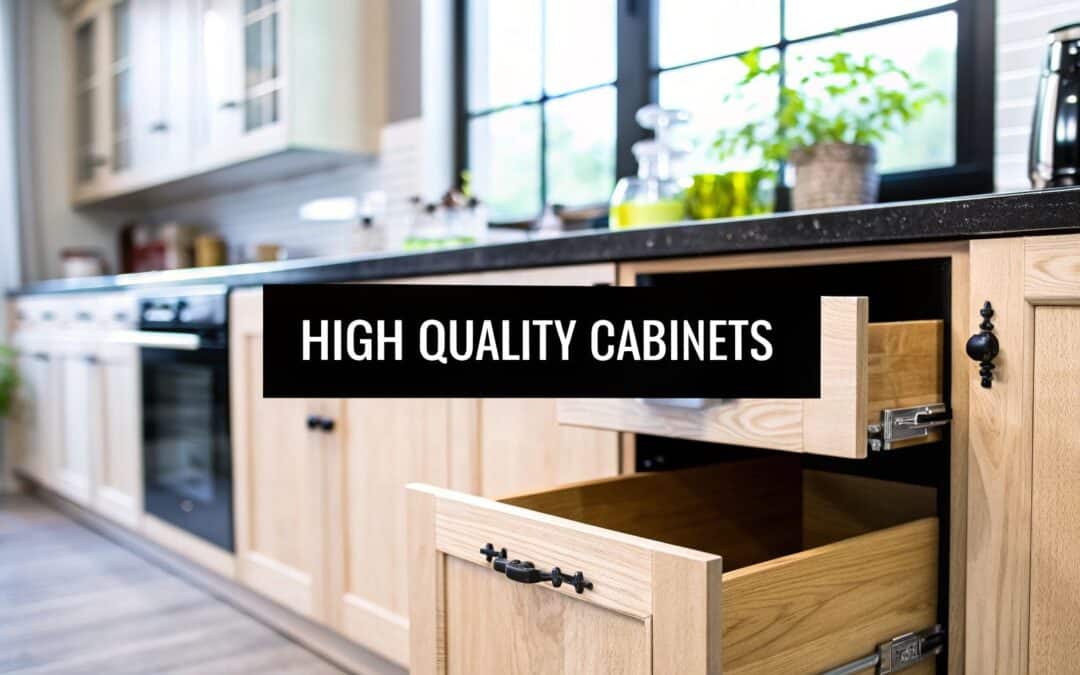
When you start looking at new kitchen cabinets, it’s easy to get caught up in how they look. But what really defines high quality kitchen cabinetry is what you can't always see at first glance. It’s the thoughtful combination of superior materials, solid construction, resilient finishes, and dependable hardware.
Think of it as an investment in your home’s future and your daily sanity. In a quality cabinet, things like premium plywood boxes, solid wood frames, soft-close hardware, and multi-layer finishes aren’t upgrades—they’re the baseline.
What Sets High Quality Kitchen Cabinetry Apart
You can think of high quality cabinets like a luxury watch. On the surface, it’s beautiful and tells time just fine. But the real value is hiding underneath—in the precision engineering, the quality of every tiny component, and the expert craftsmanship that guarantees it will work perfectly for generations. Budget cabinets might look nice when they’re first installed, but they just don't have the structural integrity to handle the bumps, spills, and constant use of a busy kitchen.
True quality comes down to four key pillars. When they work together, they create a product that’s not just stunning but built to last. Getting familiar with these elements is the best way to make a smart, long-term investment in your kitchen.
Before we dive deep into each one, here's a quick overview of what to look for.
Key Indicators of High Quality Cabinetry
A quick reference guide to the four pillars of quality cabinetry we'll explore in this guide.
| Quality Pillar | What to Look For | Why It Matters for Longevity |
|---|---|---|
| Durable Materials | Furniture-grade plywood boxes, solid hardwood doors and frames. | Resists warping, sagging, and moisture damage that plagues particleboard. |
| Expert Construction | Strong joints like dovetail, dowel, or mortise and tenon. | Creates a rigid, durable cabinet box that won't loosen or fall apart over time. |
| Lasting Finishes | Multi-step, factory-applied conversion varnish or catalyzed lacquer. | Provides a hard shell that protects against scratches, stains, chemicals, and humidity. |
| Reliable Hardware | Smooth, soft-close hinges and full-extension drawer glides. | Ensures doors and drawers function flawlessly for years without slamming or sticking. |
Understanding these pillars makes it much easier to spot cabinetry that's genuinely built to last.
The Four Pillars of Cabinet Quality
Knowing what goes into a great cabinet makes the selection process so much clearer. Each of these components plays a huge role in how your cabinets will perform and how long they'll last.
- Durable Materials: This is the foundation. High-end cabinets use furniture-grade plywood for the boxes and solid hardwood for doors and face frames. This combination is essential for preventing the warping and moisture damage that can ruin cheaper cabinets.
- Expert Construction: It’s not just what they're made of, but how they're put together. Look for construction techniques like dovetail or dowel joints. These create incredibly strong, rigid connections—a world away from the staples and glue holding together low-end options.
- Lasting Finishes: A cabinet's finish is its armor against daily life. A multi-step, factory-applied conversion varnish protects wood from scratches, stains, and humidity far better than a simple coat of paint ever could.
- Reliable Hardware: You open doors and pull out drawers every single day. The smooth, quiet action of soft-close mechanisms and full-extension glides are hallmarks of quality that ensure a great user experience for years to come. You can learn more by exploring industry-accepted kitchen cabinet standards.
The real measure of high quality cabinetry isn't how it looks on day one, but how it performs on day one thousand. It’s about silent drawers, perfectly aligned doors, and a finish that resists the chaos of a busy family kitchen.
This shift toward lasting quality is a major driver in the market. Homeowners are increasingly choosing durability and customization, which has fueled significant growth in demand for premium cabinetry. The global kitchen cabinetry market was valued at around USD 56.1 billion and is projected to keep climbing. This shows a clear preference for smarter, long-term investments in the home.
In this guide, we'll break down each of these quality pillars, giving you the confidence to tell the difference between cabinets that just look good and those that are truly built for life.
Exploring Cabinet Materials and Construction
The real heart of any kitchen cabinet is in its bones—the materials it’s built from and how everything is pieced together. A beautiful door style might be what catches your eye, but the structure hiding behind it is what determines whether your investment lasts for five years or fifty. Getting a handle on these core elements is the single most important step in finding high quality kitchen cabinetry.
Think about it like building a house. You wouldn't settle for a weak, crumbly foundation just because it’s out of sight. The same logic applies here. The cabinet box is your foundation, and its material dictates everything from overall strength and moisture resistance to how well it will hold a screw after years of use.
This is where the differences between budget and premium cabinets become impossible to ignore. Let’s break down the most common materials you'll find on the market.
The Hierarchy of Cabinet Materials
Not all cabinet materials are created equal. They range from cheap, compressed wood fibers to incredibly durable, layered plywood, and each has its own set of pros and cons.
-
Particleboard: This is what you'll find in most budget-friendly, off-the-shelf stock cabinetry. It's made by compressing wood chips, sawdust, and resin into sheets. While it keeps costs down, it's a magnet for moisture damage, can sag under the weight of your dishes, and doesn't hold screws well over the long haul.
-
Medium-Density Fiberboard (MDF): A definite step up from particleboard, MDF is engineered from finer wood fibers, which creates a much denser and smoother surface. It’s a fantastic base for paint and veneers because it lacks any wood grain. It’s still quite heavy, though, and can be damaged by long-term exposure to water.
-
Furniture-Grade Plywood: This is the gold standard for high-quality cabinet boxes, period. Plywood is built from thin layers of wood veneer (called plies) that are glued together with the grain of each layer running in the opposite direction. This cross-grained structure makes it incredibly strong, stable, and far more resistant to moisture and sagging than either particleboard or MDF.
-
Solid Wood: Loved for its natural beauty and strength, solid wood is the go-to for cabinet doors, drawer fronts, and face frames. Woods like maple, cherry, oak, and walnut have a timeless appeal that's hard to beat. But while it's perfect for those visible parts, solid wood isn't ideal for large cabinet boxes because it can expand and contract with changes in humidity.
This diagram shows how these essential components—materials, construction, finish, and hardware—all come together to define true cabinet quality.
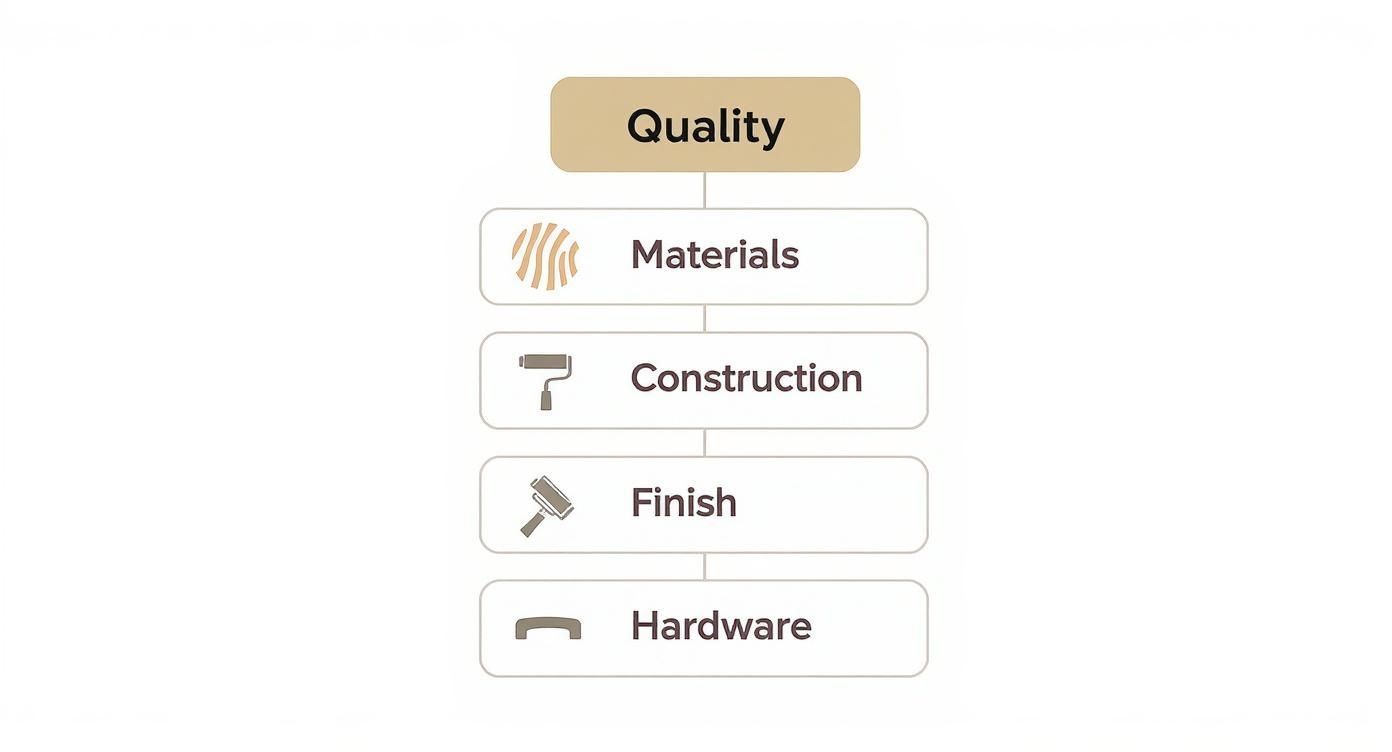
As you can see, a cabinet is only as good as the sum of its parts, and strong materials provide the foundation for everything else to build upon.
For a more detailed comparison, check out our guide to the best materials for kitchen cabinets, where we take a comprehensive look at both luxurious and durable options.
How Cabinets Are Put Together
Beyond just the raw materials, the construction methods—especially the joinery—are what create a rigid, long-lasting structure. It’s the difference between a finely crafted piece of furniture and a cheap, flat-pack item. One uses interlocking joints designed for strength, while the other relies on little more than screws and glue.
To help you spot the difference, here’s a quick comparison of what you’ll find at different quality levels.
Cabinet Material and Construction Tiers
| Feature | Premium Standard (Plywood, Dovetail Joints) | Mid-Range Standard (MDF, Mortise-and-Tenon) | Budget Standard (Particleboard, Glued/Stapled) |
|---|---|---|---|
| Box Material | Furniture-Grade Plywood: Strong, stable, and moisture-resistant. The best choice for longevity. | MDF: Dense and smooth, ideal for painted finishes. Heavier and less moisture-resistant than plywood. | Particleboard: Lowest cost, but prone to sagging and water damage. Poor screw retention over time. |
| Drawer Box | Solid Wood with Dovetail Joints: An incredibly strong mechanical joint that will not pull apart. | Plywood or MDF with Dowel Joints: A step down, but still offers good rigidity. | Particleboard with Staples/Glue: Weakest construction; prone to falling apart with heavy use. |
| Door/Frame Joinery | Mortise-and-Tenon: A classic, powerful joint that ensures frames and doors stay square and stable. | Dowel or Pocket Screws: Functional and common, but lacks the interlocking strength of mortise-and-tenon. | Butt Joints with Staples/Glue: Minimal structural integrity. The first point of failure in low-quality cabinets. |
This table makes it clear: the materials and joinery used are a direct reflection of a cabinet’s intended lifespan and performance. Premium standards are built to last a lifetime, while budget options are often a short-term solution.
-
Dovetail Joints: Instantly recognizable by their interlocking, trapezoidal "pins" and "tails," dovetail joints are a hallmark of true craftsmanship. They create an incredibly strong mechanical lock that is almost impossible to pull apart, making them the best choice for drawer boxes that see constant action.
-
Mortise-and-Tenon Joints: This classic woodworking joint involves fitting a projecting piece (the tenon) snugly into a hole (the mortise). It creates a powerful and stable connection, and it's what skilled cabinetmakers use to join the rails and stiles of cabinet doors and face frames.
-
Dowel Joints: In this method, small wooden pegs (dowels) are used to reinforce joints, adding strength and rigidity. When paired with high-quality wood glue, dowel construction can create a very durable cabinet box.
On the other end of the spectrum, lower-end cabinets often just use staples, nails, and hot-melt glue. These connections have none of the mechanical strength of real joinery and will inevitably loosen over time, especially under the weight of heavy dishes. When you see a cabinet with all-plywood construction and dovetail drawers, you can be confident it was built to last.
Choosing Hardware and Finishes That Endure
Beyond the cabinet box and the door style, the true test of high quality kitchen cabinetry comes down to the parts you touch every single day. The hardware and finishes are where the rubber meets the road—they define your kitchen's daily performance and its ability to stand up to real life. These aren't just finishing touches; they are what separate a kitchen that works from one that frustrates.
Think of cabinet hardware as the engine of your kitchen. Cheap hinges and drawer slides are like an old, sputtering motor. They might work for a bit, but they’ll be noisy, clunky, and eventually, they will fail. Premium hardware, on the other hand, is a finely tuned machine, delivering smooth, silent, and reliable performance day in and day out.
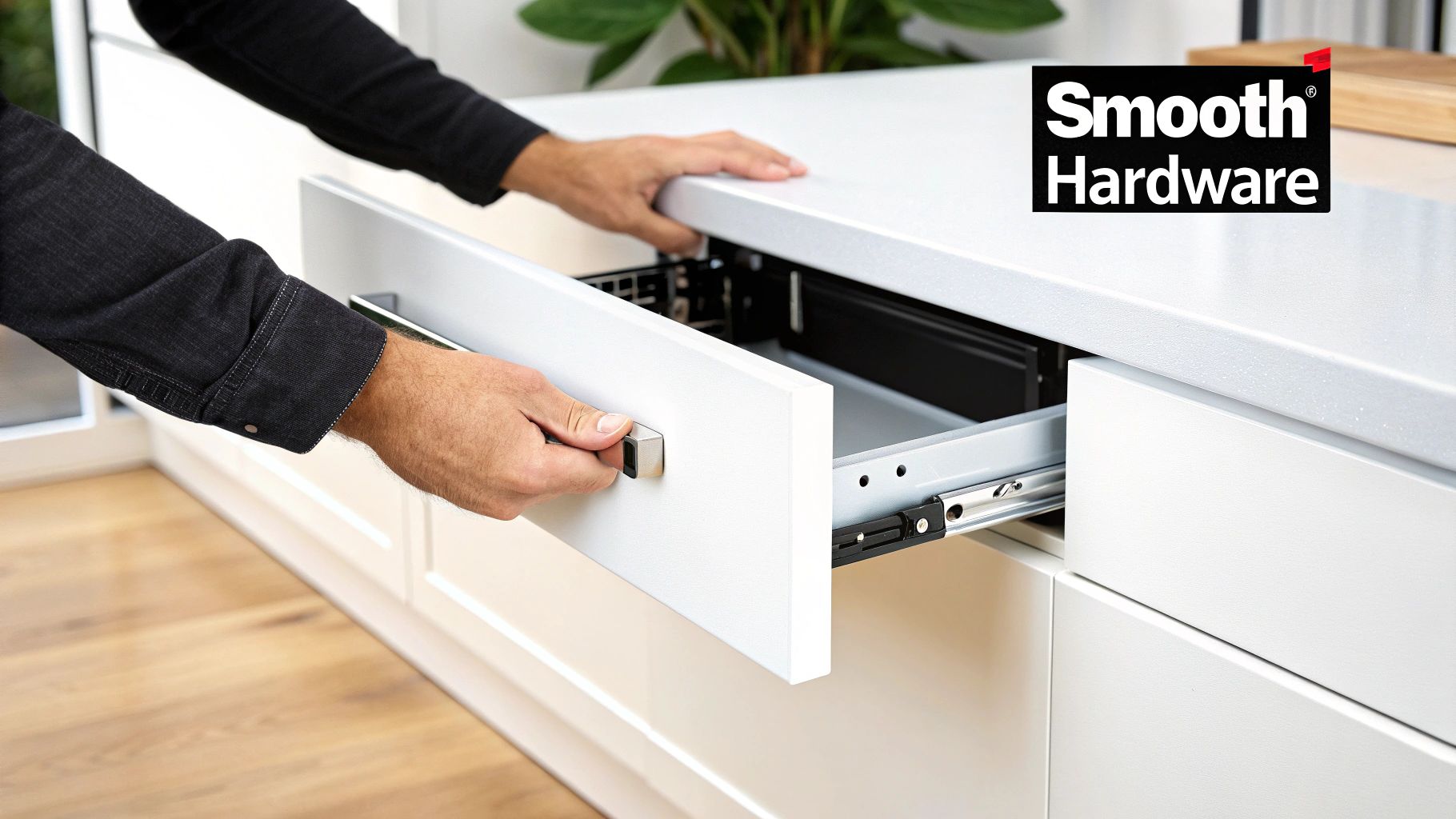
You’ll notice this difference most in the two workhorses of your cabinetry.
Hardware That Defines a Premium Experience
The entire feel of a kitchen boils down to its moving parts. Investing in top-tier hardware elevates the whole experience, turning mundane chores into effortless actions. Two key upgrades make all the difference.
-
Soft-Close Hinges: In high-end cabinetry, these are non-negotiable. Using a hydraulic mechanism, they gently pull the door shut in the final inches, completely silencing that jarring slam. Standard hinges offer no resistance, which leads to loud bangs and puts unnecessary stress on both the door and the cabinet frame over time.
-
Full-Extension, Soft-Close Drawer Glides: This is where quality becomes incredibly practical. Standard glides only let a drawer open about three-quarters of the way, leaving that back section dark and hard to reach. Full-extension glides change the game, allowing the entire drawer to pull clear of the cabinet so you can see and grab everything inside. Add the soft-close feature, and even your heaviest pot-and-pan drawers will close smoothly with just a gentle push.
A kitchen with premium hardware just feels better. It operates with a quiet confidence. Doors never slam. Drawers glide open fully, revealing everything inside without a fight. This is the functional luxury that truly defines a well-built space.
The First Line of Defense: A Superior Finish
If hardware is the engine, the cabinet finish is the armor. It's the single most important barrier protecting the wood from moisture, scratches, stains, and everything else a busy kitchen throws at it. The difference between a quality finish and a basic one is like comparing a durable automotive clear coat to a quick job with a can of spray paint.
A simple coat of latex paint, which is common for DIY projects, might look nice at first, but it offers very little real protection. It stays soft, making it easy to chip, scratch, and stain from everyday spills like coffee or wine.
In stark contrast, high quality kitchen cabinetry gets a much tougher, factory-applied finish. This isn’t just paint; it’s a multi-step chemical process engineered for maximum durability.
The process usually looks like this:
- Sanding: The raw wood is sanded perfectly smooth so the finish adheres flawlessly.
- Stain/Primer: A stain is applied for color, or a specialized primer is used to completely seal the wood.
- Sealer Coat: A sealer is applied and then sanded again, creating an ultra-smooth, non-porous base.
- Topcoat Application: The final layer is a conversion varnish or catalyzed lacquer. This isn't a paint that just dries; it's a finish that chemically cures, hardening into a tough, non-porous shell that stands up to chemicals, moisture, and abrasion.
This intensive process creates a finish that is significantly harder and more resilient than any standard paint you can buy at a store. It's built to handle cleaning agents, resist yellowing from sunlight, and shrug off the inevitable bumps and spills of a busy kitchen, keeping your cabinets beautiful for decades.
For a deeper dive, check out our complete guide to cabinet hardware and finishes to help you make the best choice.
The Value of Smart Customization and Design
Truly high quality kitchen cabinetry is about so much more than sturdy boxes and a pretty finish; it’s about creating a space that’s intelligently designed for how you actually live. Modern customization goes way beyond just picking a door style or a paint color. It gets into the nitty-gritty of how you use your kitchen, turning it from a simple collection of cupboards into a highly efficient, personalized workspace.
Think of it like this: an off-the-rack suit might fit okay, but a tailored suit feels like it was made just for you. Smart cabinet design brings that same bespoke principle right into your kitchen. It’s all about solving those little everyday frustrations with thoughtful, built-in solutions that make the most of every single inch.
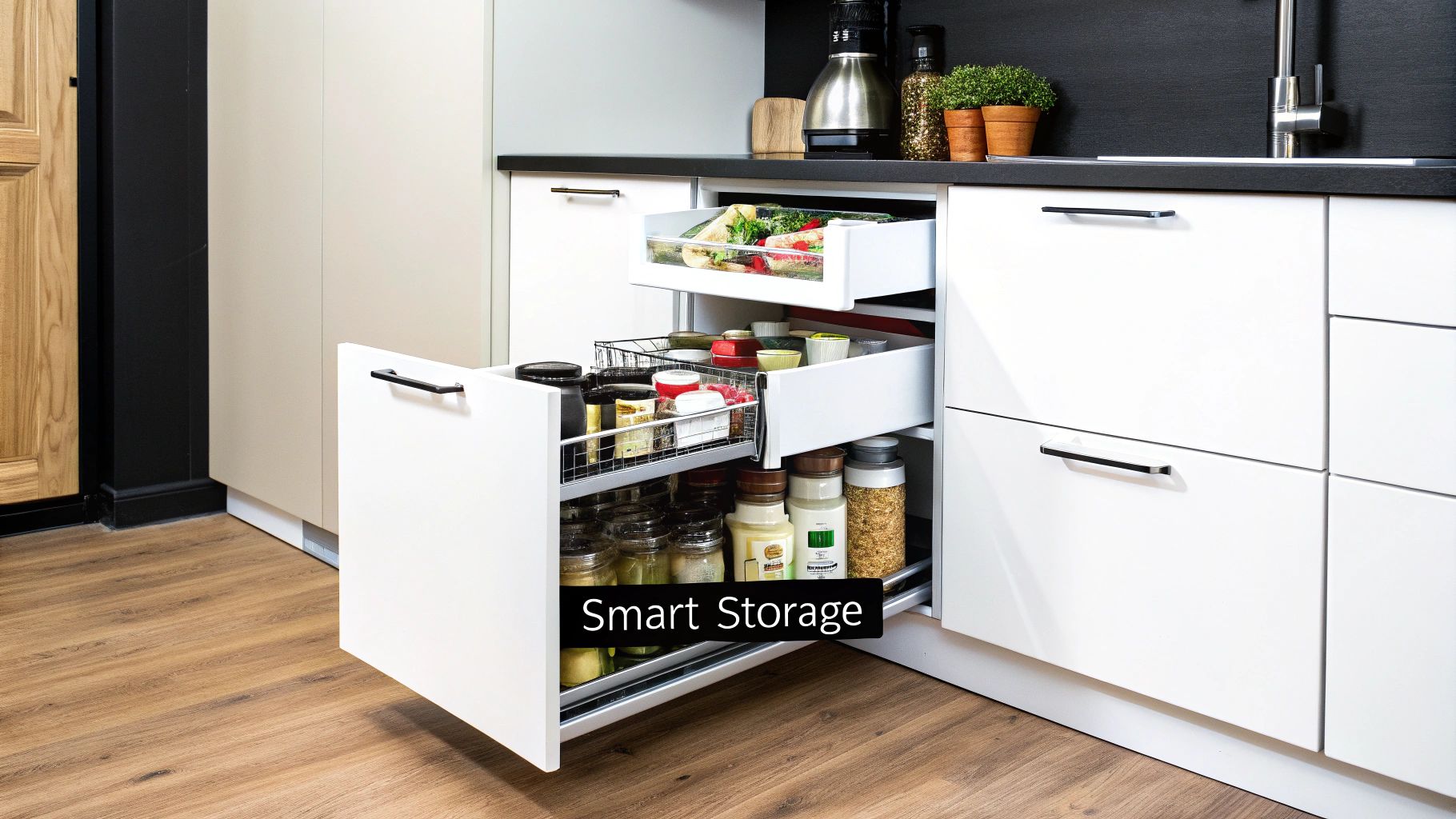
This level of personalization is becoming a top priority for homeowners who see the long-term payoff of a well-designed kitchen. In fact, recent market trends show a clear move away from mass-produced, one-size-fits-all options. Custom cabinets have grown from a 20% market share to 25%, while stock cabinetry has seen a dip. This shift proves that people are demanding better quality and more personality in the heart of their home. You can dig deeper into these cabinet market trends to see for yourself.
Tailored Storage Solutions for Modern Life
A truly functional kitchen cuts down on wasted motion and clutter. Instead of digging through deep, dark cabinets or losing things in those awkward, hard-to-reach corners, custom storage brings everything out to you. This is where a high-quality design proves its worth every single day.
Just look at some of these game-changing solutions:
- Pull-Out Pantries: Tall, slender pantry cabinets with shelves that slide out completely, giving you a perfect view of everything from spices to cereal boxes. No more lost cans in the back!
- Corner Systems: Brilliant solutions like LeMans pull-outs or "magic corners" that swing out from those blind corner cabinets, making what used to be dead space completely useful.
- Integrated Waste and Recycling: Double pull-out bins hidden away inside a cabinet keep your trash and recycling out of sight, freeing up floor space and keeping odors contained.
- Drawer Dividers and Organizers: Custom-fit dividers for cutlery, utensils, and even pots and pans keep your drawers perfectly organized and stop everything from sliding around.
These aren’t just fancy add-ons; they are core components of a kitchen that works with you, not against you. They reduce that daily friction and genuinely make cooking more enjoyable.
Investing in smart design is investing in your own time and peace of mind. A kitchen with intuitive storage doesn’t just look better—it works better, simplifying your daily routine and bringing a sense of order to a naturally chaotic space.
Building a Healthier Home with Sustainable Choices
These days, the definition of "quality" has grown to include the health of your home and the planet. High-quality cabinetry gives you the chance to make responsible choices that benefit your family and the environment. This means looking closely at the materials and finishes that go into your project.
Two key factors are front and center for creating a healthier, more sustainable kitchen:
- Low-VOC and No-VOC Finishes: Volatile Organic Compounds (VOCs) are nasty chemicals found in many paints, stains, and glues. They "off-gas" into your home's air, hurting your indoor air quality. Reputable cabinet makers have moved to low- or no-VOC finishes, which dramatically cut down on these emissions and create a safer space for your family to breathe.
- Sustainably Sourced Woods: Keep an eye out for cabinetry made from woods that are FSC (Forest Stewardship Council) certified. This certification is your guarantee that the wood was harvested from responsibly managed forests that put environmental health and social well-being first.
Choosing cabinets that check these boxes is a powerful move. It shows that you value not only exceptional craftsmanship but also the long-term health of your home. A beautifully designed, sustainably built kitchen is really the ultimate expression of modern quality.
Making a Smart Investment in Your Kitchen
When you start looking into high quality kitchen cabinetry, the first question that pops into your head is probably about the cost. It’s natural to see new cabinets as a huge expense, but a better way to look at it is as a long-term investment—in your home's value and in your own daily life. The price tag really just reflects the quality of the materials, the sturdiness of the construction, and how much you want to personalize it.
Think of it this way: a cheap, off-the-shelf cabinet from a big-box store is a temporary fix. A premium, well-built cabinet is a permanent upgrade. That distinction is everything, because quality cabinetry gives you a return on your investment that goes way beyond the initial bill. It makes your kitchen work better and seriously boosts your home’s resale value for years.
The True Cost of Quality Cabinetry
The price for new kitchen cabinets can swing wildly depending on what you choose. To get a realistic idea, it helps to understand the three main tiers and what each one really offers. This breakdown shows you how the upfront cost lines up with the durability and flexibility you get.
-
Stock Cabinets: These are your most affordable, mass-produced options. They come in standard sizes right off the shelf. While they're easy on the wallet, you get almost no say in customization, and they’re usually built from lower-grade materials like particleboard, which means they won’t last forever.
-
Semi-Custom Cabinets: This is the middle ground. These cabinets give you more freedom with styles, finishes, and sizes. They often use better materials, like plywood boxes, giving you a solid balance between quality and personalization for a mid-range price.
-
Fully Custom Cabinets: This is the top of the line. Custom cabinets are built from scratch to your exact needs. You have total control over the materials, the design, and how they function, which guarantees a perfect fit and unmatched durability. It's the highest-priced option, but it also delivers the greatest long-term value.
This "investment-first" mindset is a huge part of why the global kitchen cabinet market was recently valued at around USD 160 billion. Experts predict it could hit USD 245 billion by 2032, all because homeowners are catching on to the real benefits of durable, high-value renovations.
Return on Investment: The Real Value
Choosing high quality cabinetry pays off in real, tangible ways—both while you're living in your home and when it's time to sell. The payoff isn't just about looks; it’s about creating a kitchen that’s more durable, more functional, and ultimately more valuable.
A well-built cabinet can handle the daily grind without sagging shelves, peeling finishes, or hardware that gives up on you. That durability means you dodge the headaches and costs of repairs and early replacements that are so common with cheaper options. It’s the classic "buy it once, buy it right" approach.
The smartest investment isn’t always the cheapest one. It’s the one that eliminates future costs, enhances your daily experience, and adds measurable value to your home. Quality cabinetry checks all three boxes.
On top of that, a beautifully designed kitchen is consistently one of the best home improvements you can make for increasing resale value. Potential buyers know quality when they see it, and they're often willing to pay a premium for a kitchen with solid, well-crafted cabinets they won't have to tear out in a few years. In a way, the principles are similar to those involved in restoring antique furniture, where good craftsmanship is preserved to maintain and increase value over time.
Your Kitchen Cabinetry Questions, Answered
Making a big decision like investing in new kitchen cabinetry always comes with a few questions. It’s completely natural. To help you move forward with confidence, we’ve put together some straightforward answers to the questions we hear most often from homeowners.
How Long Should High Quality Kitchen Cabinets Last?
When we talk about truly high-quality kitchen cabinetry—the kind built with furniture-grade plywood, solid joinery, and premium hardware—we're talking about a serious long-term investment. You should expect them to last 25 to 50 years, and honestly, with the right care, even longer.
This is a world away from the budget-friendly cabinets you might find at a big-box store. Those are often made from particleboard and tend to show their age within 10-15 years. You'll start to see sagging shelves, peeling finishes, and hardware that just gives up. The incredible lifespan of premium cabinets really boils down to two things: a superior core construction and a finish that can stand up to daily life.
Is Solid Wood Always the Best Cabinet Material?
This might surprise you, but no. While solid wood is absolutely the gold standard for cabinet doors and face frames because of its undeniable beauty and strength, it’s not the best pick for the entire cabinet box. Wood is a natural material, which means it breathes—expanding and contracting with humidity changes. Over time, this can lead to warping.
That's why you'll find that the best cabinet makers almost universally use furniture-grade plywood for the cabinet boxes. Plywood offers what we call "dimensional stability," meaning it resists warping and holds its shape incredibly well through thick and thin. It’s also better against moisture and holds screws much more securely, making it the perfect, unwavering foundation for your cabinet’s structure.
This isn't a compromise. The combination of solid wood for doors and furniture-grade plywood for the box is a strategic design choice. It uses the best properties of each material to give you maximum durability and beauty.
What Is the Biggest Difference Between Stock, Semi-Custom, and Custom Cabinets?
The main differences really boil down to three things: flexibility, the quality of materials, and the way they're built. Each one serves a different kind of project and budget.
- Stock Cabinets: These are the off-the-shelf option. They are mass-produced in standard sizes with a pretty limited menu of styles and finishes. They’re the most affordable, but you get what you get—there's no wiggle room for your kitchen's unique layout.
- Semi-Custom Cabinets: This is the middle ground. You get more choices in sizes, finishes, and cool storage features. The materials and construction are usually a nice step up from stock, offering a bit more personalization without the full custom price tag.
- Custom Cabinets: This is the pinnacle of quality and personalization. Custom cabinets are built from scratch, just for you. You have complete control over every single detail—size, style, material, and function. This guarantees a perfect fit and makes the most of every single inch of your space.
Are Frameless Cabinets Better Than Framed Cabinets?
One isn't "better" than the other; it’s really about the look you're going for and how you use your kitchen. The quality of either style is all about the materials and construction, not the frame itself.
Framed cabinets have a face frame on the front of the cabinet box. This adds rigidity and creates that classic, traditional kitchen look that many people love.
Frameless cabinets, often called "European-style," skip the face frame altogether. This design gives you a sleek, modern aesthetic and offers slightly more interior storage space, since there's no frame in the way. Access to what's inside is just a bit easier, too.
Ready to invest in cabinetry that’s built for a lifetime? At Sinclair Cabinetry inc, we blend expert craftsmanship with modern design to create custom solutions that are as durable as they are beautiful. See how we do it and what makes our quality different.