

Whether you're planning a full kitchen gut job or just a simple cabinet refresh, getting the numbers right is the first and most critical step. From my experience, knowing the standard dimensions isn't just a "nice-to-know"—it's the foundation for a layout that actually works.
Standard kitchen cabinets are built to specific, industry-wide measurements. This ensures that your appliances, countertops, and other key kitchen elements all fit together smoothly without any last-minute surprises. Think of them as the building blocks for your dream kitchen.
A Quick Reference for Standard Cabinet Dimensions
To make your planning a little easier, it's helpful to have a go-to guide for these core numbers. Base cabinets, for instance, are almost always 34.5 inches high and 24 inches deep. Wall cabinets are typically 12 inches deep, and tall pantry cabinets usually come in at 84 or 96 inches high.
Getting a handle on these basics will set you up for success. If you want to dive even deeper, you can explore a complete guide to standard cabinet sizes for the kitchen to see how everything comes together in a real-world design.
This image below breaks down the three most important measurements for a standard base cabinet.
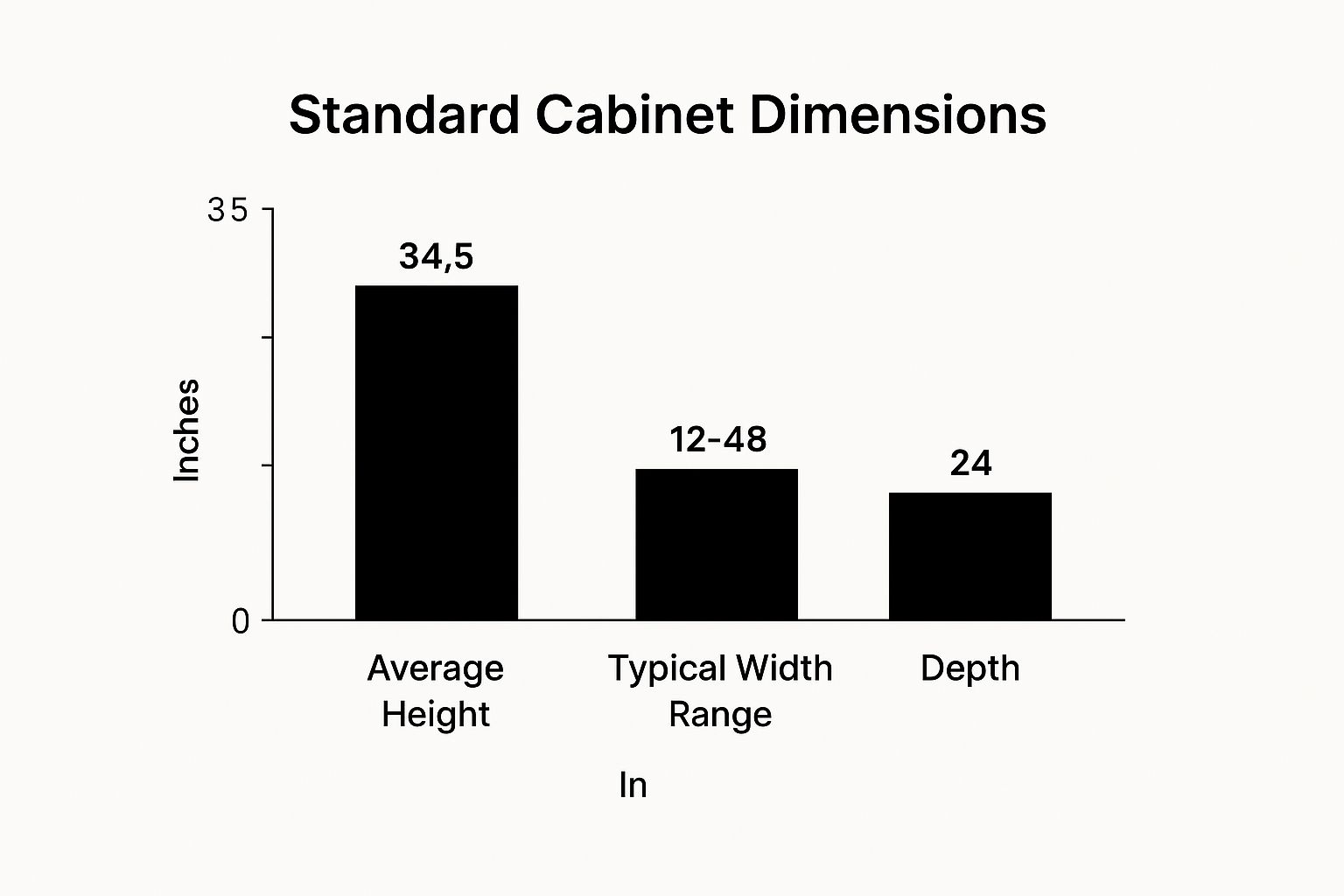
As you can see, the height and depth are pretty much fixed. Where you get your flexibility is in the width. This is what allows you to customize your layout with different cabinet combinations while still working within a standard, predictable framework.
To give you a quick summary of the key measurements all in one place, I've put together this simple lookup table.
Standard Kitchen Cabinet Dimensions Quick Lookup
Here’s a simple cheat sheet with the standard heights, depths, and most common widths for the three main types of kitchen cabinets.
| Cabinet Type | Standard Height | Standard Depth | Common Widths |
|---|---|---|---|
| Base Cabinet | 34.5 inches | 24 inches | 9, 12, 15, 18, 21, 24, 30, 33, 36, 48 inches |
| Wall Cabinet | 12, 15, 18, 24, 30, 36, 42 inches | 12 inches | 9, 12, 15, 18, 21, 24, 27, 30, 33, 36 inches |
| Tall Pantry Cabinet | 84, 90, 96 inches | 18 or 24 inches | 18, 24, 30, 36 inches |
Keep this table handy as you start sketching out your plans. It will help you visualize how different units can fit together to create a functional and cohesive kitchen layout.
Exploring Kitchen Base Cabinet Dimensions
Base cabinets are the true workhorses of any kitchen. They form the foundation for your countertops and do the heavy lifting, storing everything from bulky pots and pans to small appliances. Getting their dimensions right is the secret to a kitchen that’s not only functional but also comfortable to work in. These aren't just random numbers; they've been refined over decades to fit the way we actually live and cook.
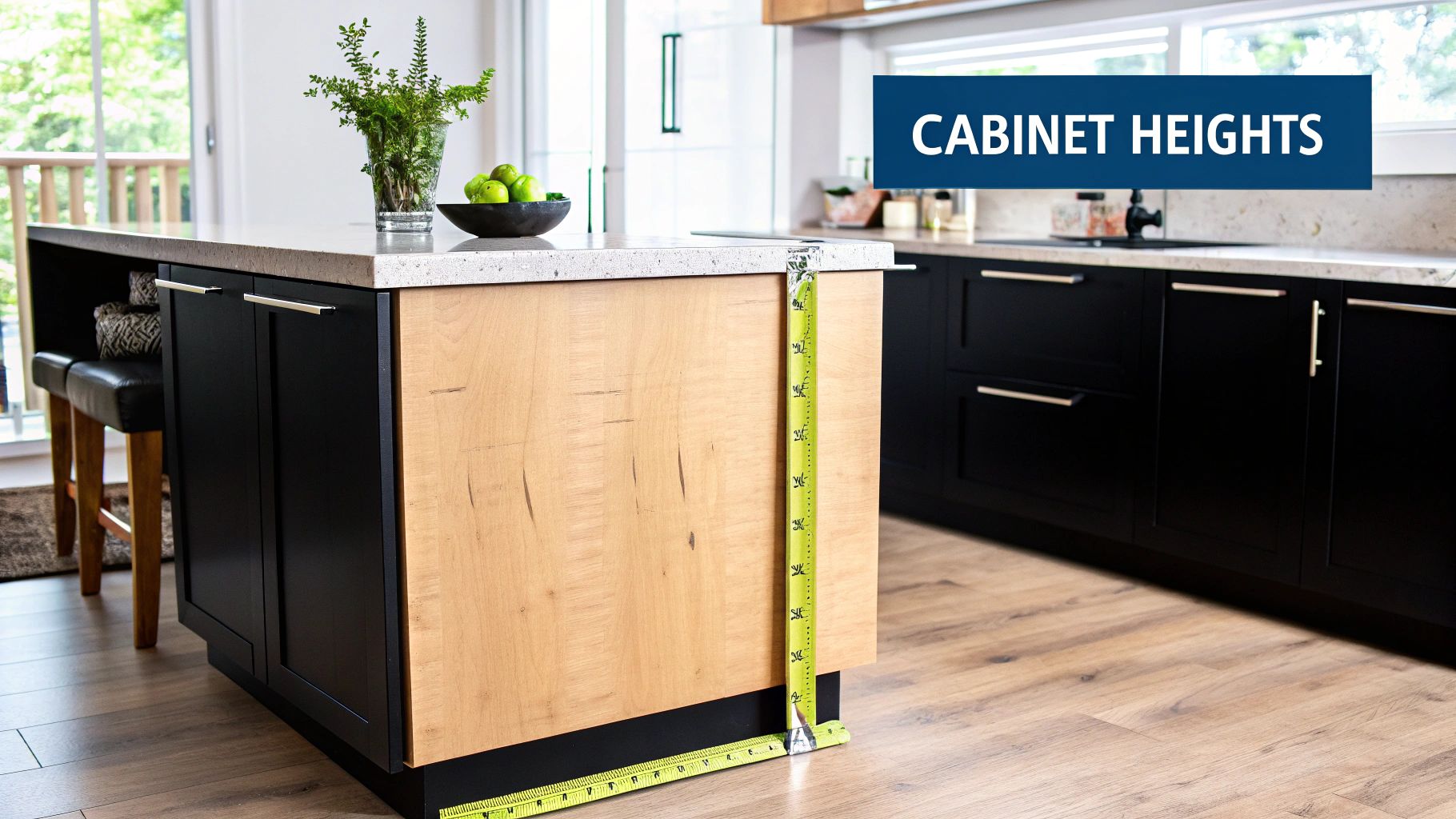
The universally accepted standard height for kitchen base cabinets is 34.5 inches (that's about 880 mm). This isn't by accident—it’s specifically designed so that when you add a typical countertop, your final work surface hits that ergonomic sweet spot of 36 inches (around 910 mm). For depth, the go-to measurement is a clean 24 inches, giving you plenty of storage space without crowding your walkways.
Breaking Down Widths and Functions
While height and depth are pretty much set in stone, the width of your base cabinets is where you get to play and really customize your layout. Cabinet widths typically come in 3-inch increments, which makes planning your space down to the last inch much easier.
- 9 to 18 Inches: Think of these as your problem-solvers. These skinny cabinets are perfect for filling odd gaps or for specialized storage like pull-out spice racks, tray dividers, or even a small trash bin.
- 24 to 36 Inches: This is your bread-and-butter range. These widths are what you'll use for most of your layout, accommodating standard drawer banks, a 30-inch single-basin sink, or a 36-inch double-basin sink.
- 36 to 48 Inches: When you've got the room, these larger units are fantastic for corner solutions like a Lazy Susan or for housing an oversized farmhouse sink. They absolutely maximize storage in bigger kitchens.
A successful kitchen cabinet renovation hinges on mapping out these dimensions carefully to create a space that looks great and works even better.
Don’t forget the toe-kick! It's that little recessed space right at the bottom of your base cabinets. The standard is 4 inches high by 3 inches deep. It might seem like a small detail, but that notch is what lets you stand comfortably close to the counter without stubbing your toes.
A Guide to Wall Cabinet Dimensions
Wall cabinets, or "uppers" as they're often called in the trade, are where you can really start to define your kitchen's personality. They're critical for providing accessible, eye-level storage, but unlike their base cabinet counterparts, their dimensions offer a lot more variety. This lets you tailor the look and feel of your space, but there are still some key standard cabinet dimensions that guide these choices to make sure the final result is both beautiful and functional.
The first and most critical measurement for any wall cabinet is its depth. The industry standard here is a firm 12 inches deep. This isn't an arbitrary number; it's designed to give you plenty of room for dinner plates, bowls, and glasses without jutting out so far that it blocks your view or cramps your countertop workspace. While some cabinet lines offer 15-inch or even 24-inch depths (often for specialized spots, like over a refrigerator), that 12-inch standard is the go-to for a reason.
Selecting the Right Wall Cabinet Height
The height of your wall cabinets has a huge impact on your kitchen’s overall aesthetic and feeling of spaciousness. Standard heights vary quite a bit, mostly to accommodate different ceiling heights and design goals.
Here’s a breakdown of the most common options:
- 30-Inch Height: This is a classic choice, especially in homes with standard 8-foot ceilings. It gets the job done and leaves a bit of open space above the cabinet.
- 36-Inch Height: Also great for 8-foot ceilings, this height is perfect if you want to close that gap at the top. It allows you to add a nice crown molding for a more built-in, finished look.
- 42-Inch Height: If you're lucky enough to have 9-foot ceilings, these are your best friend. Taller cabinets that stretch nearly to the ceiling create a grand, seamless look and give you a ton of extra vertical storage.
As for width, wall cabinets typically follow the same 3-inch increment rule you see with base cabinets, with common sizes ranging from 9 inches all the way up to 36 inches.
Crucial Installation Rule: Always, always maintain a minimum clearance of 18 inches between the top of your countertop and the bottom of your wall cabinets. This space is absolutely vital for fitting small appliances like coffee makers and stand mixers underneath. More importantly, it gives you enough elbow room to work comfortably. Squeezing this space is a classic design mistake that can make your prep areas feel tight and frustrating to use.
A Guide to Tall Cabinet and Pantry Dimensions
Tall cabinets are the workhorses of kitchen storage. These are your floor-to-ceiling powerhouses, perfect for pantries, broom closets, or those sleek, built-in oven units. Unlike their base or wall counterparts, their main job is to squeeze every last inch of storage out of your room's vertical space. Getting their dimensions right is absolutely essential for creating a kitchen that not only looks cohesive but functions beautifully.
The single most important measurement for a tall cabinet is its height. You'll typically find three industry-standard heights to choose from: 84, 90, and 96 inches.
-
84-Inch Height: This is a classic choice for homes with standard 8-foot (96-inch) ceilings. It leaves a neat 12-inch gap at the top, which is perfect for adding decorative crown molding to create a high-end, finished look. Some people even leave it open for displaying decor.
-
90-Inch Height: This height is a great fit for rooms with ceilings that are a bit taller than the standard 8 feet. It also works well when you want to create a more dynamic, staggered look by pairing it with taller-than-average wall cabinets.
-
96-Inch Height: If you have 8-foot ceilings and want that fully integrated, custom built-in feel, this is the one. A 96-inch cabinet goes straight to the ceiling, eliminating that awkward, dust-collecting gap. It's the key to achieving a truly grand and seamless kitchen aesthetic.
Depth and Width Considerations
When you're thinking about how far a tall cabinet will stick out from the wall, the standard depth is 24 inches. This isn't just a random number; it’s specifically designed to line up perfectly flush with your base cabinets and countertops. This alignment creates a clean, uninterrupted visual line, which is especially important when you have a pantry cabinet right next to a refrigerator enclosure.
While you can sometimes find a shallower 12-inch depth, it's far less common. You'd typically only use that in a tight spot where you're worried about walkway clearance.
For width, the standard options give you a good bit of flexibility, usually coming in at 18, 24, 30, or 36 inches. An 18-inch-wide unit makes an amazing pull-out pantry for a narrow space, while a beefier 30- or 36-inch cabinet can easily house a double oven or hold enough food to feed a small army.
Practical Example: The Double Oven Cabinet
Planning to install a double oven? Pay very close attention to the appliance manufacturer’s spec sheet. A standard 30-inch-wide oven, for example, will almost always require a cabinet that's at least 30—or even 33—inches wide. This extra space is critical for ensuring proper ventilation and making sure the appliance actually fits. Always, always confirm the required cutout dimensions before you order your cabinets.
Standard Dimensions for Bathroom Vanities
While kitchen cabinets tend to follow a pretty strict set of rules, bathroom vanities play by their own game. Their dimensions are unique, specifically tailored for smaller spaces and the different ways we use them day-to-day.
Unlike kitchen base cabinets, which almost always stand at a uniform 34.5 inches, standard bathroom vanities are usually shorter. You'll typically find their heights range from 30 to 34 inches. This creates a lower profile that's more suitable for tasks like washing your hands or face. As a bonus, this shorter stature helps make compact bathrooms feel more open and less crowded.
Understanding Vanity Depth and Width
Bathroom vanity depth is also quite a bit shallower than what you’d find in a kitchen. Instead of the standard 24-inch depth, most vanities measure between 18 to 21 inches deep. This is a really practical design choice that saves valuable floor space in often-cramped bathrooms and better accommodates various plumbing setups.
When it comes to width, you'll find the most flexibility, which makes it easier to find the perfect fit for your specific layout.
- Compact Models (24 to 30 inches): These are your go-to for powder rooms or small guest baths. They usually have a single sink and provide just enough counter space and storage for the essentials.
- Mid-Size Vanities (36 to 48 inches): This is the sweet spot for most primary or secondary bathrooms. These models offer a generous single-sink setup with plenty of counter space and a good amount of storage underneath.
- Double-Sink Units (60 to 72 inches): Perfect for spacious master bathrooms, these larger vanities feature dual sinks. They're fantastic for eliminating those morning traffic jams and maximizing personal storage for two people.
If you want to dig a little deeper into these measurements, check out our standard bathroom cabinet dimensions guide for more detailed information.
A Note on Comfort Height Vanities
There's a growing trend toward "comfort height" or "counter height" vanities. These models stand at 36 inches tall (including the countertop), matching the more ergonomic height of a standard kitchen counter. This is an excellent option for taller individuals or anyone who'd rather not bend over as much.
Why Standard Cabinet Dimensions Are a Big Deal
While custom cabinets are fantastic for creating a one-of-a-kind space, there's a lot to be said for sticking with standard cabinet dimensions. Honestly, these established measurements bring some serious practical and financial upsides to any project. They aren't just random numbers; they’re more like a universal language spoken across the entire home design and construction world.
Following these standards allows manufacturers to produce cabinets in bulk, which is great for your wallet because it makes them more affordable and easier to find. It also takes a lot of guesswork out of the renovation process. When you choose cabinets with standard sizes, you can be confident that appliances like dishwashers, ranges, and refrigerators will slide right into place without needing expensive, last-minute changes. This predictability even helps countertop fabricators, who can work off established depths to cut down on errors and save time. You can get a deeper look at these core measurements in our guide to kitchen cabinet standards.
Creating a Universal Design Language
The benefit of standardization goes way beyond just your project. It’s what allows designers, builders, suppliers, and homeowners to all work from the same playbook.
- Plays Well with Others: It’s the reason you can often mix and match components from different brands and have them fit together without a hitch.
- Predictable and Smart Layouts: Designers can whip up efficient, user-friendly kitchen plans because they know the key measurements are already set.
- Easy Replacements Down the Road: If a cabinet door gets damaged years from now, finding a standard-sized replacement is a whole lot simpler than commissioning a custom one-off piece.
This common language isn't just for builders. It’s also incredibly important for other pros, like those involved in understanding real estate floor plans, where precise, predictable dimensions are everything.
The global kitchen cabinets market was valued at around USD 100.79 billion in 2024 and is expected to keep growing. That kind of massive scale really depends on standardized sizes to make manufacturing and global trade efficient. Think of standard cabinet dimensions as the foundation of a global design language.
Common Questions About Cabinet Dimensions
Even with all the standard numbers laid out, a few specific questions always seem to pop up during the planning phase. Let's tackle some of the most common queries we hear from homeowners, so you can iron out those final details and keep your project moving smoothly.
Customization and Spacing
Can I Get Custom Cabinet Dimensions?
Absolutely. Custom cabinets can be built to virtually any size you can dream up. This is the go-to solution for rooms with funky layouts, non-standard appliances, or if you just have very specific ideas for storage that stock sizes can't meet.
Just keep in mind that custom work comes with a higher price tag than standard or even semi-custom options. For most homes, sticking to standard dimensions gives you the best blend of function and value.
What Is the Standard Space Between Cabinets and an Island?
Giving yourself enough elbow room is one of the most important parts of a functional kitchen design. The National Kitchen & Bath Association (NKBA) recommends a walkway of at least 42 inches between your main cabinets and a kitchen island.
If you expect two or more people to be cooking or working in the kitchen at the same time, you'll want to bump that clearance up to 48 inches. This ensures everyone can move around safely and all your cabinet and appliance doors can open fully without bumping into anything.
Pro Tip: How Do I Measure My Space for Standard Cabinets?
Grab a tape measure and a notepad, and start by sketching a rough outline of your room. Measure the total length of each wall where you plan to install cabinets. Critically, you need to mark the exact locations of windows, doorways, light switches, outlets, and any plumbing lines. It’s also smart to measure your ceiling height in a few different spots, as older homes especially can have surprising variations.
Dimensions Beyond the Kitchen
Do Closet Cabinet Dimensions Differ from Kitchen Cabinets?
They sure do. While you might occasionally see a 24-inch deep cabinet in a high-end closet for hanging clothes (the same depth as a kitchen base cabinet), it's not the norm.
Closet systems are all about maximizing usable space, so shallower depths of 12 or 16 inches are far more common for shelving. Standard widths for closet modules also tend to be 18, 24, or 30 inches, giving you the flexibility to mix and match for a truly personalized organization system.
Ready to bring your vision to life with cabinets that fit your space and style perfectly? The experts at Sinclair Cabinetry inc have over 35 years of experience crafting high-quality, real wood cabinetry for every room in your home. Explore our custom kitchen, bathroom, and closet solutions today!