

Here's the rewritten section, crafted to sound like an experienced human expert, following the provided style guide and examples.
At its core, the choice boils down to this: refacing is a cosmetic facelift that keeps your existing cabinet boxes to save time and money. A full replacement is a structural gut-and-rebuild that gives you total design freedom. Deciding which route is best for you—cabinet refacing cost vs. new cabinets—really depends on the current state of your kitchen, your budget, and what you're ultimately trying to achieve with your renovation.
Refacing vs. Replacement: What’s the Real Difference?
When you’re mapping out a kitchen remodel, the terms "refacing" and "replacing" might sound similar, but they describe two completely different projects. Getting this distinction right is the first step toward making a confident, smart decision for your home. One path is a highly efficient refresh, while the other is a complete transformation from the ground up.
Cabinet Refacing: A Strategic Update
Think of cabinet refacing as giving your kitchen a brand-new skin. The "bones"—the cabinet boxes securely mounted to your walls—stay exactly where they are. The work is all about updating everything you see and touch.
The process involves:
- New Doors and Drawer Fronts: This is where the magic happens. You get to pick entirely new styles, whether you're going for clean, modern slab doors or timeless Shaker designs.
- Fresh Veneer or Paint: The cabinet frames and any exposed sides are covered with a thin layer of real wood veneer or professionally painted to perfectly match your new doors.
- Updated Hardware: New pulls, knobs, and hinges tie the whole look together, making everything feel cohesive and modern.
This approach is perfect for anyone who is generally happy with their kitchen’s layout but is tired of its dated look.
Key Insight: Refacing is a powerful cosmetic fix. It delivers the feel of a brand-new kitchen at a fraction of the cost and with far less disruption to your daily life.
Cabinet Replacement: A Total Overhaul
Cabinet replacement is exactly what it sounds like—a complete tear-out of your old cabinetry followed by the installation of brand-new units. This is a much bigger job, often taking everything down to the studs so you can start with a blank slate.
You’d go this route if your goals are bigger than just a style update. For instance, replacement makes sense if:
- Your existing cabinet boxes are warped, water-damaged, or just falling apart from old age.
- You want to completely change your kitchen's footprint, like adding an island, moving the sink, or reconfiguring appliances.
- Your current cabinets are made of cheap particleboard, and you’re ready to upgrade to durable, solid wood construction.
This process gives you unlimited freedom to customize, but it naturally comes with a higher price tag and a much longer project timeline.
Here’s a simple way to see the core differences side-by-side:
| Feature | Cabinet Refacing | Cabinet Replacement |
|---|---|---|
| Core Process | Keeps existing cabinet boxes; replaces doors, drawers, and veneers. | Complete removal and installation of entirely new cabinets. |
| Kitchen Layout | Remains the same; no changes to the cabinet footprint. | Fully customizable; allows for complete layout redesign. |
| Best For | Cosmetic updates when cabinet boxes are in good condition. | Structural issues, layout changes, or a desire for all-new materials. |
| Primary Goal | Refreshing the aesthetic on a moderate budget. | Transforming kitchen function, flow, and overall quality. |
Comparing The Financial Investment Of Your Cabinet Project
When you're weighing cabinet refacing cost vs new cabinets, the numbers really do tell a big part of the story. It's crucial to understand where your money is going in each scenario. This isn't just about the final price tag; it's about the value you get for every dollar you invest in your kitchen.
Think of it this way: a complete cabinet replacement is a major capital investment. You're paying for brand-new cabinet boxes, doors, drawer fronts, hardware, and all the labor that comes with tearing out the old and installing the new. Refacing, on the other hand, is a much more strategic approach. It keeps the most expensive part—the cabinet structure—and focuses your budget on the visible surfaces that completely redefine your kitchen's style.
Breaking Down The Costs
Cabinet refacing has become an incredibly popular choice for a reason—it’s a cost-effective alternative that offers some serious savings. Based on 2024-2025 data, the average cost to reface kitchen cabinets falls somewhere between $4,000 and $15,000, depending on your choice of materials and the size of your kitchen.
In contrast, a full cabinet replacement typically starts around $10,000 and can easily shoot past $30,000, with high-end custom projects even exceeding $45,000. That means refacing can cost anywhere from 50% to 78% less than a full tear-out.
Looking at it per linear foot gives you an even clearer picture:
- Refacing: Averages around $100 to $250 per linear foot.
- Replacement: Can jump from $500 to over $1,200 per linear foot, especially for custom jobs.
This infographic breaks down how the two projects compare in terms of both cost and the disruption to your home life.
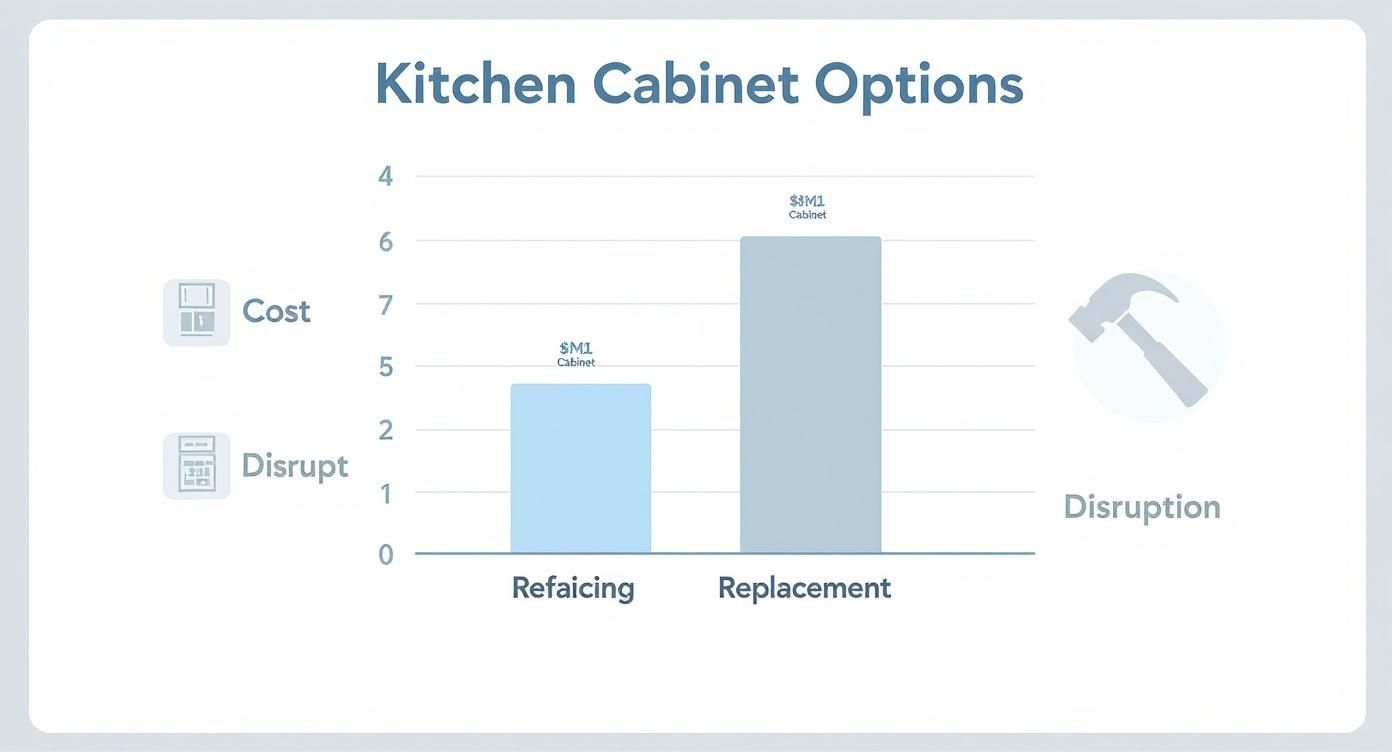
As the chart shows, refacing gives you a significant financial edge while minimizing the time your kitchen is out of commission.
A Side-by-Side Financial Comparison
To really see the financial difference, let’s put the two options head-to-head. The table below breaks down the typical costs you can expect with each project, giving you a transparent look at where your budget goes.
Cost Comparison Cabinet Refacing vs New Cabinets
| Cost Factor | Cabinet Refacing (Average) | New Cabinets (Average) |
|---|---|---|
| Total Project Cost | $4,000 – $15,000 | $10,000 – $30,000+ |
| Cost Per Linear Foot | $100 – $250 | $500 – $1,200+ |
| Material Expenses | Moderate (Doors, Veneer, Hardware) | High (Full Boxes, Doors, Shelving) |
| Labor Costs | Lower (Less Demolition & Install Time) | Highest (Demolition, Install, Finishing) |
| Associated Costs | Minimal (Few additional trades needed) | Potential for Plumbing, Electrical, Drywall |
The bottom line is clear: the savings with refacing are substantial. This is mostly because you're using fewer materials and the labor time is significantly shorter.
Where Your Money Really Goes
With a full cabinet replacement, a huge chunk of your budget gets sunk into things you don't even see—the cabinet boxes themselves. On top of that, the demolition process can open a can of worms, revealing hidden issues like damaged drywall or outdated wiring that need to be fixed, adding unexpected costs to your bill. For a deeper look at these figures, you can check out our detailed breakdown of the average cabinet refacing cost.
Expert Takeaway: The primary financial benefit of refacing is efficiency. You are paying only for a cosmetic transformation, not a complete structural rebuild. This targeted spending delivers a high-impact visual update without the premium cost of a full demolition and installation.
Making an informed decision means understanding the total financial picture, just like you would when looking at a water heater replacement cost guide for other home upgrades. The principle is the same: know where your money is going. With cabinet refacing, your investment is focused squarely on the high-visibility elements—new doors, drawer fronts, and hardware—that give your kitchen a fresh, modern look. It's a smarter way to spend that not only saves money upfront but also maximizes the aesthetic return on your investment.
Understanding the Return on Investment for Each Option
When you're weighing cabinet refacing against a full replacement, the initial price tag is only half the story. A savvy homeowner knows to look past the upfront expense and consider the long-term value—the Return on Investment (ROI). This is the key metric that tells you how much of your project’s cost you can realistically expect to get back when you sell your home.
Thinking about the cabinet refacing cost vs new cabinets through the lens of ROI changes the entire conversation. It’s not just about what you spend today; it's about making a smart financial move that pays off down the road.
Why Refacing Often Delivers a Higher ROI
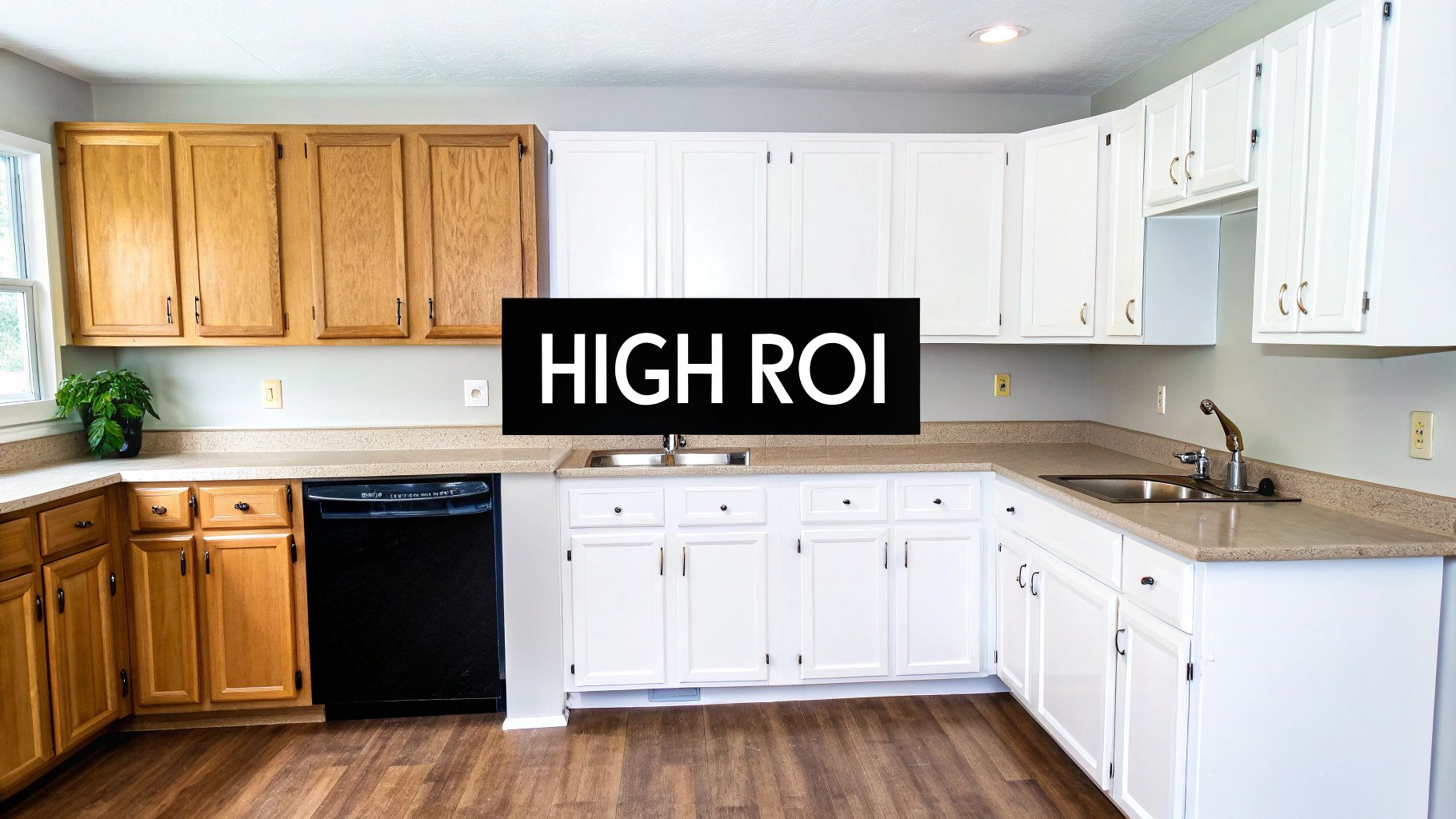
Cabinet refacing almost always beats a full replacement on ROI for one simple reason: it delivers a high-impact, visual transformation for a much lower cost. A potential homebuyer walks in and sees a modern, updated kitchen. They don't know the cost-effective method you used to get there—they just see a high-value feature that looks brand new.
This is where refacing really shines as a strategic financial tool. You’re putting your money into the most visible parts of your kitchen—the doors, drawer fronts, and hardware—that define its style, without pouring cash into new cabinet boxes that add very little to the overall look.
A Look at the Numbers
The data makes this value proposition crystal clear. Recent cost-vs-value reports show that a mid-range kitchen remodel that includes cabinet refacing averages just over $27,000. On the flip side, a similar project with a full cabinet replacement can easily soar to nearly $80,000. That's a massive cost difference of over 60%.
But here’s the most compelling number: the return. Cabinet refacing projects boast an impressive ROI of around 96.1%. For every $100 you spend, you can expect your home's value to increase by about $96. New cabinets, however, typically deliver a much lower return, landing somewhere between 38% and 49.5%.
The financial choice is pretty obvious for any homeowner focused on getting the most value for their dollar.
The ROI Equation: The lower upfront cost of refacing, combined with its dramatic visual impact, creates an unbeatable value proposition. Buyers see what looks like a fully renovated kitchen, and you recoup a much larger percentage of your investment when you sell.
To get a better handle on how this might apply to your own home, it helps to explore the factors that influence your kitchen renovation return on investment.
Situational ROI Scenarios
Of course, the best ROI isn't a one-size-fits-all number; it really depends on your specific situation and the local real estate market. Let’s walk through a couple of real-world examples.
-
Scenario 1: The Pre-Sale Facelift
Imagine a homeowner getting ready to sell in the next year or two. The kitchen works well and has a good layout, but the original oak cabinets are seriously dated. They invest $8,000 in professional refacing with clean, white Shaker doors, which instantly brightens the entire space. This smart, low-cost update makes the home far more attractive to buyers and lets the owner get back nearly every dollar they spent. A $30,000 full replacement would have been a major over-investment with a much lower return. -
Scenario 2: The "Forever Home" Upgrade
Now, think of a family that loves their home and isn't planning on moving. Their kitchen layout is clunky, the drawers are sticking, and the cabinets are just falling apart. In this case, a full replacement makes more sense. While the immediate ROI is lower (around 45%), the real value is in the years of improved functionality, custom storage, and personal enjoyment. The return here is measured less in resale profit and more in lifestyle improvement.
This table breaks down what you can typically expect:
| Project Aspect | Cabinet Refacing | New Cabinets |
|---|---|---|
| Typical ROI | 80% – 96% | 38% – 50% |
| Financial Goal | Maximize resale value | Long-term functional upgrade |
| Best For | Pre-sale updates, budget remodels | Layout changes, fixing structural issues |
| Investment Type | Low-cost, high-return cosmetic | High-cost, lifestyle-focused capital |
Ultimately, the right choice comes down to aligning the project with your personal and financial goals. If maximizing your home's value for a future sale is the top priority, cabinet refacing offers a clear and powerful financial advantage.
Evaluating Project Timelines and Household Disruption
Let’s talk about a resource that’s just as precious as your money: your time. While the financial breakdown of refacing versus replacement is a huge piece of the puzzle, you also have to consider the impact on your daily life. A kitchen remodel can seriously disrupt everything from your morning coffee routine to family dinners.
This is where refacing and replacement head down two very different paths. One is a quick, streamlined update, while the other is a full-blown construction project that demands a much bigger commitment.
A full cabinet replacement can feel like a home invasion, complete with weeks of dust, constant noise, and a kitchen that’s completely off-limits. Getting a handle on these logistical hurdles is key to setting realistic expectations and keeping your sanity.
The Refacing Advantage: Speed and Minimal Disruption
Cabinet refacing is all about efficiency. The whole process is incredibly fast because it skips the single most disruptive part of a remodel: demolition. Your cabinet boxes stay put, which means your kitchen remains mostly usable from start to finish.
The on-site work is where you’ll really see the difference. A refacing project typically takes only 2 to 4 weeks from your first consultation to the final install. Better yet, the actual hands-on installation work is usually wrapped up in just 3 to 5 days. This quick turnaround keeps labor costs down and drastically cuts the time your kitchen is out of commission—a massive win for any busy household.
This streamlined process means:
- Less Dust and Debris: No tear-out means the mess is kept to an absolute minimum.
- Faster Turnaround: You get your kitchen back in days, not weeks or months.
- Reduced Stress: The project is over so quickly it barely makes a dent in your daily routine.
Key Takeaway: Refacing is designed to minimize household disruption. Its speed makes it the clear winner for anyone who wants a high-impact upgrade without turning their home into a construction zone for the long haul.
The Reality of a Full Cabinet Replacement
On the flip side, a full cabinet replacement isn't just a remodel; it's a major construction project. It's a long, invasive process that will leave your kitchen completely unusable for a significant amount of time.
You can expect the timeline for a full replacement to stretch anywhere from 12 to 16 weeks. This lengthy schedule accounts for demolition, potential plumbing and electrical rerouting, drywall patching, flooring updates, and then the cabinet installation. Just getting the custom cabinets built can take several weeks before a single worker steps foot in your home.
A typical replacement schedule looks something like this:
- Demolition (1-2 days): This is the loud, messy part where all the old stuff gets torn out.
- Structural and Utility Work (1-3 weeks): If you need to move pipes or wires, or if there are hidden issues behind the walls, this is when it happens.
- New Cabinet Installation (1 week): The new cabinet boxes are finally installed.
- Countertops, Backsplash, and Finishing (2-4 weeks): Once cabinets are in, countertops can be measured, fabricated, and installed, followed by the final touches.
Each of these steps can run into delays, and living without a kitchen for months can be a serious strain on any family. It's critical to understand the complete kitchen remodel timeline to prepare yourself for the challenges ahead. This isn't just about convenience—it's about the day-to-day reality of living through a major renovation.
How to Decide Between Refacing and Replacing
Making the final call between refacing your cabinets and a full-blown replacement can feel like a huge decision. It really boils down to asking the right questions about your current kitchen and what you hope to achieve. While the cabinet refacing cost vs new cabinets debate usually starts with the budget, the best choice for you is just as much about your layout, the condition of your existing boxes, and your long-term plans.
This isn't about finding one "right" answer. It's about figuring out the smartest path for your specific situation. Let's get past the generic pros and cons and give you a practical way to look at your kitchen and make a call you can feel good about.
Assess Your Current Cabinet Condition
First things first, you need to play detective and give your current cabinets an honest evaluation. The single most important factor here is the structural integrity of your cabinet boxes—the frames that are attached to the wall.
Open up your cabinets and really look at them. Are the boxes still solid and square? Be on the lookout for any signs of water damage, like swollen wood, dark stains, or peeling layers, especially under the sink area. If your boxes are made from sturdy plywood or solid wood and they're in good shape, then you've got a great foundation for refacing.
On the other hand, if your cabinets are made of cheap particleboard that's starting to crumble, sag, or show major wear, refacing is off the table. Trying to cover up a failing structure is like putting a brand-new roof on a house with a cracked foundation. It's a temporary cosmetic fix that's guaranteed to cause bigger headaches down the road.
Evaluate Your Kitchen Layout and Functionality
Next, take a step back and think about how your kitchen actually works for you day-to-day. Are you happy with the current layout? Or do you find yourself doing laps around an awkwardly placed island just to get from the fridge to the sink?
Cabinet refacing is the perfect move when your main goal is a cosmetic facelift. It works on the assumption that you're pretty happy with the existing footprint of your kitchen.
You should lean toward refacing if:
- You like where your appliances, sink, and countertops are located.
- You have enough storage space for all your pots, pans, and groceries.
- Your main goal is to update the look—say, going from dated oak to a clean, modern white Shaker style.
But if your kitchen feels cramped, inefficient, or just plain outdated from a functional standpoint, a full replacement is the only way to go. You simply can't change the layout by refacing.
You’ll have to choose replacement if:
- You dream of adding a kitchen island or a spacious pantry cabinet.
- You want to move the dishwasher or fridge to create a better workflow.
- You want to add modern storage solutions like pull-out spice racks or clever corner lazy Susans that your current cabinet boxes can't support.
Decision Point: If your frustration with your kitchen is more about how it works than how it looks, replacement is your only real path forward. A new layout gives you a clean slate to completely improve the room's flow and usability.
Align the Project with Your Budget and Timeline
Finally, your budget and timeline are going to have a big say in this decision. As we've covered, refacing is significantly cheaper and faster than a full replacement. A typical refacing job can be wrapped up in just a few days, which means less disruption to your daily life.
This makes refacing a fantastic option for homeowners who need a quick, high-impact update without the extended chaos of a gut renovation. It's also a financially savvy move if you're thinking of selling your home in the near future, as it often delivers a higher return on investment.
A full cabinet replacement, however, is a major construction project. It can take weeks, sometimes even months, to complete. It involves demolition, potentially moving plumbing and electrical lines, and coordinating a team of different tradespeople. While it's certainly more expensive and disruptive, the end result is a completely new, customized space designed to last for decades.
Ultimately, your cabinet decision should be part of the bigger picture of any comprehensive kitchen renovation projects, considering the overall design and function. By carefully weighing these key factors—condition, layout, and logistics—you can confidently choose the option that best fits your home, your budget, and your lifestyle.
Key Factors Beyond the Initial Cost
While the price tag is often the first thing people look at when comparing cabinet refacing vs. new cabinets, the real decision lies in the details. A handful of other critical factors come into play, touching on everything from your creative freedom and long-term functionality to the environmental footprint of your project. The best choice is about seeing the full picture to make sure your new kitchen meets all your expectations, not just your budget.
At its core, the most significant difference comes down to design flexibility. Refacing is a fantastic cosmetic update, but it's fundamentally tied to your kitchen's existing layout. You can completely transform the style, color, and vibe of the room, but you can't change the footprint.
Design Limitations And Creative Freedom
Think of cabinet refacing as the perfect solution for a major visual overhaul. If you actually like your kitchen's workflow but are just tired of looking at those dated oak doors, refacing opens up a world of possibilities. You can pick from hundreds of new door styles, finishes, and hardware combinations to get a completely fresh look without the chaos of a full demolition.
However, if your kitchen’s problems run deeper than just aesthetics, refacing is just a band-aid. It won't let you add that pantry you've been dreaming of, create a functional island, or move the sink to a more convenient spot.
The Fundamental Trade-Off: Refacing locks you into your current kitchen layout. If your goal is to truly reimagine the space—to fix a clunky workflow, add smart storage, or reconfigure appliances—a full cabinet replacement is the only way to start from a completely blank slate.
Full replacement is your chance to correct years of frustration. It’s an opportunity to build a kitchen that not only looks beautiful but works exactly how you live.
Material Choices And Structural Integrity
The materials you choose will have a lasting impact on both how your kitchen looks and how well it holds up. With refacing, your choices are all about the "skin" of the cabinets—the new doors, drawer fronts, and veneers. The options are vast, from affordable and durable rigid thermofoil (RTF) to gorgeous, premium wood veneers.
But remember, the final result is only as good as the bones underneath. If your existing cabinet boxes are built from sturdy plywood or solid wood, you've got a fantastic foundation to work with. If they’re made from low-grade particleboard that’s starting to sag or show signs of water damage, simply covering them up is a temporary fix for a much bigger problem.
New cabinets, on the other hand, represent a total upgrade from the inside out. You get to choose the material for the entire structure—solid wood, high-grade plywood, or other modern composites—ensuring your kitchen is built to last. This is especially important if you’re planning to install heavy countertops like granite or quartz, which demand rock-solid support.
The Environmental Impact
In a world where sustainability matters, the environmental cost of a renovation is becoming a bigger part of the conversation. From this angle, cabinet refacing has a clear edge. By keeping your existing cabinet boxes, you're preventing a massive amount of material from being hauled to a landfill.
Let's break it down:
| Factor | Cabinet Refacing | New Cabinets |
|---|---|---|
| Landfill Waste | Minimal (only doors & drawer fronts) | Significant (entire old cabinet system) |
| Resource Use | Preserves existing wood boxes | Requires harvesting new raw materials |
| Carbon Footprint | Lower due to less manufacturing | Higher due to fabrication & transport |
Choosing to reface is an inherently eco-friendly move. It’s a smart form of upcycling that dramatically reduces waste and conserves natural resources. While you can certainly source new cabinets made from sustainable materials, refacing maximizes the value of what’s already in your home, making it the greener choice for anyone looking to minimize their project’s environmental impact.
Have Lingering Questions? Let's Clear Them Up.
Even after weighing all the pros and cons, it's natural to have a few questions holding you back. Deciding between cabinet refacing vs. new cabinets is a big deal, and you want to be completely confident in your choice. Here are answers to a couple of the most common concerns we hear from homeowners.
Does Refacing Really Look as Good as New?
Yes, absolutely. When a professional gets the job done right, the final result is indistinguishable from brand-new cabinetry. Think about it: the doors, drawer fronts, and hardware are all completely new. Every visible surface of your old cabinet boxes gets covered with a fresh, matching veneer.
The secret is in the quality of the materials and the precision of the installation. A high-end finish is all but guaranteed with an experienced hand.
Am I Stuck With My Old Kitchen Style if I Reface?
Not at all—and this is one of the biggest perks of refacing. You are not locked into your old cabinet style. You can pick from hundreds of different door profiles, from traditional raised panels to sleek, contemporary slab doors. The same goes for colors and finishes.
This flexibility lets you completely transform your kitchen’s entire vibe without the mess and expense of ripping out the cabinet boxes.
The Bottom Line: The deciding factor is the condition of your cabinet boxes. Refacing is a fantastic, value-packed solution if they are structurally sound and made from solid wood or durable plywood. But if the boxes themselves are warped, water-damaged, or falling apart, replacement is the only logical choice for a lasting investment.
Ready to explore a high-quality, cost-effective update for your kitchen? The experts at Sinclair Cabinetry inc have over 35 years of experience crafting beautiful, durable cabinet solutions. Learn more about our custom refacing and replacement options at https://sinclaircabinets.com.