

Ever felt like you’re running a marathon just to make a simple dinner? You grab veggies from the fridge, walk across the room to the sink, then trek back to the other side to get to the stove. It’s exhausting, and it doesn’t have to be that way. This is where the kitchen work triangle comes in—a design secret that’s been making kitchens flow better for nearly a century.
The Secret to an Effortless Kitchen: The Work Triangle
The concept is simple but powerful: the three main work areas in any kitchen are the refrigerator (for food storage), the sink (for cleaning and prep), and the stove (for cooking). By arranging these three points in a triangle, you create a clear, efficient path that makes your workflow feel completely natural.
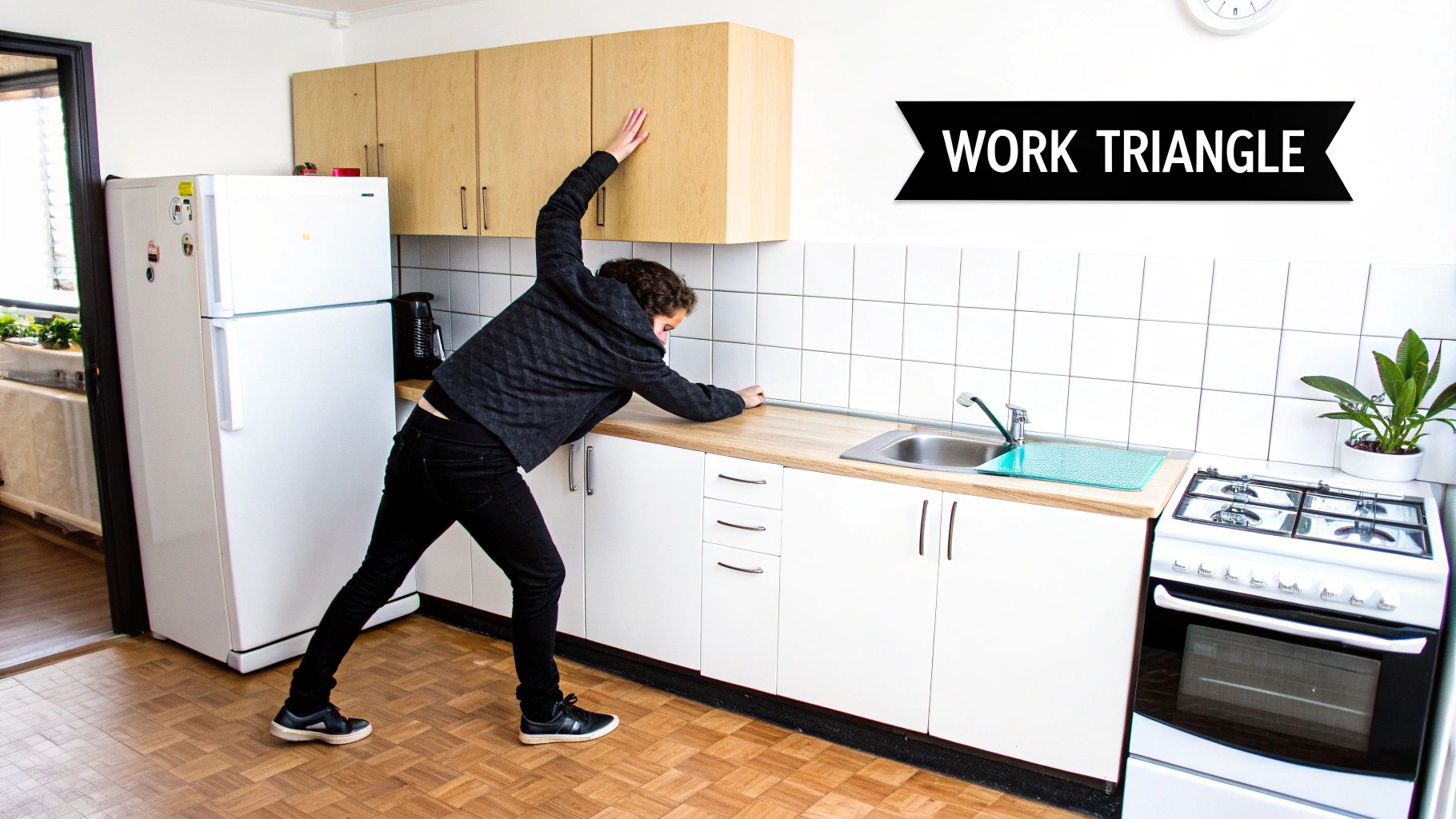
Imagine gliding through your kitchen with an effortless rhythm. You move from the fridge to the sink to wash produce, then pivot to the stove, all without a single wasted step. This seamless experience isn't an accident; it's the result of smart design rooted in the kitchen work triangle. It’s the invisible foundation of a kitchen that just works.
Why This Timeless Concept Still Matters
At its core, the work triangle is all about ergonomics—designing a space that fits you, not the other way around. A well-planned triangle keeps you from feeling boxed in while also making sure everything is within easy reach. It’s the ultimate kitchen shortcut.
By optimizing the path between your key appliances, you reduce physical strain and mental clutter. Cooking becomes a creative pleasure instead of a logistical headache. The benefits are undeniable:
- Better Efficiency: You’ll save time and energy by cutting down the steps between tasks.
- Safer Cooking: A clear, direct path between work zones minimizes the risk of spills, collisions, and accidents, especially when you’re carrying hot pans.
- Smoother Workflow: It creates a logical sequence for meal prep, from gathering ingredients to cooking and cleanup.
- Less Traffic: A good triangle helps keep foot traffic out of your main work area, a lifesaver in busy family homes.
The goal of the work triangle isn’t just to connect three dots on a floor plan. It’s to create a compact, comfortable, and highly functional hub that makes everyday kitchen tasks feel intuitive.
The Building Block of Your Dream Kitchen
Understanding the work triangle is the first, most important step toward creating a space that works as beautifully as it looks. It’s the framework that should guide all your other design choices, from where your cabinets go to which countertops you choose.
Before you fall in love with a finish or a fixture, mapping out this essential pathway ensures your final layout is built for real life. This is where Sinclair Cabinetry’s expertise in custom design really shines. We don’t just build cabinets; we design the entire kitchen around your workflow, using the proven principles of the work triangle to craft a space that’s tailored to how you actually live and cook. It’s this ergonomic foundation that elevates a good kitchen into a truly great one.
Uncovering the Origins of Modern Kitchen Efficiency
The kitchen work triangle wasn’t just a passing design trend; it was a concept born from the science of making life easier. To really get it, you have to picture kitchens in the early 20th century. They were often a jumble of separate, clunky furniture, turning simple daily chores into a real workout. The idea for the triangle didn't come from a home decor magazine—it came from the serious field of industrial psychology.
A new way of thinking was taking hold. Pioneers in efficiency started wondering why the principles that made factories run smoothly couldn't be applied to the home. They began to study the actual movements people made while cooking, cleaning, and storing food, looking for ways to cut out wasted steps and needless effort. It was a revolutionary idea: to bring scientific precision to the heart of the home.
The ultimate goal was to transform the kitchen from a place of drudgery into a highly functional workspace. By observing the natural flow of kitchen tasks, these innovators paved the way for a design standard that would define kitchens for the next century.
The Dawn of Ergonomic Design
The key player in all of this was Lillian Moller Gilbreth, an industrial psychologist and engineer who was a true trailblazer in motion study. Back in the 1920s, she took her factory expertise and applied it to the household, carefully tracking every single step involved in common kitchen jobs. Her research was groundbreaking because it treated the home kitchen with the same analytical rigor as an industrial assembly line.
Gilbreth proved that a smart layout could dramatically reduce physical work. In one of her most famous experiments, she prepared a strawberry shortcake in two different kitchens. In the first, a typical, disorganized setup of the time, the task required a staggering 281 steps. But in her optimized L-shaped kitchen? It took just 45 steps.
That simple comparison was a lightbulb moment. It showed that how you arranged your appliances and cabinets wasn't just about looks—it directly impacted your time and energy.
The core insight was simple yet profound: an efficient kitchen layout could give people back hours of their day and reduce physical fatigue, making home life more enjoyable and productive.
This research laid the foundation for the work triangle in kitchen design. The concept was later officially defined in the 1940s at the University of Illinois School of Architecture, creating a clear, standardized model that would shape post-war home building across America. You can learn more about its historical development on Wikipedia.
From Scientific Theory to Design Standard
Formalizing the work triangle—the path connecting the sink, stove, and refrigerator—gave designers and builders a simple but powerful rule of thumb. It provided straightforward geometric guidelines for creating a workspace that was compact enough to be efficient but not so tight that it felt cramped.
This scientific approach to the work triangle in kitchen design had a huge impact on how we think about modern cabinetry. Cabinets were no longer just boxes on a wall; their placement became a crucial part of a larger system built for optimal workflow. At Sinclair Cabinetry, our entire design philosophy is built on this legacy. We believe every cabinet should not only look beautiful but also contribute to the smart, ergonomic flow of your kitchen. It's thanks to these early standards that today's kitchens are such marvels of efficiency.
Applying the Core Rules of the Work Triangle
So, we've talked about the theory. Now, let's get down to what really matters: applying these rules in your own kitchen. This is where the abstract concept of the work triangle becomes a practical tool for creating a space that just works. These aren't rigid, unbreakable laws, but more like a time-tested recipe for a kitchen that flows without friction.
At its heart, the work triangle is all about a few simple measurements. The goal is to keep your three main work zones—the sink, the refrigerator, and the stove—close enough to be convenient but far enough apart so you aren't tripping over yourself.
The Golden Rule of Distances
First things first: the length of each side of the triangle. Each leg, which is the distance between any two of those key appliances, should be between four and nine feet. This is the ergonomic sweet spot.
Anything less than four feet and your workspace becomes a bottleneck. You’ll feel cramped, boxed in, and constantly bumping into open appliance doors. Stretch it beyond nine feet, and you’re turning a simple pivot into a cross-kitchen hike. It completely defeats the purpose of an efficient layout.
It's like a well-choreographed dance. The steps are close enough for a graceful, connected performance, but there's plenty of room to move freely without bumping into your partner. straying from these dimensions turns that dance into an awkward shuffle or a frantic sprint.
Stick to that 4-to-9-foot range, and you'll find that a single step or a quick turn is all it takes to move from one task to the next.
Calculating the Total Perimeter
Next, look at the big picture. The total perimeter of the triangle—that’s all three sides added together—should fall between 13 feet and 26 feet.
This rule is a fantastic gut check for your overall layout. A total distance under 13 feet usually means your appliances are uncomfortably close, while anything over 26 feet signals a layout that requires way too much walking. Nail this, and you know your kitchen's foundation is solid. Getting these measurements right is a crucial first step, and you can dive deeper into all the other essential kitchen design measurements that bring a project together.
To make these guidelines easy to reference, here’s a quick summary of the core rules.
Kitchen Work Triangle Dimensional Guidelines at a Glance
This table breaks down the standard measurements and principles that ensure your work triangle is as efficient as possible.
| Guideline | Recommended Measurement | Rationale |
|---|---|---|
| Each Triangle Leg | Between 4 and 9 feet | Keeps appliances close for convenience without making the space feel cramped. |
| Total Perimeter | Between 13 and 26 feet | Ensures an efficient overall workflow without forcing you to take excessive steps. |
| Traffic Flow | No major paths crossing it | Prevents household traffic from interrupting your work and creating safety hazards. |
| Obstructions | No islands or cabinets inside | Guarantees a clear, direct path between your sink, stove, and refrigerator. |
These numbers provide a proven framework for a kitchen that feels intuitive and easy to work in.
Keep the Triangle Clear and Unobstructed
Finally, we have two simple rules about what happens inside the triangle. For maximum safety and efficiency, your work triangle needs to be a protected zone.
First, no major traffic patterns should cut through the triangle. If family members are constantly walking through your prep area to get to the back door, it’s not only disruptive but also a safety risk. A great layout will always route foot traffic around the core work zone, not directly through it.
Second, the triangle itself should be free from major obstructions. A poorly placed island or a tall pantry cabinet can act like a roadblock, forcing you to walk around it every time you move between appliances. While an island can absolutely be part of the triangle by housing the sink or cooktop, it should never be a barrier.
The goal is to maintain clear, direct paths between your three key points. When you achieve that, cooking transforms from a series of chores into a seamless, enjoyable glide.
Evolving the Triangle for How We Live Today
Let's be honest, the classic work triangle was designed for a different world. It came from an era of smaller, closed-off kitchens, usually with just one person doing all the cooking. Fast forward to today, and the kitchen is the absolute heart of the home—a bustling hub for family dinners, homework sessions, and entertaining friends. That old, rigid triangle just doesn't cut it anymore.
Modern kitchens are bigger, often part of an open-concept layout, and need to handle multiple people at once. That simple path between the sink, stove, and fridge can turn into a traffic jam real fast. But instead of throwing out the triangle's core ideas, we just need to expand on them to fit how we really live.
From a Single Triangle to Multiple Work Zones
The best way to bring the work triangle into the 21st century is to think in terms of work zones. A work zone is simply a dedicated spot for a specific task, fully equipped with its own tools, storage, and appliances. It’s like creating a series of mini-triangles or highly efficient workstations throughout your kitchen, so different activities can happen at the same time without anyone getting in the way.
By setting up zones, you're applying the same logic as the work triangle—keeping related items close together—but on a much larger and more practical scale. This approach is key to creating a kitchen that actually works, and checking out different kitchen layout ideas is a great first step to mapping out your own.
Here are a few common work zones to consider:
- Prep Zone: This is where most of the action happens, usually near the sink and fridge. You’ll want plenty of counter space here, with easy access to knives, cutting boards, and mixing bowls.
- Cooking Zone: Centered around your cooktop and ovens, this zone needs nearby storage for all your pots, pans, spices, and cooking utensils. No more running across the room for the olive oil.
- Cleaning Zone: This area brings together the sink, dishwasher, and trash/recycling bins. Grouping them makes cleanup a quick, streamlined process instead of a scattered chore.
- Baking Zone: If you love to bake, a dedicated station is a dream come true. Think about a lower countertop for rolling dough, smart storage for your stand mixer and baking sheets, and easy-to-reach bins for flour and sugar.
- Beverage Station: A coffee bar or beverage center with its own coffee maker, mugs, and maybe a small bar fridge is a fantastic way to keep that high-traffic activity out of the main cooking chaos.
The goal is to design a kitchen where multiple things can happen at once, harmoniously. When you think in zones, the person making coffee isn't bumping into the person prepping vegetables. It just flows.
Planning for Multiple Cooks and Open Layouts
In a kitchen built for more than one person, a single work triangle is almost guaranteed to fail. The solution? Create secondary work triangles. A large kitchen island, for instance, might have a second prep sink. This instantly creates a new, independent triangle with the refrigerator and a stretch of counter, allowing two people to prep food simultaneously without crossing paths.
This diagram breaks down the core rules of distance and traffic flow that form the foundation of any good layout—whether it's a classic triangle or a modern, multi-zone kitchen.
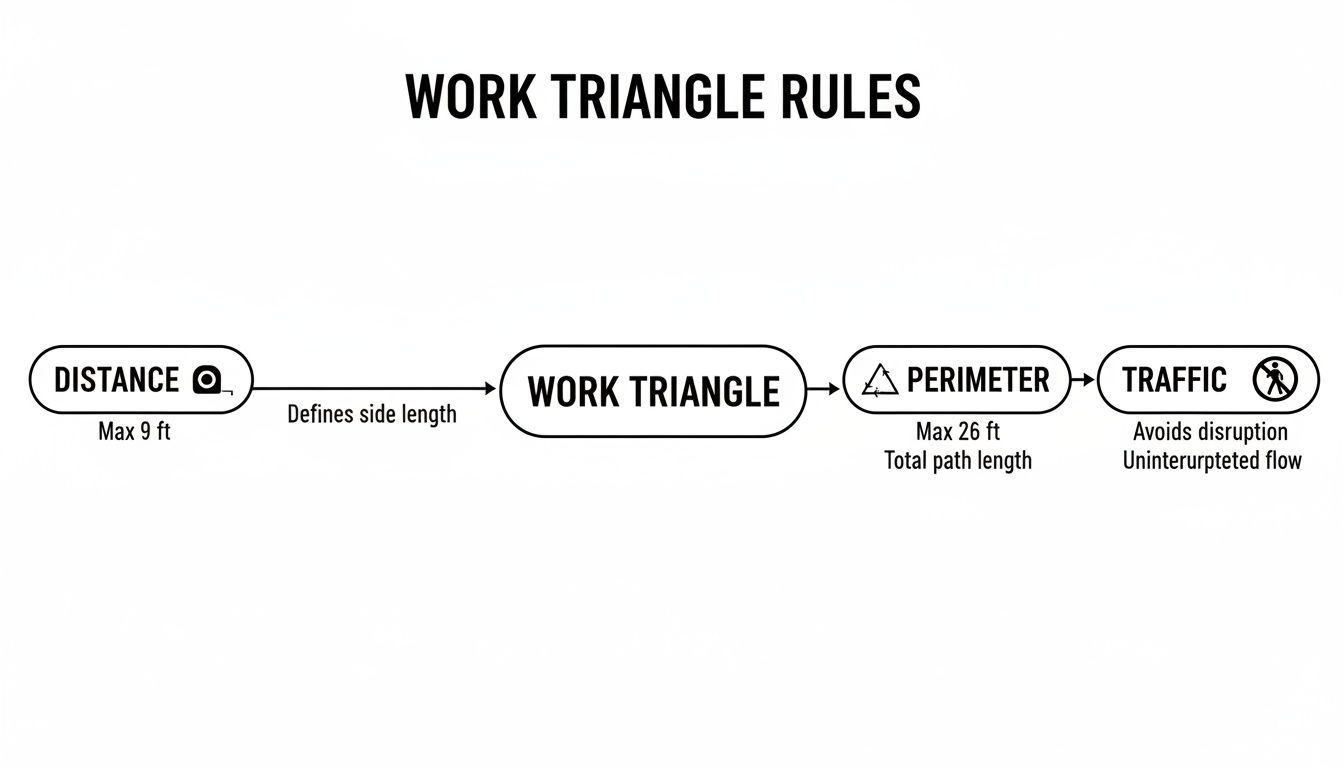
These principles of clear pathways and smart spacing are just as important today as we adapt the triangle for modern life.
Integrating Accessibility and Smart Technology
A truly modern kitchen is also an accessible one. The work triangle's principles can easily be adapted to meet ADA (Americans with Disabilities Act) standards. This means creating wider pathways (at least 42-48 inches), providing clear knee space under sinks and cooktops, and placing essential appliances within easy reach. The core focus on minimizing steps and creating a logical flow lines up perfectly with universal design.
On top of that, smart appliances add another layer of efficiency. A smart fridge that helps build your shopping list or a voice-activated faucet can cut down on trips across the room and streamline your tasks. When you thoughtfully integrate these technologies into your work zones, you take your kitchen’s functionality to a whole new level.
The work triangle is no longer a rigid rule to be followed blindly. It’s a flexible framework that, when thoughtfully evolved, helps create a space that’s perfectly suited for how you live today.
How Custom Cabinetry Brings Your Kitchen Workflow to Life
A perfect layout on paper is a great start, but it's only half the battle. The true magic of a work triangle happens when it’s backed by cabinetry built for the way you actually live and cook. Think of the triangle as the basic road map for your kitchen; your cabinets are the express lanes and clever shortcuts that make the journey smooth. If they’re poorly designed, you’re stuck in traffic.
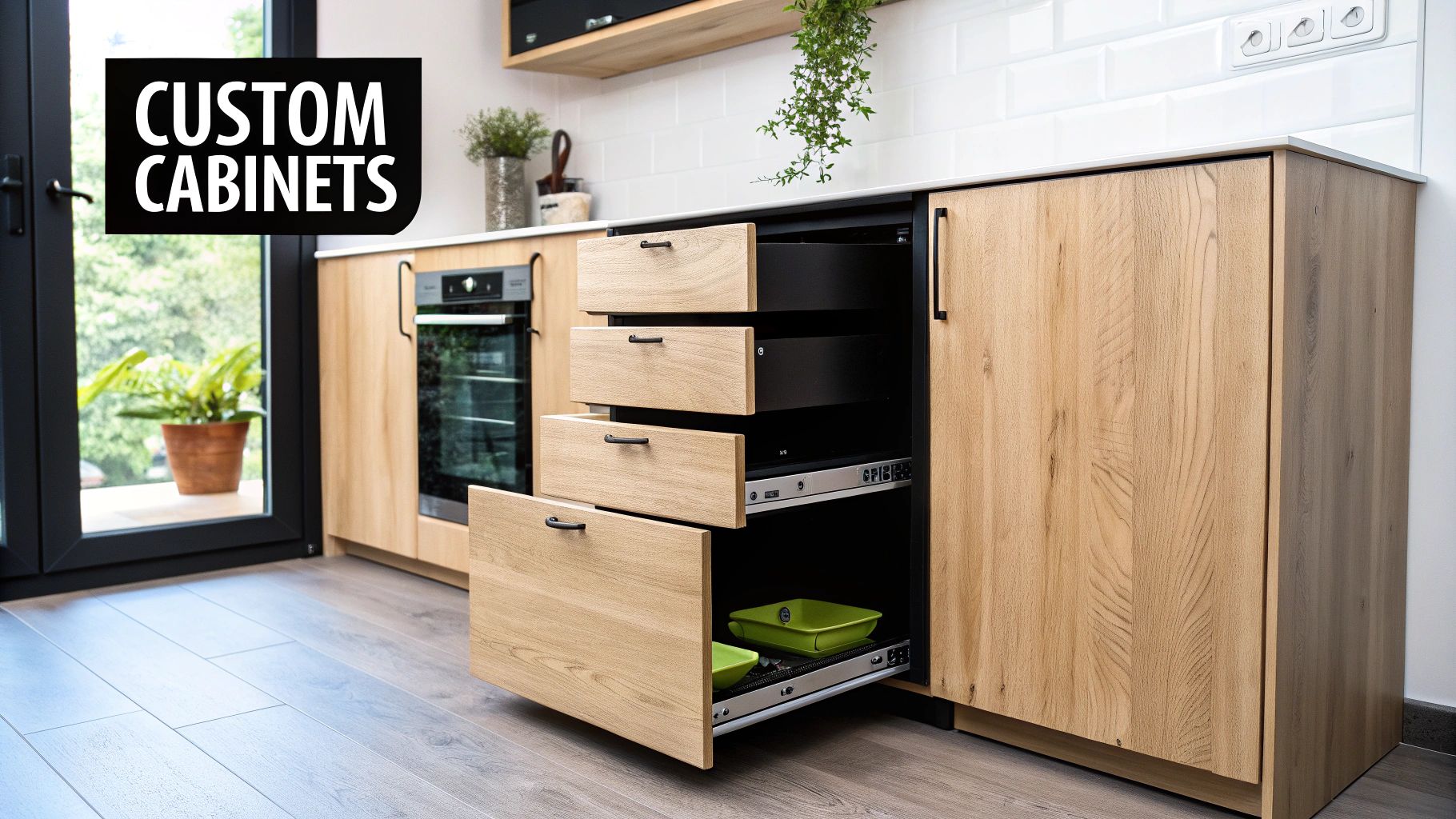
This is where the difference between off-the-shelf stock cabinets and custom work really shines. Stock cabinets are mass-produced in standard sizes, forcing you to cram your workflow into their one-size-fits-all boxes. The result? Awkward gaps, wasted corner space, and a layout that feels like a compromise from day one.
Custom cabinetry, on the other hand, is designed around you. It’s the bridge between a smart design theory and how you function in the real world, making sure every inch of your kitchen has a job to do.
The Sinclair Cabinetry Advantage in a Triangle Layout
Once you have a solid work triangle, the next move is to supercharge the storage and function within it. Sinclair Cabinetry’s custom solutions are crafted to elevate every point of your triangle, turning a good layout into an incredible one.
- At the Refrigerator: Forget a generic pantry. Imagine a floor-to-ceiling pull-out pantry right beside your fridge, where all your ingredients are visible and easy to grab. Meal prep just got a whole lot faster.
- At the Sink: We design under-sink cabinets with slick, integrated pull-out bins for trash and recycling. We can also add custom dividers for cleaning supplies, keeping your prep and cleaning zones completely uncluttered.
- At the Stove: Deep, custom-sized drawers for pots and pans directly under the cooktop mean no more crouching down to dig through a dark cabinet. We can also add a narrow pull-out for spices and oils right nearby, so everything you need is within arm’s reach.
Custom cabinetry doesn’t just fill space; it activates it. Each cabinet is planned to support the tasks you perform, turning chaotic movements into a smooth, intuitive glide.
For those looking to update their existing kitchen, a smart approach can be to combine targeted custom additions with modernizing what you already have. Learning how to reface kitchen cabinets can give your space a fresh look while you invest in custom pieces that solve your biggest workflow problems.
Turning Dead Space into Dynamic Storage
Stock cabinets are infamous for creating dead corners and leaving weird, unusable slivers of space. Because they only come in standard sizes, you’re often stuck with "filler panels"—strips of wood that do nothing but cover a gap. This is where your kitchen’s efficiency goes to die.
Custom cabinetry completely solves this problem. We build solutions that are made-to-measure for your room, transforming awkward areas into hardworking assets.
- Corner Solutions: Say goodbye to the black hole in the corner. We install clever Lazy Susans and pull-out corner systems so no inch is wasted.
- Appliance Garages: Custom nooks keep small appliances like toasters and blenders off your countertops but still within easy reach.
- Integrated Panels: We can create seamless panels for your refrigerator and dishwasher so they blend in perfectly with your cabinetry, giving you a clean, cohesive look.
Ultimately, a truly efficient kitchen is born from the marriage of intelligent design and precision craftsmanship. While the work triangle gives you the map, diving into the world of custom cabinets gives you the high-performance vehicle you need to navigate it effortlessly.
Designing Your Perfect Kitchen with Sinclair Cabinetry
Bringing your vision for a functional and beautiful kitchen to life is the final and most exciting step. We’ve explored the time-tested principles of the work triangle in kitchen design and its modern adaptations into flexible work zones. Now, let’s see how Sinclair Cabinetry transforms these powerful concepts into your reality.
Our collaborative design process is where your ideas meet our 35 years of expertise. We don’t just sketch a layout; we build a virtual model of your future kitchen. This allows you to see exactly how your space will function before a single cabinet is built.
Visualize Your Workflow with 3D Modeling
We use advanced 3D modeling software to create a digital twin of your kitchen. This is a game-changer. It’s a powerful tool that lets you walk through the space, check clearances, and visualize the flow between your sink, stove, and refrigerator. It’s the ultimate way to test your work triangle and make adjustments with confidence.
With these digital previews, we can:
- Refine Appliance Placement: We’ll make sure your main work zones are perfectly positioned for an effortless workflow.
- Test Cabinet Functionality: You can open virtual drawers and doors to see how they interact with the space and each other. No surprises on installation day.
- Perfect Traffic Patterns: We can confirm that pathways are clear and household traffic won’t disrupt your cooking.
This process eliminates all the guesswork, ensuring the final result is as practical as it is beautiful. To make informed decisions when planning your space, it's beneficial to understand the key factors in kitchen remodeling that influence both budget and design.
Marrying Flawless Function with Timeless Style
A perfect workflow is only half of the equation. The other half is the artistry of bespoke wood cabinetry that brings warmth and character to your home. Our commitment to quality means every piece is meticulously handcrafted from high-quality materials, built to last for generations.
We believe that true kitchen efficiency is achieved when intelligent design is paired with precision craftsmanship. From custom-fit pantries that maximize every inch of storage to ergonomic drawer systems that put everything at your fingertips, our solutions are built to support and enhance your layout.
Sinclair Cabinetry isn’t just about building cabinets; it’s about creating the functional heart of your home. We translate the proven principles of kitchen design into a stunning, practical reality tailored specifically to you.
Turning your dream kitchen into a stunning, practical space is our passion. We manage every detail, from the initial design consultation to professional installation, guaranteeing a seamless experience and an exceptional outcome. Let's begin the journey of creating your perfect kitchen together.
Answering Your Questions About the Kitchen Work Triangle
Okay, so you've got the basic concept down. But how does the classic work triangle actually hold up in the real world, especially with today's kitchen designs? It’s one thing to understand the theory, but it’s another to apply it when you’re staring at an open-concept floor plan or a quirky galley kitchen.
Let’s tackle some of the most common questions and roadblocks homeowners run into. These are the practical, real-world answers you need before you start your remodel.
Is the Work Triangle Outdated in Big, Open-Concept Kitchens?
Not at all—in fact, its core idea is more important than ever. While it's true that a single, gigantic triangle stretched across a massive open-concept kitchen would be a nightmare to work in, the principle of an efficient workflow just adapts.
In larger kitchens, we simply evolve the concept. Instead of one triangle, we create dedicated “work zones” or even multiple, smaller triangles. You might have your main cooking triangle (sink-range-fridge) and then a separate beverage station with its own small sink and wine cooler. The goal is always the same: cut down on wasted steps and create a flow that just makes sense. This is where custom cabinetry really shines, helping to visually and functionally define these zones for a seamless design.
Will a Kitchen Island Get in the Way of the Work Triangle?
An island can be your kitchen's best friend or its worst enemy. A poorly placed island is one of the most frequent design mistakes we see—it becomes a frustrating roadblock you’re constantly dodging. But a thoughtfully placed island can be the key to a brilliant workflow.
The trick is to make the island part of the triangle, not an obstacle in its path. By placing your cooktop or a prep sink in the island, it becomes one of the three anchor points. To pull this off, you absolutely must leave wide, clear pathways around it—we recommend 42 to 48 inches at a minimum to keep things from feeling cramped. Proper layout planning is what turns a potential barrier into the functional heart of your kitchen.
A well-placed island doesn't break the triangle; it becomes an anchor point within it. The worst mistake is dropping an island in the middle of a pre-existing path, forcing you to constantly walk around it.
What if My Kitchen’s Shape Just Doesn’t Work for a Triangle?
Don't worry, you're not alone. Many kitchens, like long, narrow galleys or compact single-wall layouts, simply don't have the space for a textbook triangle. When that's the case, we stop focusing on the literal shape and start focusing on the principle behind it: an efficient sequence of tasks.
- For a galley kitchen: We place the major appliances on opposite walls. This setup naturally minimizes the steps needed to move between them, keeping the workflow tight and effective.
- For a single-wall kitchen: The workflow is linear instead of triangular. Here, the goal is to arrange the three key zones in a logical order (think fridge to sink to cooktop) and make sure the distances between them are comfortable, not excessive.
In these types of layouts, custom cabinetry is a game-changer. It lets you squeeze every last drop of storage and efficiency out of the space, ensuring your kitchen is perfectly optimized for cooking, even without a classic triangle.
Ready to see how these principles could transform your own home? The expert designers at Sinclair Cabinetry can help you map out a kitchen that’s as functional as it is beautiful. We use 3D modeling to let you visualize your workflow before we build a thing. Start designing your dream kitchen today by visiting https://sinclaircabinets.com.