
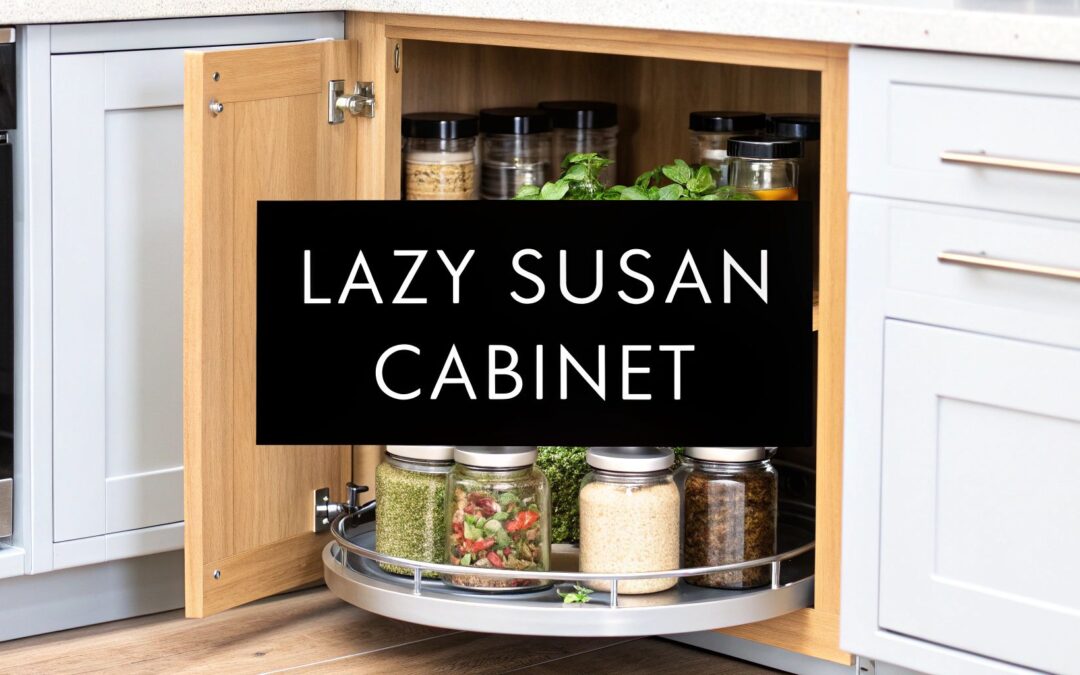
If you’ve ever had to get on your hands and knees to retrieve a long-lost pot from the dark depths of a corner kitchen cabinet, you already understand the problem a lazy susan is designed to solve.
Simply put, a lazy susan cabinet is a brilliant storage solution built to reclaim those awkward, hard-to-reach corner spaces. It’s built with rotating shelves—often shaped like a circle, a kidney, or a pie-cut—that spin on a central pole or pivot. This simple mechanism lets you bring everything hidden in the back right to the front with just a gentle push.
Solving the Awkward Corner Cabinet Dilemma
That frustrating experience of digging through a cavernous corner cabinet is a universal kitchen complaint. The lazy susan cabinet turns that narrative on its head. Think of it as a revolving door for your kitchenware, transforming one of the most inefficient storage areas into a highly functional and accessible space.
Instead of fixed shelves that create a deep, unreachable void, the rotating platform makes every inch of the cabinet’s interior usable. With a quick spin, the contents glide smoothly into view, putting everything you need right at your fingertips. It’s a simple but incredibly effective design that has been a staple in kitchens for decades for one reason—it just works.
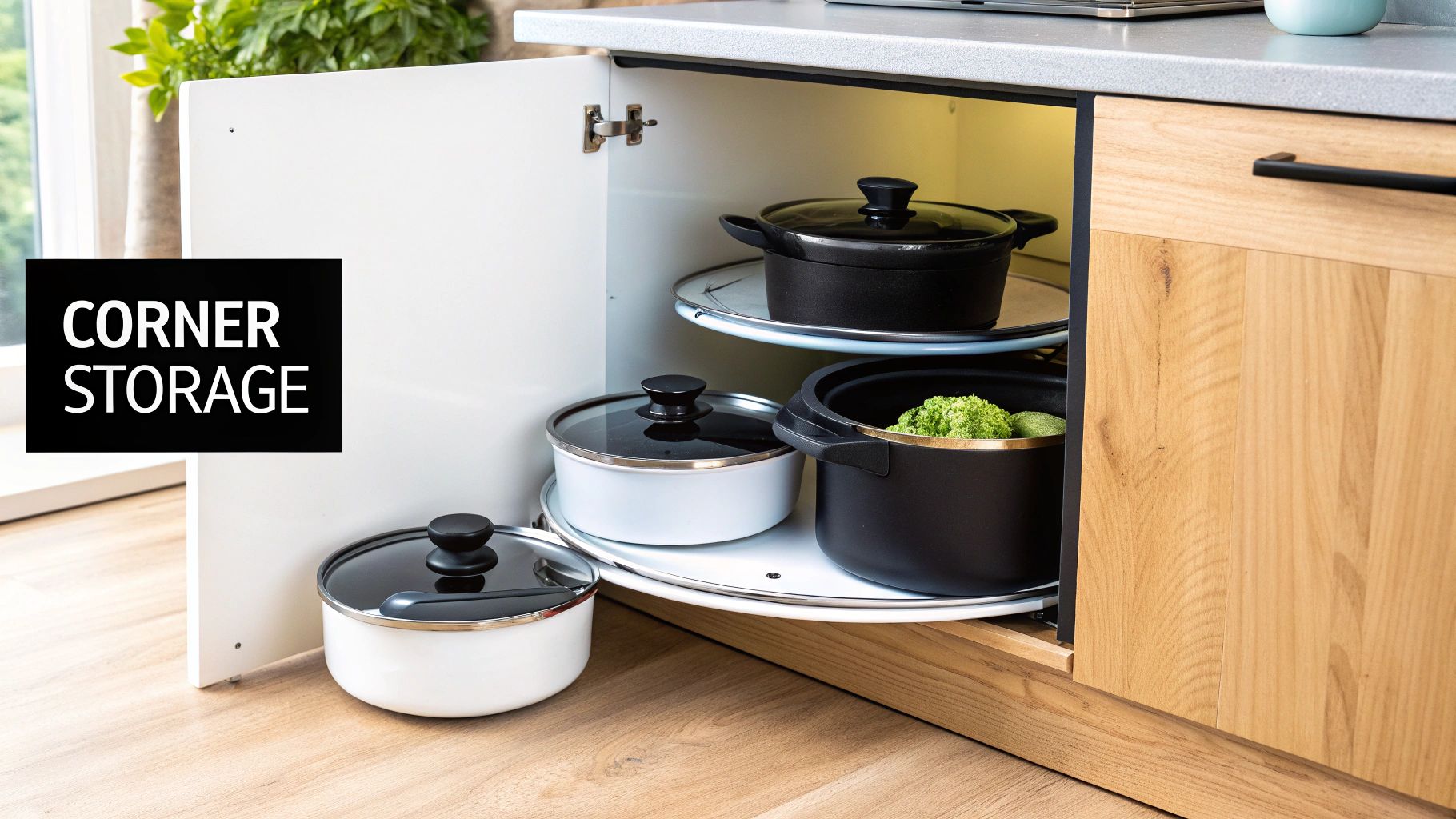
A Brief History of the Lazy Susan
While it really took off in American kitchens during the post-war boom of the 1950s and 1960s, the concept is much older. Its roots actually trace back to the 18th century, with some of the earliest examples appearing around 1780.
Back then, they were known as 'dumbwaiters'—not the elevator kind, but rotating trays used in dining rooms as silent, mechanical servers to replace human staff. You can learn more about the history of the lazy susan and its journey from a dining room centerpiece to a kitchen must-have.
The core purpose of a lazy susan cabinet is simple: to make the inaccessible accessible. It converts wasted corner volume into prime, easy-to-reach storage real estate.
Lazy Susan Cabinet at a Glance
To get a quick handle on what makes this cabinet so popular with homeowners and designers alike, here’s a breakdown of its key features and benefits.
| Feature | Description |
|---|---|
| Rotating Shelves | The defining characteristic, allowing 360-degree access to all stored items. |
| Space Optimization | Specifically engineered to make use of difficult L-shaped or diagonal corner spaces. |
| Improved Accessibility | Eliminates the need to reach into deep, dark corners to retrieve items. |
| Versatile Storage | Ideal for storing pots, pans, small appliances, dry goods, and pantry staples. |
This clever design takes a notoriously tricky spot in the kitchen and makes it one of the most useful, proving that good design is all about solving everyday problems.
A Closer Look at the Different Types of Lazy Susans
Not all lazy susans are built the same. The right one for your kitchen really comes down to your specific layout and, more importantly, the kind of corner cabinet you have. Getting to know the main varieties is the first step toward finally making that awkward corner useful. Each design is a clever solution to a unique spatial puzzle, engineered for a perfect fit.
Think of it like picking the right key for a lock. They all spin, but their shapes and the way they work are specifically tailored to different cabinet door styles. Let's break down the three most common types you'll find out there.
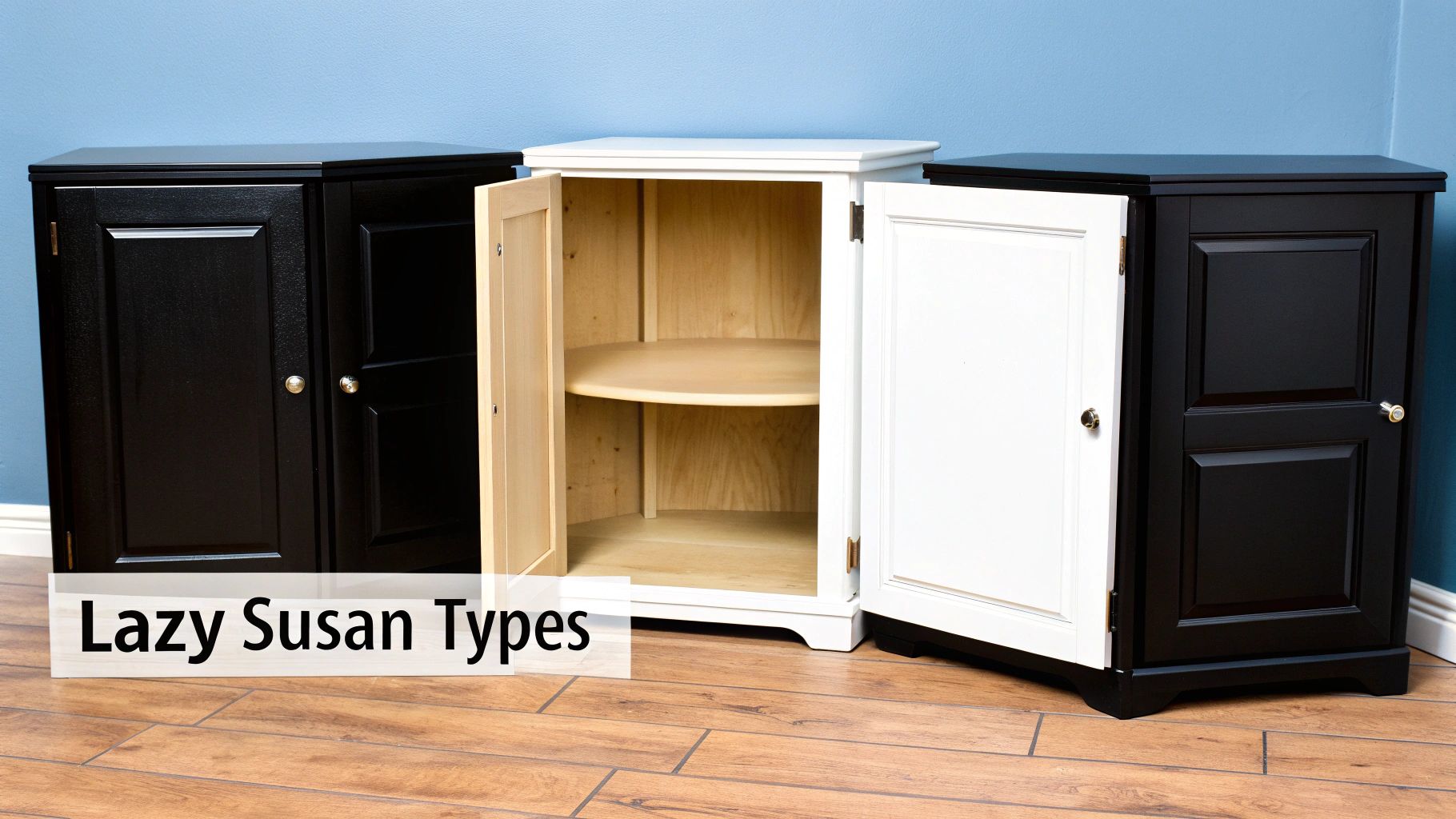
The D-Shaped or Carousel Lazy Susan
First up is the D-Shaped lazy susan, often called a carousel or full-round. This one is made for diagonal corner cabinets—the kind with a single door angled at 45 degrees between two runs of cabinets. It’s shaped exactly like it sounds: a circle with one flat side, like the letter 'D'.
That flat edge sits flush against the cabinet door when it’s closed, which lets the circular shelves make the most of that deep corner space. Open the door, and the shelves can spin a full 360 degrees, giving you total access to everything inside. It’s the most straightforward design and provides a big, uninterrupted rotating surface for storing all sorts of items.
The Kidney-Shaped Lazy Susan
Next is the Kidney-Shaped lazy susan. This one was engineered specifically for L-shaped corner cabinets with two bifold doors hinged in the middle. When you open them, they fold together and create a wide opening to the cabinet.
The shelves are mostly circular but have a distinct inward curve, which gives them their classic kidney shape. That little indentation is actually a brilliant piece of engineering—it provides the exact clearance needed for the cabinet doors to fold inward and close properly without smacking into the shelf. It’s a simple solution that solves a very common cabinetry problem in standard 90-degree corner setups.
The key difference is simple: a D-Shape is for a single diagonal door, while a Kidney-Shape is for a two-part bifold door. Choosing the wrong one means your cabinet door won't close.
The Pie-Cut or Pac-Man Lazy Susan
Finally, we have the Pie-Cut lazy susan, which some people call a "Pac-Man" because of its shape. This design also fits into L-shaped corner cabinets but works very differently from the kidney style. The shelves have a wedge-shaped cutout, usually around 90 degrees, that matches the corner of the cabinet itself.
What makes the Pie-Cut so unique is that the shelves are often attached directly to the cabinet doors. So, when you open one of the doors, the whole shelf system pivots and glides out of the cabinet right along with it. This brings everything stored inside directly to you, so you don’t even have to reach in.
This integrated movement makes it incredibly accessible. The rotating shelves swing smoothly out of the deep corner and into your kitchen, making it ridiculously easy to grab whatever you need. Each of these styles—D-Shaped, Kidney, and Pie-Cut—offers a distinct mechanical solution, ensuring there's a perfect lazy susan for just about any kitchen corner you can throw at it.
Choosing the Right Size, Materials, and Finishes
Once you've decided on the right type of lazy susan for your kitchen layout, the fun really begins. It's time to get into the details: size, materials, and finishes. These are the choices that make the lazy susan feel like a truly integrated part of your kitchen, not just a functional add-on.
Getting these details right is what separates a good corner cabinet from a great one—a solution that fits perfectly, matches your style, and is built to last.
First things first: measurements. This is the one step you absolutely cannot skip or rush. A simple miscalculation can turn an exciting installation into a major headache, with a unit that won't even fit through the cabinet door, let alone spin freely.
Start by measuring the interior dimensions of the cabinet—the height, width, and depth. Next, measure the cabinet opening itself. This is the crucial bottleneck your new lazy susan has to clear.
As a rule of thumb, a standard 36-inch corner base cabinet can usually handle a lazy susan with a diameter between 28 and 32 inches. A slightly smaller 33-inch cabinet will likely need a 24 or 28-inch model. Always plan for a couple of inches of clearance to prevent any scraping or jamming.
Finding the Right Materials
The material you choose for the shelves will influence everything from how much weight they can hold to how easy they are to clean. Each one has its own strengths.
- Polymer or Plastic: This is your go-to for a budget-friendly and practical solution. Modern polymer shelves are surprisingly tough, a breeze to wipe down, and often come with a textured surface to stop your jars and cans from sliding around.
- Wood: If you're aiming for a more premium, seamless look, wood is the way to go. Usually crafted from maple or birch plywood, these shelves are incredibly strong and can easily support heavy items like a stand mixer or cast-iron pots. Best of all, they can be finished to perfectly match your cabinetry. To learn more about material choices, check out our guide on the best materials for kitchen cabinets.
- Wire: Typically made from chrome-plated or coated steel, wire shelves have a big advantage: visibility. You can easily see what’s stored on the shelf below. They also allow for air circulation, which makes them a great choice for storing things like potatoes and onions.
The right material is all about balancing your budget, storage needs, and personal style. A busy family kitchen might lean toward easy-to-clean polymer, while a home chef might prefer the sturdy elegance of wood.
Matching Finishes to Your Kitchen Style
Finally, the finish is what ties the whole look together. You want your lazy susan to feel like it was always meant to be there, not something added in later. Polymer models usually come in neutral colors like white, almond, or gray, making them easy to blend into almost any design.
Wood, on the other hand, gives you a lot more creative freedom. You can buy the shelves unfinished and stain or paint them yourself for a perfect match with your existing cabinets. You can also find them pre-finished in a range of popular wood tones.
If you need some inspiration, it can be really helpful to explore various kitchen designs to see how different materials and finishes come together in a real space. This can help you pick a finish that complements your countertops, backsplash, and flooring for a truly cohesive look.
The Real Pros and Cons of a Lazy Susan
While a lazy susan cabinet is a brilliant solution for conquering those awkward kitchen corners, it’s not a perfect fit for every single situation. Like any design choice, it comes with its own set of trade-offs. Knowing the real-world balance is the key to deciding if it’s the right organizational hero for your space.
Making an informed decision means looking past the initial "wow" factor and weighing the practical realities of using it day-to-day. For many people, the benefits are a total game-changer, but knowing the full picture ensures you won't face any surprises after installation.
The Clear Advantages of a Lazy Susan
The biggest win here is its incredible ability to maximize usable space. That deep, dark corner cabinet, once a black hole for lost Tupperware lids, becomes fully accessible. Instead of digging blindly into the abyss, a simple spin brings every single item right to you.
This leads to a few key pros:
- Unmatched Accessibility: It completely eliminates the frustrating "reach and dig" method. Everything is visible and within easy grasp, which is a lifesaver for storing frequently used pots, pans, or small appliances.
- Superior Organization: The rotating platforms are perfect for grouping similar items. You can dedicate one shelf to baking supplies and another to serving dishes, keeping your kitchen ridiculously tidy and efficient.
- Efficient Use of Awkward Space: Let's be honest, without a lazy susan, a corner cabinet is one of the most inefficient storage spots in a kitchen. This mechanism is one of the few solutions purpose-built to reclaim that territory.
The Potential Drawbacks to Consider
Of course, the design isn't without its quirks. The primary complaint comes down to simple geometry: you're putting a round object inside a square box. The circular shelves inevitably leave small, unused gaps in the corners of the cabinet. For true space-maximization purists, this can feel a little wasteful.
Another common concern is the chance that items might fall off the shelves, especially if you give it an enthusiastic spin. This can be a real headache, since retrieving a fallen jar from behind the unit is nobody's idea of fun.
Expert Tip: Look for lazy susan models with a raised lip or a small guardrail around the edge of the shelves. This simple feature is highly effective at preventing items from tumbling into the cabinet's abyss.
Finally, you have to be mindful of weight limits. While sturdy wood models can handle heavy cast-iron pots, less expensive polymer versions might have lower weight capacities. Overloading the shelves can cause them to sag, wobble, or spin unevenly.
This classic organizer has a long history for a reason. Its modern form was heavily marketed after the term "Lazy Susan" was added to Webster's Dictionary in 1933. A 1917 advertisement even priced one at $8.50, highlighting its value in homes long before modern kitchens took shape. You can read more about the history of the lazy susan and its rise to becoming a kitchen staple.
How Lazy Susans Stack Up Against Other Solutions
While a lazy susan cabinet is a classic and effective choice, it’s not the only player in the game of conquering kitchen corners. It's smart to see how it compares to other popular solutions to make the best decision for your specific needs, layout, and budget. The right choice really comes down to balancing accessibility, storage efficiency, and cost.
Some homeowners prefer alternatives that offer a different approach to accessing that deep, awkward space. To really appreciate what a lazy susan brings to the table, it's helpful to compare it against various storage solutions for small spaces, which helps clarify its unique position in optimizing those often-wasted areas.
Blind Corner Cabinet Pull-Outs
A popular alternative is the blind corner cabinet pull-out. Just imagine a set of shelves on a sliding track. Instead of spinning, you open the cabinet door and pull a handle, which makes the shelves slide forward—and often sideways—bringing the entire contents right out into the open.
- How They Work: These systems use a clever sliding and pivoting mechanism. The front shelves pull straight out, and the back shelves slide over to take their place, making everything easy to grab.
- Best For: Storing uniformly shaped items like boxes, cans, or rectangular containers that might not sit as neatly on a round, spinning shelf.
These pull-outs are often seen as more space-efficient because their rectangular shape fits the square cabinet better, minimizing the wasted space you sometimes see with round lazy susan shelves.
This visual guide can help clarify if a lazy susan is the right starting point for your decision-making process.

As the infographic shows, for homeowners who need to solve a corner cabinet problem and want to maximize every available inch, a lazy susan is a very strong contender.
Magic Corners and Swing-Outs
For those looking for the ultimate in easy access, there are magic corner or swing-out units. These are the most mechanically complex options out there, featuring an advanced system where opening the cabinet door triggers a mechanism that pulls both front and rear shelves completely out of the cabinet.
A magic corner functions like a high-tech valet for your cookware. It doesn't just present your items; it brings them directly to you, eliminating any need to reach into the cabinet at all.
While incredibly user-friendly, this advanced engineering comes at a higher price and involves a more complex installation. To see a detailed breakdown of these and other systems, our guide to cabinet corner solutions offers an in-depth comparison.
Corner Cabinet Storage Solutions Compared
Deciding on the best corner cabinet organizer can feel overwhelming, so we've put together a simple table to compare the most common options side-by-side. This should help you weigh the pros and cons based on what matters most to you.
| Solution Type | Best For | Accessibility | Space Efficiency | Typical Cost |
|---|---|---|---|---|
| Lazy Susan | Everyday items, pots, pans, and round containers. | Good to Excellent: Items rotate into view. | Good: Some wasted space at corners with round shelves. | $$ |
| Blind Corner Pull-Out | Uniformly shaped items like boxes, cans, and Tupperware. | Excellent: All shelves slide out for full access. | Excellent: Rectangular shelves maximize the cabinet's footprint. | $$$ |
| Magic Corner/Swing-Out | Heavy cookware or homeowners who want zero reaching. | Superior: The entire unit swings completely out of the cabinet. | Very Good: Complex mechanism takes up some interior space. | $$$$ |
| Fixed Shelving | Budget-conscious projects where access isn't a priority. | Poor: Requires reaching far into the back. | Poor: Items get lost in the back, making space unusable. | $ |
Ultimately, while pull-outs and magic corners offer incredible accessibility, they also come with a higher price tag.
Finally, the most basic option is simple fixed shelving. While it's the most affordable, it brings you right back to the original problem: a deep, dark, and inaccessible corner. It requires you to manually dig for items and is generally the least functional choice. Each solution has its merits, but the lazy susan often strikes that perfect balance between accessibility, functionality, and cost.
Smart Tips for Installation and Organization
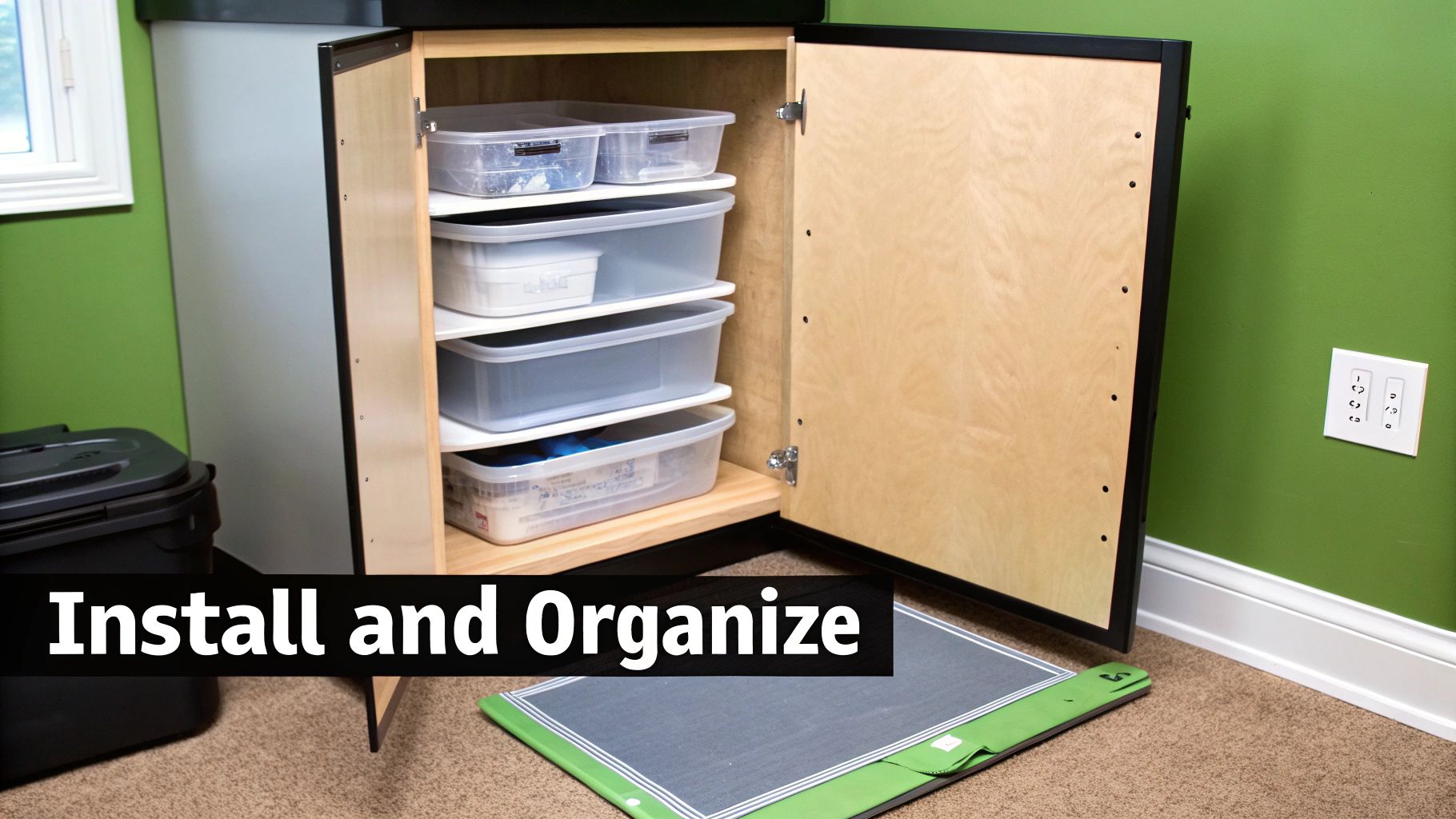
Putting a lazy susan into a cluttered corner can feel like a game-changer, but the real magic is in the details—getting the installation just right and organizing it smartly. Whether you're working with a brand-new unit or fitting one into an existing cabinet, it can absolutely be a manageable DIY project if you’re patient and precise.
If you're tackling the job yourself, the single most critical step is making sure the center post is perfectly level. Even a tiny tilt can cause the shelves to wobble, scrape against the sides, or spin unevenly, which completely defeats the purpose of a smooth-gliding organizer. Use a level and check the post from a few different angles before you lock it down.
DIY vs. Professional Installation
So, should you do it yourself or call in a pro? It really comes down to the complexity of the job.
- DIY Friendly: Installing a pre-made lazy susan into a new, empty corner cabinet is usually pretty straightforward. The mounting points are easy to get to, and the instructions are typically clear enough for a weekend project.
- Consider a Pro: Retrofitting an existing cabinet is a whole different ballgame. It demands exact measurements to ensure the spinning shelves will clear the door frame and any internal supports. If you aren't comfortable with making precise cuts or navigating a complex assembly, calling a professional is a smart investment.
The whole point of a lazy susan is effortless access. A proper installation ensures the mechanism works exactly as it should, while smart organization keeps it from turning into a chaotic, spinning mess.
Once your lazy susan is installed and spinning smoothly, it’s time to organize it for maximum efficiency. Don't just start throwing things in there; a little bit of strategy goes a long way.
One of the biggest frustrations is having small items constantly tip over. To solve this, grab some clear, wedge-shaped bins to group things like spices, baking supplies, or small jars. This keeps everything contained and lets you pull out an entire category at once. For more ideas on taming your kitchen clutter, check out our guide on how to maximize cabinet space for some extra inspiration.
Another fantastic tip is to use non-slip shelf liners. These simple liners create a grippy surface that stops cans, bottles, and containers from sliding around every time the shelves turn. It’s a small addition that makes the entire unit quieter and keeps your items securely in place, finally turning that once-dreaded corner into a perfectly organized hub.
Common Questions About Lazy Susan Cabinets
When you're trying to decide if a lazy susan is the right move for your kitchen, a few questions always seem to pop up. Getting some straight answers can make all the difference in finalizing your plans with confidence.
How Much Weight Can a Lazy Susan Hold?
The weight capacity really depends on what the shelves are made of. A standard polymer or plastic shelf will comfortably hold around 20 pounds, which is plenty for most pantry goods, spices, or plastic containers.
If you need something more robust, a wood or metal wire version can often support 50 pounds or more. That makes them a great choice for storing heavier pots, pans, and even small appliances. It's always a good idea to check the manufacturer's specs just to be sure.
Can You Add a Lazy Susan to an Existing Cabinet?
Absolutely. You can definitely add a lazy susan to a cabinet you already have—it's a process called retrofitting. It's actually a pretty popular DIY project for homeowners looking to get more out of their existing kitchen storage.
The key is to measure everything carefully. You'll need the cabinet's interior height, depth, and, most importantly, the door opening. You have to make sure the unit you buy can fit through the door and still have enough room to spin freely once it's installed.
While the concept is centuries old, the modern lazy susan is far from outdated. Sleek designs and advanced mechanics have kept it relevant as one of the most efficient solutions for functional corner storage in today's kitchens.